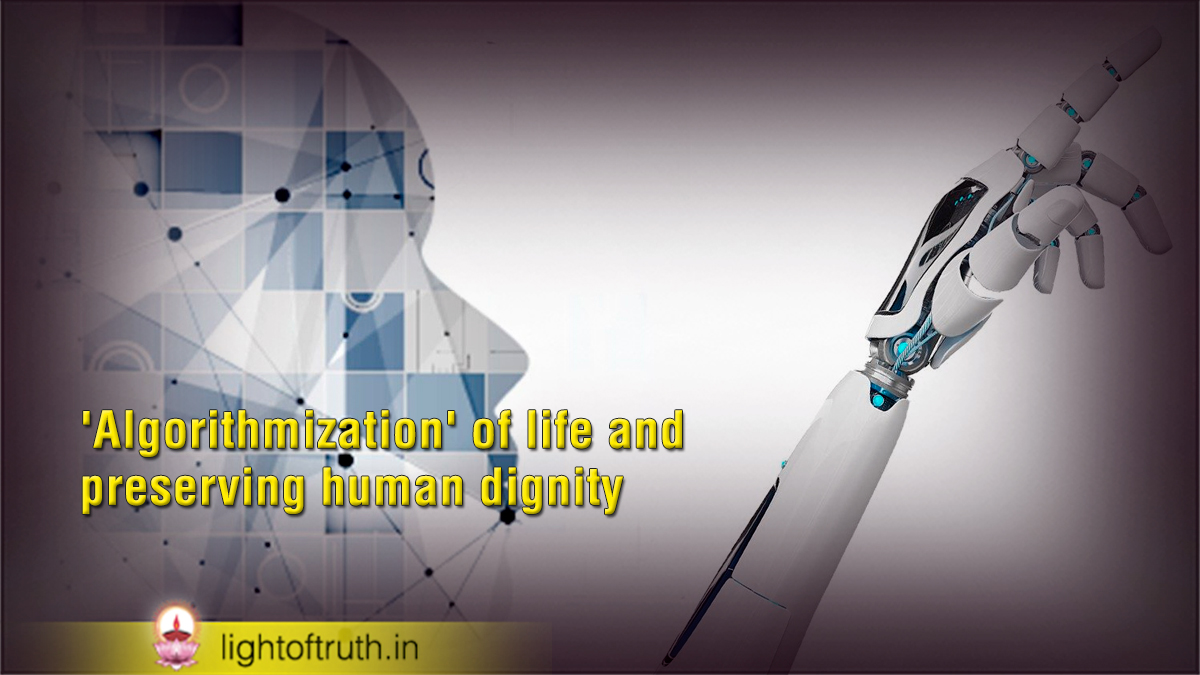
Bruno Giussani, author of a book on artificial intelligence’s impact on our lives, reflects on Pope Leo XIV’s Message for the 60th World Day of Social Communications, “Preserving Human Voices and Faces.”
How many algorithms are part of our daily lives? How many sensors? How many screens?
Interacting with screens and digital interfaces of all kinds has become the main activity for almost all of us.
But how many of these interactions are truly the result of a choice? More than a habit, it is becoming a condition. Our society is increasingly structured around algorithms and digital networks that shape its forms and dynamics.
This has not happened – and is not happening – through public debate, political decision-making, or a democratic process, but rather as the indirect (though by no means accidental) consequence of commercial mechanisms and the often uncritical and impatient adoption of technologies that, in effect, redefine the social, economic, and cultural sphere.
This “algorithmization” of life raises essential questions. Who controls these systems? What values and logics do they convey, and which do they exclude? What are the consequences for our autonomy as human beings? And are we still capable of asking ourselves these questions, or are we becoming accustomed to living in a world where the answers are already written into the computer code that surrounds us?
When, in his illuminating Message for the 60th World Day of Social Communications, celebrated on May 17, His Holiness Pope Leo XIV writes that our challenge “is not technological, but anthropological,” he captures in one sentence that seems simple the full depth, unease, and responsibility that each of us should feel in the face of advancing digital technologies, and especially artificial intelligence (AI)..
The arrival, three and a half years ago, of generative AI — the chatbots with which we interact by writing or speaking — has further accelerated this replacement of human logic with techno-logic.
All of us therefore — technological experts and beginners alike, enthusiasts as much as skeptics — share the same responsibility: to demand technologies that serve people and truth, not the other way around. Tools of justice rather than power. To protect freedom, equality, and human judgment. To recognize that not all questions have an algorithmic answer, that not everything calculable is therefore right, good, or desirable. To measure innovation by the standard of each person’s dignity. And to never forget, behind every algorithm, every app, and every screen, the faces and voices of our fellow human beings.