
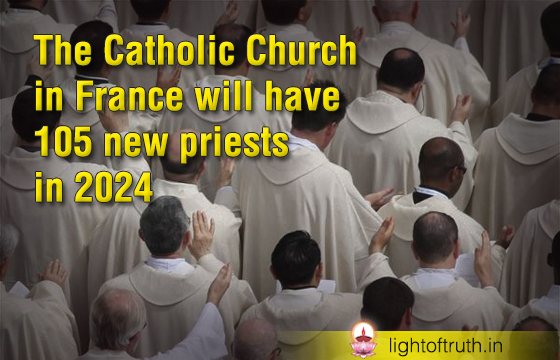
The French Bishops’ Conference (CEF) reported that, in 2024, 105 new priests will be ordained, 17 more priests than in 2023, when 88 new priests were ordained in the European country. An article published on the CEF website said the vast majority of priestly ordinations are celebrated during the month of June, particularly on the Sunday before the solemnity of Sts. Peter and Paul, which the Catholic Church celebrates every year on June 29.
Of the 105 new priests, 73 are diocesan, 16 belong to religious orders, 10 are members of communities, two belong to societies of apostolic life, while the remaining four “were ordained in the institutes under the former Ecclesia Dei commission, celebrating according to the Roman Missal of 1962 [before the reform of Vatican II].”
At a press conference, Bertrand Lacombe, the archbishop of Auch and a member of the council for ordained ministers and laypeople in ecclesial mission, highlighted two aspects to be considered regarding the new priests: “the essential mission of the priest in the Church and the meaning of this mission today within an increasingly secularized French society” and “the ongoing reflections of the bishops as well as the initiatives launched in the dioceses to raise up vocations.”
The French prelate wished a “beautiful ministry to the priests who are responding to the spiritual expectations of our time: The adventure is worth the effort and gives light to the world!”
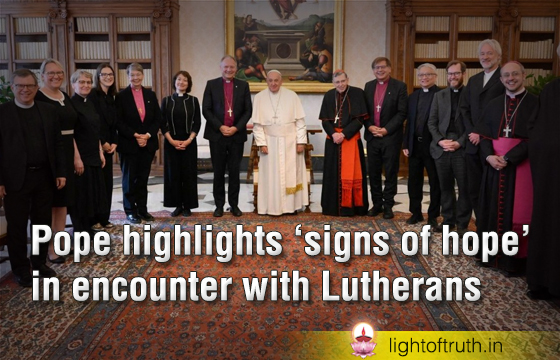
Pope highlights ‘signs of hope’ in encounter with Lutherans
Pope Francis welcomed a delegation of leaders from the Lutheran World Federation to the Vatican, describing their visit as “an important gesture of ecumenical fraternity.” Recalling an earlier meeting with Lutherans, in 2021, Pope Francis highlighted the upcoming anniversary of the First Council of Nicea as “an ecumenical event.” The Nicene Creed “is an ecumenical bond that has its centre in Christ”, the Pope said, quoting the Common Word issued by LWF General Secretary, Rev. Dr. Anne Burghardt and Cardinal Kurt Koch from the Dicastery for Promoting Christian Unity during the Federation’s recent General Assembly in Krakow. “In this context,” he said, “you rightly recalled a beautiful sign of hope, which has a special place in the history of reconciliation between Catholics and Lutherans.”
Pope Francis then turned to the earlier Joint Declaration on the Doctrine of Justifi-cation, signed 25 years ago, in which Catholics and Lutherans agreed on the common goal of “confessing Christ in all things.” “Jesus Christ is the heart of ecumenism,” the Pope said. “He is divine mercy incarnate, and our ecu-menical mission is to bear witness to this.” That Declaration is “another sign of hope in our history of reconciliation,” he said, as he invited Catholics and Lutherans to celebrate the anniversary of its signing “as a celebration of hope.”
Then, noting “our common spiritual ori-gin” in “one baptism for the forgiveness of sins” Pope Francis called on Lutherans and Catholics to “confidently continue as pilgrims of hope” in the ongoing dialogue “of truth and charity.” Concluding his remarks, the Holy Father recalled a story about Orthodox Bishop John Zizioulas, who would say, jokingly, that the union of Christians would be achieved only on the day of Judgment at the end of time. “But in the meantime,” Pope Francis said still quoting the late Bishop, “we have to walk together: journeying together, praying together, and performing works of charity together.”
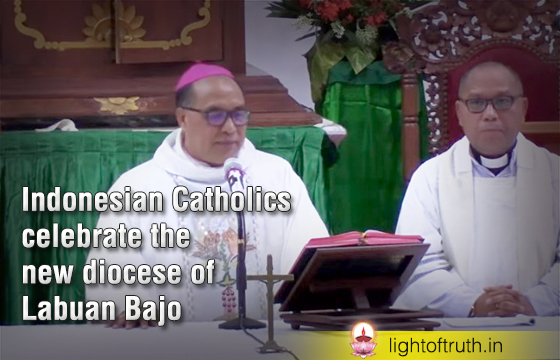
Indonesian Catholics celebrate the new diocese of Labuan Bajo
Indonesian Christians are celebrating a new diocese in the country. On 21st June, in fact, Pope Francis erected Labuan Bajo, in the Catholic-majority area of Flores Island, in the province of East NUsa Tenggara (Ntt), and appointed as its first bishop the Reverend Maksimus Regus, of the Ruteng clergy, until now rector of the local Catholic University of St. Paul. Hundreds of faithful and dozens of priests attended the announcement made by Bishop Siprianus Hormat, Bishop of Ruteng, in the Church of the Holy Spirit in Labuan Bajo, in an atmosphere of joy that involved the entire community.
The new diocese of Labuan Bajo covers an area that is now a popular tourist destination, but until a few years ago, it was still a remote area in the westernmost sector of the Indonesian archipelago that was predominantly mountainous.
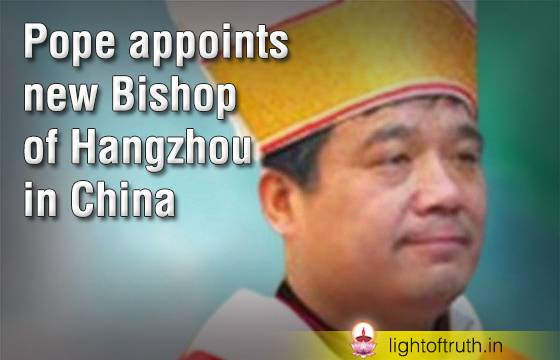
Pope appoints new Bishop of Hangzhou in China
Giuseppe Yang Yongqiang is the new bishop of Hangzhou, the capital of Zhejiang province in China. “As part of the dialogue concerning the implementation of the Provisional Agreement between the Holy See and the People’s Republic of China.” A Statement released by the Holy See Press Office last Saturday, June 22, “On June 12, 2024, the Holy Father appointed Giuseppe Yang Yongqiang as bishop of Hangzhou (Zhejiang province, China), transferring him from the See of Zhoucun (Shandong province, China).” The solemn Eucharistic liturgy for the bishop’s installation in his new episcopal seat will be celebrated in Hangzhou Cathedral on Thursday, June 27. Giuseppe Yang Yongqiang was born on April 11, 1970, in Boxing (Shandong), into a Catholic family. In 1987, he entered the Holy Spirit Seminary in Jinan. He conducted his philosophical and theological studies at that seminary and at Sheshan Seminary in Shanghai.
On June 15, 1995, he was ordained a priest. After serving as a parish priest, he was sent to further his education at the National Seminary in Beijing. Subsequen-tly, he served as a lecturer at the Holy Spirit Semi-nary. Appointed coadjutor bishop of Zhoucun, he was consecrated on November 15, 2010, and on February 8, 2013, he succeeded Bishop Ma Xuesheng in leading that diocese. On June 12, 2024, Pope Francis appointed him bishop of Hangzhou.
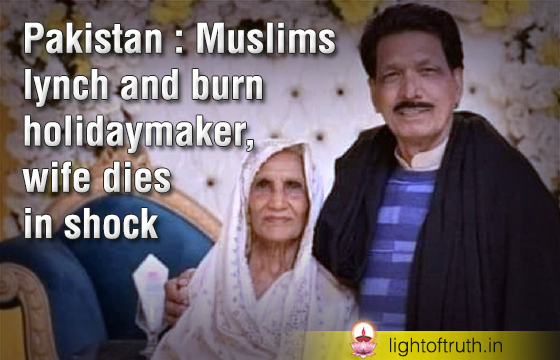
Pakistan: Muslims lynch and burn holidaymaker, wife dies in shock
A new tragedy linked to blasphemy has unfolded in Pakistan, where cases of lynching mobs acting with impunity in the name of religion are becoming more and more frequent amid the inaction of the authorities and the silence of international community. The latest incident occurred on June 22 in the Swat Valley. The victim, Mohammad Ismail, was on vacation when he was attacked and torched alive for burning pages of the Qur’ân. Such a story clearly illustrates how Pakistan state is incapable of guaranteeing safety and security to its citizens. Instead, powerful groups rule, their violent ideology contributing to the list of innocent victims, people like Mashal Khan, Shama and Shahzad, Priyantha Kumara, Nazir Masih, and now Mohammad Ismail.
Another victim is Allah Rakhi, the widow of 72-year-old Christian Nazir Masih, who died from the effects of the traumatic experience of seeing her husband killed. Since 1987 when blasphemy became an offence, dozens of people have been reportedly lynched by mobs, based on specious charges used to settle personal scores, exact revenge, justify extrajudicial killings, and target religious minorities, like Christians and Ahmadis. In this latest case, police had arrested Mohammad Ismail and charged him with blasphemy for burning Arabic-language papers. But an angry mob came to the Madyan Swat police station demanding the officers hand over the man to be executed on the spot. When police refused, a group stormed the station. After injuring some agents and vandalising the premises, they took the victim from his cell to lynch, and burnt him alive while shouting extremist slogans.
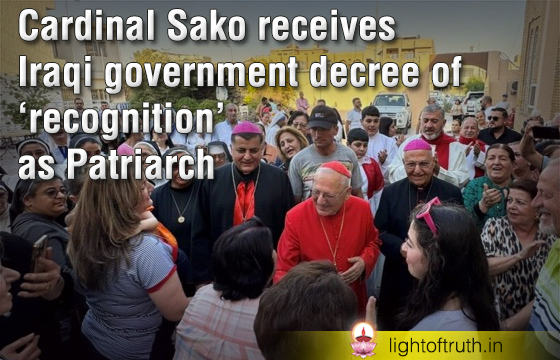
Cardinal Sako receives Iraqi government decree of ‘recognition’ as Patriarch
Iraq’s Prime Minister Mohammed Shia’ al-Sudani issued a decree “to appoint Patriarch Louis Raphaël Sako as Patriarch of the Chaldeans in Iraq and in the world”, restoring his “institutional recognition” rescinded last July. Cardinal Sako had refused to return to Baghdad for almost a year since President Abdul Latif Rashid revoked Decree 147, which recognised the cardinal in legislative terms as head of the Chaldean Catholic Church with responsibility for its endowments.
He moved his residence to Erbil, in Iraq’s northern Kurdish region, returning to the capital briefly in April on the prime minister’s invitation but leaving disappointed that the decree was not restored. A statement from the patriarchate offered “thanks and gratitude to the Christian and Islamic Shiite and Sunni religious authorities…who supported [the patriarch] in the crisis of with-drawing the decree”, as well as international actors including the US State Department.
In a homily during Mass at Baghdad’s Mar Gorgis Church on 12 June to mark his return to the city, Sako said that Chaldean Christians “are one of the colours of the beautiful fabric of Iraq that must be preserved” and defended their historic place in the region.
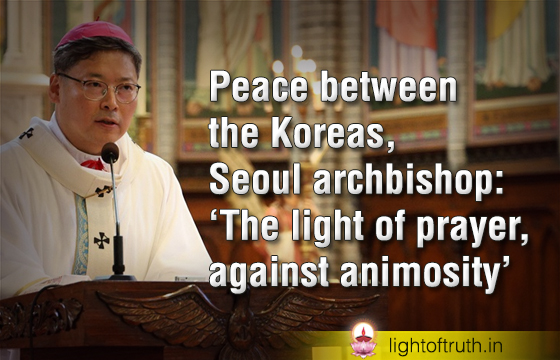
Peace between the Koreas, Seoul abp: ‘The light of prayer, against animosity’
“Even though the situation between the two Koreas may appear bleak we Christians can-not remain in despair. On the contrary, it is precisely in this age of growing animosity that our prayer can illuminate our time with a greater light.” This is the message the Archbishop of Seoul Peter Chung Soon-taick issued on the occasion of Day of Prayer for Reconciliation and Unity of the Korean people, coinciding with the 73rd anniversary of the be-ginning of the war that led to the painful wound of separation bet-ween Seoul and Pyongyang.
The anniversary falls this year at a time particularly marked by tension. Seoul woke up to news of the launch of 350 more balloons carrying waste from the North to South Korea overnight, in what was the fifth such launch since late last month. About 100 balloons, carrying mostly waste paper and rubbish, landed in the capital and the northern part of Gyeonggi province.
For his part, President Yoon Suk Yeol paid a visit to the US aircraft carrier Theodore Roosevelt (CVN-71), which called at the naval port in the southeastern city of Busan, ahead of joint exercises between South Korea, the US and Japan that will kick off tomorrow and are aimed at countering the growing threats from North Korea.
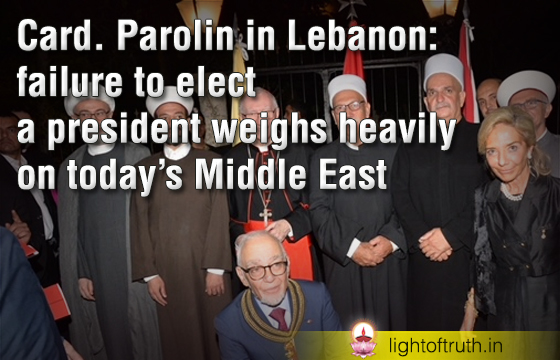
Card. Parolin in Lebanon: failure to elect a president weighs heavily on today’s Middle East
At the invitation of Marwan Sehnaoui, President of the Lebanese Association of the Sovereign Order of Malta, the Secretary of State of the Holy See, Cardinal Pietro Parolin, was in Lebanon on a five-day visit (23-27 June) to see the Order’s humanitarian activities, as well as meet with the country’s authorities, the local Church, and representatives of Islamic religious authorities.
Card. Parolin celebrated Mass on the Solemnity of Saint John the Baptist, Patron Saint of the Order of Malta, in the Church of St Joseph of the Jesuit Fathers, in the presence of the Commander-in-Chief of Lebanon’s Armed Forces, General Joseph Aoun. This provided him with an opportunity to relay the Holy See’s concerns about the detrimental delay in electing a president.
Lebanon has been without a head of state since November 2022, due to a power game by the Shia community, led by Hezbollah, which is seeking to impose its candidate, and the lack of consensus within the Maronite community, from whose ranks the president must be picked in accordance with the constitution.
In his homily on Saint John the Baptist’s Day, the Holy See’s secretary of state echoed the Vatican’s concerns in the matter. “The Church in Lebanon must also bear witness, according to her high mission to keep alive and effective the message of ‘living together’,” he said. “In this regard, allow me to stress that we have felt a great void for months. A Christian voice is missing, one that would undoubtedly make the difference; the voice of the President of Lebanon is missing. This absence weighs heavily at this very serious time for the Middle East.”
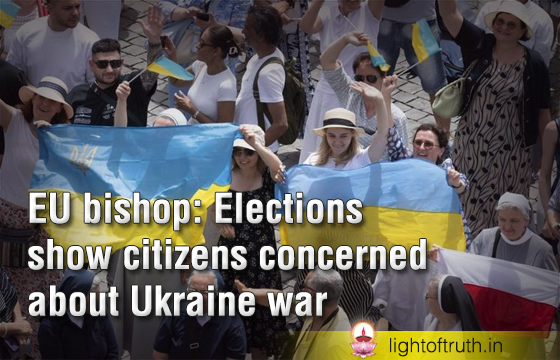
EU bishop: Elections show citizens concerned about Ukraine war
Citizens of the European Uni-on want EU politicians to be more actively engaged in inter-national issues such as the Ukraine war, an Italian bishop said after the EU elections earlier this month.
Bishop Mariano Crociata of Latina, president of the Bishops’ Conferences of the European Union (COMECE), told EWTN News that despite low voter turnout, EU citizens have an expectation that the elected members of the 27 countries’ joint parliament will respond to the problems they are living through, including fear of widespread war in Europe.
“The [election] result denotes …in the citizens of the countries that are part of the European Union, a phase of concern, perhaps one must even say fear,” he said. He explained that there is fear regarding “the presence of a war whose outcome is not foreseen or understood” and voters are looking for greater peace of mind.
EU citizens also have the expectation, he said, that elected officials will “do something, to have their voices heard” and “to have the political strength to become more and more an international subject, a subject that at least operates, is active as much as possible, in the confrontation between the big and medium powers that have responsibilities on so many things and particularly on the war in Ukraine.”
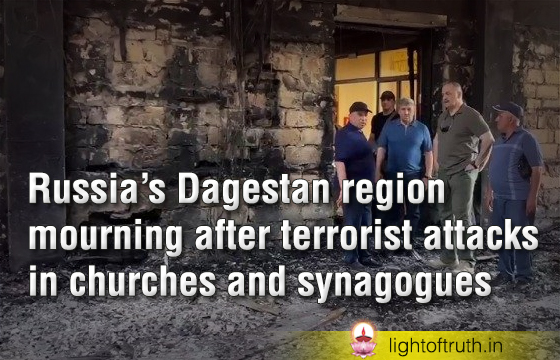
Russia’s Dagestan region mourning after terrorist attacks in churches and synagogues
Panicked-stricken people and police were seen in Russia’s volatile Dagestan region. The area plunged into mourning on June 24 following attacks against houses of worship in the regional capital, Makhachkala and Derbent, with an ancient Jewish community.
The Investigative Committee, the country’s top state criminal investigation agency, said all five attackers were killed after horrific battles. Of the 19 other people killed, 15 were police.
Among the dead was the Reverend Nikolai Kotelnikov, a 66-year-old Russian Orthodox priest at a church in Derbent. Local authorities said the attackers slit his throat before setting fire to the church. The attack came as the Orthodox faithful celebrated their Pentecost, also known as Trinity Sunday.
Shortly after the attacks in Derbent, militants reportedly fired at a police checkpoint in nearby Makhachkala. They attacked a Russian Orthodox Church and a synagogue before being hunted down and killed by special forces. Medical authorities in Dagestan said 16 people, including 13 police, were hospitalized with injuries, including four officers in grave condition. The bloodshed was the latest that officials blamed on Islamic extremists in the predominantly Muslim area in the North Caucasus.