
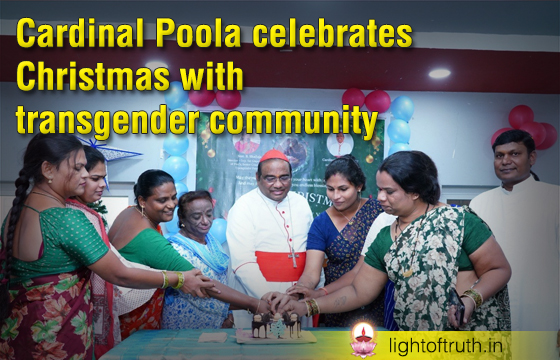
Cardinal Anthony Poola has joined the transgender community of Hyderabad, a southern Indian city, to cele-brate Christmas that many say has sent a message of inclusivity and Christian love for the margi-nalized. “True Christmas lies in embracing the poor and ne-glected, offering them accep-tance and dignity,” said Cardi-nal Poola, the Archbishop of Hyderabad and a member of the Vatican Dicastery for Pro-moting Integral Human Deve-lopment. The December 18 celebration was organized by the Hyderabad Archdiocese Social Service Society (HASS). Cardinal Poola distributed certificates to transgenders who completed jute bag-making training programs facilitated by the society. He also presented sewing machines to women from Self-Help Groups and distri-buted Christmas gifts to all 93 transgender participants, along with members of the women SHG groups. “This semi-Chri-stmas celebration serves as a powerful testament to the Church’s commitment to inclu-sivity, spreading the message of love, hope, and dignity for all, especially those on the peri-pheries of society,” the cardinal added. The society director Father Madanu Anthony said the program was “a witness to the Church’s commitment to serving marginalized commu-nities.” Transgender community is among the most marginalized groups, often facing discrimi-nation and rejection and the cardinal’s gesture has sent out a “powerful message of inclu-sion and compassion,” Father Anthony added.
Priest runs restaurant with a mission in India’s Goa
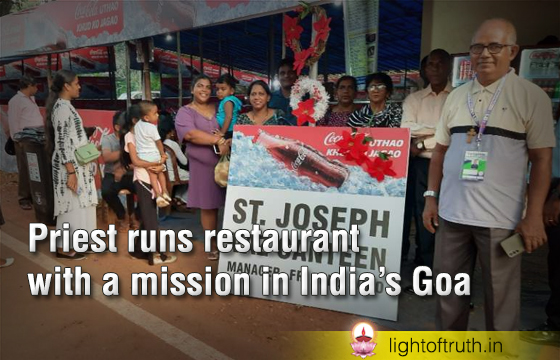
British national Carl Cox was surprised to know St. Joseph Vaz Canteen, where he had just had some snacks and tea in old Goa, was run by a Catholic diocesan priest. “The snacks are delicious, and I was taken aback to find that a Catholic priest was running it,” the 32-year-old scientist working at a private firm in the UK, told. “This is my third time visiting Old Goa and the crowds are getting bigger and bigger here, revealing their deep faith in St Francis Xavier,” Cox said. As he spoke, his wife, Danica Pereira, 30, nodded approvingly with a smile. “The food served here in the canteen is typically Goan, tasty and spicy,” she says, as she collected some packed food from the counter. Cox, his wife, and father, Jeff Cox, 68, were visiting the western Indian state as part of their pilgrimage to witness the once-in-a-ten-year Exposition of the relics of St. Francis Xavier in the former capital of Portuguese-ruled India. Jeff Cox was sipping a fresh lime soda, just served to him by the waiter. “It is very fresh and cool,” he said with a smile. The canteen is named after St. Joseph Vaz, a Goa-born Indian missionary priest hailed for pioneering evangelization in Sri Lanka in the late 17th and early 18th centuries.
Wave of attacks during Christmas season worries Odisha Christians
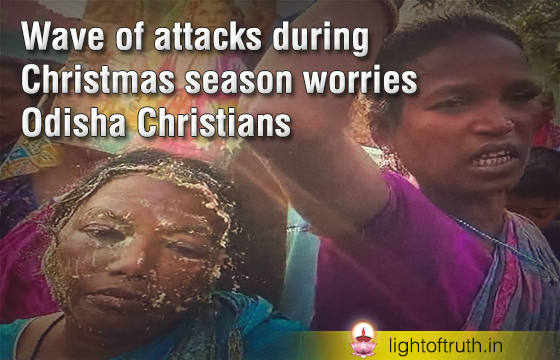
A wave of violence against Christians in Odisha, eastern India, has raised alarm over citizens’ religious freedom guaranteed by the country’s Constitution. The latest incident occurred on December 26 in the Gabardhanpur village of Balasore district, where the members of the New Life Church were attacked while celebrating Christmas with a local family. According to Pastor Sadhu Sundar Singh of the Church, Gobinda Singh, a resident of Gabardhanpur, had invited him and his colleagues, Subhasini Singh and Sukanti Singh, to his home for prayers and Christmas celebrations. The gathering involved cake cutting and a shared meal. However, a drunken man from the village approached Gobinda Singh under the pretext of asking for food. Ignoring requests to wait, he rallied villagers waiting nearby and falsely claimed that religious conversion was taking place in the house. The mob attacked the gathering, severely beating Subhasini and Sukanti Singh. Their clothes were pulled, as the mob shouted accusations of forced conversion. Pastor Singh shared a video of the incident. In the video, a man named Badal Kumar Panda, wearing a white shirt and a tilak, introduced himself as the Block President of Devsena. He is seen pointing towards the women and saying, “I came here because these people are converting our people to their religion. We have been working tirelessly, turning our blood into water to preserve our religion, and these people are converting them. They are destroying our society. If anyone knows of such conversions happening in our area, please report them to us immediately, and we will respond without delay.” Though Gobinda Singh and his family denied the allegations, the group dragged them out and attacked them.
Research Patent Granted to Prof. Sanjose A Thomas
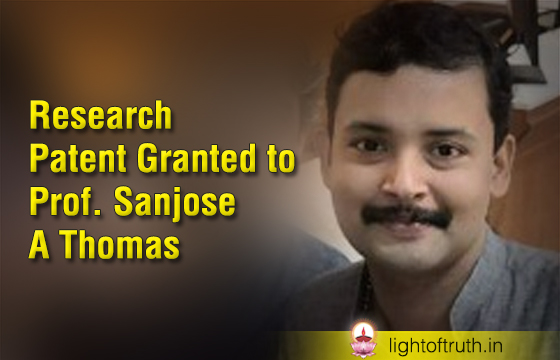
Prof. Sanjose A. Thomas, Head of the Department of Sociology at Theva-ra S.H. College, has been awarded a pa-tent for his research titled “How to Transform Emotiona-lity in Social Media for the Benefit of Society.” The Department of So-cial Sciences at Sacred Heart College is spearheading this innovative study. By utilizing new technologies, the research aims to redirect the use of social media towards areas that require urgent intervention, thus enabling it to be used constructively for the benefit of mankind. This is the first time a social scientist from Kerala has received a patent for re-search in the field of communication & media. The IQAC patent depart-ment at SH College, Thevara ex-pressed confidence that this timely research will help regulate the in-ternet usage of the new generation and thereby enhance their partici-pation in social lives. The proposed patent has the scope to transform social media activism in the 21st century and may redefine online culture both in terms of entertain-ment as well as information dissemi-nation.
Radio Salesian marks 9th birthday with listeners
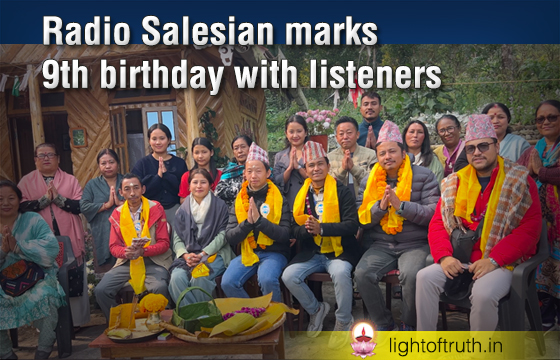
The first college based community radio of Darjeeling Hills marked its 9th birthday with its listeners from a remote tea garden village. Operating from Salesian College Autonomous Sonada, Radio Salesian is a venture of Kolkata Salesians with its claim to be the only Community Radio of South Asia Salesians. “Radio Salesian 90.8 FM celebrated its 9th birth day with great enthusiasm, with a cake-cutting ceremony led by Marma Tea Estate listeners under the Mirik Sub-division last week,” says Program Coordinator Radio Journalist Samir Chhetri.
The event featured a joyous gathering of senior listeners and village elders who have been dedi-cated supporters of the station. Re-presenting Radio Salesian were Radio Journalists (RJ) including Program Director Sameer Chettri, along with RJs Moses Tamang, Pratap Rai, Wang Lama, and Bandana Lohagun, who were given royal felicitation by the villagers. The celebration also includ-ed the participation of listeners from neighbouring tea garden villages.
The station’s only female RJ, Miss Bandana Lohagun, said, “This anni-versary celebration strengthened the connection between Radio Salesian and its community of listeners, high-lighting the station’s ongoing co-mmitment to engage with its audience and be their voice.” Listeners from neighbouring tea garden villages also participated in the celebration.
Pope Tells New Cardinals Never To Stray From The Path Of Jesus
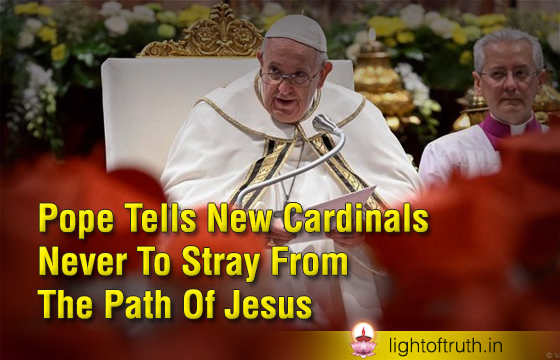
Pope Francis on December 07 encouraged the group of twenty-one new cardinals from across the globe to “walk in the way of Jesus: together, with humility, wonder and joy.” Presiding at Holy Mass for the Ordinary Public Consistory for the Creation of New Cardinals in St. Peter’s Basilica, the Pope reminded the prelates receiving the red hat, that just as Jesus’ ascent to Jerusalem was not an ascent to worldly glory but to the glory of God, they too must put the Lord at the centre and be builders of communion and unity.
Recalling the Gospel of Mark, the Pope said that in Jerusalem, Jesus would die on the cross to restore us to life. He took a “difficult uphill path that would lead him to Calvary,” he explained, while the disciples were thinking of a “smooth downhill path for the triumphant Messiah.” The Pope noted that the same thing can happen to us: “Our hearts can go astray, allowing us to be dazzled by the allure of prestige, the seduction of power, by an overly human zeal for the Lord.” “That is why,” he continued, “we need to look within, to stand before God in humility (…) and ask: Where is my heart going? Where is it directed? Have I perhaps taken the wrong road?”
The Holy Father focused the rest of his homily on how the new Cardinals are called to make every effort to walk in the path of Jesus. “To walk in the path of Jesus means above all to return to him and to put him back at the centre of everything,” he said, warning them to look out for secondary things and external appearances that can overshadow what truly counts.
The very word “Cardinal”, he explained, refers to a hinge inserted into a door to secure, support and reinforce it.

Notre Dame Cathedral ‘Back In The Light’ After Glorious Reopening
The doors of the newly restored Notre-Dame of Paris Cathedral were officially reopened to the public during a ceremony on December 07 just over five years after a blaze ravaged the iconic structure’s roof, frame, and spire. The celebration, which began at around 7:20 p.m. local time, was attended by some 1,500 people, including about 40 heads of state, including U.S. President-elect Donald Trump and Ukrainian President Volodymyr Zelenskyy.
Breaking five years of silence, the bell of Notre-Dame, known as the “bourdon,” rang out across Paris. This was the first step in the reopening office, initiated by three knocks on the cathedral’s central portal, the Portal of the Last Judgment, by the archbishop of Paris, Laurent Ulrich. The opening of the doors was set to the music of the polyphonic piece “Totus Tuus,” composed in 1987 by Henryk Gorecki during Pope John Paul II’s visit to Poland and sung by the 150 young members of the Maîtrise de Notre Dame.
“May the rebirth of this admirable church be a prophetic sign of the renewal of the Church in France,” Pope Francis said in a letter read by the apostolic nuncio of France, Archbishop Celestino Migliore, after a tribute to the firefighters who saved the 800-year-old cathedral from the flames and the French president’s speech. ”I invite all the baptized who will joyfully enter this cathedral to feel a legitimate pride and reclaim their faith heritage,” he added.
World Leaders Must Broker Christmas Peace, Pope Francis Urges During Angelus
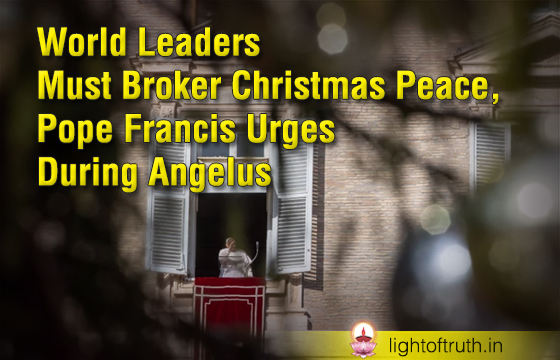
Pope Francis issued a heartfelt plea for peace dur-ing Angelus on the solemnity of the Immaculate Conce-ption on December 08, urg-ing international leaders to broker ceasefires in conflict zones by Christmas.
“I appeal to governments and the international community that a ceasefire may be reached on all war fronts by the Christmas celebrations,” the pope said from the window of the Apostolic Palace, addressing pilgrims and visitors gathered in St. Peter’s Square.
The pontiff specifically called for continued prayers for peace in “tormented Ukraine, in the Middle East – Palestine, Israel, Lebanon, and now Syria – in Myanmar, in Sudan, and wherever people suffer from war and violence.”

Cardinal Pizzaballa: Pope Francis Calls Holy Family Church In Gaza Every Day
Latin Patriarch of Jeru-salem Cardinal Pierbattista Pizzaballa, OFM, said that Pope Francis is known by the children of Holy Family Church in Gaza as “the grandfather.”
During a Dec. 6 press conference organized by Aid to the Church in Need International, the Latin patriarch of Jerusalem told journalists “the pope is calling every day at 7 p.m.” “It became a kind of status quo,” Pizzaballa said with a laugh. “Maybe half a minute, 30 seconds, maybe more, maybe less. And now he became the grandfather of the children, the pope, because he’s talking. They now know that he is calling.” For the community of Gaza it is a very big support – psychological, emotional, and spiritual,” he added.
This Christmas, in spite of the war and poor conditions, Pizzaballa said Holy Family Church in Gaza is preparing something special. “Christmas is the feast of the children,” he said. “What we will try and do, if we are able, is to introduce not just food but also some toys. Something that will make a difference to the everyday life for children.”
Nicaraguan Dictatorship Kidnaps And Expels Another Priest
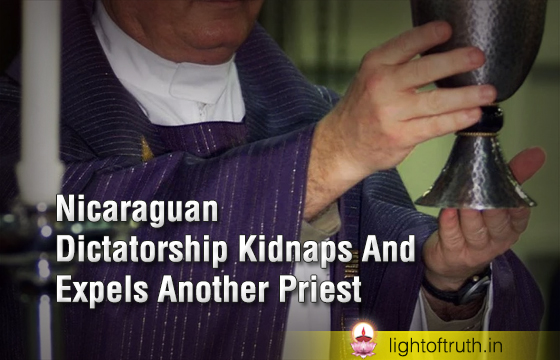
The Nicaraguan dictatorship of Daniel Ortega and his “co-president” and wife, Rosario Murillo, this week kidnapped and expelled from the country Father Floriano Ceferino Vargas, a priest of the Diocese of Bluefields.
Medardo Mairena, a former peasant leader now in exile, stated on X that “Father Floriano Ceferino Vargas, parish priest of the Church of San Martín de Porres in Nueva Guinea, has been exiled by the Sandinista regime,” further specifying that the priest is now in Panama.
In an interview with EWTN Noticias, lawyer and researcher Martha Patricia Molina said it is not known exactly why Vargas was kidnapped and expelled from the country. However, Molina said, “just because you are religious in Nicaragua, the dictatorship can kidnap you.”
Molina, who has documented hundreds of attacks by the Nicaraguan government against the Catholic Church in recent years, also indicated that it is possible that the priest had made “some comment that they [the dictatorship] consider hostile to the supposed revolution, which at every moment they say must be defended.”
The researcher also commented that, in the midst of everything, it is good to know that the priest “is not going to be in the prisons of Nicaragua, where more than 40 mechanisms of torture, cruel, inhuman, and degrading treatment are practiced.”
The priest was arrested after celebrating Mass in his parish. The kidnapping and expulsion of Vargas happened the same week Pope Francis sent a letter to the country’s Catholics in which he encouraged them and reminded them that faith and hope “work miracles.”
Growing concern for the well-being of the Catholic Church in Nicaragua was also expressed this week by the bishops of Central America, who convoked for Dec. 8, the solemnity of the Immaculate Conception, a day of prayer for the persecuted Church in the neighbouring country.