HINDU HARDLINERS ATTACK INDIAN CHRISTIAN SCHOOLS

Hindu hardliners have stepped up intimidation of Christian educational institutions in India, not least Catholic colleges. In one recent case, sheer numbers were used to break through a security cordon with the aim of performing a nationa- listic ritual.

Braving wintry early January winds, armed police guarded St Mary’s College in Vidisha of Madhya Pradesh State in central India. Some 800 young Hindu men entered the campus, some by scaling walls, but police managed to stop them performing a purportedly patriotic ritual in front of students.

The Bharat Mata Aarti ritual can entail a personification of Mother India represented by the Hindu goddess Durga.

However, Archbishop Leo Cornelio, head of the Catholic

Church in the troubled state, said the attempt really had nothing to do with patriotism. Attempts to discredit church insti- tutions were aimed at gaining control over them, he warned.

The archbishop noted that Catholic schools and colleges run on secular lines are allowed under the nation’s constitution. “No one can take that right from us,” Archbishop Cornelio said.

CATHOLIC RELIGIOUS PLEDGE TO PROTECT SECULARISM

Catholic priests and nuns from 31 religious congregations have pledged to protect the secular and democratic ethos of Indian constitution amid calls from rightwing Hindu groups to make India a theocratic nation.

“There is an urgent need for us to wake up to the harsh realities of diluting the secular, socialistic and democratic ethos of our constitution and protect them,” said Father Jacob Peenickaparambil Feb. 19. He was speaking at the end of a three-day biennial convention of Forum of Religious for Justice and Peace in Ranchi, the capital of north- eastern Indian State of Jharkhand.

More than 60 men and women from Religious congregations discussed the theme “challenges to secular democracy in India today” – and felt the need to create awareness among the people to protect the constitution of India.

“Unless we propagate the values of our constitution, its secular, socialistic and democratic values, and the rights of minorities will not be safe in the country,” said Father Peenika- parambil, national convenor of the group and a member of Carmelite Mary Immaculate (CMI) congregation.

Several speakers at the meeting said pro-Hindu groups continue to clamor to make India a Hindus- alone state, with the government supporting them with discriminative policies that sideline Muslims, Christians, dalits, tribals and other social and ethnic minorities. “The discriminatory policies in force in the country have widened the gap between the rich and the poor,” said Sister Manju Kulapuram, national executive secretary of the forum. She cited the increasing cases of attacks against Christians and Muslims, including several cases of lynching in the past two years in the name of protection of cows taking place in the country.

PHILIPPINE BISHOP SHEDS LIGHT ON ASH WEDNESDAY BURNS

An investigation has ruled out sabotage as the cause of skin rashes from ashes used during an Ash Wednesday ritual in a Manila diocese.

Bishop Pablo Virgilio David of Kalookan said the “mystery burns” people had on their foreheads after the ashes were administered were caused by acid.

Bishop David said several Mass-goers reported feeling a burning sensation on their foreheads immediately after being marked. When the people washed the ashes off, rashes and blisters appeared on their skin.

The ashes in question were not used after reports were received. Doctors who examined the rashes said a chemical substance caused the skin burns. The ashes are still being tested in a laboratory. He has already ordered a review of close-circuit television footage to look for possible “sabotage.” A laboratory test found high level of acidity in the ashes due to “over burning.”

“They call it overcooked charcoal that turned into caustic ashes that produced high acidity when mixed with water,” said the prelate.
He said a similar incident was reported in

Ireland several years ago.
Bishop David said the burning of a huge pile of palm fronds resulted in the “over burning” of ones on the bottom that produced greyish ashes instead of black charcoal.

“Not everybody was affected. Only those who received the acidic ashes had blisters,” said the prelate.

After reviewing close-circuit television footage the possibility of sabotage was ruled out.

He said the parishioners who suffered blisters received proper medication.

Mass-goers reported feeling a burning sensation on their foreheads immediately after being marked with ashes.

NEARLY 50,000 BAPTISMS REGISTERED IN CHINA IN 2017, SAYS VATICAN AGENCY

The Catholic Church in China registered 48,556 baptisms in 2017, reflecting the vitality and missionary strength of the Catho- lic communities there, according to a report by Fides, the news agency of the Congregation for the Evangelization of Peoples.

The figures likely are in- complete, however, given the difficulty of procuring data from Catholic communities in the rural parts of China, the report said.

But the numbers still “reflect the vitality and the missionary dynamism of a community that fully lives faith,” said the organization conducting the annual survey: the Faith Institute for Cultural Studies, a church-run organization based in Shijiazh- uang. Fides republished the organization’s findings Feb. 15.

The province of Hebei which consistently has the highest number of baptisms each year of all the Chinese provinces – topped the list again with 11,899 bapti- sms, the report said. The Arch- diocese of Beijing registered 1,099 baptisms, while the Dio- cese of Ningxia had 128 new Catholics baptized. China’s north west autonomous region of Xinjiang, where the majority of the population is Muslim, registered 66 baptisms. The Qinghai province had 54 baptisms, and isolated communities such as Hainan Island in southern China and Tibet had 38 and 11 baptisms, respectively.

PEACE DEAL AFTER PAKISTANI CHRISTIANS FLEE BLASPHEMY MOB

Christian and Muslim clerics signed a peace accord to restore calm in the Pakistani city of Lahore, a day after hundreds of minority families fled their homes fearing attacks from hard-line groups over alleged blasphemy.

More than 1,000 Christian families left the Shahdara neigh- bourhood after locals protested against Patras Masih, 18, who allegedly shared a photo of a Hindu wearing shoes in Roza-e- Rasool, the burial place of the Prophet Muhammad in Medina, Saudi Arabia.

Non-Muslims are prohibited from entering Mecca and Medina, Islam’s holy cities.

Masih was arrested on Feb. 19. His family is in hiding. “He was a member of a Facebook page titled “paglo ki basti” (the slum of lunatics). The existence of this photo challenges the religious sentiments of Muslims. This may result in an unpleasant incident,” said complainant Hafiz Muhammad Awais.

A mob carrying wooden sticks and placards gathered on a main road, burned tires and chanted religious slogans on Feb. 21 while demanding the public execution of the Christian sanitary worker. They also gathered outside the teenager’s house and threatened to burn all Christian houses in the area.

UNDERGROUND CATHOLIC: WE ARE EXCLUDED FROM DIALOGUE BETWEEN CHINA AND THE HOLY SEE

The news of an “imminent” agreement between China and the Holy See on how to appoint bishops is arousing tensions, debates and the taking of positions among the official and unofficial Chinese Catholics (under- ground). Above all, the campaign in favour of signing the agreement that some media have undertaken to convince the world the benefits of a deal and perhaps even to convince China, which so far has not expressed itself, is being targeted. Several speeches criticize the fact that this campaign has silenced the voice of the unofficial Church. The following article, received from AsiaNews, is from an underground Catholic of China, known to us, who signs with the pseudonym “John.”

“Beware of false prophets, who come to you in sheep’s clothing, but underneath are ravenous wolves. By their fruits you will know them. Do people pick grapes from thorn bushes, or figs from thistles? Just so, every good tree bears good fruit and a rotten tree bears bad fruit. A good tree cannot bear bad fruit nor can a rotten tree bear good fruit. Every tree that does not bear good fruit will be cut down and thrown into the fire. So by their fruits you will know them” (Mt. 7:15- 19). Before starting, I wanted to mention this biblical passage to remember what is happening or is about to happen.

Reading the article “China, the “under-ground” bishop: we will follow the Pope, because we trust the Lord,” I would like to thank the author because he put quotation marks on “underground” to describe this Chinese bishop of Qiqihar [this is Msgr Giuseppe Wei Jingyi, interviewed by Vatican Insider, on February 16th last]. All this is really ridiculous: this so-called underground bishop is actually an official bishop who wants to represent the underground Church and claims to be an authoritative voice. The bishop asks his friends in Hong Kong, Macao, Taiwan to “set aside the pretence” to speak in his place. If this is true, I would like to ask: who should represent the voice of the underground Church? Whose voice should that be? Based on what? What is the core of our Catholic faith? Who can represent the interest of the Chinese faithful?

MIRACLES MULTIPLY AT BANGLADESH’S TOP CATHOLIC SHRINE

Jolekha Begum is eight months pregnant but the Muslim primary school teacher still travelled more than 150 kilometres across Bangladesh on a wintry morning in late January to worship at a miracle-bestowing shrine that has gained fame nationwide. This year, about 50,000 devotees flocked there to attend the feast on Feb. 2, which was presided over by Cardinal Patrick D’Rozario. Traditionally, it is celebrated ahead of Lent, which begins on Feb. 14 this year, rather than on June 13, St Anthony’s feast day in the church’s liturgical calendar. Most devotees are Catholics from Dhaka Archdiocese’s Bhawal region, one of country’s oldest and largest Catholic strongholds covering seven parishes.

TURKISH MONASTERIES TO BE RETURNED TO THE CHURCH

Have the monks from one of the last monasteries in eastern Turkey finally won their battle? In 2014, fifty properties belonging to the Syrian Orthodox Church were expropriated by the government in southeast Turkey. Among them were several ancient monasteries where a dozen monks continue to live. Since then, the monks have launched a series of legal cases to recover their properties. A recent decree may finally grant them victory, according to a report in the Hürriyet Daily News in early February.

ASIA BIBI FAMILY APPEAL TO POPE FRANCIS FOR HELP

Pope Francis says a Catholic woman sentenced to death under Pakistan’s blasphemy laws and a Nigerian woman who was captured by Jihadist militants Boko Haram are both “martyrs.”

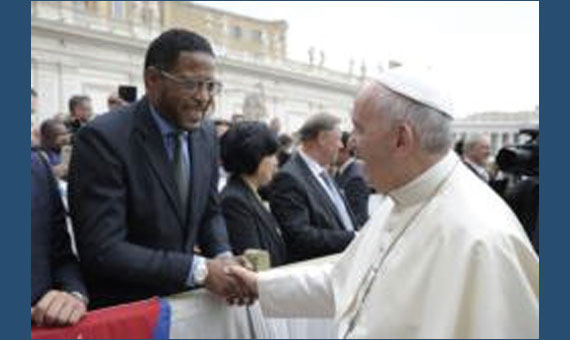
He made the remarks during a private audience in the Vatican with the husband and daughter of Asia Bibi, imprisoned since 2009 for an alleged offence against the Prophet Mohammed. Asia Bibi has always denied the offence.

The family was also joined by Rebecca Bitrus, who told the Pope how she had been raped by one of her Boko Haram kidnappers and later gave birth to his son.

“Rebecca’s testimony and that of Asia Bibi represent models for a society that today is afraid of pain,” Francis said according to a statement from the Italian branch of Aid to the Church in Need (ACN) whose president and founder were present during there meeting. “They are two martyrs.”

The Pope met the group in the Apostolic Palace hours before Rome’s Colosseum is lit up in red, an event aimed at highlighting the persecution of Christians which has been

steadily on the rise in the Middle East, parts of Asia and Africa. Before the papal audience Ashiq Masih said he wanted to appeal to Francis to do “everything he can” to have his wife released, and at the end of the audience asked the Pope to pray for his wife “and all persecuted Christians.”

Ms Bitrus has described in the past how she had been taken from her husband, saw her 3-year-old son drowned by kidnappers and told she be made to “work for Allah.” She was later imprisoned where one of her captors “forced himself” on her and she became pregnant. “After that I tried to kill myself,” she explained. But the wife of a Pastor, herself abducted from Gwoza, pleaded with me not to take my life. She already had two children fathered by the militants. When the time came for me to give birth, I delivered at home, alone.”

NIGERIA’S BOKO HARAM CRISIS: COURT FREES 475 SUSPECTS

When mechanics Taye and Kehinde Hamza agreed to service a vehicle at their workshop in Nigeria’s Bauchi State in 2010, they could never have imagined the years of hell which would follow. The car, it turned out, belonged to a Boko Haram fighter, and the job was enough to get the twins arrested.

It would be another eight years until they were free again, cleared along with 473 others of terrorism charges.

At a previous mass trial, held in October, more than 400 suspects were released, with just 45 jailed for their roles in the Boko Haram insurgency which has killed more than 20,000 people and displaced millions of others.

Justice Minister Abubakar Malami told the BBC that the released suspects would be rehabilitated before being allowed to return to their families.

But while these judges are making headway into the backlog of people awaiting trial, there are still another 5,000 people are still waiting for their own dates to be set.

The judges have found 205 people guilty of terror-related offences – including the “master- mind” behind the abduction of the Chibok girls.

But while convictions like this offer the hope of justice for Boko Haram’s many victims, campaign group Amnesty International has questioned the method of the trial.

Official Website

Exit mobile version