Two Chinese priests placed in detention

Two priests of the under-ground Catholic Church in China have been detained by authorities in Hebei Province, a source told.

The priests from Xuanhua Diocese are Father Su Guipeng and Father Zhao He.

The source said Father Zhao, who serves in the Dongcheng Catholic Church, was taken away by the personnel of the United Front Work Department of Yan-gyuan County on Oct. 24.

Seven unidentified people who went to the church said that they would take the priest to talk to local government officials, but the priest had not returned.

The source said that the priest had been placed in detention at a hotel. His mobile phone had been confiscated and he was under constant guard.

The priest was reportedly asked to study newly revised regulations on religious practice and to recognize the state-controlled Chinese Catholic Patriotic Association (CCPA).

The government officials were said to have warned that the Catholic Church in China was required to be autonomous from the Vatican. This was not withstanding a provisional Vatican-Beijing agreement signed two months ago, covering sensitive issues such as the appointment of new bishops in China.

Zen presents letter to pope warning him on China

The Hong Kong emeritus bishop on Nov. 8 told ucanews. com that underground clerics have cried to him since the Vatican-China deal on the appointment of bishops.

“They said officials have forced them to become open, to join the Chinese Catholic Patri-otic Association and to obtain a priest’s certificate with the reason that the Pope has signed the Sino-Vatican provisional agreement,” said Cardinal Zen.

He said some parts of the agreement had not been made public, meaning that brothers and sisters of the underground church did not know what they should do. “Some priests have escaped, and some have disappeared because they do not know what to do and are annoyed. The agreement is undisclosed, and they do not know if what officials say is true or not,” he said.

Cardinal Zen said the China Church was facing new persecution and the Holy See was helping the Chinese Communist Party suppress the underground community.

He flew to Rome from Oct. 29 to Nov. 1 to hand his letter to the Pope. “I want to talk to the Pope again and hope he will consider again, but this may be the last time,” he said.

In his letter he described how the underground church had seen money confiscated, with clergy having relatives disturbed by the authorities, going to jail or even losing their lives for the faith.

“But the Holy See does not support them and regards them as trouble, referring to them causing trouble and not supporting unity. This is what makes them most painful,” said Cardinal Zen.

The letter also stated that the Chinese Church did not have the freedom to elect bishops.

“The pope has said that members of the Chinese Church should be the prophets and sometimes criticize the government. I feel very surprised that he does not understand the situation of the Chinese Church,” Cardinal Zen said.

On Sept. 26, four days after the provisional agreement was signed, the pope wrote a message to Chinese Catholics and the universal church explaining the reasons for signing the agreement: to promote the proclamation of the Gospel, and to establish unity in the Catholic community in China.

In addition, after his pastoral visit to Lithuania, Latvia and Estonia from Sept. 2-25, the pope told the media on his flight home that people should “pay tribute to those who suffered for faith,” especially in those three countries brutally trampled by the Nazis and the Communist Party.

Cardinal Zen told ucanews.com that the pope’s words made him feel that “he does not seem to know that their history is also the history of the Chinese Church and the current situation.” He suspects the pope was deceived by people around him who did not tell him the real situation faced by the Chinese church.

Cardinal Zen criticized the Vatican secretary of state, Cardinal Pietro Parolin, who negotiated with the Chinese government.

Pope says peace begins at home by saying ‘no’ to rivalry

Pope Francis holds a Mass for the cardinals and bishops who have died over the course of the year at St Peter’s Basilica at the Vatican on Nov. 3. He says people must reject pride and rivalry.

World peace must begin in individuals’ hearts and in their families by saying “no” to pride and rivalry, Pope Francis says.

“When we read news about wars — think about the starvation of children in Yemen, which is a fruit of war — ‘it’s far away, poor babies,’ but why don’t they have anything to eat?” the Pope asked during his homily on Nov. 5 during Mass in the chapel of his residence in the Vatican City.

The Mass was celebrated just days after news media reported the death of 7-year-old Amal Hussain, a Yemeni girl whose photo by Tyler Hicks in The New York Times in mid-October brought renewed attention to the devastating impact the war in Yemen is having on innocent civilians.

“The same war that we make in our homes, in our institutions” by engaging in rivalry and gossip grows exponentially and leads to real wars that kill people, the Pope said at his morning Mass.

“So,” he said, “peace must begin there: in the family, in the parish, in institutions, at the workplace by always seeking unanimity and agreement and not one’s own interests.”

In the day’s gospel story from St Luke, Jesus tells a leading Pharisee that when he hosts a banquet he should not invite his friends and relatives, who will feel obliged to repay him, but invite the poor and needy.

“Blessed indeed will you be because of their inability to repay you,” the Pharisee says. Jesus’ point, the Pope said, is to avoid acting only out of one’s self interest and choosing friends only based on the benefits they can bring.

Thinking only of how a relationship can be a benefit is a form of selfishness, he said, while Jesus preached the exact opposite: gratuity, which “broadens one’s horizons because it is universal.”

In fact, he said: “Jesus came to us not to collect things or form an army. No, no. He came to serve us, to give us everything freely.” In the day’s first reading, the Pope said, St Paul advised the Philippians to be “of the same mind, with the same love, united in heart,” because choosing one’s friends based on what one can gain always divides a community.

“Rivalry and vainglory,” or excessive pride, are the two things that always run counter to harmony and agreement in a family or community, the Pope said.

In families and even in parishes, he said, gossip often is born of rivalry because people think the easiest way to grow in importance in the eyes of others is to “diminish someone else through gossip.”

French bishops tackle structural reform

The Bishops Conference of France (CEF) has devoted several working sessions of its latest plenary assembly, which concludes on Nov. 8, to discussing its current system of organization with a view of simplifying its national level operations and strengthening those at the provincial level.

How is it possible in a single program to evaluate meetings organized by the bishops’ conference in Paris, consultations at the “provincial level” and the ongoing work in each diocese?

These are the growing tensions that the French bishops are currently facing. As a result, the bishops have now established a small working group tasked with proposing a new schema of organization for the work of the conference.

“The objective is to restore provincial level structures, which were neglected by the previous reform, and which the bishops now feel are relevant to enable consultations to take place in a simpler manner,” said one assembly participant.

“It is clear that the work of the various episcopal commissions and councils is functioning badly and is actually just eating up time,” he said.

On the other hand, bishops generally agree that the smaller dioceses – and even certain provinces – cannot do without “national” support.

Indian appointed to new international Charismatic renewal body

The Vatican has appointed an Indian lay leader to the 18-member Catholic Charismatic Renewal International Services, known as CHARIS.

Cyril John, a former Indian bureaucrat, is one of the two Asians appointed by the Vatican’s Dicastery for Laity, Family and Life. The other Asian is Brother James Shin San-Hyun from South Korea.

The dicastery, a department of the Roman Curia, on October 31 announced that Pope Francis has erected a new body, CHARIS, to provide a new, single, international service for the needs of the Catholic Charismatic Renewal in the Church.

Rome has appointed Dr Jean-Luc Moens, a member of the Emmanuel Community from Belgium, as the moderator of the new entity, and Capuchin Father Raniero Cantalamessa, papal preacher from Italy, as its Ecclesiastical Advisor. Shayne Bennett from Australia represents Oceania in the worldwide body.

John, a native of Kuravilangad in Kerala, got involved in Charismatic renewal movement in 1982. He has been the chairman of the renewal in the Archdiocese of Delhi, chair-man of Indian National Service Team, Chairman of ICCRS Sub-Committee for Asia-Oceania since 2006 and was Vice-President of ICCRS Council from 2007 to 2015, according to a press release from K P Shaji, administrator of the National Charismatic Office based in New Delhi.

Indian Catholic entrepreneur uses skills to fight global poverty

No matter when someone writes to Ashish Gadnis, there is almost no chance he will answer from Austin, Texas, where he lives. He spend in Rwanda and in Brazil, before taking a flight to Myanmar. He’s not a coffee grower, but he will talk about fair trade, and with a huge Benedictine cross on his chest, he will speak to you about Catholic Social Teaching providing a clear goal for his company – taking 100 million people out of poverty by 2026.

And Gadnis knows what poverty is. He grew up in Mumbai, India, in the 1970s when there wasn’t “much options those days in India to get out of poverty.”

“I did not want to stay in that ration line and I realized that I could break the cycle of poverty if I could get a job as a software programmer,” he recalled.

But for a 20-year-old Indian it wasn’t really about education – it was about getting out of the country: “That’s the dogma – if you want a better life, you gotta go.”

He immigrated first to Colombia and then, in 1994, landed in the United States. Ten years later, he was a founder and CEO of a successful IT company.

Indian Christians demand equality for Dalits

India’s Catholics and Protestants jointly observed on November 11 as Dalit Liberation Sunday with liturgy and activities urging an end to discrimination suffered by people of lower-caste origins within the church and society.

Bishop Sarat Chandra Nayak, chairman of the Indian bishops’ office for people of socially poor castes and tribes, asked people to remember the 100 poor Christians killed in anti-Christian violence in Odisha State’s Kandhamal 10 years ago. The observation is a “call to the whole Christian community to renew our faith, to awaken our consciousness to be the voice of the voiceless and to stand with vulnerable Dalits in society,” he said in his message.

Sword of Damocles hangs over Taiwan

Various commentaries appeared online after the signing of the Sino-Vatican provisional agreement on bishop appointments on Sept. 22, but, frankly speaking, it is very hard to find a comprehensive one in the mainland media except those we call “sunflower” (pro-government) articles.

Most are written by church members or academics, and it is obvious that they feel reluctant to express all their ideas.

If they had expressed all their thoughts, their articles and even their online platforms could have been blocked. To say whatever you want can result in you not being allowed to say anything at all. The result is that commentators self-censor, making it impossible for readers to understand their entire viewpoints.

The Sino-Vatican agreement, for the Vatican, is for pastoral purposes, but for China it is purely and simply a political agreement. As such, we need to analyze it under a political micro-scope to have a deeper under-standing.

Secret contacts between China and the Vatican have been conducted for several decades. As everyone knows, the Vatican is far more anxious and urgent than China in this matter. China has always regarded the power to appoint bishops as a non-negotiable part of its national sovereignty.

American religious brother among new martyrs recognized by Vatican

The Vatican has issued sixteen decrees advancing the causes of candidates for canonization and beatification.

With the approval of Pope Francis, the Congregation for the Causes of Saints proclaimed the martyrdom of Brother James Alfred Miller, and American religious who was killed in Guatemala in 1982. The Congregation also confirmed the “cult from time immemorial” of Michele Giedrojc, a layman who lived in the 15th century in what is now Lithuania and Poland. The decree, equivalent to beatification, gives him the title of “Blessed.”

In other decrees, the Congregation recognized ten martyrs of the Spanish Civil War; certified miracles attributed to two Italian woman, who now become eligible for beatification and confirmed the “heroic virtue” of ten other candidates for beatification.

Pakistan govt accused of caving in to Asia Bibi protesters

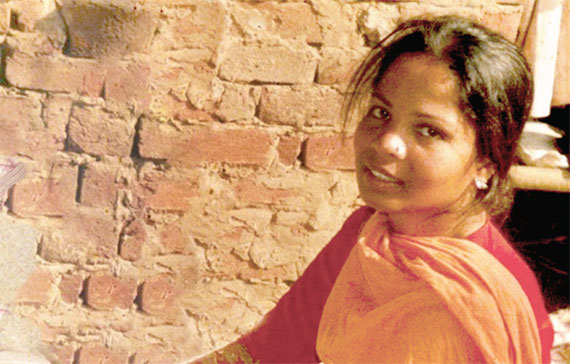
Supporters of Islamist group Tehreek-e-Labbaik Pakistan hold a protest in Islamabad on Nov. 2 against the acquittal of Asia Bibi. Pakistan’s government has been criticized for agreeing to the group’s demands.

Pakistan’s independent hu-man rights body has condemned the government’s inability to preserve “the writ of the state” during protests that erupted after the acquittal of Catholic woman Asia Bibi in a blasphemy case.

The Human Rights Commission of Pakistan (HRCP) condemned the government’s submissive response to protests by Islamist group Tehreek-e-Labbaik Pakistan (TLP), terming the rapid agreement to the group’s demands as “a mockery of the rule of law.”

“What was hailed as a land-mark judgment and a human rights victory unraveled into a situation in which there was no distinction between the peaceful right to dissent and the thuggery of mobs who claimed a moral right to wreak public havoc, to attack citizens and law enforce-ment personnel, to wantonly destroy property and to incite hatred against religious minorities,” said HRCP in a statement on Nov. 4.

Official Website

Exit mobile version