CARDINAL FILONI: “HOLY SEE-CHINA PROVISIONAL AGREEMENT OF HISTORICAL SIGNIFICANCE”

Cardinal Fernando Filoni, Prefect of the Congregation for the Evangelization of Peoples, followed the delicate and complex path of the Catholic Church in China since 1992, the year of its arrival in Hong Kong. In those same years the diplomatic detente began between the People’s Republic of China and the Holy See, with the first contacts between members of the Secretariat of State and the Ministry of Foreign Affairs of Beijing. Your Eminence, for several years now you have led the Dicastery of the Holy See responsible for evangelization, with particular reference to the so-called “mission” territories. Cardinal Fernando said the following on  the pastoral significance of the “Provisional Agreement on the Appointment of Bishops” signed by the Holy See and the Chinese Government on 22 September 2018?

“Since the Dicastery that I oversee has a particular responsibility for accompanying the Church in China, I feel particularly called upon to speak about the pastoral significance of the Provisional Agreement. But I think Pope Francis said it best when, in his Message to the Catholics of China last September, he wrote: Furthermore, “The Provisional Agreement signed with the Chinese authorities, while limited to certain aspects of the Church’s life and necessarily capable of improvement, can contribute – for its part – to writing this new chapter of the Catholic Church in China. For the first time, the Agreement sets out stable elements of cooperation between the state authorities and the Apostolic See, in the hope of providing the Catholic community with good shepherds.”

BP. HINDER: THE POPE IN ARABIA WILL BE A BRIDGE FOR DIALOGUE WITH MUSLIMS

Pope Francis’s visit to the United Arab Emirates (UAE), a country where most migrant workers are Catholic from different Asian countries, is an “encouragement and a recognition of their existence and value,” this according to Paul Hinder, Apostolic Vicar of Southern Arabia (United Arab Emirates, Oman and Yemen). Speaking to AsiaNews on the eve of the first papal trip to a Gulf country, the prelate notes that “His presence shows the unity among us, in spite of tensions and differences that characterise a multinational and multicultural Church, which is united under the same sky.”

CHALDEAN PATRIARCH: ONE MILLION IRAQI CHRISTIANS HAVE EMIGRATED IN RECENT YEARS

In recent years, with the migratory flows of the Iraqi population to other countries, about a million indigenous Christians have left Iraq. Chaldean Patriarch Louis Raphael Sako recalls this in a message released on January 31 on the occasion of the sixth anniversary of his patriarchal election. On this occasion, the Patriarch traces a brief account of the events that have marked the years of his patriarchal ministry, outlining problems, difficulties, initiatives and hopes that have marked the path of the Chaldean Church. Among the emergencies, the Primate of the Chaldean Church recalls the flight of Christian populations from Mosul and the Nineveh Plains conquered by the jihadists of the Islamic State (Daesh) and the difficulties encountered in ensuring pastoral and material care for tens of thousands of refugees for more than three years.

VENEZUELAN ARMY BESIEGED HUNDREDS OF PROTESTERS IN MATURIN CATHEDRAL

As opposition marches were held across Venezuela on January 23, at least 700 opposition supporters were trapped in Maturin’s Cathedral of Our Lady of Mount Carmel for several hours, besieged by the Venezuelan Army.

The Jan. 23 marches were convoked by the National Assembly, Venezuela’s democratically elected legislature, which is controlled by the opposition. At one of these marches in Caracas, Juan Guaido, head of the National Assembly, declared himself interim president, calling leader Nicolas Maduro illegitimate.

Tens of thousands of Venezuelans marched in support of the opposition, and security forces met some of the protesters with tear gas. Local NGOs have said 14 people were shot dead during protests Jan. 22-23.

Bishop Enrique Pérez Lavado of Maturin reported that seminarians, priests, and some 700 people participating in the demonstration were besieged in the cathedral, with the military “trying to break their way inside,” according to the Venezuelan bishops’ conference on Twitter.

Soon after, Pérez reported that the soldiers had surrounded the church, with more than a thousand opposition demonstrators inside: “The National Bolivarian Army is guarding the entrances to Our Lady of Mount Carmel Cathedral where there are more than a thousand opposition supporters.”

According to a report on Twitter by Radio Fe y Alegría, government supporters were also inside the cathedral. The station said that Father Samael Gamboa negotiated with the security forces for the people to leave in groups, “to guarantee their human rights.”

The people took refuge in the cathedral due to repression by the regime’s security forces and by pro-government groups. Earlier this month, the bishops called illegitimate Maduro’s swearing in for a second term as president. Maduro won a May 2018 presidential election which was boycotted by the opposition and has been rejected by much of the international community.

HOPE WANES IN CHURCH WOUNDED BY SIN, POPE TELLS PANAMA CLERGY, LAITY

A church wounded by sin can paralyze, confuse and tire the hearts of Catholic clergy and laypeople, causing them to doubt their mission in the modern world, Pope Francis said.

Celebrating Mass at the Cathedral Basilica of Santa Maria La Antigua on Jan. 26 with priests, consecrated men and women and members of lay movements, the Pope warned that the burdens and troubles in the church can lead to a “weariness of hope” that “calls into question the energy, resources and viability of our mission in this changing and challenging world.”

“The weariness of hope comes from seeing a church wounded by sin, which so often failed to hear all those cries that echoed the cry of the Master: ‘My God, why have you forsaken me?’” he said. Thousands of pilgrims and Panamanians waited outside — some camped outside since 4 a.m. — cheering loudly as the bells of the cathedral hailed Pope Francis’ arrival.

Upon entering the 220-yearold church, the Pope was greeted with applause by those present, including President Juan Carlos Varela of Panama and his wife, Lorena Castillo.

The Pope then spent several minutes praying before a statue of Santa Maria La Antigua, patroness of Panama. The original image, which depicts Mary holding baby Jesus in her arms and carrying a rose, was first brought into the country by Spanish conquistadors in 1510.

During the Mass, Pope Francis consecrated the altar of the newly renovated cathedral. Removing his chasuble and rolling up his left sleeve, he poured chrism oil and anointed the altar. According to World Youth Day officials, the Cathedral Basilica of Santa Maria La Antigua is the first cathedral in the Americas to have an altar consecrated by a Pope.

CZECH LAWMAKERS APPROVE TAXATION OF CHURCH RESTITUTION PLAN

The Czech Parliament’s lower house has approved a proposal drafted by Communist lawmakers to tax the compensation that the country’s churches receive for property seized by the former Communist regime.

On January 23, 106-56 vote shows the rising influence of the Communists. The party is not part of the centre-left ruling coalition led by Prime Minister Andrej Babis but helped the minority Cabinet survive a confidence vote.

The nation’s churches, including the Roman Catholic Church and the Jewish community, have had some property held by the state returned, and they are also to receive some $3 billion over 30 years.

FRANCIS EXPRESSES OPENNESS TO MARRIED PRIESTS IN PLACES WITH ‘PASTORAL NECESSITY’

Pope Francis closed the door Jan. 27 on his making celibacy optional for all Catholic priests, but also expressed openness to allowing older married men to be ordained to the priesthood where there is a “pastoral necessity.”

In a press conference aboard the papal flight back to Rome after a five-day visit to Panama, the pontiff first stated firmly: “I am not in agreement with making celibacy optional.”

But the Pope then noted that there are areas of the world where Catholics are deprived of the Eucharist — mentioning specifically the Pacific Islands and the Amazon region — and said “it is a thing to think [about] when there is a pastoral necessity.”

“I believe that the issue must be open in this sense: where there is a pastoral problem because of the lack of priests,” said Francis. “I will not say that it must be done. Because I have not reflected, I have not prayed sufficiently over this. But the theologians must study.”

Francis spoke about priestly celibacy in a 47-minute press conference in which he also sought to downplay expectations for an upcoming February Vatican summit on clergy sexual abuse with the presidents of the world’s Catholic bishops’ conferences.

On celibacy, the pontiff was asked if he could imagine a future in which the Catholic Church would adopt the practice of Orthodox Churches, which allow priest candidates to choose during their formation period whether to marry or remain celibate.

The Pope referred to a phrase he attributed to Pope Paul VI: “I would prefer to give my life before changing the law of celibacy.” He noted that in the Orthodox tradition, priestly candidates must choose whether they will marry before they are ordained deacons.

“My decision is: optional celibacy before the diaconate, no,” said Francis.

“It’s personal, but I will not do it,” he said. “Maybe I am closed-minded, but I do not feel that I can place myself before God with this decision.”

“But where there is not the Eucharist … who will make the Eucharist?” Francis asked.

BEWARE OF ‘SPIRALS OF HATRED’ ON SOCIAL MEDIA: POPE

Pope Francis has warned against the increasing narcissism and “spirals of hatred” found on social media networks, encouraging people to cultivate community in their internet interactions. In his World Communications Day message, published on January 25, Pope Francis said that online discussion is “too often based on opposition to the other.”

“We define ourselves starting with what divides us rather than with what unites us, giving rise to suspicion and to the venting of every kind of prejudice (ethnic, sexual, religious and other),” Francis wrote.

This creates a digital environment that nourishes “unbridled individualism which sometimes ends up fomenting spirals of hatred,” he explained.

“As Christians, we all recognise ourselves as members of the one body whose head is Christ. This helps us not to see people as potential competitors, but to consider even our enemies as persons,” he said. “We no longer need an adversary in order to define ourselves” because in “the all-encompassing gaze we learn from Christ” our identity and our relationship in communion with others, he explained.

WELBY SAYS IT IS ‘WONDERFUL’ TO CONVERT TO CATHOLICISM

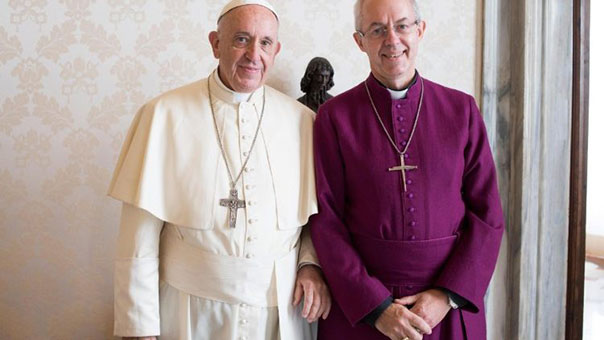
The Archbishop of Canterbury has said he is perfectly happy if members of the Church of England convert to Catholicism, and that it can even be “wonderful.”

In an interview with Fraser Nelson, editor of The Spectator, the Most Rev Justin Welby says he does not mind at all that many of Church of England clergy defected to Rome after the ordination of women priests.

“Who cares?” he says. “I don’t mind about all that. Particularly if people go to Rome, which is such a source of inspiration. I had an email from a very old friend, an Anglican priest who has decided to go to Rome. I wrote back saying: how wonderful! As long as you are following your vocation, you are following Christ. It’s just wonderful.

“What we need is for people to be disciples of Jesus Christ. I don’t really care whether it’s the Church of England or Rome or the Orthodox or Pentecostals or the Lutherans or Baptists. They are faithful disciples of Christ.” The Spectator reports that Archbishop Welby has a Catholic priest, Fr Nicolas Buttet, as his spiritual adviser and that one of his closest friends is Cardinal Vincent Nichols, Archbishop of Westminster. He also goes see the Pope regularly and they talk about personal things.

His interview comes as Bishop Brian Farrell, LC, Secretary of the Pontifical Council for Promoting Christian Unity, suggests that after a difficult year for ecumenism, the churches might be at a new “turning point.”

NATIONAL CONSULTATION TO ADDRESS CHALLENGES, CRISES IN INDIAN CHURCH

A nation consultation, “We too are Church,” is being organized as a response to the various challenges and crises facing the Church in India.

The initiative by Catholic lay people is an attempt to implement “the far reaching teachings” of the Second Vatican Council, says a press note from consultation coordinator chhotebhai, a former president of the All India Catholic Union.

Renowned speakers and concerned participants from across the country are expected to attend the February 9-11 meeting to be held at Proggaloy Pastoral Centre, Kolkata.

The consultation will also stress the need for Christians to prepare for the forthcoming general elections in the country.

Among the topics to be discussed are: The Renewal of the Church according to Vatican II, The Current Political Scenario, The Role of the Media, Crisis Management and Leadership Skills, The Status of Women in the Church, Youth Aspirations and Expectations.

The speakers include Professor Maria Fernandes, vice chairperson, Bengal State Women’s Commission, Reverend Subhash Anand, emeritus professor, Papal Seminary, Pune and Percival Holt, a delegate to the recently held World Youth Synod in Rome and Holy Spirit Sister Tessy Jacob, a media researcher.

Official Website

Exit mobile version