
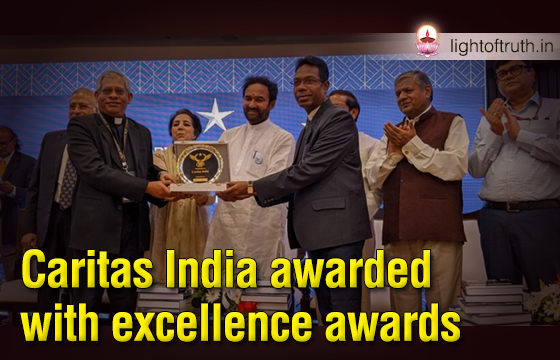
Caritas India, the social development arm of the Catholic bishops in India, has been awarded for its excellent work in humanitarian aid and disaster risk reduction, community health, climate-adaptive agriculture and food sovereignty.
Book on nuns’ valiant struggle against archdiocese released
A book on the unusual struggle of a group of Catholic nuns against an archdiocese and their congregation was launched June 26 during a virtual function.
The book, “My Prophetic Struggle, The Narakkal Story,’ written jointly by Carmelite Sister Annie Jaise and feminist theologian Kochurani Abraham, was released by Sister Elsa Muttathu, the national secretary of the Conference of Religious of India. The first copy was received by Jesuit Father T K John, a veteran theologian.
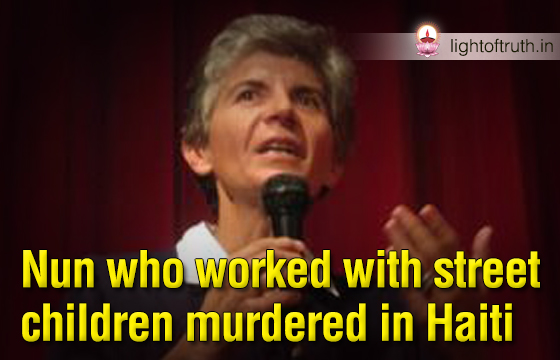
Nun who worked with street children murdered in Haiti
An Italian missionary who dedicated herself to working with street children in Haiti for more than 20 years, was murdered.
Sister Luisa Dell’Orto, a Little Sister of the Gospel of Saint Charles de Foucauld, was shot during a robbery attempt on June 25.

Indian Catholics slam silence over Nigerian massacre
Catholics in India have questioned the silence of the global community over the brutal mass killing of Christians in southwest Nigeria recently and want it to take a strong stand against such atrocities. Scores of Catholics belonging to the Catholic Congress based in Kerala state in southern India staged a rally in Kottayam district, a Christian stronghold, and condemned the massacre.On June 5, Pentecost Sunday, gunmen believed to be Islamic extremists associated with Islamic State West Africa Province (ISWAP) entered St. Francis Xavier Catholic Church in Owo, Ondo state. They fired weapons, detonated explosives and killed at least 40 people, government agencies said. “We appeal to the global community to stand up against the mass murders in Nigeria,” said Catholic Congress president P.P. Joseph of Changanaserry Archdio-cese. “Unless the global conscious rises up against such murders, humanity will not survive in this world.”
Archbishop Joseph Perumthottam of Changanassery Archdiocese in Kerala wrote an editorial for Deepika (Light), a church-run daily, in Malayalam, the official language of the southern state.
“When it comes to the killing and persecution of Christians, certain media houses maintain silence. What sort of media ethics is this?” he wrote in a June 13 article.
The prelate claimed that in 2021 alone at least 6,000 Christians were slaughtered in Nigeria by Islamic terrorist groups such as Boko Haram among others. Since 2009, at least 40,000 Christians were killed by Boko Haram in Nigeria, he added.
The prelate also expressed concern over the spread of Islamic terror in other African countries and other parts of the world, noting that Christians are “the worst victims of persecution” and questioned why global powers could not protect human beings from the onslaught of Islamic terrorists.

Opposition to reinstatement of Indian bishop cleared of rape
A civil society group assisting Catholic nuns in distress has opposed a reported move to reinstate Bishop Franco Mulakkal to his former post after being acquitted of rape charges by a trial court.Save Our Sisters (SOS) in a June 14 statement urged Catholic authorities “to reconsider a possible attempt to bring back Bishop Mulakkal” while referring to news reports about his resuming pastoral duties in Jalandhar Diocese in northern India. The media reports appeared after a visit by Archbishop Leopoldo Girelli, the Vatican’s apostolic nuncio in India, to the diocese on June 11-12.
“It is true Archbishop Girelli has confirmed to priests that the Vatican [has] accepted the Indian court order that exonerated Bishop Mulakkal from charges of rape,” said Bishop Agnelo Rufino Gracias, apostolic administrator of Jalandhar, although he dismissed the media reports.There was no discussion on the reinstatement of Bishop Mulakkal, he told UCA News. “It is normal practice that the Vatican accepts the ruling of a court in any country where it works,” Bishop Gracias said. “There was nothing more to be attached or attributed to it.” SOS, however, said the Vatican is likely to act solely on the report and advice of the apostolic nuncio, who is a Mulakkal supporter

Attacks on Christians increasing in India
An interdenominational rights group in India’s national capital has demanded the federal government and judiciary intervene immediately to check the rapid rise in incidents of violence, coercion and false arrests of Christians.
The New Delhi-based United Christian Forum (UCF) has cited 207 cases of persecution in 2022 to back the demand. It documented 505 cases in 2021. “This data flies in the face of statements by government functionaries and leaders of the ruling party at the center and in the states that there is no persecution and that there are only a few stray incidents by fringe elements,” said UCF national president Michael Williams in a press statement on June 13. William said it was ironic that the culprits, many of whom even film the acts of vandalism and physical violence on unarmed women and men, dare to defy the law with such impunity while the pastors and faithful gathered for prayers are arrested on false charges of religious conversion. “In all such cases, the police are either mute spectators or active participants. Despite our appeals to senior officials and administrators, the police have failed to follow protocol, rules and conduct investigations,” the press statement added.
Based on the data collected from its national helpline number 1800-208-4545, the UCF said as many as 57 cases of persecution against Christians were recorded in May alone. The most acute situation prevailed in UP and MP states in the north, Chhattisgarh in the east and Karnataka in the south. “The data collected so far wasn’t exhaustive as many incidents did not come on our radar and hence aren’t recorded” There were 40 incidents recorded in January, 35 in February, 33 in March and 40 in April.

Christians condemn article defaming India’s first layman saint
Catholics have criticized a pro-Hindu publication for calling Devasahayam Pillai, the first Indian layman to be declared a saint, “a thief who was shot dead for his crime.”
The objectionable writing questioning the recent canonization titled “Devasahayam Pillai and Holy Sins” is published in the June 10 issue of Kesari, a Malayalam-language weekly known as a mouthpiece of the Hindu nationalist Rashtriya Swayamsevak Sangh (RSS) in southern India’s Kerala state.
The three-page article by writer Murali Parapuram claimed that all the reasons cited by the Catholic Church for the saint-hood are totally false because there was no spiritual transformation in him.
It further described Saint Devasahayam as “a victim of religious conversion activities carried out by Christian missionaries” and charged the Church with “distorting history through fraudulent documents to promote their religious interests rather than any other concerns.”
“The RSS magazine is creating mistrust and confusion among the people and thereby whipping up communal discord,” said Father Michael Pulickal, secretary of the social harmony and vigilance commission of Kerala Catholic Bishops’ Council.
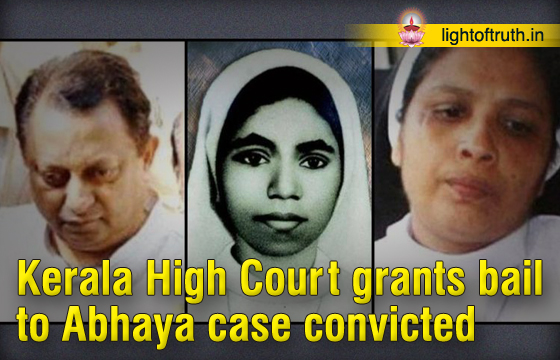
Kerala High Court grants bail to Abhaya case convicted
The Kerala High Court on June 23 granted bail to a Catholic priest and a nun who have been sentenced to life imprisonment in the sensational Abhaya murder case.
The division bench of Justices Vinod Chandran and C Jayachandran acted upon the petitions of Father Thomas Kottoor and Sister Sephy seeking suspension of their life term.
The court asked the two to deposit 500,000 rupees each and refrain from leaving Kerala without the court’s permission.
Earlier in December 2020, a Central Bureau of Investigation (CBI) Special Court had sentenced the priest to two life terms besides a fine of 500,000 rupees after conviction under Section 302 (murder) of the Indian Penal Code.
Sister Sephy was also convicted and handed down life imprisonment under the same section in addition to seven years of rigorous imprisonment for tampering with evidence under Section 201 (destruction of evidence).
After a prolonged legal battle, the CBI court had found them guilty of murdering Sister Abhaya, whose body was found March 27, 1992, inside a well at a con-vent in Kottayam, a town in Kerala. The trial court had allowed the discharge petition of another alleged accused Father Jose Puthrikkayil.

Address casteism at thanksgiving for Devasahayam: Dalit group
The Catholic Church in India should seriously address the existence of casteism within its fold as it organizes a national thanksgiving prayer for Saint Devasahayam, says the Dalit Christian Liberation Movement.
The Church in India will on June 24 hold the prayer service from the tomb of the newly canonized India’s first lay person at St Francis Xavier’s Cathedral of Kottar, Tamil Nadu.
An open letter from the Dalit movement agrees to celebrate Devasahayam’s canonization is quite fitting, but what is “more important and necessary is to invoke the true spirit of his martyrdom.”
The June 23 letter signed by M. Mary John, the movement’s president, urges the Church not to treat the thanksgiving “only as a spiritual exercise or religious ritual” but as an occasion to introspect about the conti-nuing oppression and discrimination of its Dalit members.
“This occasion should be a call to the Catholic Church to stop this. This is also important in the context of the call by Pope Francis for Synodality in the Church,” it adds.
John says the saint was martyred because he converted to Christianity defying the then prevailing oppressive and discriminating caste system. Saint Devasahayam became “a true witness” to Christ’s values and mission.
“He stood up firmly against the caste hegemony of the ruling class of the then kingdom of Travancore in South India,” the letter explains.
The movement says Devasahayam was martyred for the same cause that the movement now demands.
The global Christian community, it says, is ignorant about continuation of the caste oppression and discrimination even three centuries after Devasahayam’s times and that its “worst victim” is the Dalit Christians.
“But even after so many years, casteism, caste oppression and discrimination continues in the Catholic Church itself, which need to be challenged on this occasion,” the letter asserts.
The letter further says the movement has raised this issue “vociferously in recent times. But this truth will be suppressed and hidden by the glitters of the celebration, liturgical services and rituals scheduled to be led by the top members of India’s Catholic hierarchy.”
It wants the hierarchy in India to use the thanksgiving occasion to own up the existence of casteism in the Church and resolve to take steps to eradicate it.

Church music hits right note in Bangladesh
For more than three decades, Ruma Brizita Biswas had sung several popular liturgical and devotional songs with incorrect notations and lyrics because nobody taught her the correct versions.
“One of my favorite songs is Jishu ghrinar rajjye enechho tomar prem (Jesus, you brought your love to the kingdom of hatred), but I had been singing it incorrectly all my life as ‘Jesus brought love to your kingdom of hatred.’ The same happened to other songs as well,” Biswas, a Bengali Catholic, told..
The 40-year-old is choir leader of St. Joseph’s Cathedral Parish of Khulna Diocese in southern Bangladesh. The parish has about 5,000 Catholics.
A church-sponsored mu-sic training program in national capital Dhaka has helped her correct her wrong lyrics, she said.
Biswas was one of 50 participants in the national training on liturgy and church music by the Catholic bishops’ commission for liturgy and prayer at Holy Spirit Major Seminary from June 3-9. They included two priests, 11 nuns and laypeople representing eight Catholic dioceses of Bangladesh.