

Nigeria’s ruling party announced on July 10 that its ticket in the 2023 presidential election will not include a Christian, as presidential candidate Bola Tinubu selected Senator Kashim Shettima as his running mate in the 2023 general elections.
The announcement came less than a month after the Nigerian bishops’ conference warned that a ticket consisting only of Muslim candidates would further undermine national unity, amid years of bloody Christian persecution in the West African nation.
After the announcement Sunday, Christians expressed concern that ignoring the country’s custom of electing Muslims and Christians together could compound religious employment and property discrimination in the country.
Several high-profile members of the All Progressives Congress, Nigeria’s ruling party, having resigned their membership over the decision. The June 10 announcement was made in Daura, the hometown of President Muhammadu Buhari, who is leader of the APC. Buhari is term-limited and can not seek a third term in office.
With Catholic and other Christian leaders pushing back on the prospect that both Nigeria’s president and vice-president will be Muslims, the announcement has amplified division among Nigerians along religious lines, in a country where the fault lines of ethnicity and religion have claimed lives and livelihoods.
Nigeria, Africa’s most populous nation, has 3 major religions, more than 400 languages and 250 ethnicities. Hundreds of Christians have been killed in the country in recent months, in terror attacks that have also seen more than a dozen priests kidnapped or killed.
Nigerian society is divided between a predominantly Muslim northern region and predominantly Christian southern areas. The country has customarily elected presidential tickets with one Muslim and one Christian candidate, usually representing both religious diversity and regional balance — a practice that many Nigerians believe has helped hold together a country with deep religious, regional, and economic rifts.
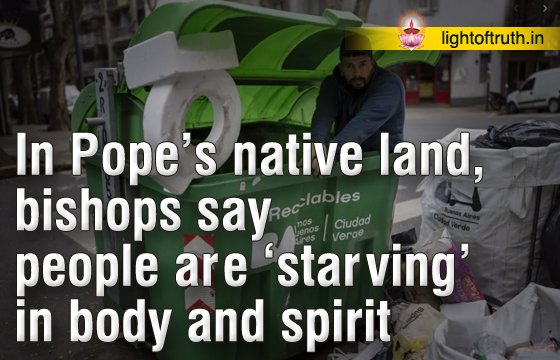
In Pope’s native land, bishops say people are ‘starving’ in body and spirit
As Pope Francis’s native Argentina finds itself on the brink of hyperinflation and led by a president and vice president in a public dispute, the country’s bi-shops say the people are “starving,” hungry both in body and spirit.
“Today our homeland is a hungry, bewildered, worried and wounded people. Many families lack daily bread and decent work. Poverty has grown,” said Arch-bishop Carlos Alberto Sánchez of Tucuman on Saturday, July 9.
“There is hunger for justice and dignity, for respect and care for life in all its stages. There is hunger for social peace, respect for the constitution and authentic democracy.”
“There is hunger for dialogue, encounter and participation to overcome divisions and confrontations. There is a hunger for truth, for an education that puts the human person in first place, that does not impose ideologies, that leads to thinking and realizing oneself with dignity,” he said.
“There is a hunger for freedom and for a more secure and cordial life. There is a hunger for trust and joint work among all for the good of all. There is hunger for hope and consolation… There is hunger for fraternity and love,” saud Sánchez.
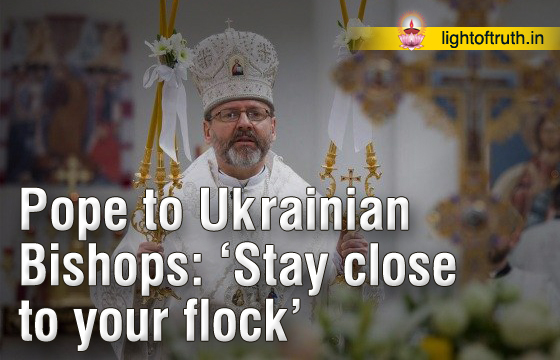
Pope to Ukrainian Bishops: ‘Stay close to your flock’
Pope Francis has urged the Ukrainian Greek Catholic Bishops to be shepherds of their flock and to be close to the faithful entrusted to their care, giving them courage and hope.
The Ukrainian Bishops are holding their annual Synod to discuss the theme of synodality in their Church. The meeting, running from 7-15 July, had to be moved from Kyiv to Przemysl, in Poland, due to the ongoing war in Ukraine. In a letter addressed to the Major Archbishop of Kyiv-Halych, Sviatoslav Shevchuk, head of the Ukrainian Greek Catholic Church (UGCC), the Pope first of all reiterated his prayers and closeness to the Ukrainian people enduring the war waged by Russia against their country.
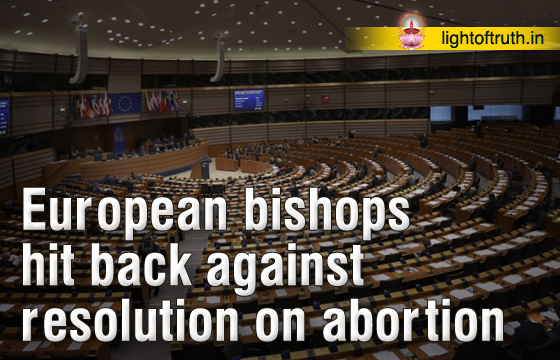
European bishops hit back against resolution on abortion
Europe’s top body of bishops has condemned the European Parliament’s favourable vote Thursday, July 7, on a resolution calling for access to abortion to be included in the E.U. Charter of Fundamental Rights.
The resolution, titled, “European Parliament resolution on the US Supreme Court decision to overturn abortion rights in the United States and the need to safeguard abortion rights and women’s heath in the EU,” also condemns the United States’ Supreme Court’s decision last month to overturn legislation protecting federal abortion rights.
The resolution was adopted with 324 votes in favour, 155 against, and 38 abstentions.
In a July 8 statement, Father Manuel Barrios Prieto, General Secretary of the Commission of the Bishops’ Conferences of the European Union (COMECE), voiced regret for the resolution, which he said, “paves the way for a deviation from universally recognized human rights and misrepresents the tragedy of abortion for mothers in difficulties.”

Webb telescope images feed the mind and spirit, Jesuit astronomer says
The Jesuits at the Vatican Observatory were wowed like most people by the beauty of the photos from NASA’s James Webb Space Telescope, but the director said they also are excited by the scientific information the telescope will reveal. “Such images are a necessary food for the human spirit — we do not live by bread alone — especially in these times,” said Jesuit Brother Guy Consolmagno, the observatory director, after NASA released a first batch of images from what the space agency describes as “the largest, most powerful space telescope ever built.”
“The images are gorgeous, as anyone can see for themselves,” Consolmagno said. “It’s a tantalizing glimpse of what we’ll be able to learn about the universe with this telescope in the future.”
NASA described Webb’s mission as studying “every phase of 13.5 billion years of cosmic history — from within our solar system to the most distant observable galaxies in the early universe, and every-thing in between.”
“The science behind this telescope is our attempt to use our God-given intelli-gence to understand the logic of the uni-verse,” Consolmagno said. “The universe wouldn’t work if it weren’t logical. But as these images show, the universe is not only logical, it is also beautiful.”
“This is God’s creation being revealed to us, and in it we can see both his astonishing power and his love of beauty,” the Jesuit said. The Vatican Observatory director also noted that “astronomy is a small field,” so he knows many of the scientists who helped build the instruments on the telescope and plan its observations.
Their years of effort, he said, “is a tribute to the power of the human spirit, what we can do when we work together.”
“And at the same time,” he said, “I am amazed and grateful that God has given us humans, his creation, the ability to see and understand what he has done.” Pointing to the telescope’s “first spectrum of water vapor in the atmosphere of an exoplanet,” a planet that orbits a star outside the solar system, Consolmagno reminded readers of one of his Jesuit-scientist predecessors.
Pope Francis says becoming pope made him less rigid and more merciful
Pope Francis said the goals he has achieved in more than nine years as pope were simply the fruit of the ideas discussed by the College of Cardinals prior to his election. In an interview with Argentine news agency Télam published July 1, the pope said that objectives, such as the reform of the Roman Curia, were “neither my invention nor a dream I had after a night of indigestion.”
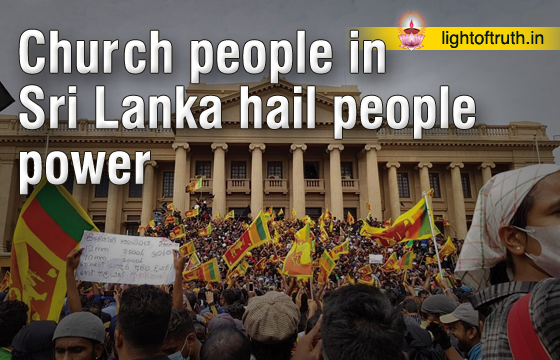
Church people in Sri Lanka hail people power
As Sri Lanka witnessed a second wave of massive protests; some Church people say people’s power is at work in the island nation.
Sri Lankans on July 9 assembled at Galle Face on the Arabian seashore in the capital city of Colombo forcing the president and the prime minister to step down.
This was the second mass wave of protests by all communities in the country. The protesters stormed the official residence of the president and the parliament, as police and military watched without any resistance.
“People have walked down from various cities and villages to the presidential palace in Colombo,” Salvatorian Father Jokin Anthony Nirmal Suranjan told Matters India over phone. “They will not return until the president steps down and a new election is announced,” he added.
The protesters have also stormed the residence of Prime Minister Ranil Wickramasinghe forcing him to resign.
Father Suranjan termed the resignations of the president and the prime minister as people’s victory in Sri Lanka.
The protesters were seen swimming in the private swimming pool of the president and enjoying food in the kitchen stores.
“They did not loot the official residence or parliament, but set fire to the private residence of the president Gotabaya Rajapakse at the sea side,” Father Suranjan pointed out.
Claretian Father Rohan Dominic, a Sri Lankan who works with the UN council for religious, used his Facebook page to congratulate the people for the massive protests. “We, the people have the real power and if we are vigilant, we will always be powerful,” he said.
“What we experience today is the first step of the change. There is very long way to go for a real transformation. Let us do it together,” he added.
Sensing danger, the president left both his official and private residences and his whereabouts are unknown. However, he has announced that he would resign on July 13.
Earlier, an appeal by the president to stop the protestors by law was rejected by the Supreme Court of Sri Lanka, saying they have no power to stop people’s reactions and protests.
Some personnel of the military and police have joined the protesters. According to some newspaper reports, both military and police have not been paid salaries for the past five months.
The Island, a Sri Lankan newspaper, quoted Speaker Mahinda Yapa Abeywardena to report that Rajapaksa will resign on July 13. The speaker is likely to head a coalition interim government until election is announced, according to some media reports.
Meanwhile, Cardinal Malcolm Ranjith, Archbishop of Colombo, has also sought international intervention to solve Sri Lanka’s worst economic crisis.
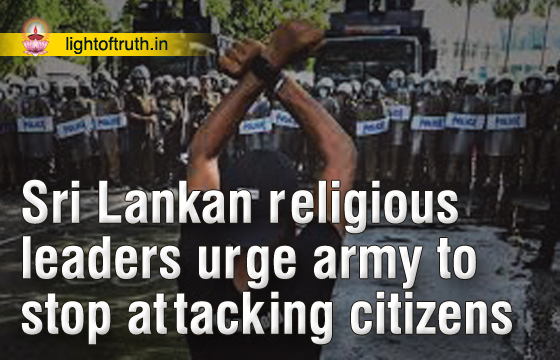
Sri Lankan religious leaders urge army to stop attacking citizens
Sri Lankan religious leaders have urged the armed forces not to attack unarmed civilians after a video clip of an army officer kicking a man in the chest as he queued up at a gas station went viral on social media.
“We urge the army not to lose the respect you have earned. What the forces are doing is protecting the corrupt rulers who have dragged the country into calamities,” said Ven. Omalpe Sobitha Thera, an internationally acclaimed Buddhist scholar, researcher and philanthropist.
He said people are experiencing hunger, pain and despair with little or no hope at the moment for an end to the ongoing economic and social crisis in the country.
“The security forces should be sensitive to the people,” the Buddhist monk said on July 6.
The Sri Lankan army has appointed a five-member Court of Inquiry to investigate the aggressive conduct of the officer who was identified as Lt Col Vi-raj Kumarasinghe, the commanding officer of the Sri Lanka National Guard.
Lt Col Kumararasinghe has been withdrawn from his posting at the Yakgahapitiya fuel station on the Kurunegala – Dambulla road, where the incident reportedly occurred.
“No matter what kind of order you receive from senior officers, don’t go against the law in the country”
Father Cyril Gamini, the editor of the weekly Catholic newspaper Ganartha Pradeepaya, condemned the attack.
“No matter what kind of order you receive from senior officers, don’t go against the law in the country,” Father Gamini said on July 6.
“The security officers have pledged and promised to protect civilians.”
President Gotabaya Rajapaksa has appointed several former military officers to key positions in his civil administration, which has been criticized by some political analysts as an attempt to militarize the island nation.
Similar incidents involving clashes between the public and police or armed forces are being reported in a country reeling from its worst economic crisis since independence in 1948.
There have been widespread protests since March against the powerful Rajapaksa family for mishandling the economy. The protesters have been demanding the resignation of President Rajapaksa.
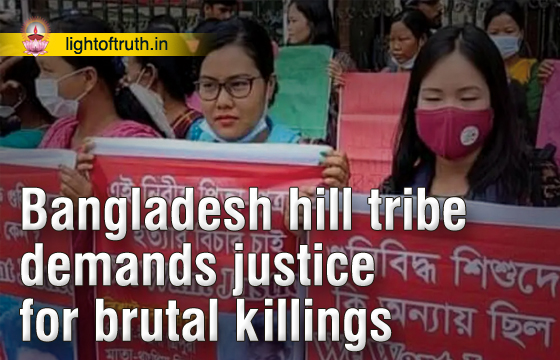
Bangladesh hill tribe demands justice for brutal killings
Hundreds of ethnic Tripura people marched on the streets demanding justice and compensation for the families of four of their men shot dead by an armed rebel group in Bangladesh’s restive Chittagong Hill Tracts (CHT).
The Tripura Welfare Associa-tion organized a human chain on July 3 to protest the June 21 killing by an insurgent group called Kuki-Chin National Front in the Bilachhari area of the Rangamati district.
The gunmen fired indiscriminately killing three members of the same family, reports said. Another person was hacked to death, while two children were seriously injured.
The CHT, which includes three hilly and forested districts of Khagrachhari, Bandarban and Rangamati, continues to be restive despite the government signing an accord in 1997 to end more than two decades of deadly insurgency. The latest violence has spread panic among tribal people, some local people say.
Nidharam Tripura and five members of his family sought shelter in a relative’s house after fleeing the village and two days later he heard that four of his neighbors had been killed.
“I can’t say how many shots were fired that evening …I quickly ran to my relative’s house,” Tripura told.
“We are not safe anywhere now. The terrorists have been threatening us for the last few months and they are demanding various resources from us. Now we want protection by the government,” the 49-year-old Baptist said. “No effective action has yet been taken by the government against the terrorists which is extremely worrying”
The Kuki-Chin National Front (KNF) and its armed wing, the Kuki-Chin National Army (KNA), are fighting for the rights of the Zo (or Zomi) people. The KNF considers the Bawm, Lusai, Pangkho, Khyang, Khumi and Mru ethnic groups which inhabit the CHT as Zo people.
Many have made unverified claims that the KNF is backed by the government to create unrest among the various hill tribes.
“Despite the KNF’s acknowledgment of the killings and its subsequent eviction, no effective action has yet been taken by the government against the terrorists. It is extremely worrying,” the Jana Samhati Samiti (JSS) said in a statement on July 3.
“We demand the government take strict action against the KNF and arrest the terrorists and bring them before the law as well as provide necessary security for the victims and rehabilitate them in their respective villages with proper compensation,” the statement said.
The JSS is the largest and most influential ethnic political organization in the CHT. It signed a peace agreement with the government in 1997 and members of its armed wing, the Shanti Bahini, laid down their arms.
The peace accord brought an end to more than two decades of armed struggle between the military and the JSS which sought autonomy for the hill tribes. Thousands were killed in the bush war including JSS members, soldiers and civilians.
While JSS’s armed insurgency sought greater autonomy for hill tribes, it was also a violent response to state-sponsored large-scale migration of Bengali Muslims on the hills for a demographic change in the largely tribal region.
A JSS splinter group opposed the peace treaty and formed the United People’s Democratic Front (UPDF), triggering a turf war between the two groups. The groups have seen further splits in recent years, intensifying violence.
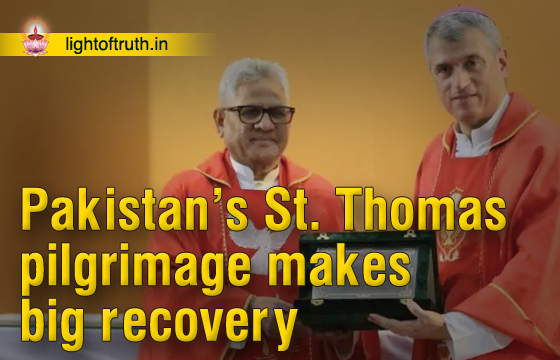
Pakistan’s St. Thomas pilgrimage makes big recovery
Parkash Aslam organized 14 seminars on St. Thomas the Apostle prior to the annual pilgrimage at the archaeological site of Sirkap in Taxila, Punjab province.
“Many faithful still have no idea about St. Thomas the Apostle. Both priests and catechists are only interested in celebrating regular Masses. A series of seminars on Catholic saints, especially the Doubting Thomas can help strengthen the faith of minority Christians,” he told.
Since May, the volunteer of the St. Thomas group at St. Gerard Church in Faisalabad has been organizing sessions on one of the Twelve Apostles of Jesus in Catholic churches in Faisalabad inviting the faithful to join the July 3 pilgrimage to Sirkap which is home to the ruins of the first church on the Subcontinent.
According to tradition, St. Thomas passed through Taxila on his way to India and preached at the court of King Gondophares. An early 3rd-century Syriac work known as the “Acts of Thomas,” discovered in 1822 in Syria, says the king gave some money to the saint and ordered him to build a royal palace.
St. Thomas, however, gave away all of the money in alms and when the king discovered his disobedience, he ordered that the saint be burnt alive.
Meanwhile, the king’s brother, Gad, died and then miraculously came back to life, whereupon he recounted that in heaven he had seen a palace built for Gondophares by St. Thomas. The king pardoned the saint and converted to Christianity, along with the people of the capital.
One legend has it that St. Thomas himself constructed the throne and preached here for 40 years. As the pilgrimage grew over years in northern Pakistan, the tradition of July 1-3 pilgrimages morphed into an annual fair in 1992.
Volunteers of the St. Thomas group accompanied eight buses from Faisalabad, singing hymns and distributing refreshments along 322.3 kilometers north towards Taxila. The group charged each pilgrim 2,500 rupees (US$12).
They were among more than 3,000 pilgrims who prayed and lit candles at the meter-high throne. The pilgrims later visited the Taxila Museum which also displays a “holy bone” relic of St. Thomas.
According to Father Nasir William, director of the Commission for Social Communications in Islamabad-Rawalpindi diocese, it’s a record since the pandemic began in Pakistan in March 2020.
“Huge crowd in groups turned up, especially from different parishes of Punjab and Khyber Pakhtunkhwa provinces. St. Thomas the Apostle Catholic Church, located behind the Taxila museum, added another attraction for pilgrims this year. Parishioners were advised to wear face masks as coronavirus cases climb across the country,” he said.
The National Command and Operation Center has issued fresh guidelines for Eid al-Adha, the Muslim feast of sacrifice, urging people to follow standard operating procedures after a 4.61% Covid-19 positive ratio was recorded in the country with 675 cases on July 4.