

Myanmar has known many, many dark chapters in its history, especially over the past 18 months since the latest coup d’etat. But the execution of four pro-democracy activists — the first judicial executions in more than three decades — plunges the country into even greater darkness.
The news broke less than a week after the country marked its Martyrs Day — the anniversary of the assassination of founding father General Aung San and several members of his cabinet in 1947. Today, his daughter, democracy leader Aung San Suu Kyi, languishes in prison again, and Myanmar has four new martyrs to mourn.
I had the privilege of meeting two of the four: Kyaw Min Yu (aka Ko Jimmy) and Phyo Zeya Thaw. I did not know them intimately, but I met them a few times.
In the course of my human rights work throughout Asia over the past 25 years or more, I have known many friends and acquaintances who have been in jail or run the risk of imprisonment; quite a few have endured shocking torture; some who face death threats; two who have survived assassination attempts; and another two who have been assassinated.
“It shows the world the scale of the depravity, inhumanity, brutality, cruelty and criminality of the illegal military dictator-ship”
But this is the first time any-one I have met has been sentenced to death in cold blood by a dictatorship and the sentence has been carried out.
When the death sentence was imposed on these four earlier this year and upheld against their appeal last month, I was shocked.
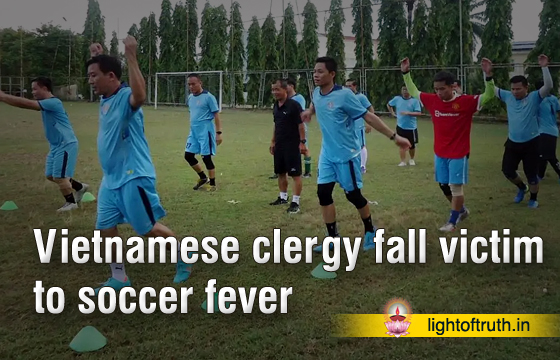
Vietnamese clergy fall victim to soccer fever
Father Joseph Pham Huu Quang attends soccer practice sessions on July 18 Monday and Friday afternoons at Tay Loc stadium in Thua Thien Hue province.
Father Quang, who has to ride a motorbike to the state-run stadium 30 kilometres from his Son Qua parish, is at the ground regular as clockwork, wearing football boots and a blue strip, talking with other priests before their 90-minute practice sessions.
“We do some warm-up, stretching and leg exercises for a while and then learn the skills necessary to run and control, pass, shoot and head balls,” he said, adding that these are essential to promote physical health, reduce injuries and play well.
The 38-year-old priest, who plays in midfield, said in the early days of practice he fell and sprained his knee dodging a pass that was about to touch his left hand. He was a bit discouraged because of the pain, and it took him a few days to recover.
“I have since gained practical experience to confidently over-come light injuries,” said the priest, who had not played soccer since he left Xuan Bich Major Seminary in Hue in 2016.

Southeast Asian MPs slam Myanmar executions
Parliamentarians from Southeast Asian nations have strongly condemned the execution of four political prisoners by Myanmar’s military junta as an “act of judicial barbarism.”
Myanmar’s state media announced that the death sentences of four prisoners were carried out on an unspecified date at Insein Prison in Yangon. They were the first such executions in the country since 1988 and spark-ed global outrage.

Sundarbans ban leaves Bangladesh communities reeling
The Bangladesh government’s ban on access to the Sundarbans forest has left those who earn their living from the world’s largest stretch of mangroves in hardship amid a lack of promised compensation. The Forest Department has banned the issuing of passes and permits to enter the Sundarbans for June- August. The move covers fishing, crab and honey harvesting and entry of all tourists to all rivers and canals in this extensive mangrove forest. According to the recommendations of the Integrated Resources Management Plan for the protection of fish resources in the Sundarbans from 2019, the Forest Department has stopped fishing in all rivers and canals in this forest from June 1 to Aug 31.

Indonesian Catholic mother sustains faith, struggles for rights
For 87-year-old Thresiamma, nothing works without the blessing of Jesus. As Maria Yuliana Farida carried the freshly harvested cocoa fruit in a basket into the backyard of her home, she murmured: “If one of these is damaged, we will have less to eat next week.”
The cocoa fruit harvested in the June-July season in Indonesia’s Catholic-majority Flores Island is part of her family’s weekly income. “I believe that God, who we call in our language, Mori Kraeng, will always provide what we need. But of course, we also need to work hard,” 44-year-old Farida says with a smile.
She and her husband, Fransiskus Din, 47, work hard five days a week from morning till evening to feed their three children and bring them up in the faith.
While Saturdays is market day, the Catholic family spends Sundays as a day of rest and prayer dividing it between the parish church and home, Farida said.
Every Saturday morning, Farida and Din, walk one kilometer along the only pathway that connects their Wae Sano village to the outside world.
Carrying the farm produce on their heads, the couple walks the narrow, potholed path to arrive at a road that leads to the traditional market in Werang, a sub-district town, 10 kilometres to the east from their village.
Farida’s non-descript and isolated village, surrounded by hills and forests, is part of Indonesia’s Christian-dominated East Nusa Tenggara province. Sundays “are like a small feast day,” as they take a break from the dawn-to-dusk farm work and start the day with Sunday Mass in the village, Farida said. On Sunday mornings, Farida and her family walk to St Michael Parish Church, barely 100 meters from their house, dressed in their Sunday best. “Going to meet God means that I wear a nice dress,” Farida said.

Bishops must be good listeners, says nun at Vatican who helps select them
While the perfect Bishop does not exist, he does have to be a person who knows how to get others involved in the life of the church and to listen to everyone, including those with whom he may disagree, said a new member of the Dicastery for Bishops.
French Salesian Sister Yvonne Reungoat told Vida Nueva, a Spanish publication re-porting news about the Catholic Church, that “the ideal Bishop does not exist.” But he has to be a shepherd who is “close to the people entrusted to him, he has to know how to involve priests, laity and religious, and people of different generations.”
“The path of synodality” is essential for this process and “it must be the usual way of animating the church to favour collegiality,” she told the publication in an interview published online July 24. Canadian Cardinal Marc Ouellet, who heads the dicastery, once told Vida Nueva that “30% of those chosen to be Bishops reject the appointment.” The publication asked Sister Reungoat what might explain this situation.
“There may be a difficulty in accepting the responsibility of being Bishop of a particular church, with all the joys, challenges and complaints that it entails,” she said.
“That is why I think that, to be a Bishop, one must have the ability to listen, both to those who have the same ideas and to those who protest. Is not easy. Just think of the issue of abuse, which has marked the life of the church in various parts of the world in recent years,” she added.
In mid-July, Pope Francis named 14 new members to the dicastery responsible for helping the pope choose bishops for Latin-rite dioceses outside of the church’s mission territories. For the first time ever, the members included women: two religious and one lay. Before Pope Francis’ reform of the Roman Curia took effect in June, members of the dicastery were only cardinals and a few bishops.
Members meet twice a month to review dossiers submitted by Vatican nuncios about potential candidates and to vote on the names they recommend to the Pope.
Sister Reungoat, former superior general of her order, told Vida Nueva it is important for women to have a role in the naming of new Bishops.
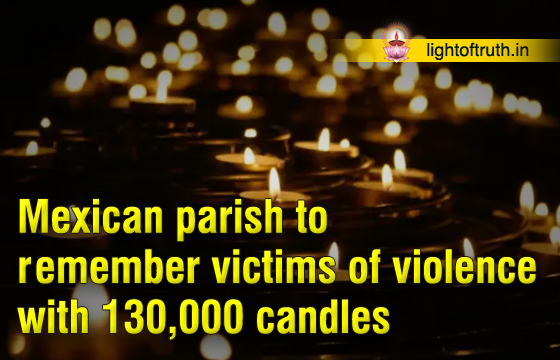
Mexican parish to remember victims of violence with 130,000 candles
A Mexican parish will remember the victims of violence in the country with 130,000 candles to be lit the night of July 30, as part of the Day of Prayer for Peace called by the Mexican Bi-shops’ Conference.
In a video message, Father Alberto Medel, pastor of Our Father Parish in the Diocese of Xochimilco, south of Mexico City, recalled the Bishops’ conference’s invitation to pray especially on July 31 “for the perpetrators and the civil authorities, so they may open their hearts to this situation of unleashed violence that we are experiencing and that has claimed so many lives and that has caused so much pain.”
In response, the Mexican priest said, his parish seeks to prepare itself to observe that day “with a prayer vigil in which we want to light 130,000 candles” in order to “remember all those who have died in such a violent way and at the same time in such a pointless way.”
The vigil will be held July 30 at 8 p.m. Central time and will be broadcast on the YouTube channels and Facebook pages of Medel, the Diocese of Xochi-milco, the Archdiocese of Mexico, and the archdiocese’s weekly publication Desde la Fe.
According to the local press, in the three and a half years of President Andrés Manuel López Obrador’s administration, nearly 130,000 people have been murdered in Mexico. When the president completes his six-year term, it could be the most violent administration in the history of Mexico. In this same period, seven Catholic priests have been murdered.
According to official figures, from Jan. 1 to July 24 of this year, 14,943 homicides have been committed in Mexico.
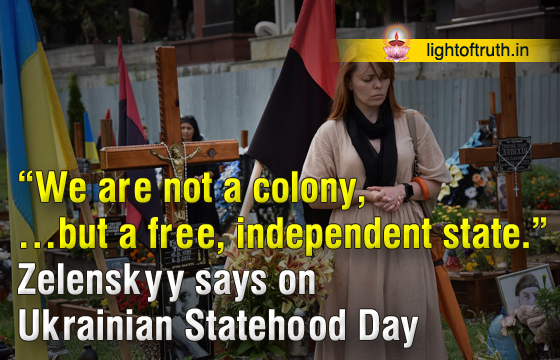
“We are not a colony, …but a free, independent state.” Zelenskyy says on Ukrainian Statehood Day
Ukrainians will fight for their statehood to the last and will not stop until they liberate the last meter of Ukrainian land, President Volodymyr Zelenskyy said in a video address for Ukrainian Statehood Day July 28.
The day marks the 988 baptism of “Kyivan Rus,” the origin of Christianity in the region, but this is the first year Ukrainians marked Statehood Day, reported Religious Information Service of Ukraine.
Zelenskyy stressed that Ukrainians need neither fireworks nor pomp to show the importance of statehood for the Ukrainian people.
“Today we defend (Ukraine) with weapons in hands. For 155 days in a row,” he said, referring to the Feb. 24 Russian invasion. “We can say that for us, State-hood Day is every day. Every day we fight so that everyone on the planet finally understands: We are not a colony, not an enclave, not a protectorate …not a province, but a free, independent, sovereign, indivisible and independent state.”
Zelenskyy outlined the main historic events that laid the basis for Ukraine’s statehood and noted: “All stages of the history of Ukraine’s statehood, its defense and struggle for it can be described in one sentence: We existed, exist and will exist. We will exist, because our state has incredible sons and daughters who have stood up for its de-fence.”
The United Nations reported July 25 more than 5,200 civilians had been killed and more than 7,000 injured in Ukraine since the war began.

Sydney McLaughlin gives ‘all the glory to God’ after smashing another world record in hurdles
Olympic track and field gold medalist Sydney McLaughlin, who broke her own world record in the 400-meter hurdles at the World Athletics Championships on July 23 in Oregon, is using her time in the limelight to share her Christian faith.
After smashing her previous record set a month ago, she gave all credit to God in a social media post that has since gone viral with over 400,000 likes.
Her 50.68-second finish was the fourth time this year that the 22-year-old New Jersey resident broke the world record in the event.
In an Instagram post following the win, McLaughlin quoted Hebrews 4:16, which describes God’s generosity in giving his people what they need: “So let us come BOLDLY to the throne of our gracious God. There we will receive His mercy, and we will find grace to help us when we need it most.”
In her Instagram caption, McLaughlin added that prayer and hard work “divinely culminated in 50.68 seconds.”
In an NBC Sports interview following her latest victory, McLaughlin was asked how she accomplished her goal. She said, “I’ll have to start off by saying all the glory to God.” She continued by saying that God gave her the strength to achieve this milestone.
McLaughlin is not Catholic, but she grew up in a devout Christian household and attended Union Catholic Regional High School in Scotch Plains, N.J.

Six years after grisly murder, France remembers Father Jacques Hamel
Six years after Father Jacques Hamel was murdered by knife-wielding terrorists while celebrating Mass at his parish church in northern France, locals gathered to commemorate his life and to pray.
“We enter into prayer where Jacques fell, victim of the madness of men,” Archbishop Dominique Lebrun of Rouen said at the suburban Rouen church of Saint-Étienne-du-Rouvray. An eyewitness said the 85-year-old priest twice told the attackers “Begone, Satan!” before they slit his throat.
Three nuns and several parishioners were present when the attack took place. One elderly parishioner was severely hurt when the attackers tried to take him hostage. The two attackers, both 19 years old, were killed by police as they exited the church.
Hamel’s death shocked France and much of the world. Pope Francis offered a Mass for the priest shortly after the attack, calling Hamel a martyr.
In March, four men were convicted of terrorist conspiracy after a three-week long trial. Three of the men convicted received between 8 and 13 years in prison.