
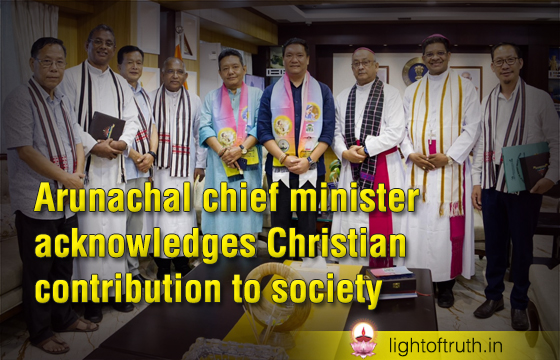
Chief Minister of right wing Hindu Bha-ratiya Janata Party ruling northeastern state of Arunachal Pradesh had words of apprecia-tion and praise for a group of Catholic Church leaders visiting him on July 17. In his official Facebook post Chief Minister Pema Khandu said, “blessed to receive a call-on from Bishop Benny Edathittayel of Itanagar, Bishop George Palliparambil of Miao and the members of the Arunachal Pradesh Catholic Association, led by President Shri Taw Tebin Ji.”
“Their tireless efforts in promoting peace, education, and social welfare in our state are truly commendable,” he wrote. Serving a second term as Chief Minister Khandu did not hesitate to place on record the contribution of the Church stating, “I deeply appreciate the Catholic community’s dedication to raising awareness on critical issues like corruption, drug abuse, and the money culture in elections, contributing to a more informed and respon-sible society.” In concluding the post the Chief Minister of Arunachal Pradesh state which introduced the anti-Christian legislation – Freedom of Religion Act in 1978 – did not hesitate to say, “Thank you for your selfless service and commitment to the betterment of Arunachal Pradesh.” Pema Khandu born on August 21, 1979 is the son of former Chief Minister of Arunachal Pradesh late Shri Dorjee Khandu. Several states in India, including Arunachal Pradesh, Uttar Pradesh, Madhya Pradesh, Himachal Pradesh, Gujarat, and Odisha, have implemented anti-conversion laws. Anti-conversion laws are legislative measures aimed at preventing or prohibiting religious conversions. These laws can be used to discourage individuals from leaving a particular faith or to restrict religious groups from actively seeking new members from other religious backgrounds. The specific provisions and enforcement of anti-conversion laws differ across jurisdictions, and they may involve both criminal and civil penalties. Christian leaders content that the implementation of these laws have the potential to favour domi-nant religions or suppress minority faiths
Indian Church leaders scramble to defuse ‘crusader’ row
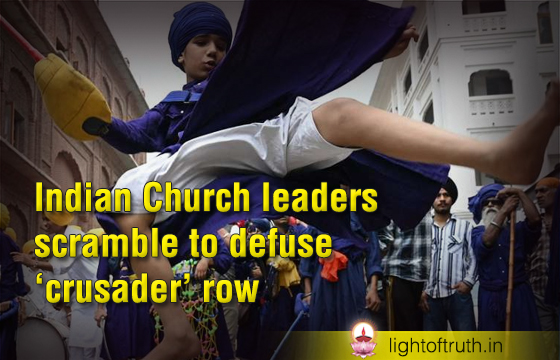
Church leaders have met the top leader of Sikhism after Sikhs objected to being called “crusaders” by unidentified pastors in a northern Indian Punjab state. The pastors alle-gedly called Sikh community members “crusaders” following a spate of attacks on the state’s Christians, who were accused of forced conversions. Christians account for 10 percent of Punjab’s population.
“Some unknown pastors have allegedly used the word ‘crusaders’ for them [Sikhs]. It is painful and unfortunate,” Bishop Agnelo Rufino Gracias, apostolic administrator of Jullundur diocese in Punjab state, told. The prelate added that they have had a “good rapport with the Sikhs” for years and hardly “faced any issues.” A delegation from Jullundur (Jalandhar) diocese in northern Punjab met Jathedar Giani Raghbir Singh of the Akal Takht (the seat of power of the Sikh religion) on July 15. The Sikhs form the majority of Punjab’s 28 million population the Jathedar is the head of the Sikh religion. The meeting took place in Amritsar, where the Jathedar is based. The delegation, led by Father John Grewal, the diocese’s director of interreligious dialogue, handed Singh a letter titled “Masih Maha Sabha” (Christian General Assembly) and promised cooperation to address the contentious issue of religious conversion.
Odia Family Relieved As Catholic Nun Liberates Them From Bondage
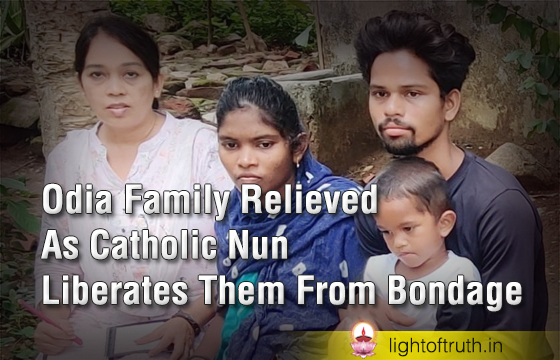
A family in Odisha now thanks a Catholic nun for rescuing them from bonded labour in the southern Indian state. “I can finally breathe freely. I thank Sister Sujata pro-fusely,” says Deepthi Singh, who was held in bondage along with her husband in a brick kiln in Karnataka state’s Mallur district. The 22-year-old pregnant woman told Matters India July 17 that they had spent “countless nights crying out for help, feeling bitter about my circumstances and even blaming my parents.” Sister Sujata Jena’s initiative has helped Deepti, her husband, father, mother and stepmother to return to Gandhinagar, their village in Odisha’s Gajapati district, on July 11 after toiling in the Karnataka brick kiln for a total of nine years. Sister Jena, a lawyer and a mem-ber of the Congregation of the Sacred Hearts of Jesus and Mary, said she heard about the family on July 3 during her visit to villa-ges in Gajapati district to conduct awareness programs for migrant workers. One of the participants of an awareness program was Deepti’s mother Subasini Singh, who told the nun how her family – husband, daughter, son in law and another member – was held in bondage in Karnataka. On her return to Bhubaneswar, Odisha capital, five days later, Sister Jeana appealed to the Labour Commissioner of Karnataka to get the family released from the illegal bondage. “The family’s rescue highlights the demeaning conditions of migrant labourers in India,” Sister Jena, who has worked among migrants for more than five years, told.
Indian Church leaders back Amnesty’s Manipur relief camp call
Church leaders have concu-rred with a global rights group report that relief camps in Mani-pur in India’s northeast are “in dire need of support” after secta-rian strife uprooted more than 50,000 and killed over 220 people, most of them Christians.
”There is no doubt, Amnesty International has come out with the reality existing in Manipur” in northern India, said A.C. Michael, based in the national capital New Delhi. “Both the federal and state governments failed to restore peace even after a year,” he told on July 19. In a report released on July 16, Am-nesty accused Indian Prime Minister Narendra Modi’s pro-Hindu Bharatiya Janata Party (BJP) government in Manipur, bordering civil war-hit Myanmar, of ignoring the plight of people living in relief campus in the state. They are “in dire need of support” even after the promise of a financial aid package by Modi in April this year, the London-based rights group said in the report. Amnesty said its findings revealed “a picture of a state missing-in-action” despite the claims of “ti-mely intervention” and promise of financial aid. The camps lack adequate relief and rehabilitation measures, including adequate shelter, sanitation, food, water, medical care, and access to edu-cation opportunities “in violation of the UN Guiding Principles on Internal Displacement,” the re-port said. The Catholic Church has a diocese in the troubled state, based in the state capital Imphal, and headed by Abp Linus Neli.

Christian leaders ask India to repeal anti-conversion laws
A delegation of Christian leaders has urged India’s federal government to ask 11 states to repeal the sweeping anti-conversion laws, which they say target Christians.
“The anti-conversion law has been weaponized to target religious minorities,” an eight-member delegation from the United Christian Forum (UCF) told federal minority affairs minister Kiren Rijiju. The delegation met the minister in his office on July 20 and asked him to “issue an advisory to the state governments to repeal the anti-conversion law.” Stringent laws that criminalize conver-sion have been enacted in 11 states, most of them ruled by the Hindu right-wing Bharatiya Janata Party (BJP). The Christian forum monitors anti-Christian violence in the country and its delegation presented a memorandum to the minister highlighting the rising persecution against Christians. “The minister agreed to look into our grievances,” said A C Michael, a delegation member. Michael told on July 22 that they would discuss the issue further with the federal government and the provincial states concerned. The memoran-dum has the details of persecution, including murder, false cases, social boycotts, and denial of burial grounds. There were 727 incidents of violence against Christians in 2023, the memorandum said, and termed them “as a disturbing trend.” In the current year till June-end, “a staggering 361 incidents of targeted attacks” against Christians were reported, it said. The central Indian state of Chhattisgarh tops the list with 96 incidents, followed by northern Uttar Pradesh, which has 92 cases. Both the states are ruled by the BJP and have the anti-conversion law in force, which bans religious conversion by using force or allurement. “The primary reason for these attacks “was the false allegations of fraudu-lent [religious] conversions,” the memorandum noted. The memorandum said that “police collude with the right-wing groups” to target Christians, who make up a mere 2.3 percent of India’s 1.4 billion people. The delegation also told the minister that Christians were mercilessly beaten to death for their faith even when the Indian constitution guarantees religious freedom.
Indian heads International Catholic Biblical Society
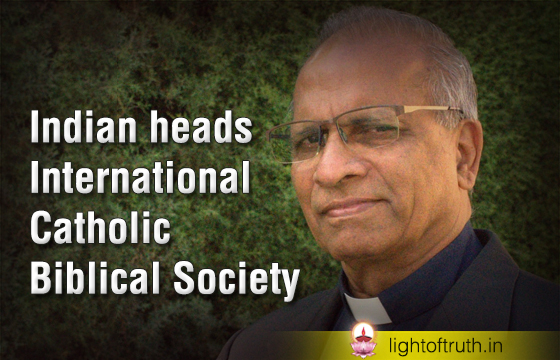
The Society of Paul superior general Father Domenico Solliman has appointed Father Jose Pottayil as the director of the Madrid-based International Catholic Biblical So-ciety that was set up a hundred years ago by Venerable James Alberione, the congregation’s founder. Father Pottayil is the first Asian and Indian to head the society known as SOBICAIN (Società Biblica Cattolica Inter-nazionale). Father Pottayil, a member of the congregation’s India-Great Britain-Ireland province, has served as its general councilor, vicar general, India provincial, director of apostolate and animator of various communities and groups.
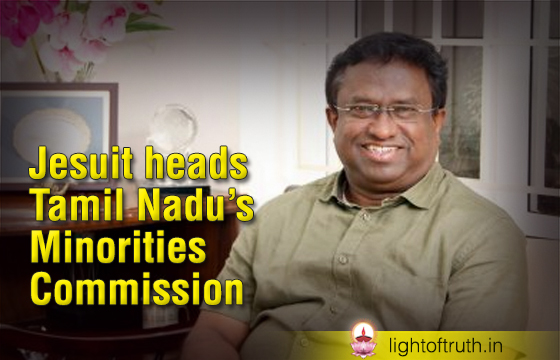
Jesuit heads Tamil Nadu’s Minorities Commission
The southern Indian state of Tamil Nadu has appointed Jesuit Father Joe Arun as the chairperson of its 10 member Minorities Commission. A government notification on July 23 said the appointment is for 3 years. The 59-year-old Jesuit is the secretary for the higher education secretariat of Jesuit Conference of South Asia and Director of the Chennai-based LIBA (Loyola Institute of Business Administration), a 45-year-old business management institute.
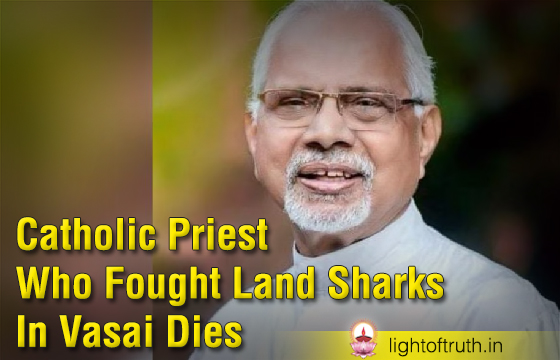
Catholic Priest Who Fought Land Sharks In Vasai Dies
A Catholic priest, who had gone beyond his priestly duties to fight illegal land grabbers and promote peace and communal harmony even at risk to his safety, died July 25 after a prolonged illness. Father Francis D’Britto of the western Indian Vasai diocese was known for his involvement in public movements such as the Harit (green) Vasai initiative to promote environmental sustainability and green practices. The death occurred at his home in Vasai, some 60 km north of Mumbai. He was 81. He was born December 4, 1942, to Marathi-speaking parents, in Girij, a tiny Vasai village. After studies in St. Pius, a Goregaon seminary, he was ordained a priest on December 23rd 1972, for the Bombay arch-diocese. He had also served as the spokesperson for Vasai diocese in the 2000s.
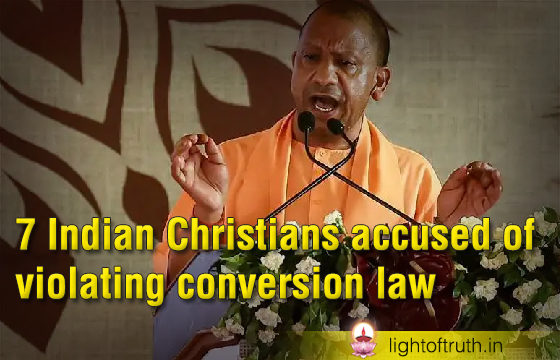
7 Indian Christians accused of violating conversion law
Seven Christians have been accused of violating the stringent anti-conversion law in two separate incidents in the northern Indian Uttar Pradesh state. Police arrested Pastor Ram Udeshy Sahani, Babulal Sahani and Vinod Kumar on July 14 in Maharajanj district. They were charged with converting a man by allegedly offering money and promising miraculous healing, according to a complaint lodged by his wife, Chanda, who was identified by only her first name. The police in Senduria village said the woman alleged in her complaint that her husband, who was identified by a single name, Anil, removed portraits of Hindu gods and goddesses from their home after his conversion. The three Christians were arrested but Babulal Sahani and Vinod Kumar were released on bail on July 16. “The police did not invoke the provisions of the anti-conversion law” against the two, said a lawyer dealing with their case. Four other Christians were accused of converting Hindu villagers in the Moradabad district by a leader of the Hindu group Vishwa Hindu Parishad (VHP or World Hindu Council). Police reportedly arrested two among them and were on the lookout for the two others. VHP local leader Pankaj Singh Pal registered the complaint at the Thakurdwara police station. He accused the Christians of converting Hindus by offering them “fridges, televisions, bicycles, motorcycles and sewing machines among other things” and “a cash reward of 25,000 rupees [about $300].” Pal alleged that those ready to become pastors were offered a monthly remuneration of 35,000 rupees and household expenses. The VHP leader further alleged that some 50-60 persons were already converted to Christianity and this had agitated the local Hindus. “Both cases were baseless and aimed at giving a negative image to Christians,” said Father Mathew from the Indian Missionary Society in Varanasi. Uttar Pradesh is India’s largest and most populous state. It is ruled by Prime Minister Narendra Modi’s right-wing Bharatiya Janata Party. The state enacted a stringent law, the Uttar Pradesh Prohibition of Unlawful Conversion of Reli-gion Act, in 2021. “Anti-conversion cases are part of the right-wing conspiracy against Christians,” Father Anand Mathew of the Indian Missionary Society told. The priest said that the police and media in the state were being used to target the tiny Christian community in the state. Some 24 Christians were already put behind bars in Uttar Pra-desh for violating the anti-conversion law after the general election results were announced on June 4. Only six persons “had got bail,” said a Church leader helping them with legal matters. Christians make up a mere 0.18% of Uttar Pradesh’s more than 200 million people, most of them Hindus. However, the state tops in cases of violence against Christians in the country, according to published records.

Catholic diocese moves court to quash Indian state’s order
A Catholic diocese has approached the top court of a central Indian state over a government order asking two of its schools to reimburse close 180 million rupees (some US$2.2 million) after accusing them of collecting exorbitant fees from students. The Jabalpur diocese in Madhya Pradesh approached the State High Court on July 16 “seeking a direction to quash the order from the [Jabalpur] district education officer,” said Father Davis George, diocesan vicar-general. The order is untenable and there is “no truth in it,” Father George told. The priest denied the Madhya Pradesh state education department’s claim that two diocesan schools, named after St. Aloysius, collected exorbitant student fees. The Catholic schools were told to reimburse nearly US$2.2 million after the management was accused of overcharging students in the past six years. The July 9 order named 10 private schools including four run by the Church of North India (CNI). The Protestant-run schools were also told to repay close to US$2.1 million. Madhya Pradesh has the highest number of tribal people in India. Christian schools are the most sought-after in Jabalpur, known as the cultural capital of Madhya Pradesh. This is the first time Christians are being told to reimburse the fees collected from students. The CNI’s Jabalpur diocese is also contemplating filing an appeal in court. “We are in consultation with lawyers,” said a CNI member who did not want to be named. The state is ruled by the pro-Hindu Bharatiya Janta Party (BJP) of Prime Minister Narendra Modi. The BJP is against missionary activities that benefit the tribal people and other poor sections of society, said a Church official. “We are targeted for providing quality education at an affordable rate,” he told on July 16.