
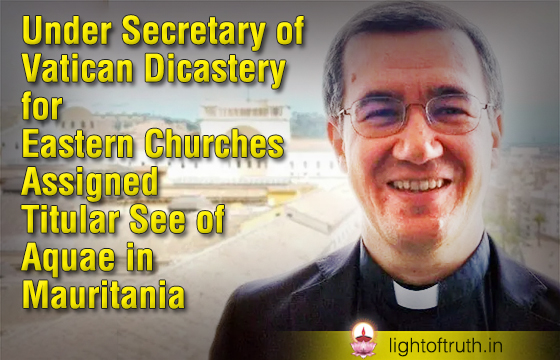
Pope Francis has assigned the Under Secretary of the Vatican Dicastery for Eastern Churches, Mons. Filippo Ciampanelli, the Titular See of Aquae in the Northwestern African nation of Mauritania. The assigning of Mons. Ciampanelli the Maurita-nian Titular See was published by the Holy See Press office on Sunday, January 12. Born in July 1978 in the Catholic Diocese of Novara in Italy, the Under Secretary of the Vatican Dicastery for Eastern Churches was ordained a Priest for the same Diocese in June 2003.
A participant in the Synod on Synodality, the multi-year XVI Ordinary General Assembly of the Synod of Bishops, which Pope Francis officially inaugurated in 2021 and later extended to 2024, Mons. Ciampanelli was a member of the Synod on Synodality Study Groups.
The Vatican official, who read Pope Francis’ spiritual reflection on “the passion for evangeli-zation,” when the Pontiff was having health complications in November 2023 has been assigned the Titular See that was esta-blished in 1933.
Titular Sees are Episcopal Sees that once existed but no longer function as such due to historical circumstances, such as Catholic and Christian population shifts or suppression.
The Catholic Culture, describes Titular Sees as “some two thousand ancient Catholic dioceses and archdioceses whose titles are now given to those bishops who do not occupy residential sees” including Auxiliary Bishops, Coadjutor Bishops, Vicars Apostolic, as well as “officials of the Roman Curia.”
Often located in Asia Minor, North Africa, the Balkans, and parts of Europe such as Greece, these territories became extinct “after the Moslems had destroyed the Church in these lands”, the Catholic Culture has explained.

Black Nazarene procession attracts millions in the Philippines
The Black Nazarene procession in Manila, Philippines, which annually attracts one of the world’s largest crowds for a reli-gious devotion, attracted hundreds of thousands of enthusiastic pilgrims on Jan. 9. Taking place each year in January, the procession, known locally as “Traslacion,” sees devotees carry across Manila a replica of a famous life-size statue of Jesus carrying a black wooden cross. The Philippines and East Timor are the only countries in Asia that are majority Catholic, with over 80% of the population of the Philippines belonging to the Church.
The procession’s organizers estimated that about 220,000 people attended Mass before the start of the procession, Rappler reported, and at least 800,000 peo-ple were gathered at the church Thursday evening, according to the Philippine Star. Hundreds of thousands more joined the proce-ssion as it went by. As in past years, many of the devotees were barefoot and some even jumped onto the float and clutched at the cross carried by the famous statue.
The image of Jesus used in the procession is believed to have been brought from Mexico to Filipino shores in 1606 by missio-naries of the Order of Augustinian Recollects. The life-size statue of Jesus is today enshrined in the famous minor basilica popularly known as the Quiapo Church, located in the Archdiocese of Manila. First enshrined at St. John the Baptist Church in Luneta, the image was transferred to Quiapo in 1868.
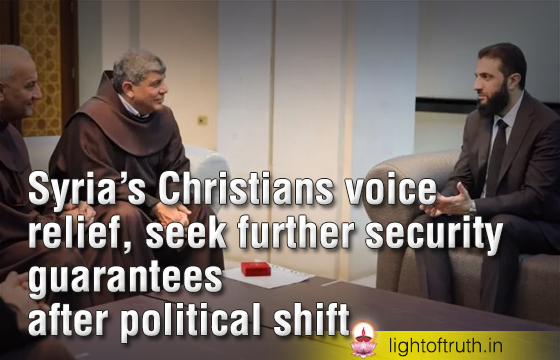
Syria’s Christians voice relief, seek further security guarantees after political shift
More than a month after Syria’s political shift, Christians there are vocalizing a sense of relief as initial assurances for their safety and security by the de facto government have report-edly been provided. Christians continue to seek more concrete guarantees, although opinions differ on what form these guara-ntees should take.
For some Christians, the Church remains their primary safeguard, as it has been since Ottoman rule. In this view, clergy are in charge of representing their communities in political and legal arenas.
The Greek Orthodox Patriarch, John X (Yazigi), is the most visible Christian leader in Syria, along-side the Latin apostolic vicar, Bishop Hanna Jallouf. The latter enjoys a longstanding and strong relationship with the new authori-ties. He recently visited his home-town and parish (Al-Qaniya, Idlib countryside) for the first time since his episcopal appointment, where he was warmly received.
Despite an important meeting between church leaders and re-presentatives with Ahmed Al-Sharaa, the head of Syria’s new administration, three patriarchs based in Damascus were notably absent. The absence was report-edly due to the customary visit of Patriarch Yazigi to congratulate the new leader – a visit that tradi-tionally precedes any other meet-ings with clergy.
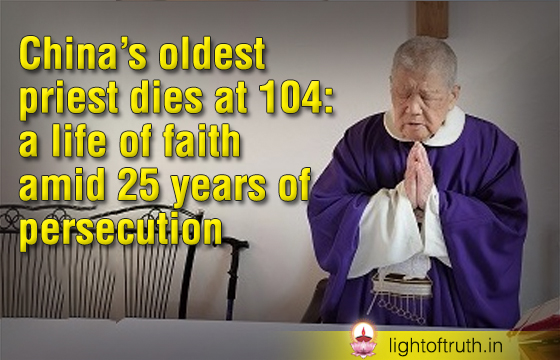
China’s oldest priest dies at 104: a life of faith amid 25 years of persecution
China’s oldest priest has passed away, leaving behind a legacy of brave adherence to the faith of the Catholic Church in the face of persecution. Father Joseph Guo Fude, SVD, died on Dec. 30, 2024, two months from what would have been his 105th birthday. He was one of the few remaining Catholic priests in China who had been ordained prior to the establishment of the People’s Republic of China.
“Father Guo is a symbol of the courageous faith and extraordinary suffering of China’s Catholics,” Benedict Rogers, human rights activist and author of “The China Nexus: Thirty Years in and Around the Chinese Communist Party’s Tyranny,” told CNA. Rogers noted that although the priest had “spent a quarter of a century in prison,” he continued serving and ministering to his people through his 90s. “He treated prison not as the harsh injustice that it was but as an opportunity to grow in faith, spirituality, and prayer.” According to AsiaNews, which reported the Chinese cleric’s passing, Guo spent a total of 25 years in prison during his lifetime.
“Looking back on my life,” Guo reportedly wrote following the occasion of his 100th birthday, “prison became a place where I could reflect, pray, and grow spiritually … My imprisonment gave me the strength to face life’s challenges and continue to serve God, knowing that every trial was part of his divine plan. My experience in prison taught me that earthly riches are ephemeral, while faith in God is the only true wealth.”
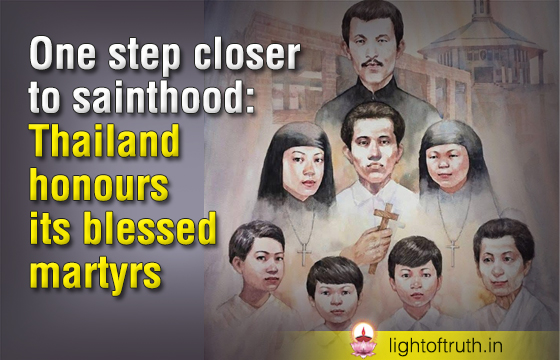
One step closer to sainthood: Thailand honours its blessed martyrs
Before the Eucharistic celebration comme-morating the Feast of Blessed Nicholas Bunkerd Kritbamrung in Samphran, west of Bangkok, on January 12, the Apostolic Nuncio to Thailand, Archbishop Peter Bryan Wells, presented relics of the eight martyrs to Archbishop-elect Francis Xavier Vira Arpondratana of the Metropolitan Archdiocese of Bangkok and to six bishops and representatives from its suffragan dioceses: Ratchaburi, Chanthaburi, Nakhon Sawan, Chiang Mai, Chiang Rai, and Surat Thani.
The relics, encased in newly crafted reliqua-ries, symbolize the unity of these eight martyrs, who lived and died for their faith during a time of persecution in the mid-20th century.
In his homily, Archbishop Wells highlighted the martyrs’ courage, saying, “They were bap-tized into Christ first in water and then in blood.” He challenged the faithful to draw inspiration from their sacrifices and to live out their baptismal promises with convi-ction.
Last year, the Catholic Bishops’ Conference of Thailand (CBCT) resol-ved to unify the canonization causes of Blessed Nicholas Bunkerd Kritbam-rung of Bangkok and the Seven Blessed Martyrs of Songkhon. The decision underscores their shared witness to Christ during a period of political and social turmoil between 1940 and 1944, when Christianity was targeted as a “foreign religion.”
Blessed Nicholas, a priest from Samphran, his hometown, ministered to his flock amid persecution. Sentenced to 15 years of imprison-ment, he baptized 66 fellow prisoners while incarcerated. Despite enduring nine months of illness, he remained steadfast in his faith and passed away in prison in 1944 at the age of 49.
Meanwhile, in the Catholic village of Song-khon, catechist Philip Siphong and six women, including two nuns, who chose martyrdom rather than renouncing their faith.
Their sacrifices were recognized by Pope John Paul II, who beatified the seven Songkhon martyrs in 1989 and Blessed Nicholas in 2000.

Indian archbishop awaits PM’s response to harassment plea
An Indian archbishop says he is waiting for a response from Indian Prime Minister Narendra Modi a week after seeking his intervention to stop harassment of Christians using laws that criminalize religious conversion. Archbishop Peter Machado of Bangalore told on Jan. 2 that he has “not yet received any response” to his letter to Modi’s office seeking he address some “pressing concerns of the Christian community” in India. Machado wrote to Modi’s Office on Dec. 23, seeking “five gifts” from the PM that would make the Christian community in India happy during Christmas. “We only apply and apply, hoping for a good response to our pressing concerns from the Prime Minister,” Machado said, expressing hope he will have a response. Machado told Modi that anti-conversion laws, currently in force in 12 states, are “distre-ssing, often leading to unjust persecution of Christians. “These laws, misnamed ‘Freedom of Religion Bills,’ impose stringent and unreasonable restrictions, violating personal liberty and human rights,” the letter said. He wanted Modi “to foster genuine freedom of religion by directing states to adopt a more tolerant approach.”
The prelate also wanted Modi’s inter-vention in “resolving the burning Manipur issue” of ethnic violence between Christian-majority Kuki and Hindu-majority Meitei groups in north-eastern India. He said Christians in Manipur have received a raw deal, but the prime minister has not visited the state since the onset of the civil unrest more than a year ago. Machado also wanted Modi to intervene and stop all attacks on Christians and their institutions. He noted that the Delhi-based United Christian Forum recorded 767 incidents in 2024 targeting Christians, and 80 Christians were jailed because of their faith in Christ. Machado also wanted the government to extend to Christians of Dalit origin the social welfare benefit guaranteed in the constitution for lower caste people. The government blocked Chri-stians and Muslims from receiving these benefits meant to help lower caste people on the ground that their religions do not approve of the caste system. Are Christians and Muslims “not citizens of this country with equal rights and privileges guaranteed to all in the country according to our constitution?” he asked in the letter.
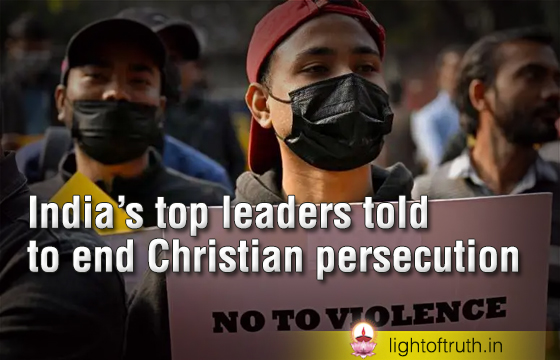
India’s top leaders told to end Christian persecution
More than 400 Christian leaders, including activists, lawyers and scholars, have urged India’s president and prime minister to take immediate action to address what they said was increased persecution against Christians. The appeal comes after 14 violent incidents against Christians were reported across the country during the Christmas season, a Dec. 31 statement from the group said. Statistics from the Religious Liberty Commission of the Evangelical Fellowship of India (EFIRLC) and the United Christian Forum (UCF) for 2024 highlighted the increase in violence Christians are enduring, the statement said. It said that between January and mid-December last year, more than 720 violent incidents were reported to the EFIRLC, while UCF recorded 760 cases by the end of November. The figures showed a steep rise in such incidents over the last decade, from 127 incidents recorded by the UFC in 2014.The UCF is an inter-denominational Christian organization in India that fights for the rights of the Christian minority.
A letter emailed on Dec. 31 to Indian President Droupadi Murmu and Prime Minister Narendra Modi by 30 Church groups calls for immediate and decisive action to curb the acti-vities of violent mobs, terrorizing communities and tarnishing the image of the country. The letter was signed by A C Michael, a former member of India’s minorities commission, Supreme Court lawyer Sister Mary Scaria, and UCF President Michael Williams.
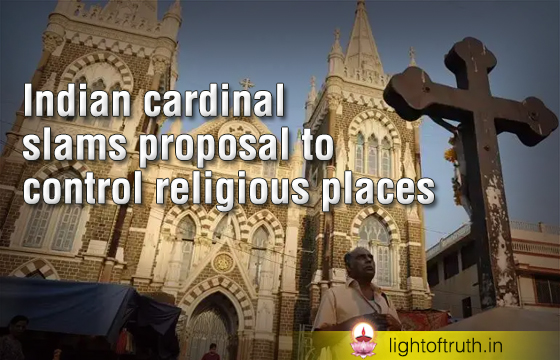
Indian cardinal slams proposal to control religious places
Indian Cardinal Oswald Gracias and Christian leaders in Western Indian Maharashtra state have opposed a government pro-posal to bring worship places of all religions under the govern-ment’s control. “I am totally against this. It interferes with the religious freedoms guaranteed by the Indian Constitution,” Gracias, the Archbishop of Bombay, based in the state capital, told on Jan. 2. Last month, Rahul Narwekar, the speaker of the state legislative assembly, urged the House to consider a new law bringing religious places and properties of all faiths under state control. The cardinal said the state already exercises adequate control over Christian properties through its charity commissioner, an official who oversees the administration of churches’ properties and chari-table activities. “Besides, the Ca-tholic Church has more stringent measures to regulate affairs of the church than the government,” Gracias added.
Narwekar made the remarks while discussing changes in regu-lations for the management of Siddhivinayak Trust, which ma-nages a prominent Hindu temple in Mumbai (formerly Bombay), the country’s financial capital. He said Indian secularism demands treating all religions equally, but people question the government controlling only Hindu religious places. “I think all religions should be treated equally, and as such, worshipping places of all religions should be brought under the control of the government,” he said. Gracias said the govern-ment is “floating this idea to gauge our response, but it will certainly create disturbance in our communities.”
Indian Catholic leaders echo concern over falling birth rates
Catholic leaders in India have lauded the chief minister of a southern state for raising the issue of falling birth rates in the world’s most populous country and urged the government to encourage couples to have more kids. “A young and vibrant population is an asset for any country and its decline is a matter of serious concern for everyone,” said Catholic Bishops Conference of India (CBCI) spokesperson Father Robinson Rodrigues. Andhra Pradesh chief minister, N Chandrababu Naidu, raised concern over declining birth rates in his own constituency and said last week that “India should not repeat the mistakes committed by other countries such as South Korea and Japan.” Naidu, who represents the city of Kuppam in the state legislature, was shocked to find the birth rate in his constituency had fallen to 1.5 – below the national average of 2. India’s current demographic dividend could last till 2047, but “if less than two children are born [per woman], then the population will fall [in the future],” the chief minister said. Naidu said the decline was “a worrying trend and needed a nationwide discussion on population management.”
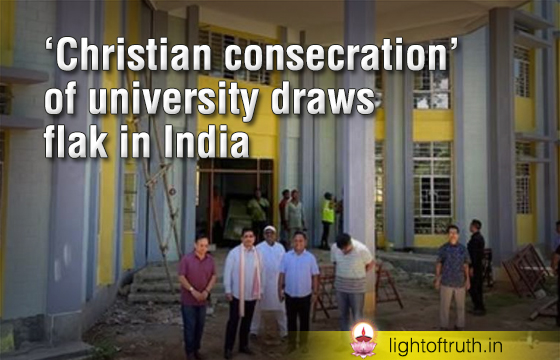
‘Christian consecration’ of university draws flak in India
A proposal to hold a Christian prayer service at the inauguration of a university in a northeast Indian state has been criticized by political leaders and civil society. Church leaders in Meghalaya, where Christians form a majority, advised caution and suggested upholding the nation’s secular tradition. The plan to “consecrate the Captain Williamson Sangma State University on January 13 by following Christian rituals” was announced by the state’s Education Minister Rakkam A Sangma recently, the New Indian Express newspaper reported on Jan. 5. The university, named after the state’s first chief minister, focuses on tribal studies and indigenous language preservation. “Ours is a Christian state. We want to consecrate the first state university with a massive prayer meet. If parliament can be blessed with Hindu rituals, why not Christian rituals in a Christian state?” Sangma reportedly said. The new building of the Indian parliament was inaugurated by Prime Minister Narendra Modi in May 2023 by invoking Hindu gods. However, critics of Sangma’s proposal pointed out that a multi-religious prayer was also held at the new Indian parliament. Thma U Rangli-Juki, a non-government organization (NGO) in Meghalaya, said Sangma’s statement goes against the constitutional values of secularism. “Meghalaya may be a state where [a] majority of its population practices various forms of Christianity but that in itself does not make it a Christian state,” the NGO said in a statement. The state is home to people of several faiths and “the minister’s ignorant statement blatantly creates discriminatory conditions for the state’s other religions,” it said. The NGO demanded that the planned prayer service be cancelled immediately.