
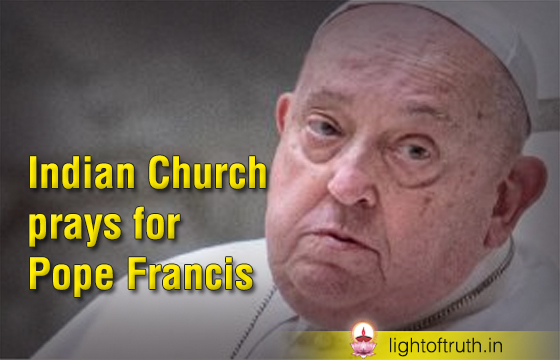
Catholics in India have joined their counterparts across the world to pray for Pope Francis, who has been undergoing treatment for double pneumonia in a Rome hospital. Archbishop Andrews Thazhath, president of the Catholic Bishops’ Conference of India, on February 19 called on the country’s Catholics to pray for the Pope after the Vatican announc-ed that the pontiff’s condition had worsened. The archbishop said the Pope was diagnosed with a polymicrobial respiratory tract infect-ion. “Recent tests reveal a complex clinical picture, requiring an extended hospital stay for the 88-year-old Pontiff in Rome,” said a statement issued by the conference. Abp Thazhath, while praying for the Pope’s health and recovery, entrusted him “to the mercy and care of Our Lord. Let us join together in prayer for his strength and healing.” Earlier, Major Archbishop Raphael Thattil, head of the Syro-Malabar Church, too urged his people to pray for Pope Francis whose health condi-tion caused concern. “According to the infor-mation we have received, the Holy Father’s health condition is worrying. Therefore, I request all Syro-Malabar Catholics to pray for the Pope,” the major archbishop’s February 19 message said. He urged all churches and institutions under his Church to offer Masses for the Pope and Catholic families to pray for the pontiff during the evening prayers.
Cardinal Filipe Neri Ferrão the President of the Conference of Catholic Bishops of India (CCBI) and the Federation of Asian Bishops’ Conferences (FABC) has issued a heartfelt appeal to all members of the Catholic Church in India, urging them to join in prayer for the swift and complete recovery of Pope Francis. In a circular addressed to archbishops, bishops, priests, deacons, religious, catechists, and lay faithful, Cardinal Ferrão expressed deep concern for the health of the Holy Father. He called upon the faithful to unite in fervent supplication, seeking God’s healing grace for the Pope, who carries the great responsibility of shepherding the Universal Church. “At this time, as he is facing serious health challenges, let us, as one family in faith, turn to the Lord in earnest supplication, entrusting our beloved Pope to the healing grace of our Divine Physician,” Cardinal Ferrão stated.
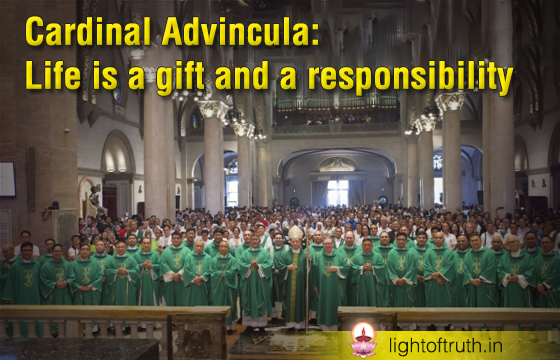
Cardinal Advincula: Life is a gift and a responsibility
During Sunday Mass (February 23) at the Manila Cathedral for the 2025 Walk for Life, Cardinal Jose Advincula of the Archdiocese of Manila emphasized the sacredness of life and the responsibility that comes with it. “Let us continue marching and proclaiming that life is beautiful, that it is an undeserved gift, and that it is also a task and a responsibility to uphold and protect,” he said in his homily.
The archbishop of Manila, the capital of the Philippines, spoke out against various threats to human dignity, including abortion, the commodification of sex, and what he described as the “manipulation of human procreation.” He strongly condemned euthanasia, referring to it as “mercy killing” and calling it “morally indefensible.” Furthermore, he reiterated that extrajudicial killings are “evil” and go against the dignity of human life.
This year’s Walk for Life, an annual event promoting the sanctity of human life and the family, gathered over 3,500 participants. The faithful walked a two-kilometre route from Rizal Park to the Manila Cathedral at dawn on Sunday, publicly affirming their commitment to defending life, especially the unborn. Organized by the Sangguniang Laiko ng Pilipinas, or Philippines’ Council of the Laity, the event was held in partnership with the Episcopal Commission on Family and Life (ECFL) of the Catholic Bishops’ Conference and the Manila Archdiocesan Office for the Promotion of the New Evangelization.
Bishop Jesse Mercado of the Diocese of Parañaque, who serves as ECFL chairman, highlighted the importance of collective action in upholding life and family values. “Our presence here is a clear message to the world that life is sacred, family is a gift, and unity is our strength,” Mercado said. He further expressed hope that the united voices of the faithful would inspire a culture that respects every human life from conception to natural death. “Hope that our collective voice will continue to shape a culture that values every human person from conception to natural death,” the bishop added.
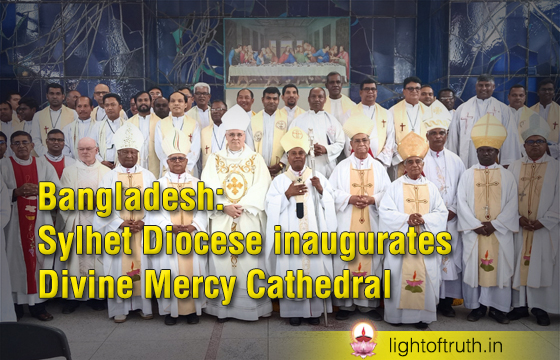
Bangladesh: Sylhet Diocese inaugurates Divine Mercy Cathedral
In a momentous and spiritually uplifting event, the Sylhet Diocese in Bangladesh celebrated the inauguration and blessing of the newly built Divine Mercy Cathedral on February 22. After years of anticipation, the Christian community in Bangladesh joyfully gathered to witness the grand opening of the sacred place of worship. The theme of the event, “A Meeting of Faith, Unity, and Blessings,” resonated throughout the ceremony as thousands of faithful, clergy, and distinguished guests participated in the historic occasion.
Archbishop Kevin S. Randall, the Apostolic Nuncio of the Holy See to Bangladesh, graced the event as the chief guest, alongside Bishop Shorot Francis Gomes of Sylhet Diocese. The event commenced with a solemn Holy Mass, during which Bishop Gomes led the blessing of the cathedral. As prayers and hymns echoed through the newly built church, the faithful gathered in deep reverence and gratitude. Archbishop Randall explained the significance of the cathedral and said, “This cathedral is not just a structure; it stands as a testament to the unity, faith, and service of the Christian community. It calls upon us to keep our hearts open to the Lord.”
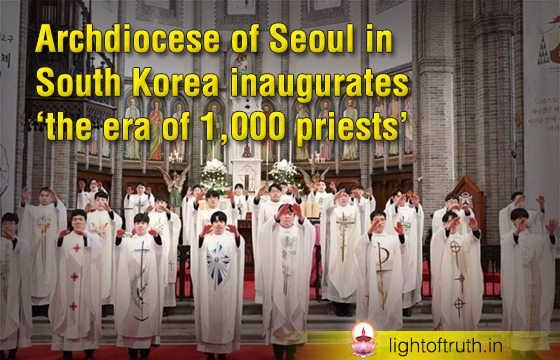
Archdiocese of Seoul in South Korea inaugurates ‘the era of 1,000 priests’
The Archdiocese of Seoul in South Korea has reached “the era of 1,000 priests” upon ordaining 26 new priests for the local Church on Feb. 7. Archbishop Peter Chung Soon-taick, who presided over the ceremony, called on the new priests to carry out their ministry “with true love and constant joy.”
“Priests are called to serve the people of God as collaborators of the bishop and united with the bishop through their priestly ministry,” the archbishop recalled in his homily. He added: “Remember that you have been chosen and appointed from among men to carry out the work of God.” He also urged them to “always take as an example the Good Shepherd who came not to be served but to serve, and to seek and save the lost sheep.” The Archdiocese of Seoul reached the milestone 194 years after its creation.
With these 26 ordinations, the number of priests in the most important archdiocese of the Asian country, which will host the next World Youth Day in 2027, rose from 974 (including a cardinal, an archbishop, three bishops, and four monsignors) to exactly 1,000.
In total, the Korean Church has 5,721 priests, according to the latest figures from the episcopate. In its history, the local Church has ordained more than 7,000 priests, St. Andrew Kim Taegon being the first person to receive holy orders in 1845. At the Feb. 7 ceremony, the second deaf Korean priest (and the fourth in all of Asia) was also ordained. In a statement to the Archdiocese of Seoul, Father Kim Dong-jun said he wants to “serve deaf culture in the manner of Jesus Christ, with sensitivity and warmth toward the weak.”
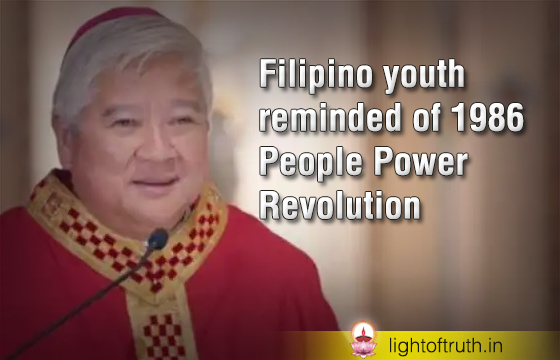
Filipino youth reminded of 1986 People Power Revolution
A Catholic bishop in the Philippines has urged youth in the Catholic-majority nation to conti-nue advocating for social change while seeking out truth, drawing lessons from the People Power Revolution. Archbishop Socrates Villegas of Lingayen-Dagupan made his remarks in a message sent to Radio Veritas Philippines ahead of the 39th anniversary of the 1986 popular protest, Radio Veritas Asia reported on Feb. 21.
“In February 1986, we, your grandparents, stood for four days at the Epifanio delos Santos Avenue [EDSA] in Quezon City, between Camp Aguinaldo and Camp Crame,” Villegas said. “We offered food and prayed the rosary to the soldiers who had been deployed to disperse us. We sang Bayan Ko [‘Our Fatherland,’ a protest song] and slept on the streets,” Villegas added. The pre-late noted that on Feb. 25, 1986, following a peaceful protest, the “dictator and thief” Ferdinand Marcos Sr. fled to Hawaii in exile. “We ousted the dictator without violence and bloodshed,” Villegas emphasized.
An estimated 2 million Fili-pinos participated in the non-violent People Power Revolution from Feb. 22-25, 1986, which ended Marcos’ 20-year-long dictatorship and restored demo-cracy in the nation. Villegas underlined the significance of standing up for what is right and refusing to ignore the wrongdoings of leaders or those in power.
“Abp Socrates loves you. I will not lie to you. I will not mis-lead you. I was there. I saw the corruption, torture, killings, and illegal arrests. That is what ha-ppened,” Villegas said. Villegas pointed out that the revolution was the response of God-loving Filipi-nos to “evil men and evil deeds.”
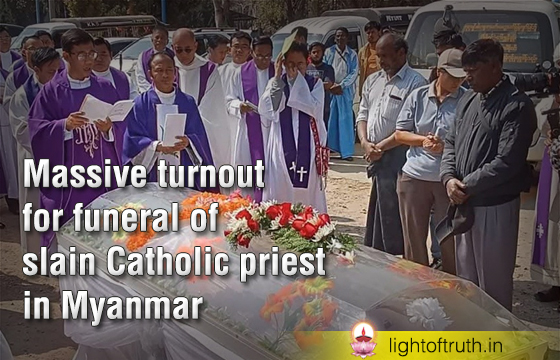
Massive turnout for funeral of slain Catholic priest in Myanmar
More than 5,000 mourners gathered in the village of Pyin Oo Lwin, defying the dangers and prevailing violence, to honour the late father Donald Martin Ye Naing Win, the Catholic priest who brutally murdered on February 14 in his parish of Our Lady of Lourdes in the Archdiocese of Mandalay.
Priests, religious figures, and the faithful assembled at the Catholic Church of the Assumption of the Virgin Mary, where Archbishop Marco Tin Win presided over the funeral Mass, offering condolences and prayers for the slain priest’s family. The moving ceremony included the reading of messages from the Apostolic Nunciature in Yangon and the Bishops’ Conference of Myanmar, which expressed their deep solidarity with the grieving community.
According to sources from Fides News Agency, the overwhelming turnout at the funeral reflected the high regard in which Father Donald was held among the local people.
During his homily, Archbishop Tin Win condemned the cycle of violence gripping the nation, saying, “Violence only brings death and destruction; it is always a defeat.”
He called upon “all armed groups and actors involved in the conflict to lay down their weapons and take a path of peace and reconciliation.”
Father Donald, who was the first parish priest of Our Lady of Lourdes Church, was known for his dedication to the community, particularly in organizing educational initiatives for children and young people. Due to the ongoing civil war, many schools in the region remain closed, leaving religious leaders and catechists to provide informal education.
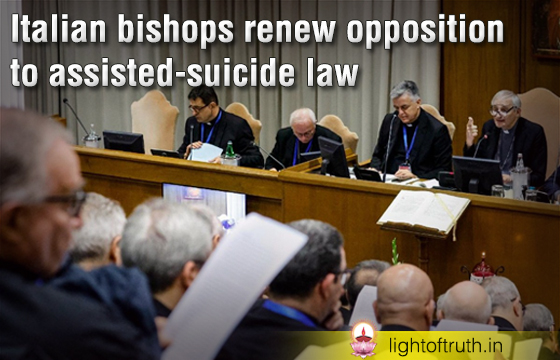
Italian bishops renew opposition to assisted-suicide law
The Italian Bishops’ Conference (CEI) has condemned the recently approved law by the Regional Council of Tuscany on medically-assisted suicide, saying it contradicts the value of human life. In their February 19 statement, which came a few days after the legislation passed, the bishops raise concern that this approval prioritizes assisted death over palliative care and moral responsibility. “We express concern for recent regional initiatives on the subject of end-of-life, said the bishops in a statement. “The first task of the civil community and the health system is to assist and care, not to hasten death.” The law was passed after years of debate and allows terminally-ill patients with unbearable suffering to seek medically-assisted suicide under strict conditions. The law therefore requires a medical and ethics commission to consider an end-of-life request for no more than 30 days.
Life is sacred and should be protected, even in the face of pain and terminal illness, say the bishops, calling for a just society need to encourage value for life not in facilitating death but in providing unwavering support, comfort, and dignity to those facing their most difficult moments. The Italian bishops recalled a message from the bishops of the Emilia-Romagna region last year. “Procuring death, directly or through medically assisted suicide, radically contrasts with the value of the person, with the purposes of the State and with the medical profession itself.”
The bishops lamented the fact that the law on palliative care has not yet been fully implemented and reminded the Regional Council of Tuscany that rights “must be guaranteed to everyone, in an effective and uniform way in each Region, because they represent a concrete way to alleviate suffering and to ensure dignity until the end, as well as a high expression of love for others.”
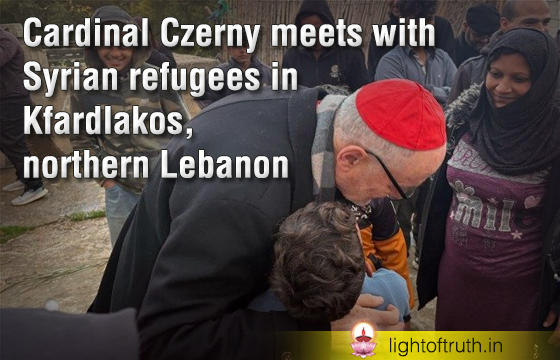
Cardinal Czerny meets with Syrian refugees in Kfardlakos, northern Lebanon
The Refugee Camp 004 for Syrian refugees in the village of Kfardlakos, Zgharta district, northern Lebanon, is one of fifty camps scattered throughout the country. 125 people, 25 families, and over 60 minors continue to struggle in difficult living conditions eleven years after their escape from Syria, where life is even more difficult. Cardinal Michael Czerny, Prefect of the Dicastery for Promoting Integral Human Development, wished visit this place during his ongoing mission to Lebanon.
“We have come to know you and listen to you, and we share your hope of returning home, to Syria,” Cardinal Czerny states. “The Pope is happy that I am here among you. We weep for your suffering. The Pope weeps with you, he loves you.” On the return journey to Harissa, he comments on the visit: “I am speechless after seeing a life lived at the extreme. The conditions are impossible, people fight to survive, they want to return home but they know that in Syria it is difficult. In fact, there is no home there anymore.”
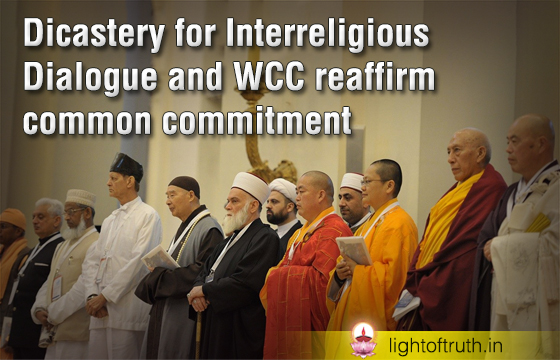
Dicastery for Interreligious Dialogue and WCC reaffirm common commitment
The Dicastery for Interreligious Dialogue (DID) and the Office of Interreligious Dia-logue and Cooperation (IRDC) of the World Council of Churches (WCC) concluded their annual meeting in Rome, held from 17 to 20 February 2025. The gathering, which took place at the Dicastery’s office, provided an opportunity to assess past initiatives, review ongoing interreligious activities, and explore future collaborations. A key focus was preparing for the 50th anniversary of cooperation between the two institutions, which will be marked in 2027.
Since 1977, the DID and WCC have worked together to promote interreligious dialogue within an ecumenical framework. Their collaboration has produced significant documents, including Interreligious Prayer (1994), Reflection on Interreligious Marriage (1997), Christian Witness in a Multi-Religious World: Recommenda-tions for Conduct (2011), Education for Peace in a Multi-Religious World: A Christian Perspective (2019), and Serving a Wounded World in Interreligious Solidarity: A Christian Call to Reflection and Action During COVID-19 (2020).
In their discussions, both delegations reaffirmed their dedication to strengthening interreligious dialogue.
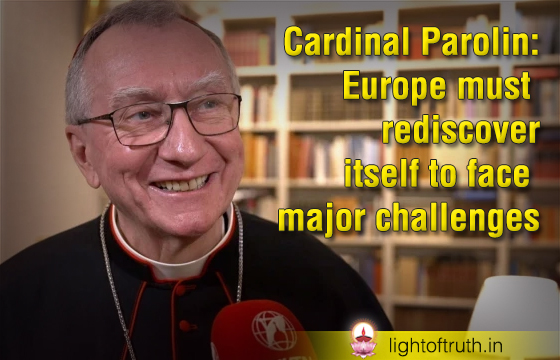
Cardinal Parolin: Europe must rediscover itself to face major challenges
Cardinal Pietro Parolin, the Vatican secretary of state, said that Europe must “rediscover itself” in order to be able to face the “major challenges” of culture, commerce, and migration. In a Feb. 15 interview with the daily Eco di Bergamo, the Vatican offi-cial recalled the “warning of St. John Paul II,” which Pope Francis has also taken up: “Europe, re-discover yourself, be yourself.”
The cardinal stressed that the Old Continent is suffering from a “crisis of ideas” that prevents it from facing the future: “Europe currently has good antibodies to hold up under crises and challen-ges. But the most serious problem is the lack of ideas for the future that allow it to respond with deter-mination to international compe-titors,” he said. Parolin specified that this weakness is due to the relationship that Europe has with its own history, the result of “a deep, and partly justified, fear of its past.” However, he emphasiz-ed that along with the dark episodes of its history, “there are many bright moments.”
In this regard, he referred to the debates on the European Constitution, in which an explicit reference to the continent’s Judeo-Christian roots was avoided, advocating for a generic mention of its “cultural, humanist, and religious heritage.” According to the cardinal, this weakened the continent’s awareness and the sense of European identity: “In-stead of building Europe on its deep foundations and roots, a changing consensus of values has been preferred. But the future can only be built on the past,” he pointed out.
Although Parolin said there were reasons to be concerned, especially in the face of “practi-cal atheism, populism, and reli-gious illiteracy,” he praised other “encouraging phenomena” such as the increase in requests for baptism by young French people.