Bishops in India meet with government official about anti-Christian harassment

A group of Catholic bishops in India has met with a state official about a series of incidents involving the harassment of Christian services by right wing activists accusing churches of trying to forcibly convert Hindus. The Church in India says it takes strong measures to assure.

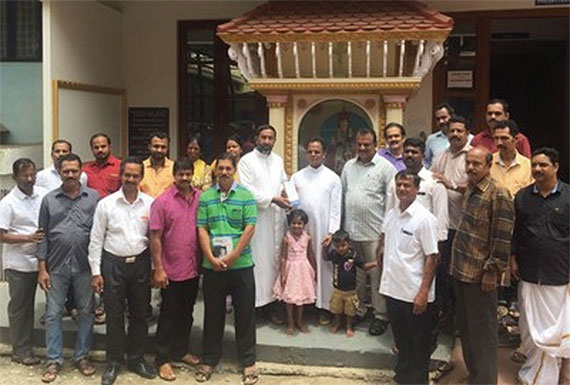
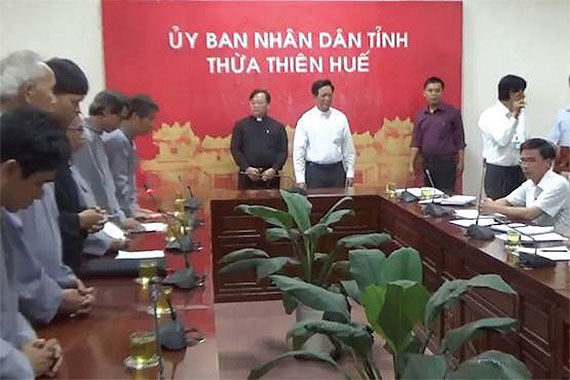
Seven bishops from the Indian State of Uttar Pradesh have met with the chief minister of the state to discuss the recent disruptions of Christian places of worship in the state.

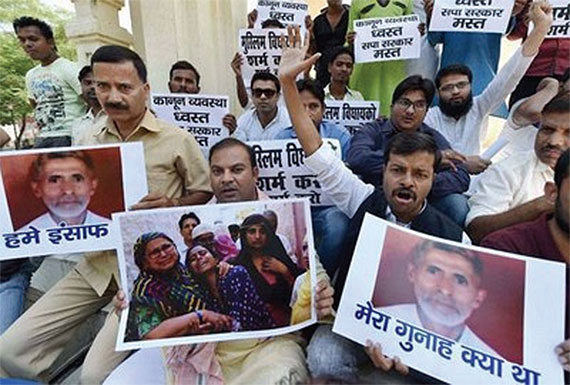
In recent months, right-wing activists from the Hindu Yuva Vahini (HYV) have stopped services and harassed worshippers in the state, which is India’s largest, accusing churches of trying to convert the local Hindu population to Christianity. The HYV was founded by the chief minister, Yogi Adityanath, in 2002.

“We expressed a few concerns, seeking security and safety to the minority and especially to the places of worship, we also asked the honorable Chief Minister to look into the matter, where people take law into their own hands,” said Bishop Gerald John Mathias, the Bishop of Lucknow.

Mathias told Crux the chief minister assured them he would not permit vigilantism, and expressed his support for the work of the church in helping the poor and education.
“However, he told us that he was against ‘conversions,’ but we could go on speaking about Prabhu Yesu (Lord Jesus), and have respect for others faiths, and live in good will with all.”

Church attendance in Philippines declines

The failure of families to sustain values formation among young people is one of the factors that has led to a decline of church attendance in the predominantly Catholic Philippines.

“[Young people] don’t feel that it is important to attend Mass on Sundays,” noted Henrietta de Villa, former Philippine ambassador to the Vatican.

Results of a survey conducted last month showed that church attendance among Catholics is declining even as most Filipinos claim that religion is very important in their daily lives.

The survey by pollster Social Weather Stations (SWS) noted that the proportion of those who attend religious services weekly was lowest among Catholics at 41 percent.

De Villa said the result of the survey shows the importance of a “solid Christian family” that can guide the so-called “millennials” in the practice of their faith.

The lay leader said while she was happy about the growing number of Filipinos who said religion is “very important” to their lives, “it is sad that few people are going to church.”
“It is very important that families should start to form their children in faith while they are young,” said De Villa.

Archbishop Emeritus Oscar Cruz of Lingayen-Dagupan said “family and life apostolate” should be strengthened.
“It will have a big influence on people,” said the prelate.

Archbishop Cruz also blamed the proliferation of modern technology and other recreational activities as among the causes of Filipinos’ declining interest in church activities.

De Villa, meanwhile, said that aside from strengthening Catholic families, priests and bishops should also be conscious in sharing “meaningful” homilies, especially to young people. Results of the SWS survey, conducted in late March, showed that Catholics are the least active among Filipino groups in attending weekly religious services.

Of the surveys on church attendance conducted by the pollster since 1991, weekly attendance at religious services has always been lower among Catholics.

Russian court bans ‘extremist’ Jehovah’s Witnesses

Russia’s Supreme Court formally banned Jehovah’s Witnesses as an extremist organization and ordered the state to seize its property in Russia, according to Russian news media. The court, after six days of hearings, ordered the closing of the group’s Russia headquarters and its 395 local chapters on April 20.

The Interfax news agency quoted Justice Ministry attorney Svetlana Borisova in court as saying the Jehovah’s Witnesses pose a threat to Russians.
“They pose a threat to the rights of the citizens, public order and public security,” she told the court. Borisova also said the Jehovah’s Witnesses’ opposition to blood transfusions violates Russian health care laws.

“We are greatly disappointed by this development and deeply concerned about how this will affect our religious activity,” said Yaroslav Sivulskiy, a spokesman for Jehovah’s Witnesses in Russia. “We will appeal this decision, and we hope that our legal rights and protections as a peaceful religious group will be fully restored as soon as possible.”

MINORITY REPORT: BEING A COPTIC CHRISTIAN IN AN ‘ISLAMICISED’ COUNTRY LIKE EGYPT

They trace their origins back to the age of the Apostles, yet still the Copts are treated as second-class citizens in their own county.

When Islamic State extremists attacked Saint Mark’s Coptic Orthodox Cathedral in Alexandria on Palm Sunday, they struck at the historic heart of Egypt’s Christian community. The Coptic Patriarch, Pope Tawadros II, was leading a service inside when a suicide bomber was challenged at the church gates.

Forty-five people were killed in two separate attacks on Coptic churches that Sunday: one of the bloodiest days of violence against Christians in Egypt in decades. Earlier at St George’s church in the city of Tanta, 60 miles north of Cairo, at least 28 people died and another 80 were injured when another attacker slipped past security and blew himself up near the front pews of the church. The Patriarch later issued a statement declaring that “these acts will not harm the unity and cohesion of the people.”

Pope Francis shuns bullet-proof vehicle for Cairo visit

Pope Francis has chosen not to travel in a bullet-proof vehicle for his first trip to Egypt this week, despite a recent spate of terrorist attacks targeting the country’s Christians.
The Pope will fly from Rome to Cairo on April 28 for a two-day visit intended to build on inter-faith dialogue with Muslim leaders and to show solidarity with beleaguered Christian communities in the Middle East.

Despite his vulnerability as a potential terrorist target, the Pope will not travel through the streets of Cairo in an armoured vehicle, the Vatican said. “The Pope will use a closed car to move around, but not an armoured one,” said Greg Burke, the Vatican spokesman. “That’s how he wanted it.”

16 nations named ‘egregious’ religious-freedom violators

In its newly released annual report, the United States Commission on International Religious Freedom (USCIRF) is urging the State Department to designate or re-designate 16 nations as “countries of particular concern” (CPCs) because they are nations in which there are “particularly severe violations of religious freedom that are sys-tematic, ongoing and egregious.”

The nations include ten current CPCs—Burma, China, Eritrea, Iran, North Korea, Saudi Arabia, Sudan, Tajikistan, Turkmenistan, and Uzbekistan—as well six other nations: the Central African Republic, Nigeria, Pakistan, Russia, Syria, and Vietnam.

The federal commission found that in 12 other nations—Afghanistan, Azerbaijan, Bahrain, Cuba, Egypt, India, Indonesia, Iraq, Kazakhstan, Laos, Malaysia, and Turkey— “religious freedom violations are severe but do not fully meet the CPC standard.”

Egyptian bishop: we have no need of Western protection

Following a surge of attacks on Egypt’s Christians, a Coptic Catholic bishop said that there is no need for Western nations to come to their defence. “If there were oppression on the part the State or government, these sorts of remarks might make sense,” said Bishop Antonios Aziz Mina, according to a Fides report. “But now it is clear that these terrorists carry out attacks to destabilize the country, and aim to break Egypt’s Christian-Muslim harmony.” He added: “We have no need of outside protection. All we need is not to be divided from our Muslim brothers. They are the ones who can defend us, and we must help them and help the police resist against these groups which sow death, hiding behind pseudo-religious ideologies.” The prelate made his remarks after the Palm Sunday church bombings but before the attack on historic St Catherine’s Monastery.

Between election rounds, French cardinal deplores ‘democracy gone mad’

France’s Catholic primate has condemned the current presidential campaign as his country’s “worst ever” and urged Christians to help prevent democracy from “losing its sense.” “Left and right rivalled each other and had their radical wings, but there was also a centre. Now, left and right have stepped back, and the main candidates are divided by other unclear criteria. I have the impression our voters are totally lost,” said Cardinal Philippe Barbarin of Lyon.

FRANCIS GRANTS SSPX RIGHT TO CELEBRATE MARRIAGE IN SIGN OF RECONCILIATION

Pope Francis has granted permission for priests of the traditionalist Society of Saint Pius X to celebrate valid marriages, in another sign that the quasi-schismatic group are on the verge of being reconciled back into the Church. In a ruling approved by Francis, the Congregation for the Doctrine of the Faith has said that SSPX clergy can celebrate wedding liturgies providing they are assisted by a priest from the local diocese who would act as a witness to the vows. However, if there are no diocesan priests available the CDF states that a priest of the society can conduct the ceremony on his own.

The latest move, authored by Cardinal Gerhard Muller and by Arcbishop Guido Pozzo, who is in charge of the Vatican body tasked with reconciling the group back into the Church, states it is part of the process of “institu-tional regularisation” of the SSPX. Significantly, the state-ment says the group is in a “canonical irregular” situation” only “for the time being.”
Known as the Lefebvrists after their founder- a French missionary Archbishop Marcel Lefebvre -the society broke away from the Church in protest at the reforms of the Second Vatican Council.

This split occurred definitively when Archbishop Lefebvre ordained four bishops for the society without Holy See approval.

Today the group, which celebrate the sacraments solely according to the old rite, remain in a sort of canonical limbo: al-though excommunicated Arch-bishop Lefebvre’s ordinations of his bishops were valid because he himself was a legitimate bishop.

For the Indian Church, yoga is not needed to experience the divine

The Syro-Malabar Church, one of the three rites of the Catholic Church in India, has issued a note to its clergy, saying that “Yoga is not a means to experience the divine, although it may contribute to physical and mental health.” In the statement, the Church’s Synod of Bishops recognises the important role yoga plays in Indian culture, but adds that it “must be considered as a physical exercise, a posture to concentrate or meditate.” By contrast, “the divine experience does not need any particular posture.”

For former Synod spokesman Fr Paul Thelakat, yoga is “acceptable and useful for concentration, meditation and for the holistic well being of body and mind. However,” he told AsiaNews, “the Synod does not consider yoga as a mythic or esoteric short cut to the spiritual life.”

In India, yoga is a required subject in schools. Every year, on International Yoga Day of (21 June), education in schools takes a back seat to yoga events and initiatives.

In the recent past, some Indian activists and intelle-ctuals have claimed that the observance is mandatory, forcing students to sing Hindu hymns and mantra. This limits freedom of worship among minorities and represents a lack of “sensitivity” towards Christian and Muslim students.

The note, signed by Card George Alencherry, head of the Synod, clarifies the position of the Church in the matter. The “God in whom we believe is a personal God,” it reads. “God is not some-one who can be reached through a particular post-ure.” For this reason, “It is not quite right to think that the experience of God and the personal encounter with the Lord is possible through Yoga.” In view of this, “every one should take utmost care to avoid getting into those prayer groups and spiritual movements which are against the Catholic faith and do not recognise the official teachings of the Church.” In fact, the “Synod does not consider yoga as a mythic or esoteric short cut to spiritual life,” Fr Paul Thelakat added. The “Catholic Church teaches the ways of self-purification and union with God are found in asceticism and prayer.”

Official Website

Exit mobile version