

Pope Francis on 21 July expressed his hope that the Paris Olympic and Paralympic Games provide the opportunity for warring nations to respect an ancient Greek tradition and establish a truce for the duration of the Games. “According to ancient tradition, may the Olympics be an opportunity to establish a truce in wars, demonstrating a sincere will for peace,” he said.
Pope Francis was speaking after the recitation of the Angelus prayer in St Peter’s Square. He recalled that this week the Paris Olympic Games will begin, followed by the Paralympic Games, and noted that “Sport also has a great social power, capable of peacefully uniting people from different cultures.” “I hope that this event can be a sign of the inclusive world we want to build and that the athletes, with their sporting testimony, may be messengers of peace and valuable models for the young,” he said.
The tradition of the “Olympic Truce” originally aimed to allow safe participation in the ancient Olympic Games for all athletes and spectators from Greek city-states who were constantly engaged in conflict with each other. In the 1990s the International Olympic Committee decided to revive the concept of the Olympic Truce with a view to protecting the interests of the athletes and sport in general and to harness the power of sport to promote peace, dialogue and reconciliation more broadly.

Cardinal Tagle invites Catholics to share God’s gifts
Reflecting on the theme of the National Eucharistic Congress, from the Gospel of John “Remain in Me,” Pope Francis’ special envoy to the event highlighted Jesus’ mission as a gift from the Father. “Jesus is sent to be given by the Father to others,” Cardinal Luis Antonio Tagle said during his homily, and he explained that the Eucharist encapsulates this gift, as Jesus offers His body and blood for the life of the world. The Cardinal, who is the Pro-Prefect for the Section of Evangelization of the Dicastery for Evangelization, celebrated Holy Mass at the National Eucharistic Con-gress in Indianapolis, Indiana, that concluded on Sunday, July 21.
He challenged the faithful to see their own lives and the world through the lens of gift rather than mere achievement.” Do we still look at ourselves, persons, objects, work, society, events, and creation within the horizon of gift?” he asked, warning that losing this perspective leads to self-absorption and a lack of missionary zeal.
Cardinal Tagle addressed the difficult reality of disciples who abandoned Jesus, as narrated in the Gospel of John, chapter 6, and he invited introspection on whether the Church’s actions some-times contribute to this departure.
“Is it possible that we disciples contribute to the departure of others from Jesus?” he asked, urging a deeper engagement with the Eucharist and its transformative power. He also highlighted the need to welcome those who feel marginalized, such as the poor, migrants, and the elderly, ensuring they feel part of the Church community. Cardinal Tagle said that those who choose to stay with Jesus must also be willing to be sent by Him. “We should not keep Jesus to ourselves. That is not discipleship. That is selfishness,” he stated, and he called on the faithful to share the love and compassion they have received from Jesus with the weary, the lost, and the divided.

Chaldean bishops insist on two-state solution in Holy Land
As the war in Gaza threatens to further expand igniting the entire Middle East, with the Houthi rebels in Yemen and the Israeli Defence Forces (IDF) engaging in missile-strike ex-changes, the Chaldean bishops of Iraq have joined in insisting on a two-State solution in which Israel and Palestine can both live “in peace and security.” In a statement issued at the closing of their recent annual Synod presided by Patriarch Cardinal Raphael Sako in Baghdad, the Iraqi bishops expressed deep concern for the many conflicts raging in the Middle East, “especially in the Holy Land.” While condemning “all forms of violence”, they urged the international community to always uphold peace and actively engage to put an immediate end to this devastating war.
According to the Chaldean bishops, the only viable solution to the decades-long Israeli-Palestinian conflict is to create two neighbouring states that live “in peace, security, stability and mutual trust.” This stance is strongly advocated, amongst many others, by the Holy See, but is firmly opposed by the current Israeli government, especially after Hamas’ terrorist attacks of 7th October.

Investigation into plot to assassinate Pope Francis in Trieste, Italy
Italian authorities are investigating a potential assassination plot against Pope Francis following the discovery of a firearm in an abandoned suitcase at Trieste train station, just days before his scheduled visit on July 7. The incident unfolded when staff at a bar within the station noticed the suspicious luggage and alerted the authorities. Inside the suitcase, police found a Czech-made semi-automatic pistol, a magazine loaded with 14 bullets, and brand-new clothing of Turkish origin. The rapid response from Italian security agencies highlighted the seriousness of the threat. Despite the alarming discovery, Pope Francis adhered to his itinerary, attending the 50th Catholic Social Week in Trieste. He traveled through the city in an open electric vehicle and celebrated an outdoor mass in the main square, warmly greeted by the residents of Trieste. Monsignor Enrico Trevisi, the Bishop of Trieste, confirmed that the Pope was briefed on the situation but chose to proceed with his visit. “The people of Trieste welcomed the Pope with immense joy, and we didn’t want anything to mar this occasion,” Bishop Trevisi told the local newspaper Il Piccolo. Vatican spokesperson Matteo Bruni stated that the matter is under the jurisdiction of Italian authorities. He reassured the public that, despite the security scare, Pope Francis’s visit went ahead without any further issues, focusing on the promotion of Catholic social teachings.

French Dominican friar created the motto for the Olympic Games
The motto of the modern Olympic Games, “Faster, Higher, Stronger,” was coined by French Dominican friar Louis Henri Didon, who became friends with the founder of the modern Olympic Games, Baron Pierre de Coubertin, five years before the 1896 Athens Games. The motto, originally formulated in Latin as “Citius, Altius, Fortius,” was used before the modern Olympic movement at St. Albert the Great School in Paris, where the Dominican friar was the principal.
Born in 1840, Didon entered the Rondeau Minor Seminary in Grenoble, France, begi-nning at the age of nine, and during his youth, he stood out for his ability as an athlete. After visiting the Carthusian monastery in Grenoble, he decided to follow a religious vocation and took the habit of the Order of Preachers (Dominicans) at the age of 16. Six years later, after a period of formation in Rome, he was ordained a priest at age 22.
Didon soon gained fame as a preacher. During the brief Franco-Prussian War, which broke out in July 1870, he was a military chaplain and for a time was held as a prisoner. When he fell ill, he ended up as a refugee in Geneva, Switzerland. From there he was sent to Marseille, where he resumed his sometimes controversial preaching activity, which led to his being sent to Corsica in 1880.
A decade later he was appointed principal of St. Albert the Great School in Paris where he established sports as part of the school’s educational program and promoted sports competition. This decision was the result of belief in the value of sports and the contact he had had with Pierre de Coubertin since 1891. In the first race they organized, the Dominican decided to embroider on the school flag the famous motto, which would become an Olympic motto in 1894, during the first Olympic Congress held in Paris in 1894.
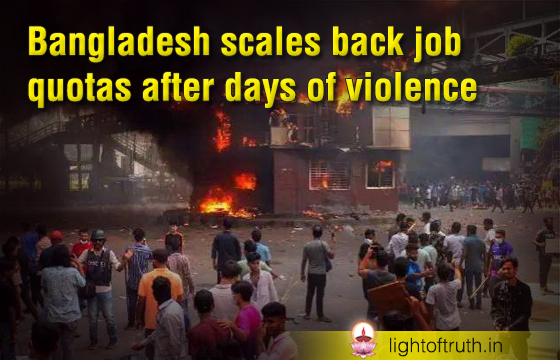
Bangladesh scales back job quotas after days of violence
Bangladesh Supreme Court reversed its earlier decision to reintroduce quota system in civil service jobs, following weeklong deadly violence that left nearly 200 killed, thousands injured, and state properties worth millions of dollars vandalized and gutted. The full bench of the Appellate Division said the government should reserve only a seven percent quota for public service jobs against the 56 percent quota policy previously. The next day, the ruling Awami League government issued a gazette to implement the court order.
The peaceful movement led by university students in the capital Dhaka and other major cities turned violent after police along with pro-government students attacked protesters last week. The attacks intensified the protests which later spread across the country. The government imposed a nationwide curfew, deployed the military, and cut off the internet for five days to restore law and order. Student activists welcomed the court verdict and urged the government to fulfill their demands including justice for the violence and killings.

Church leaders praise Pakistan amendment raising legal age for marriage of Christians
Pakistan’s National Assembly unanimously approved the raising of the minimum legal age for marriage to 18, amending a 19th-century law allowing the marriage of Christian children.
The Christian Marriage Act of 2024 amended an 1872 British rule allowing marriage at 13 for girls and 16 for boys, raising the age to 18 for both genders. The law was approved amid incidents of child marriage, kidnapping, and forced conversion in Pakistan, where about 19 million Pakistani women are victims of child ma-rriage, according to 2018 data.
The act was first introduced to the Senate last year by Sen. Kamran Michael as an update to the 1872 law and was approved on July 9 of this year after Na-veed Aamir Jeeva, a Christian from Punjab province, introduced it to Pakistan’s sovereign legisla-tive body, the National Assem-bly.
The act applies to Christians in the Islamabad Capital Terri-tory, a territory in the north-western area of the Punjab region surrounding Islamabad, the capital of Pakistan. Local Catholic lead-ers including the president of the Catholic Bishops’ Conference of Pakistan, Bishop Samson Shukar-din, and the National Commission for Justice and Peace have since hailed the act for protecting girls from forced conversions and child marriages, which is very common in Pakistan.
The new amendment may help prevent the practice of abducting young girls from the minority population of Christians and the forcing of them to convert to Islam and marry an older man. Fewer than 2% of Pakistanis are Chri-stian and Hindu, respectively. Sunni Islam is the majority reli-gion, at about 83% of the popu-lation, while Shia Islam is about 12% of the population.

Canonization process for first Korean Cardinal begins
The Vatican has approved the sainthood process for first Korean Cardinal Stephen Kim Sou-hwan, known for his love for the poor, efforts for lay participation in the Church, and support for demo-cracy.
The Vatican has allowed the launch of the sainthood process for Cardinal Stephen Kim Sou-hwan, the first Korean cardinal known for his initiatives in interfaith dia-logue, lay participation and pro-democracy stance.
In a statement, the Archdio-cese of Seoul said it has received the “no objection” letter from the Vatican’s Congregation for the Causes of Saints to start the process. Archbishop Peter Chung Soon-taick of Seoul received the letter on June 18, allowing the archdiocese to venerate Cardinal Kim as a “Servant of God.”
Kim was born in 1922 and ordained a priest in 1951. He was ordained as the bishop of Masan diocese in 1966 and the archbishop of Seoul in 1968. In 1969, Pope Paul VI made him a cardinal.
He is credited for working to implement the spirit of the Second Vatican Council. He is hailed for strengthening the Korean Church amid various trials and tribula-tions, including political turmoil under a series of military regi-mes.
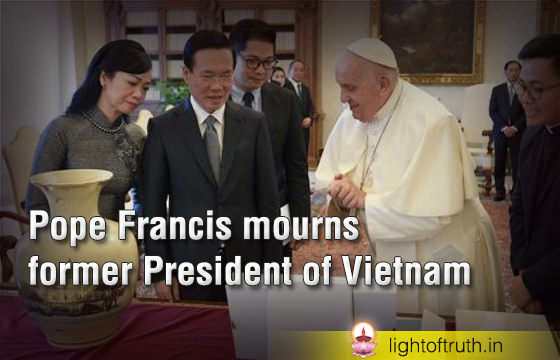
Pope Francis mourns former President of Vietnam
Pope Francis has expressed his condolences for the death of Nguyen Phú Trong, and the Ge-neral Secretary of the Communist Party of Vietnam and the country’s former President.
In a telegram sent on his behalf by the Holy See’s Secretary of State, Card. Pietro Parolin, to the country’s current President, Gene-ral Tô Lâm, the Holy Father ex-pressed his closeness to all who mourn the long-serving leader of the Asian country, who died at age 80 last week, after battling an illness.
“Having learned of the death of His Excellency Nguyen Phú Trong, General Secretary of the Communist Party and former President of the Socialist Re-public of Vietnam,” the telegram began, “His Holiness Pope Fran-cis sends condolences to all who mourn his loss, especially his fa-mily, together with the assurance of his prayers for their consolation and peace.”
In the text, the Holy Father expressed “particular apprecia-tion” for the late President’s role “in fostering and promoting the positive development of the relations between Vietnam and the Holy See.”
Pope Francis concluded his message by affirming his spiritual closeness to President Tô Lâm and to all his fellow citizens at this time of sorrow for the nation.
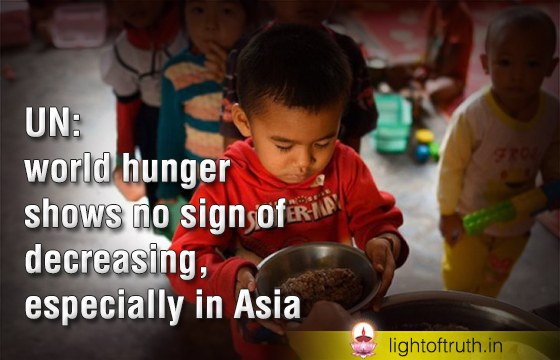
UN: world hunger shows no sign of decreasing, especially in Asia
Some 733 million people suffered from hunger last year, that is one person in 11,152 million more than in the pre-pandemic period (2019). This is the third consecutive year that the number is not decreasing, remaining “stu-bbornly unchanged,” this according to a report on The State of Food Security and Nutrition in the World (SOFI) released by the Food and Agriculture Organisation of the United Na-tions (FAO) and four other agencies. The document, presented in Rio de Janeiro, Brazil – the country that holds the rotating presidency of the G20 this year – underscores the fact that the fight against hunger has suffered a 15-year setback.
Undernourishment levels are comparable to those of 2008-09 and the Sustainable De-velopment Goal of Zero Hunger appears un-achievable by 2030, despite some improve-ments in specific areas, like breastfeeding or stunted children. Instead, if current trends continue, 582 million people will be chronically undernourished by the end of the decade, 130 million more than in the pre-COVID-19 period. At the regional level, there are wide variations. In Asia, the percentage of people afflicted by food insecurity and malnutrition has stabilised at 8.1%. But hunger is still a huge problem for the region, home to more than half of the world’s hungry people, or 385 million people.
South Asia has the highest percentage, with 13.9% undernourished (almost 281 million), while in East Asia the figure is less than 2.5% and it is just over 6% in Southeast Asia. Food insecurity (defined as the situation in which an individual is without food for one or more consecutive days) also continues at record levels in South Asia, but the worst data come from Africa, where 58% of the population is in this condition. In South Asia, 2023 saw a drop to 41.1% (compared to 24.8% in the region), equal to 833.4 million people.
Only Central Asia has seen improvements over 2021, with 2.4 million fewer people suffering from severe or moderate food in-security, even though 16.6% of the population is still affected.
Compared to the past, hunger today affects men and women almost equally, the United Nations points out, thanks mainly to improve-ments in the conditions of women around the world. Asia, on the other hand, has the highest number in absolute terms, with over 1.65 billion people who cannot afford a healthy diet.