
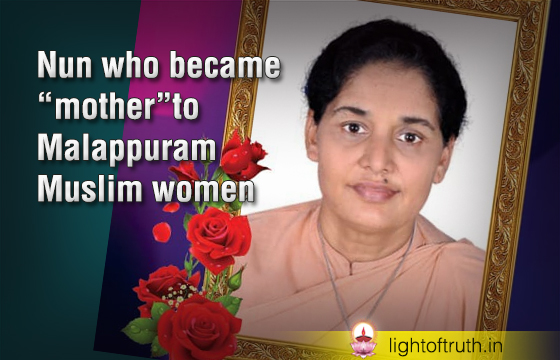
Church lead ers have mourn ed the death of a well-known so-cial worker and reformer, who had become “am-ma” (mother) to hundreds of wo-men, mostly Mu-slims, in Kerala’s Malappuram dis-trict. Apostolic Carmel Sister Marienie succumbed to cancer on October 21 at a private hospital in Kozhikode, Kerala. She was 58.
“Her passion for the people of Nilambur [Kerala] was palpable in everything she dreamt and did for them,” Sister Maria Nirmalini, Apostolic Carmel superior general told Matters India October 23. Sister Marienie was a crusader of women’s empowerment in Nilambur, a town in Kerala’s Malappuram district, as the director of Fatimagiri Social Service Centre since 2010. She had worked tirelessly for their welfare and brought several changes in their lives, Sister Nirmalini said.
“Her empowerment of women, awareness programs and relief and comfort during floods were well appreciated,” said Sister Nirmalini who termed Sister Marinie’s “untimely death” as a big loss to their congre-gation as well as to the people of Kerala.
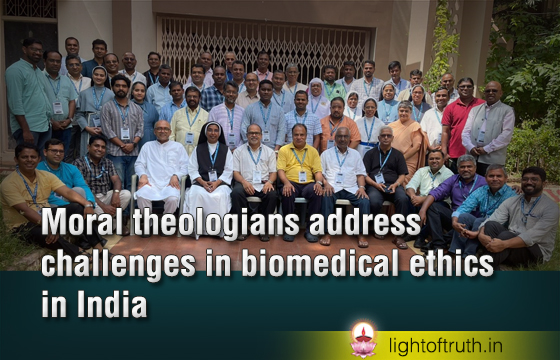
Moral theologians address challenges in biomedical ethics in India
Around 60 Catholic moral theologians from across India have spent three days in Secunderabad, Telangana, to address mounting ethical challenges in the country’s healthcare system. “Biomedical Ethics: Developments and Challenges in the Indian Scenario” was the theme of the October 18-20 conference of the Association of Moral Theologians of India (AMTI). Keynote speaker Doctor P. Ranganadham, a renowned neurosurgeon in the state, lamented the erosion of ethical standards in the medical field. The senior consultant in neurosurgery from Aster Prime Hospitals expressed concern over the commercialization of healthcare. He stressed the need to view medicine as a service rooted in compassion, not a profit-driven business. The doctor commended the government’s Ayushman Bharat initiative for enhancing access to healthcare for economically disadvantaged populations. Bishop Gerald John Mathias of Lucknow, who inaugurated the event, highlighted the vital role of moral guidance in healthcare, setting the tone for three days of profound reflection Bishop Udumala Bala of Warangal, who led the final day’s Mass, emphasized the importance of healthcare professionals upholding ethical principles and urged moral theologians to promote these values amid rapid advancements. The conference addressed a variety of pressing bioethical issues, including assisted reproductive technologies (ART), surrogacy, euthanasia, and the ethical dilemmas surrounding the withdrawal of life support for terminally ill patients. Other topics included medical tourism, organ donation, mental health, challenges faced by the transgender community, and the growing role of artificial intelligence in healthcare. Pope Francis’s appeal for a “culture of encounter,” where no individual is marginalized or excluded from medical care, served as a moral compass for the discussions. The participants highlighted the need for a strong ethical framework to brace these complex issues.
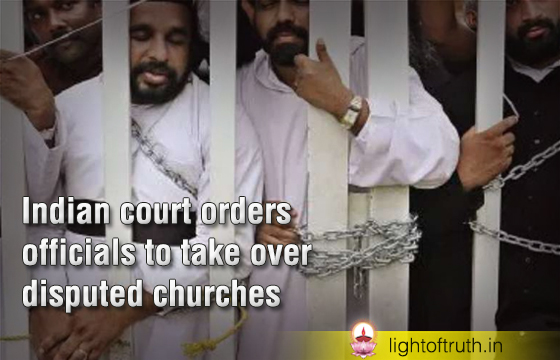
Indian court orders officials to take over disputed churches
The top court in India’s southern Kerala state has refused to set aside its earlier order directing government officials to take possession of six churches in a dispute between two factions of the Oriental Syrian Orthodox Church of Antioch. The church properties are being claimed by both the warring Jacobite and Orthodox factions of the Damascus-based church. The factions have been fighting over sharing churches and other assets in Kerala since they split in 1911. A division bench of Kerala High Court on Oct. 17 dismissed appeals from the Jacobite faction, which currently retains the six churches, and asked district collectors of Ernakulam and Palakkad in Kerala to take their possession as per an order of the Supreme Court. India’s top court declared the Kerala-based Orthodox faction the legal heir to all temporal properties of the Oriental church in India in 2017. But the Jacobite faction refused to comply, saying they were in the majority and, hence, the churches and other properties belonged to them. The high court’s order on Aug. 30 directed the district collectors to take possession and file a compliance report on Sept. 30. However, the collectors – the top government officials in districts – could not implement the court order because of opposition from the Jacobite faction, and the Orthodox faction filed a contempt case against the state government. The Jacobite faction sought quashing of the Aug. 30 order, but Justices Anil K Narendran and P G Ajithkumar dismissed its appeals. Advocate Biju Oommen, secretary of the Orthodox Church Association, said the Kerala High Court’s order asking the government to take possession “is the right direction.” Oommen is confident that the court will eventually help transfer the churches to the Orthodox faction, as they are the legal owners, as per the Supreme Court’s 2017 order. “We are now hopeful that we will get back our churches,” he told on Oct. 18. However, the rival faction is unlikely to give up easily.

Catholic leaders want review of Muslims’ land claim in Kerala
Catholic leaders have urged the Kerala government to review a state panel’s report favouring a Muslim charity’s claim over a piece of land, which threatens to evict some 600 families, most of them Catholics. Archbishop Joseph Kalathiparambil of Verapoly has urged the state government to review the Justice M. A. Nissar commission report. In an Oct. 26 statement, the archbishop said these families in a coastal village in Erna-kulam district legally bought the land decades ago and built their homes on it. He said the commission “arbitrarily inclu-ded” these lands as part of properties donated for Muslim charity (as waqf land). The archbishop’s statement said that the government should review the report and restore the ownership of the land to the original owners. The govern-ment appointed the commission in 2008 to examine the “irre-gularities” in the functioning of the state Waqf board. The commission submitted its report to the government in 2009, and the cabinet approved it the following year. The Arabic word “Waqf” literally means detention, and in Islamic Sharia law, it denotes the permanent submission of a person’s wealth or property for charity. The Central Waqf Council and State Waqf Boards manage waqf in India. The prelate asked the government to review the commission report to help the families in the neighbouring Kottapuram diocese, a suffragan of his archdiocese. “None of the victims knew about the inclusion [of their land and homes]” as Waqf properties, noted Father Antony Xavier, the parish priest of Valankanny Matha Church, which is part of the disputed land in Muna-mbam village. Among the 600 families, 400 are Christians, and others are Hindus. He said they started a relay hunger strike a fortnight ago deman-ding to restore their land ownership rights. The families claimed they legally purchased the land, which belonged to a local Muslim institution, Farook College, between 1988 and 1993, paying the prevailing market price and through registered land deeds.
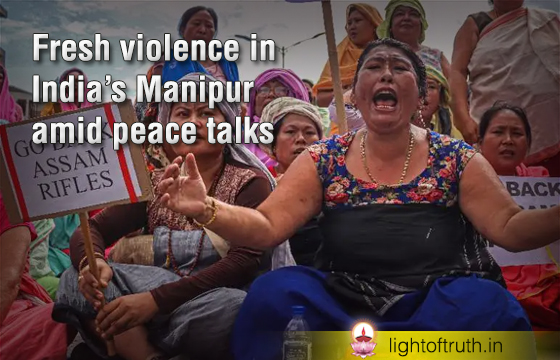
Fresh violence in India’s Manipur amid peace talks
Peace talks in India’s strife-torn Manipur state have suffered a setback after fresh violence broke out when unknown gunmen attacked a police station and set on fire five houses. The attackers opened fire with highly sophisticated weapons at the Borobekera police station in Jiribam district in the early hours of Oct. 19, local officials said. However, the army and state police repealed the attack, and there were no human casualties. A search operation was launched for the attackers across the district. Media reports blamed the armed groups of indigenous Kuki tribal people, who are mostly Christians, for the attack as the houses of the Meitei Hindus were set on fire.
A Christian leader disagreed with the “misleading” reports and said “unknown miscreants” had “set on fire a closed Chri-stian school at the district headquarters on Oct. 18,” a day before the Kuki people attacked the police station and Meitei houses. “We do not know who is behind the violence,” he told on Oct. 21 on condition of anonymity due to security reasons. He said the attacks appeared to be an attempt to ”derail the peace initia-tive taken by the federal government.” “People in the state are fed up with violence and bloodshed. They want peace,” the Christian leader added. The sectarian clashes, which began on May 3 last year, have left about 230 dead, displaced over 60,000, mostly tribal Christian people, and destroyed over 360 churches and Chri-stian institutions. Among the 3.2 million people in the state, 41% are indigenous Kuki-Zo people, mostly Christians, and the influential and wealthy Meiteis Hindus account for 53 percent. The north-eastern state borders the civil war-hit Myanmar. The current violence began when the Kuki people objected to a government plan to grant tribal status to the Meitei Hindus, helping them access reservation benefits under India’s affirmation action policy. The Kuki people allege that the official tribal status will also allow the influential Meitei community to buy land in their indigenous areas, which curren-tly can be sold only to tribal people.
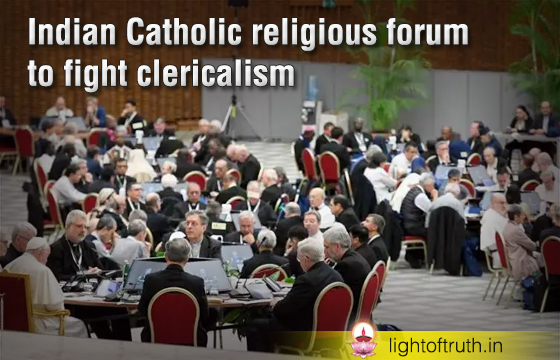
Indian Catholic religious forum to fight clericalism
A Catholic religious forum has vowed to fight clericalism in the Church by promoting lay leadership. “Clericalism is a serious issue and we have to fight it,” said Father Anand Mathew, the newly elected national convener of the Forum of Religious for Justice and Peace, a body of progressive religious priests, brothers, and nuns in India. Mathew, a mem-ber of the Indian Missionary Society based in the temple town of Varanasi in northern Uttar Pradesh, was elected unopposed to the post at its bi-annual convention in Indore in central India on Oct. 20. The Church in India is cleric – and bishop – centred and the involvement of the laity is “very negligible,” Mathew told on Oct. 25. The lay people should get “their fair share,” the priest said. The participants vowed “to work towards empowering the laity, including women, to transform the Church into a vibrant institution that stands for “the poor and those on the periphery,” Mathew added. The forum, established in 1987, has 21 state units. The forum has decided to run regional awareness campaigns among laypeople, including women and the youth, to promote gender equality in the Church’s decision-making bodies. “Once they [laypeople] are brought to the leadership level, it will infuse new dynamism,” Mathew added. The forum asked the Indian Church to take inspiration from the ongoing Synod on Synodality, convened by Pope Francis at the Vatican. The Synod on Synodality is notable for its diverse parti-cipation, welcoming laypeople and priests alongside bishops. As part of its mission, the members vowed to adopt “simpler lifestyles” and live “closer to the poor,” as Indian Church members face violence from right-wing Hindu groups. The participants stressed the need to “internalize individually and colle-ctively the values” of the papal encyclical Laudato Si’ (Praise be to you) and the apo-stolic exhortation Laudate Deum (Praise be to God). “Development must be people-centred, inclusive, holistic, just, equitable, sustainable, and life-promoting,” the forum said. It expressed concern over the exploita-tion of the earth, leading to “climate change.” The forum wanted to fight the government’s discriminatory and pro-rich policies.
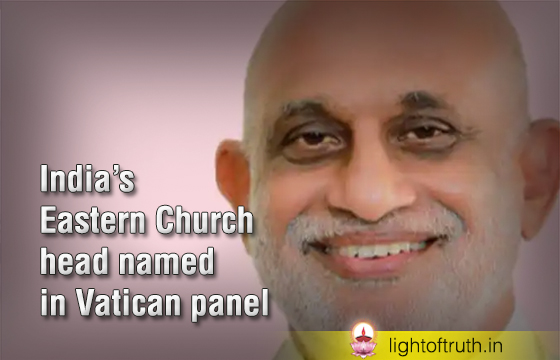
India’s Eastern Church head named in Vatican panel
The India-based Syro-Malabar Church has welcomed the appointment of its head, Major Archbishop Raphael Thattil, to a ten-member special Vatican committee on Eastern rite Churches. The appointment made by Pope Francis “is a major recognition to the Syro-Malabar Church,” said Father Antony Vadakkekara, spokes-person of the southern Kerala-headquartered Church. Thattil was “appointed a few days ago, and we were informed today,” he told on Oct. 23. Vadakkekara said the special committee advises Pope Francis on forming policies on Eastern Churches. With 35 dioceses in India and abroad, Thattil represents the second-largest Eastern rite Church in communion with the Holy See. It claims a membership of some 5 million Catholics. ”No doubt, the appointment shows Pope Francis’s special consideration toward the Church that is spread across the globe,” the Vincentian priest added. Thattil’s presence will “effectively help” the Eastern rite Churches worldwide, Vadakkekara added. Before his elevation as the head of the sui juris Church in January, Thattil led the Shamshabad diocese in northern India, touted to be the largest diocese in India, spread over 22 Indian states. As its head, Thattil visited the mission stations in remote villages with poor road connections. A priest who worked with Thattil in northern India said Thattil’s mission experience “will be an added asset” to the dicastery.
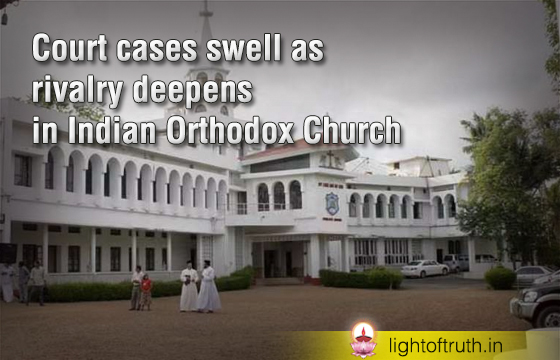
Court cases swell as rivalry deepens in Indian Orthodox Church
The rivalry within the Orie-ntal Syrian Orthodox Church of Antioch in India has deepened with its two factions and the go-vernment in the southern Kerala state approaching India’s Supre-me Court for justice over a linge-ring property dispute. A faction of the Damascus-based Church, called Jacobite Church in Kerala, appealed to the top court to “set aside” an Aug. 30 state High Court order, which directed the state government to hand over six disputed churches to the rival Orthodox faction. “We hope the court will consider our appeal and rule favourably,” a Jacobite leader told on Oct. 23. The state government, led by communist parties, became involved in the case after the state High Court found the government in “conte-mpt of court” by failing to imple-ment court orders. The Kerala High Court on Oct. 21 ordered 15 top government officials, including the chief secretary and the director-general of police, to present themselves before the court to face contempt charges. The government appealed against the High Court order in the Su-preme Court on Oct. 22, pleading not guilty to the alleged contempt. The state maintains that it with-drew from taking over the chur-ches from the Jacobites and giv-ing them to the Orthodox faction because the move could result in massive resistance and a serious threat to peace and public order. The Orthodox Church Associa-tion also approached the apex court with a caveat. “We have filed a caveat before the Supreme Court,” claimed lawyer Biju Oommen, an association official.
A caveat in the Indian judicial system allows the petitioner to present his side during a case’s hearing. The Syrian Orthodox Church of Antioch is estimated to have 2 million followers in southern Kerala. However, in 1911, the dispute over churches and other assets split the Church into the Jacobite and Orthodox factions.The Orthodox faction claims ownership of some 1,100 churches in India that are currently in the possession of the Jacobites. The Orthodox faction’s supreme head is based in southern Kerala, while the Jacobites owe their allegiance to the patriarch in Antioch. In 1934, they came together, agreed on a constitution, and elected the Catholicos of the East, based in Kerala, as their common head. However, in 1973, they split again, each faction taking over properties in areas where they dominated. The Syrian Orthodox Church of Antioch was based in Turkey. However, after World War I, the patriarchate was transferred to Homs in Syria in 1933. In 1959, it was moved to Damascus.
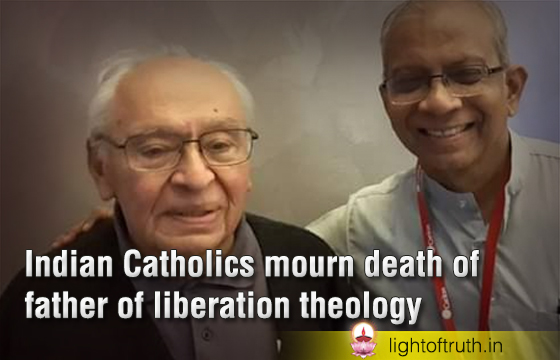
Indian Catholics mourn death of father of liberation theology
Church leaders, theologians and grassroots workers in India have mourned the death of the father of the Liberation Theology who forced Christians to recognize the poor as agents and partners and not objects of charity. Dominican Father Gustavo Gutiérrez died October 22 in Lima, capital of Peru, his native city. The “prophet of the poor” was 96.
Cardinal Filipe Neri Ferrao, head of India’s Latin Rite Church, mourned Father Gutiérrez’s death as “a tremendous loss, not only to the Church but also to the global community committed to justice, peace, and human dignity.” The South American theologian’s life was “defined by an unwavering dedication to the poor and marginalized. Through his groundbreaking work, A Theology of Liberation, he introduced the Church to a new vision of Christ’s presence in the lives of the oppressed,” said the cardinal, who is also the archbishop of Goa and Daman.
Jesuit social scientist Father Cedric Prakash, who had met Father Gutierre once, too said the “Church and in fact the whole world has lost a person who walked the talk, a courageous prophet who lived the Gospel of Jesus radically and without compromise.” Gutierrez’s theology, he added, was about a God who takes sides with the poor and the oppressed, the excluded and the exploited. Gutierrez used to stress that Christianity should accept Jesus primarily as the redeemer and the liberator of those who are oppressed.

Indian Christians protest over persecution
Some 3,000 Christians from various denominations have demonstrated near the Indian parliament, expressing concern over rising incidents of persecution against their community across the country. The Delhi-National Capital Region Christian Fellowship organized the demonstration on Oct. 26 at the Jantar Mantar – an area near parliament allotted for public rallies and protests in New Delhi. “A staggering 585 incidents targeting Christians were recorded so far this year till September,” said Michael William, president of the United Christian Forum (UCF), a Christian rights group that tracks violence against Christians in the country. The UCF recorded a total of 733 incidents of violence against Christians for the whole of 2023, an average of 61 incidents a month. The UCF has not included atrocities against Christians in the north-eastern state of Manipur, where tribal Christians have been at the receiving end of a 17-month-old communal violence that claimed over 230 lives, most of them Christians. William said repeated pleas to Prime Minister Narendra Modi and other government departments, such as the Home Ministry and the national minority commission, have proved futile. The demonstration aimed to attract government attention to Christians’ “deep anguish” over the “targeted violence,” the organizers’ statement said. ”The targeted violence and hostility appear to be suspiciously more in states ruled by the Bhartiya Janata Party (BJP),” the statement noted.