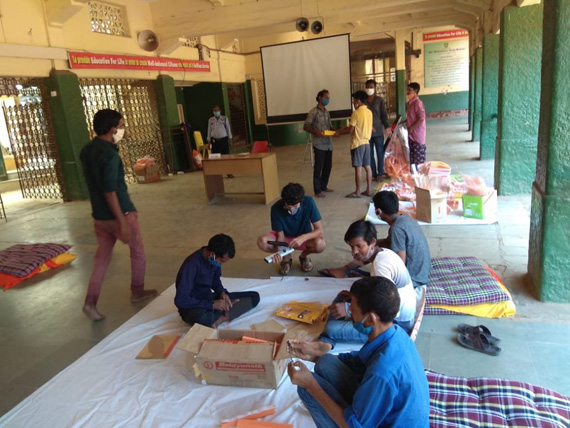
A two-day communication and media workshop on the theme “Awakening: A Missionary Responsibility” was organized by the Society of Divine Word (SVD) Mumbai province on March 3-4 at Atma Darshan, Andheri, Mumbai. As many as 30 SVD priests and two Holy Spirit sisters (SSpS) from all over India participated in the workshop. Seeing the need to preach the Gospel through social media is the need of the time as the modern techno-logy has become a handy thing.
Delhi riots 2020: A milestone on the march to a Hindu nation
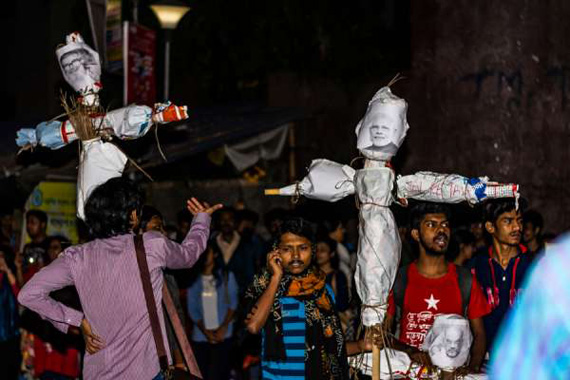
The Delhi riots of Feb. 23-27 provide harrowingly detailed narratives of the horrors of what Hindu sectarian politics has done to India, the world’s largest democracy, over the last seven decades.
After the riots in individual pockets of the capital, one could find Hindus and Muslims sharing food, echoing sentiments of brotherhood and harmony. But as one steps into northeast Delhi, the hub of the riots, the ugly face of the Hindu-Muslim divide is palpable.
Even on Feb. 29, when police said the riots were over, mobs were still shouting “Hinduon ka Hindustan” (India belongs to Hindus). In a violence-hit area, a Hindu shopkeeper was more vocal. “They have seen Hindus are not meek,” he said.
The riots provided a new but controversial slogan: “Desh ke gaddaro ko, Goli Maro salon ko” (Shoot down the traitors of the nation). The word “traitor” has somehow become synonymous with people who publicly oppose the idea of a Hindu nation and policies geared to that end. By extension, it came to mean Muslims. The slogan, publicly and brazenly, is a call to shoot down Muslims.
The Delhi riots have some ironic links to the February 2002 riots in Gujarat which killed some 2,000 people, mostly Muslims. Comparatively, the 46 deaths in Delhi could be regarded as insignificant, but the recent violence shows the definitive and advancing march toward a Hindu nation, a journey that began to take graphic shape 18 years ago in Gujarat.
Archbishop asks Indian state government to return Christ statue to cemetery
The Archbishop of Bangalore decried on March 4 the removal of a statue of Christ from a Christian cemetery. The statue was taken down after complaints from non-local Hindus.
“It is very sad, unfortunate and regrettable that the police, bowing to the pressure of a few outsiders, have forcefully removed the statue of Lord Jesus,” Archbishop Peter Machado wrote on March 4 at AsiaNews.
“It is a blow to the communal harmony of the people in our villages and also violation of the religious freedom guaranteed to us by the Indian Constitution.”
The 12 foot tall statue was taken down on March 3 from Mahima Betta cemetery in Doddasagarahalli, more than 30 miles north of Bangalore in India’s Karnataka State.
India’s ruling political party, the Hindu nationalist Bharatiya Janata Party, has been increasingly hostile to religious freedom for minorities. The BJP also controls the government of Karnataka.
According to Archbishop Machado, Christians have been making devotions at the cemetery “for the last 30 to 40 years with-out any difficulty,” and “there is absolutely no problem from local people to our burials, nor our prayers and devotions on the hill.”
He noted that for the past week or so “some people from outside have been creating tens-ions by spreading wrong rumors that the place is used for con-version, which is completely far from the truth.”
“The local villagers have publicly said that the presence of Christians and their prayers are absolutely no problem for them and, this being the case, why should some outsiders come and disturb the harmony of the village,” the archbishop asked.
Women petition Cardinal Gracias for more decision-making roles
About 150 Catholic women in India have delivered a petition to Cardinal Oswald Gracias, asking that he take concrete steps to better include women in decision-making roles in the global church.
The women are partly responding with Gracias, in which the cardinal acknowledged a bias among the members of the Catholic Church’s all-male hierarchy against giving women more leadership roles. In that interview, he also said he and his peers must “shed this prejudice.”
The three-page memorandum praises Gracias’ words in the interview, but asks for “changes in the policies, practices and structures of the Church so that women can participate fully in … leadership.”
Support independent Catholic news. Gracias is the archbishop of Mumbai, president of the Catholic Bishops’ Conference of India and one of six members of Pope Francis’ Council of Cardinals. The petition was partly drafted by Astrid Lobo Gajiwala, a medical doctor and scientist who has served as a consultor to the bishops’ conference and helped draft the organization’s gender policy.
Some of the strongest language in the petition refers to that policy, passed in 2010 and the first of its kind in the global church. The policy said the Indian Church “rejects all types of discrimination against women as being contrary to God’s intent and purpose,” according to the memo.
Catholic groups team up to help Delhi riot victims
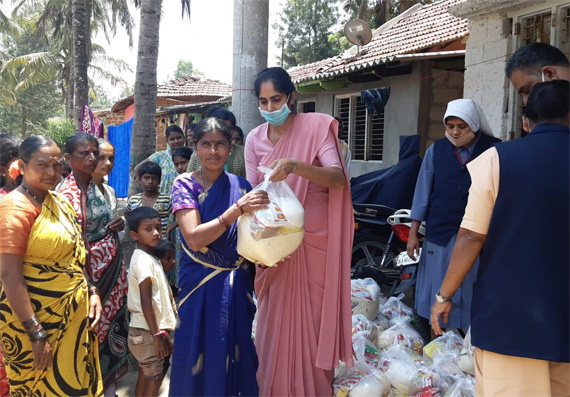
Various groups of Catholics in Delhi have decided to pool their resources and personnel for relief and rehabilitation works among the victims of sectarian violence in the national capital.
They met on March 10 under the leadership of Archbishop Anil Couto of Delhi and decided to work under the banner of the archdiocese and witness Christian services of love and compassion.
Presentation Sister Anastasia Gill, a member of the Delhi Minority Commission and among the first Christians to reach out to the riot victims in northeastern Delhi, narrated her painful experience in Shiv Vihar, a worst affected area.
She suggested the CRI members to join the local parish priest and heads of various institutions to send volunteers to help in distribution of relief material and to counsel women and children traumatized by the riots.
A legal team led by Jesuit Father Arun will help file First Information Reports and monitor people’s security requirements.
Retired bishop becomes assistant parish priest
Bishop Sebastianappan Singaroyan, who resigned as the head of Salem diocese for health reasons, has moved to a parish to work as an assistant pastor.
Pope Francis on March 9 accepted the resignation of the 68-year-old bishop and appointed a diocesan administrator.
Bishop Singaroyan, who resigned seven years before the statutory age of retirement for a bishop, says he wants to serve his people as an assistant pastor.
He left the bishop’s house on March 11 after 19 years as the prelate of the diocese in Tamil Nadu State. He now lives in Karpur Annai Velankanni substation church on the outskirts of Salem city. He went there riding his motorbike.
“The staff at Bishop’s House gave him farewell with tears,” says a Facebook post.
Bishop Singaroyan was known for his simple ways. When he was the bishop he used to travel by bicycle to nearby communities and by motorbike to far distances.
Cardinal Re claims Cardinal Zen is at odds with John Paul II, Benedict XVI on China
The newly-appointed Dean of the College of Cardinals purportedly sent a letter to cardinals on February 26 claiming that the China-Vatican deal deal represents the minds of St John Paul II and of Benedict XVI, and that Cardinal Zen is mistaken in his opposition to the deal.
An Italian text of the letter from Cardinal Giovanni Battista Re, dated on Feb. 26, was published on Feb. 29 by La Nuova Bussola Quotidiana.
“I desire first of all to emphasize that, in their approach to the situation of the Catholic Church in China, there is a profound symphony of the thought and of the action of the last three Pontificates, which — out of respect for the truth — have favoured dialogue between the two parties and not contrariety,” Cardinal Re wrote.
“Cardinal Zen has affirmed several times that it would be better to have no Accord then than a ‘bad Accord.’ The three last Popes did not share this position and supported and accompanied the drafting of the Accord that, at the present moment, seemed to be the only one possible,” he stated.
Cardinal Joseph Zen Zekiun, Bishop Emeritus of Hong Kong, has been an outspoken opponent of the 2018 agreement between the Vatican and the People’s Republic of China regarding episcopal appointments. The Church in mainland China has been divided for some 60 years between the underground Church, which is persecuted and whose episcopal appointments are frequently not acknowledged by Chinese authorities, and the Chinese Patriotic Catholic Association, a government-sanctioned organization.
Korean Christians seek action against virus-spreading sect
Mainstream Christian groups in South Korea have sought action against a neo-Christian sect accused of spreading the coronavirus that has claimed the lives of 54 people in the country.
When the virus began to spread in mid-February, authorities traced the infection to people who attended crowded prayer programs of a sect called Shincheonji Church of Jesus in the Daegu area.
Two mainstream Church groups — the National Council of Churches in Korea and the United Christian Churches of Korea — have asked the government to investigate leaders of the Shincheonji Church.
“The government should clarify facts about the spread of the infectious disease, arrest Shincheonji leader Lee Manhee and other leaders and investigate their actions,” they said in a joint statement on March 6.
The Protestant groups alleged that the secretive doomsday cult had been intentionally withdrawing information about its 200,000 followers, resulting in the spread of the infection.
According to South Korea’s Centres for Disease Control and Prevention, Shincheonji followers accounted for almost 60 percent of 7,513 cases in the country, most centered in Daegu, the base of the controversial sect.
The death toll had reached 54 on March 10, the government body said.
The Protestant groups said the Shincheonji sect is trying to buy more time to manipulate its list of followers.
“The majority of Shincheonji believers are not only the victims of this incident but also the victims of faith, which is a cult and fundamentally fake,” the groups said.
Sri Lankan cardinal prepared to launch protests
Cardinal Malcolm Ranjith says he is ready to launch street protests if Sri Lanka’s government does not bring the culprits behind last year’s Easter bombings to book.
He said the administration has not taken action regarding the Easter Sunday suicide bombings that killed about 300 people, including 40 foreign nationals, and injured at least 500.
“The most senior person in the government should have been brought to the Criminal Investigation Department and question-ed if he had been aware in advance of the Easter bomb blasts,” said Cardinal Ranjith on March 8 at Tewatta Church.
“There are reports that police officers investigating the Easter Sunday suicide bomb blasts are currently being transferred.”
The cardinal said the government should publish all the interim committee reports on the bomb blasts.
Pakistan’s PM fails to defend rights of minorities
When Imran Khan took office as Prime Minister of Pakistan in August 2018, persecuted Christians in the Muslim-majority nation expected a policy change for the better.
However, the 67-year-old former cricket captain did not live up to their expectations. On the contrary, violence against Christians continued uninterrupted, allegedly with the tacit support of the establishment.
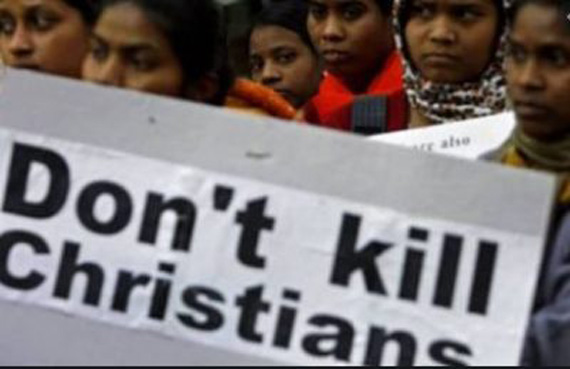
The latest victim in the long chain of violence was a 22-year-old Christian youth from Punjab province. Saleem Masih was beaten black and blue for cleaning himself in a well owned by a Muslim. He died of his injuries three days later on Feb. 28.
Rights activists like Sabir Michael say religious minorities in Pakistan have become an easy target for Islamic fundamentalists because of their poverty in all areas – social, economic, cultural and political.