
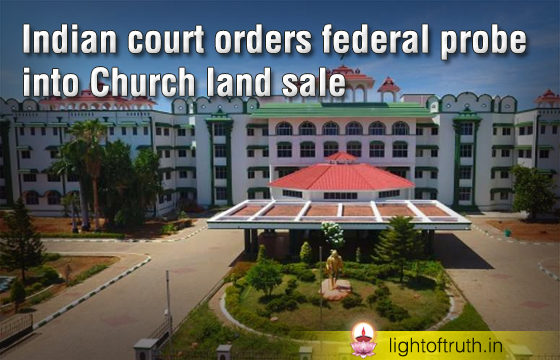
The top court in India’s southern state of Tamil Nadu has ordered a federal probe into allegations of illegally selling British-era Church properties worth millions in a Protestant diocese. The Madurai bench of the Madras High Court on Nov. 22 asked the Central Bureau of Investigation (CBI), the country’s top investigating agency, to probe the allegations linked to properties of the Madurai-Ram-nad diocese of the Church of South India. The court order was issued in response to a public interest petition filed by D. Devasahayam, a diocese mem-ber. The petitioner alleged that the Church of South India Trust Association (CSITA) and dio-cesan officials sold 31.10 acres of land worth over 220 million rupees (US$2.6 million) for a mere 12 million rupees. During the sale, the accused persons accepted 9 million in cash, in gross violation of the country’s existing banking norms. “There were fraudulent transactions of astronomical level,” including “illegal transfer of money,” the court’s order noted. In 1912, the ruling British colonial govern-ment gave the land to the Ameri-can Board of Commissioners for Foreign Missions, later known as the United Church Board for World Ministries, to set up an industrial home for needy women, carry out farming, and use the income for the welfare of the inmates. The mission body continued to administer it till 1973 and later handed it over to the CSITA without changing its original purpose. The petitioner said he approached the court because the police failed to address the corruption.
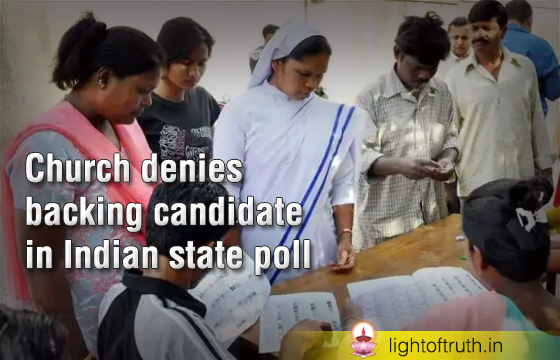
Church denies backing candidate in Indian state poll
A Church leader in the eastern Indian state of Jharkhand has warned of legal action against political parties and candidates falsely claiming the Church’s support in the ongoing state assembly election. Father Bishu Benjamin Aind, vicar-general of Khunti diocese in the state, said that “the Church never endorses or asks its faithful to support any political party or candidate.” “People are free to exercise their voting right according to their choice,” the priest told and added if any such cases are reported, “we will initiate legal action.” Aind was reacting to a video circulating on social media since Nov. 10 claiming that Christians were told to vote for an independent candidate named Anita Surin from the Torpa constituency in Khunti district. However, the priest denied any such direction was issued by the Church. Polling was held in Torpa and 42 other constituencies in the first phase on Nov. 13. The second phase of polling for 38 of the total 81 constituencies is scheduled on Nov. 20. “Since there is one more phase due, there is a high possibility of similar cases occurring,” the priest said. Aind, who belongs to the indigenous Oraon tribe, said the video claiming Church support for Surin could be “the handiwork of some anti-social elements who want to divide people in the name of caste, creed and religion.”
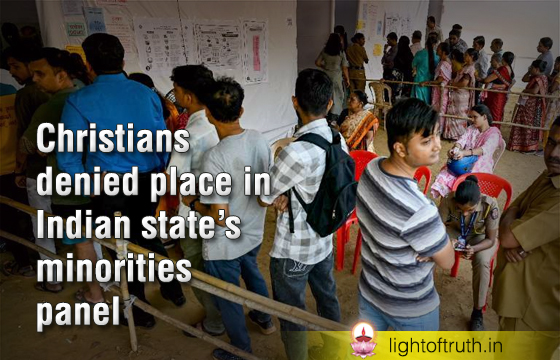
Christians denied place in Indian state’s minorities panel
The western Indian Maharashtra state did not include a Christian representative in the state panel meant to safeguard the interests of religious minorities, which Christian leaders say was unfortunate and unusual. “It is unfortunate that no one from the Christian community was given representation on the 11-member Maharashtra State Minorities Commission,” said Father Nigel Barrett, the spokesperson of Cardinal Oswald Gracias, who heads the Bombay archdiocese in the state capital Mumbai.
The pro-Hindu Bharatiya Janata Party (BJP)-led government on Oct. 11 filled nine vacant commission posts with six Muslims, two Jains, and a Sikh member ahead of assembly polls in India’s most industrialized state on Nov. 20. The minority panels are set up to safeguard and protect the interests of Muslims, Sikhs, Christians, Buddhists, Jain, and Zoroastrians (Parsis), who are notified as minority communities in the country. Christians comprise less than 1 percent (0.96) of Maharashtra state’s 126.5 million people, most of whom are Hindus. Buddhists (5.8 percent) and Jains (1.25 percent) are more numerous than Christians. However, Sikhs (0.20 percent), who are fewer than Christians, have a representative in the panel. “As a religious minority, we have every right to have at least one member in the statutory body,” Father Barrett told. The priest added, “There is resentment among the community.” He asked the government to reconsider the decision. It is the first time the state had completely kept Christians out of the minorities panel, noted Abraham Mathai, a former member of the state’s minorities commission. Christians “are legally entitled to get a seat on the commi-ssion,” Mathai told. Catholic activist Melwyn Fernandes from Mumbai (formerly Bombay) questioned the appointments just four days before the elections were announced. These appointments are aimed “at appeasing mi-nority groups,” Fernandes told. The Muslim community that got maximum representation constitutes over 12 percent of the population. So, their support is crucial ahead of the polls, he said. “It is evident that the appoint-ments were purely political,” Fernandes observed.
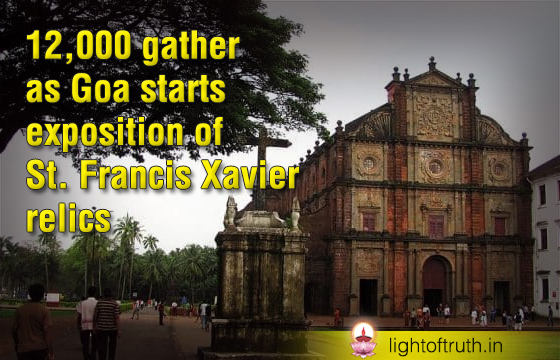
12,000 gather as Goa starts exposition of St. Francis Xavier relics
At least 12,000 people thronged India’s western state of Goa on November 21 to participate in the ceremonies marking the start of the once-in-ten-year exposition of St. Francis Xavier’s relics. The 18th expo-sition started with a Mass at the Basilica of Bom Jesus, a 16th-century UNESCO-approved world heritage monument that houses the saint’s body. “We come here as pilgrims to his feet, begging for Goa’s mercy through his intercession,” Archbishop Anil Couto of Delhi, who led the Mass, said in his sermon. Four centuries have passed since “his incorrupt body” arrived in Goa from the island of Sancian [now Shangchuan] via Malucca,” the prelate said. Cardinal Filipe Neri Ferrão of Goa and Daman said the theme of this year’s exposition is “We are messengers of the Good News of Jesus Christ.” “We are called to spread it as St. Francis did in his life,” the prelate said. Goa archdiocese has commissioned a book, Stories in Silver, with photos and text by Pantaleao Fernandes, which will be sold during the exposition. Fernandes said whenever he visited the basilica, he was curious to know the details of the 32-panel plates that adorn the casket. Fernandes told that the book narrates the stories and miracles contained in the panels and also tells the story of St.Francis Xavier’s journey from Europe. After the Mass, the relics were taken out in an electric carriage, deviating from the practice of Catholics carrying them on their shoulders. Over 2,000 men and women formed a human chain to view the relics from the basilica’s entrance to the nearby cathedral, and many joined the procession. According to authorities, all 10,000 chairs set for the visitors were occupied, and many stood to witness the opening ceremony on Nov. 21. The relics were brought down and kept inside the nearby 16th-century cathedral, open from 7 a.m. to 6 p.m. “We expect 8 million people to visit this year,” Father Henry Falcao, diocesan convener of the exposi-tion committee, told.
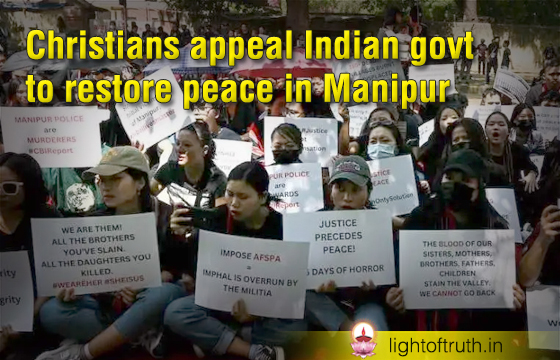
Christians appeal Indian govt to restore peace in Manipur
A Christian ecumenical body has urged India’s federal government to restore peace in Manipur state, where life was disrupted by the latest bout of violence between indigenous Christians and Meitei Hindus. “The gravity of the situation cannot be overstated. The peo-ple of Manipur are caught in a state of utter hopelessness and insecurity,” said Reverend Asir Ebenezer, general secretary of the National Council of Chur-ches in India (NCCI), repre-senting Protestant and Ortho-dox Churches in the country. In a public appeal on Nov. 19, the NCCI referred to the brutal killing of 20 people, including women and children, since Nov. 7 in the state bordering civil war-hit Myanmar. “Fami-lies have been torn apart, and entire communities have been displaced from their homes. Children cannot continue their studies,” it said. The NCCI also referred to the miseries caused to the people by the acute shortage of basic nece-ssities such as food, health-care, and transport facilities. “The continued instability is eroding the very social fabric of Manipur, and the toll on the mental and physical well-being of the people is staggering,” it said. The spate of violence began on May 3 last year and has claimed around 250 lives besides displacing some 60,000 people, mostly Christians. Over 360 Churches have been destroyed. “We condemn the violence in the strongest terms and express our grave concern over the lack of sufficient and timely intervention by the authorities,” the NCCI said.

Tribal Christians hail secular alliance’s win in India’s Jharkhand
Tribal Christian leaders have welcomed a secular regio-nal party returning to power in India’s eastern Jharkhand state in the recently concluded polls. The Jharkhand Mukti Morcha (JMM), which advocates tribal people’s rights and interests, secured 34 seats in the 81-seat state assembly. Its secular allies, including the Indian National Congress and socialist and communist parties, won 22 seats, bringing the alliance tally to 56 when the results were announced on November 23. “More than happiness, tribal Christians are relieved they won’t have to live in fear and uncertainty under a BJP government,” said Ratan Tirkey, a former member of the Jharkhand government’s tribal advisory panel. Bharatiya Janata Party (BJP) could secure only 21 seats. Smaller parties, including those allied with the BJP, won the rest of the seats. The JMM-led alliance impro-ved its performance with 56 seats, up from 47 in the 2019 election, and its leader, Hemant Soren, will again be the chief minister. Tirkey told that the BJP tried its “best to polarize the voters” based on religion and caste “but did not succe-ed.” Tirkey, a tribal Catholic leader, said the JMM is favo-urable to Christians. “Hence, we are planning to put forth some of our long pending demands like the revival of subsidies for pilgrimages in and outside India for Christians, and establishment of a minority commission office to ensure the welfare of minority commu-nities in the state,” he said.
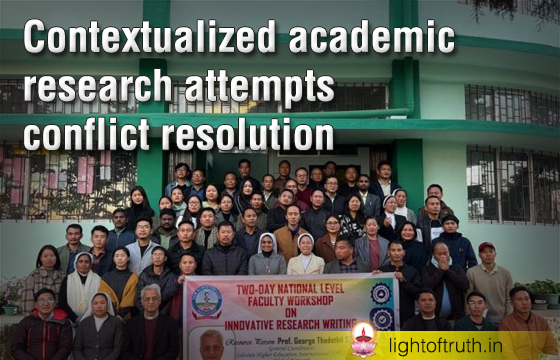
Contextualized academic research attempts conflict resolution
A premier college in violence hit Manipur state conducted a three-day innovative Faculty Deve-lopment Program Workshop on Innovative Research Writing, November 21-23. The faculty members of Don Bosco College Autonomous Maram who belonged to the different communities of the state having experienced or known persons who were affected by the ongoing conflict participated in the workshop. The college is headed by Dr Sebastian Karot the principal and noted historian of the region. Former Salesian College Siliguri and Sonada Principal and General Coordinator of Salesian Higher Education International (SHEI) Global Network, Rome, Italy Prof. George Thadathil was the resource person. During the workshop, participants identified the conflict causes from their perspective and prepared conflict resolution document on Manipur 2023-24 with possible solutions. They intend to make their findings known to the government of India and the United Nations through the Salesian Representative member at United Nations Economic and Social Council (ECOSOC) in New York.
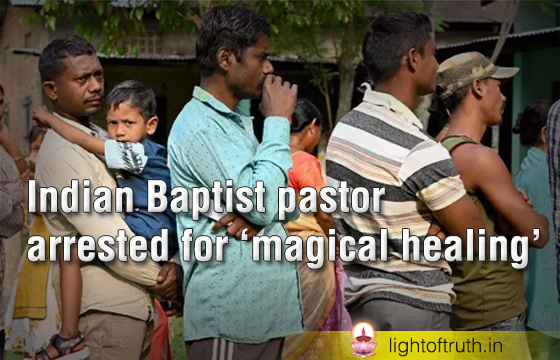
Indian Baptist pastor arrested for ‘magical healing’
Police in India’s Assam state have arrested a Baptist pastor on charges of violating a newly enacted law that curbs magical healing after he prayed over some tribal people in a village. Pastor Pranjal Bhuyan was arrested on Nov. 22 in the northeastern state for violating the Assam Magical Healing (Prevention of Evil Practices) Act and attempting to convert people to Christianity. He has been remanded to judicial custody for 14 days, police said. Bhuyan was arrested in Upper Golaghat district after a resident of Padampur village complained that the pastor was trying to convert tribal people, claiming to heal their illness through prayers. The state law came into force in March purportedly to create science-based knowledge and a safe environment to protect human health. It also aims to end evil and sinister practices that thrive on ignorance and people’s ill health. The law criminalizes practices resorting to magical healing and stipulates a three-year jail term and a fine for violations. “We had objected to the bill when it was introduced in the state assembly. The bill targets minorities like Christians and Musli-ms,” Archbishop John Moolachira of Guwahati in Assam told on Nov. 26. Under the law, people can be arrested when they pray for their relatives, said Moolachira, who is the president of the Assam Christian Forum. Prayer is a universal practice used to invoke divine intervention. The prelate observed that labeling it as a “magical healing” is misleading. “Healing is not synonymous with proselytization,” he said, adding that lawyers have been engaged in helping the pastor get bail. “We are planning to meet next month to discuss the controversial law,” Moolachira said. The Hindu right-wing Bharatiya Janata Party (BJP) runs the state government. The BJP and its supporters oppose Christian missionary work, considering it a challenge to their aim of establishing Hindu hegemony in India.

Teen rep at COP29 made climate ambassador
A student delegate from Don Bosco School Park Circus, Kolkata at COP29 held in Baku Azerbaijan last week, was declared Climate Ambassador by United Nations Agency for Develop-ment and Peace (UNADAP).
The citation presented to 14 year old student Swanik Choudhury of Class 9 reads: We commend your invaluable contribution as part of the official delegation to COP29. Your efforts have been recognised by the Secretariat, and we commend your commitment to mitigating climate change through responsible steward-ship, dedicated advocacy, and align-ment with the UNFCCC and UNSDG goals. Your participation exemplifies the spirit of global cooperation needed to drive impactful and sustainable change. The citation is signed by Executive Director of UNADAP Dr Dominic F Dixon.
Swanik, a minor, who traveled with his mother Swati Chowdhury, a teacher in the same school says, “Meeting campaigners and activists from around the world reinforced my belief in the power of unity.”
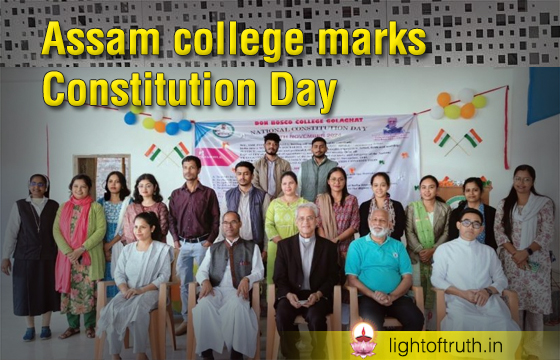
Assam college marks Constitution Day
Faculty members and students of a college in Upper Assam marked 75th anniversary of the adoption of Indian Constitution with seminar, pledge taking and medley of patriotic songs on Nov. 26.
Faculty members and students of Don Bosco College Golaghat, the second oldest Salesian Educational Centre in Assam started in 1941 cele-brated the constitution in the presence of Coordinator of Salesian Higher Education and Vice Chancellor of Don Bosco University Guwahati.
“The event was a significant occasion aimed at fostering awareness and appreciation of constitutional values among students and faculty members,” says Principal of the college, Dr. Fr. A. Amaladoss. The principal called on both students and faculty members, “to embrace their fundamental duties as citizens and to unite as brothers and sisters in upholding the values enshrined in the Constitution.”
To add a patriotic flair to the celebration, students from B.A. 3rd Semester performed a stirring patriotic songs led by Wangli Lowang and his team. Additionally, a vibrant dance performance by Ansila Dung Dung and her team captivated the audience, showcasing their artistic talents while celebrating national pride.
The program ended on a high note with everyone singing the National Anthem.