
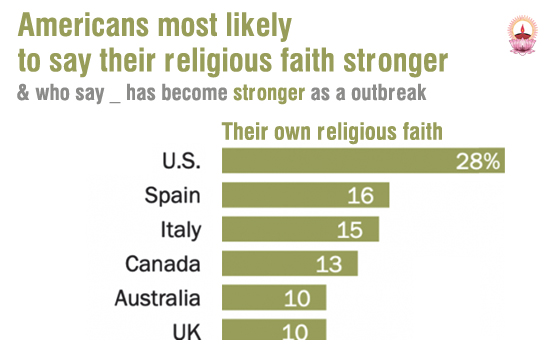
More than a third of U.S. Catholics say their own personal faith has become stronger during the coronavirus pandemic, and 3 in 10 Catholics believe the virus has strengthened the religious faith of other people in the country, according to a study released Jan. 27 by the Pew Research Centre.
Overall, 28% of Americans said their own faith had become stronger during the pandemic, with 49% of white evangelical Protestants, 21% of white non-evangelical Protestants, and 35% of Catholics agreeing.
The majority of Americans — 68% — said the pandemic has not changed their personal faith much, but despite the cancellation of religious activities and in-person services, few Americans — only 4% — say their religious faith has weakened as a result of the outbreak.
The study, conducted last summer, found that Americans are more likely than people in 14 other countries surveyed to say that their religious faith has strengthened during the COVID-19 pandemic.
“The U.S. has by far the highest share of respondents who say their faith has strengthened, with about three-in-ten holding this view,” the study reports.
In Spain and Italy, the countries with the second- and third-highest percentages, only 16% and 15%, respectively, said their faith had grown stronger. (10% was the 14-country median.)
As the study points out, Americans are more likely than people in the other surveyed countries to be religious in the first place — in Italy, for example, 25% say religion is “very important” in their lives. That number is 49% in the U.S. — and people who are religious are more likely to say the pandemic has strengthened their faith.
In countries hit by large waves of infections and deaths in the spring of 2020, the pandemic also strengthened family ties, the study found. Spain, Italy, the U.S. and the U.K. had the highest proportions of respondents who said their relationships with their immediate family members had become stronger because of the pandemic. With college and university campuses closed throughout the U.S., more young people than older people said their family connections had grown closer: Half of Americans aged 18 to 29 said so, whereas only 38% of Americans older than 50 said the same.
In nine of the 14 countries, personal religious faith grew more among lower-income people than among higher-income people. In five of the countries surveyed, the study says, those with less education are also more likely to say their faith has become stronger.
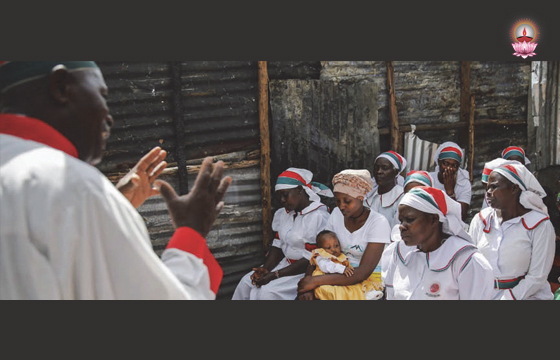
Let’s End Violence Against African Christians in 2021
As this new year begins, it’s obvious that America is facing many challenges—some old, some new. And they most certainly cannot be taken lightly. However, those of us who focus on international religious freedom also concentrate on concerns beyond our shores, and a look at Africa’s recent history in the rear-view mirror reflects terrifying images. As one deadly assault after another fades out of sight, encroaching assailants are rushing forward at terrifying speed.
The largest country in Africa and the most commercially significant, Nigeria is the site of what has been described as a slow-motion genocide in which tens of thousands of Nigerian Christians have been massacred in recent years. A Family Research Council report published in July 2020 documents horrifying statistics of mass murders there, almost entirely at the hands of three Islamist terrorist groups: Boko Haram, Islamic State in West Africa Province (ISWA-P), and Fulani jihadis.
Nigeria may be the worst example of violence against African Christi-ans, but it is far from the only one. Violent incidents across the African continent are increasing. One notorious example in November 2020 was the reported beheading of 50 civilians in Mozambique—many of them Catholic Christians.
Fighters linked to Islamic State attacked several villages in Mozambique, killing civilians, abducting women and children, and burning down homes. The gruesome description of innocent people “herded” to their death on a soccer field, where they were systematically decapitated and dismembered, was nightmarish. That wasn’t the only such incident in 2020, and it certainly won’t be the last. Due to a hapless government response, ISIS continues its assaults, most recently on January 2, 2021.

Cardinal Danish bill requiring translation of homilies threatens religious freedom
A cardinal said on Jan 22 that a proposed law in Denmark requiring the translation of all homilies into Danish is a threat to religious freedom.
In a Jan. 22 statement, Cardinal Jean-Claude Hollerich, president of the Commission of the Bishops’ Conferences of the European Union (COMECE), objected to the bill demanding that all addresses in a liturgical setting are either given in Danish or made accessible in the language.
“De facto, the impact would be of imposing undue hindrance on the fundamental right to freedom of religion,” he said.
The Catholic Church in Denmark has also expressed concern about the bill, which is thought to be directed primarily at the country’s Muslim congregations where sermons are often preached in Arabic.
Catholics comprise 1.3% of the 5.8 million population of Denmark, a historically Lutheran country neighbouring Germany, Norway, and Sweden.
Roughly a third of Catholics in Denmark are born outside the country, according to the Catholics & Cultures website. Masses in Metropolitan Copenhagen, the area surrounding the capital city, are conducted in Polish, English, Ukrainian, Croatian, Chaldean, French, Spanish, and Italian, as well as Danish.

After Israel, Will Morocco Normalize with Christians?
President Donald Trump’s Abraham Accords have been singular in focus—build Middle East peace upon Arab states establishing full relations with Israel.
And although not officially linked, three of the four nations to normalize with the Jewish state this year received something from the United States in return. The first, the United Arab Emirates (UAE), was cleared to purchase American F-35 fighter jets. (The second, Bahrain, which already hosts a US naval base, is understood to be part of a gradual Gulf alignment with Israel.)
The third, Sudan, was re-moved from the US list of state sponsors of terrorism.
This month, the fourth, Morocco, was granted US recognition of its longstanding claim to the Western Sahara, a mostly desert region on the northwest coast of Africa, which seeks independence.
But absent from the accords is any emphasis on religious freedom, despite the Trump ad-ministration making it a central feature of its foreign policy. And in relation to Christians, each nation has a unique situation.
The Emirates is officially 100 percent Muslim, though it facilitates the worship of its majority population of migrant workers. And following normalization, the UAE relaxed its sharia-based laws.
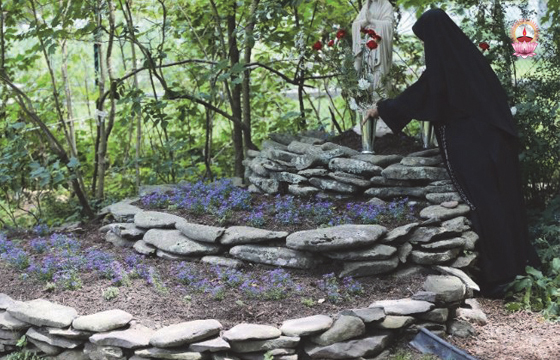
Newly-professed US religious ‘young and highly-educated’
Most religious men and women who professed their perpetual vows in 2020 are highly educated, come from a Catholic family background, and have first considered vocation at a relatively young age.
This is according to new research conducted by the Centre for Applied Research in the Apostolate (CARA).
The research was commissioned by the U.S. Conference of Catholic Bishops’ (USCCB) Committee on Clergy, Consecrated Life and Vocations (CCLV) ahead of the annual World Day of Prayer for Consecrated Life, to be marked on 2 February.
CARA received a response from 549 of 747 major superiors for an overall response rate of 73% among religious institutes. Of the 172 identified men and women religious who professed perpetual vows in 2020, 55 sisters and nuns and 57 brothers and priests responded to the survey for an overall response rate of 65%. According to the survey, the average age of responding religious of the Profession Class of 2020 is 38. Half of them were 34 or younger. On average they were 19 years old when they first considered a vocation to religious life. Three-quarters of the respondents come from families in which both parents are Catholic and 84% have been Catholic since birth.
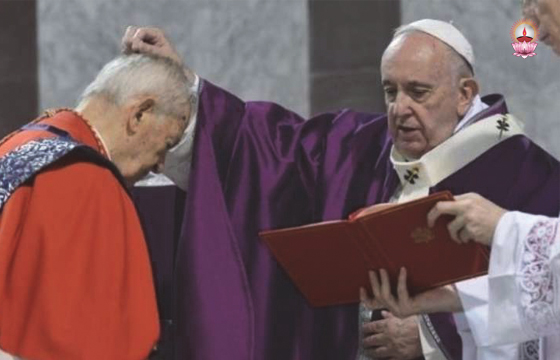
For Ash Wednesday, Vatican asks priests to ‘sprinkle’ ashes on heads
The Vatican Congregation for Divine Worship and the Sacra-ments asked priests to take special anti-COVID-19 precautions this year when distributing ashes on Ash Wednesday, Feb. 17, inclu-ding sprinkling ashes on the top of people’s heads rather than using them to make a cross on people’s foreheads.
The congregation’s note on the “distribution of ashes in time of pandemic” was published on the congregation’s website Jan. 12 and directs priests to say “the prayer for blessing the ashes” and then sprinkle “the ashes with holy water, without saying anything.”
“Then he addresses all those present and only once says the formula as it appears in the Roman Missal, applying it to all in general: ‘Repent and believe in the Gospel’ or ‘Remember that you are dust and to dust you shall return.’”
“The priest then cleanses his hands, puts on a face mask and distributes the ashes to those who come to him or, if appropriate, he goes to those who are standing in their places,” it said. “The priest takes the ashes and sprink-les them on the head of each one without saying anything.”
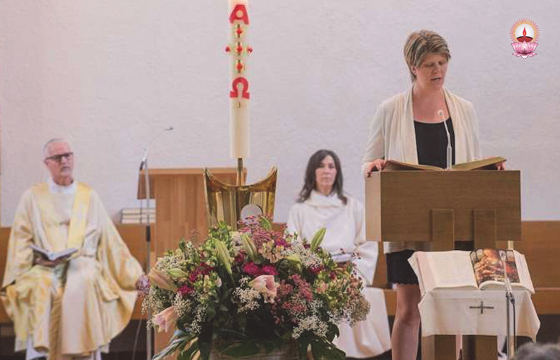
What has changed in canon law for women?
Most Catholics, who grew up seeing women at the altar reading from the Bible and serving at Mass, wondered what was improved when Pope Francis changed canon law this month, purportedly to allow women to participate in such services.
Although women have been taking care of these ministries at local bishops’ discretion, they were barred from being instituted as lectors or acolytes because church law did not allow it. These minor orders were reserved only for men until now, touted as preparation for priestly ordina-tion.
On Jan. 11, The Pope chang-ed one word in Canon 230. The law originally said: “Laymen who have the age and skills, determined by decree by the Episcopal Conference, can be permanently employed, through the established liturgical rite, for the ministries of readers and acolytes; however, this confer-ment does not give them the right to sustenance or remuneration by the Church.” Pope Francis changed the opening word, making it “laypeople” to include women. Pope Francis is pushing the Church to be more open to women, but slowly and carefully. These orders had been part of the all-male priesthood in the Catholic Church since the Coun-cil of Trent in the 16th century.
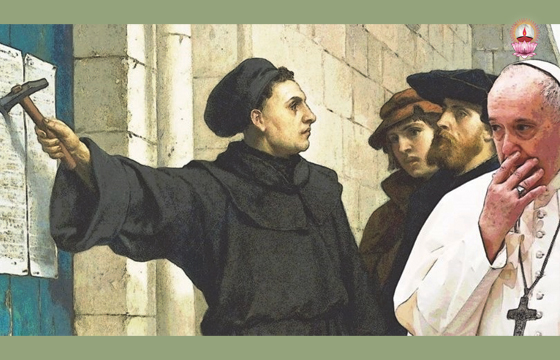
Pope Won’t Lift Luther’s Excommunication
Pope Francis has rejected an appeal to reinstate expelled Augustinian monk Martin Luther on the 500th anniversary of his excommunication, which falls on Jan. 3, 2021. The pontiff’s highly significant overtures towards Lutherans over the last five years had raised hopes in ecumenical circles for the withdrawal of the bull of excommunication, Decet Romanum Pontificem, issued by Pope Leo X on Jan. 3, 1521. Church Militant has learned that Francis will not revoke Luther’s excommunication to mark the anniversary but instead use the occasion to intensify dialogue with Lutherans. “There will be a special press release on Jan. 4 from both the Lutheran World Federation and the Vatican on the steps being taken that lead us further on the path from conflict to communion,” Professor Dr. Dirk G. Lange told Church Militant.
Pakistani Christian charged with blasphemy over Facebook post
A 25-year-old Pakistani Christian was arrested and charged with violating the country’s blasphemy laws after sharing a social media post critical of Islam in December. Pastor Raja Warris, a Christian pastor, was charged for posting on Facebook on Dec. 22 a message that reportedly hurt the religious sentiments of his Muslim neighbours.
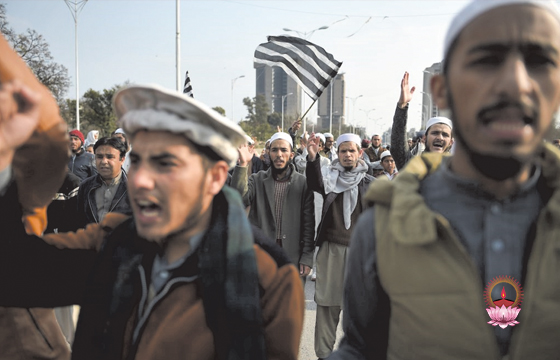
On Dec. 26, hundreds of people gathered in Warris’ Charar neighbourhood in the city of Lahore and threatened to behead the pastor and to set fire to Christian homes unless police took action.
“The situation turned dangerous when someone found out the Muslims were planning to set fire to the houses of Christians,” said Saleem Khokhar, one of those displaced by the incident.
“This forced the Christians to flee the neighbourhood,” he told the group International Christian Concern (ICC).
Hundreds of anti-riot policemen were deployed to Charar while leaders of the Christian community met with authorities to resolve the situation.
“The police said they could not guarantee the safety of our people if the accused was not presented for arrest,” said Rev. Ayub Gujjar, vice moderator of the Raiwind Diocese of the Church of Pakistan. “We reluctantly agreed to bring Warris but demanded that he be kept at an undisclosed location due to the serious threat to his life,” the church leader told local media.
On Dec. 27, police charged Warris with committing blasphemy. He also apologized for the social media post.
William Stark, regional manager of ICC, said called on Pakistani authorities “to continue to protect the homes of Charar’s Christians” although Warris has already been charged.
He said “there is still the potential for mob violence against the Christians of Charar.”
“No one should be forced to flee their home because of a social media post,” said Stark, adding that Pakistan’s blasphemy laws “must not be misused to justify mob violence.”
Advocate for India’s domestic workers
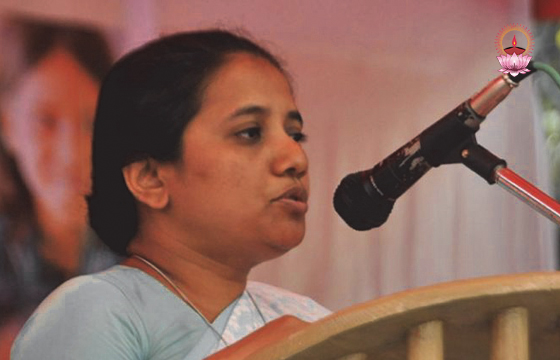
Sister Christin Mary is a member of the Missionary Sisters of the Im-maculate Heart of Mary, also known as ICM Sisters.
Based in the western Indian city of Mumbai, Mary coordinates the National Domestic Workers’ Movement, which has been championing the rights of domestic workers, children in domestic work, and migrant domestic workers since 1985. Today, its work is spread across 17 states of India, engaging nearly 200,000 domestic workers in major cities, towns and villages.
The movement was set up by Belgian Sister Jeanne Devos, also of the ICM Sisters, who spent several years as a missionary in India. She was concerned about the plight of Indian domestic workers who were exploited and whose work was undervalued.
Mary shared with Global Sisters Report about her work with the movement. She said the movement has emerged as a ray of hope for thousands of children who were deprived of their childhood and education, rehabilitating and educating them to enter mainstream society. The movement, she said, has set the tone for “breaking the slavery of silence.”
“Our journey is a road less trave-led,” the 47-year-old nun said. She expressed some of major hardships “Slow response from the govern-ments to protect the rights of workers and the exclusion of workers from the purview of labour laws even after constant lobbying efforts are some of them. Failure of the government to allocate a budget for the welfare board has created difficulties for the domestic workers to avail the social protection schemes on time. Domestic workers also report unfair dismissal when they ask for better wages and working conditions.” About her mitivations she said:
“When I was a student in a convent school in the southern Indian State of Tamil Nadu, I saw religious sisters helping the poor children who couldn’t afford to pay their fees and buy books. In my student days, I heard about the plights of child workers who were forced to sacrifice their childhoods to support their starving families. I used to be disturbed about those children, whose dreams were nipped in the bud. My desire to serve the underprivileged children and women motivated me to become a nun in 2001.”