

Thailand has banned corporal punishment of minors. With this important step, the Southeast Asian country is aligning with the UN Convention on the Rights of the Child, in force since 1990, a source of debate, especially in school and families. Traditionally, the practice was tolerated in many families, and affected a high percentage of children and teenagers. According to the latest survey by the National Statistical Office, published in 2022, 54 per cent of Thais under the age of 14 received some form of physical or psychological punishment at home.
Although down from 75 per cent in 2005, the figure is still too high for UNICEF, which is promoting the total ban of the practice. With the publication of the measure in the Royal Gazette, Thailand became the 68th country in the world to prohibit the use of coercion or violence against minors for disciplinary purposes. UNICEF Thailand welcomed the news, defining the change as a model to follow to ensure the total protection of young people from all forms of violence or exploitation.
At the same time, it stresses the importance of the government backing the ban with adequate educational campaigns, especially directed at families, where the use of force as an educational tool is still widely accepted. This will not be an easy task. In Thailand the traditional idea of family remains strongly ingrained, even when it comes with excessive behaviours. Attempts at reforms have always met with resistance in the country’s military establishment and among nationalist circles who prefer “traditional” values.
It is no coincidence that, back in 2021, during the country’s periodic review, the Global Partnership to End Violence Against Children reiterated that under international human rights law – the Convention on the Rights of the Child and other human rights instruments – states have an obligation to ban corporal punishment in all areas, including in the family.

Hindus call off rally through Christian villages in eastern India
Government interventions have forced right-wing Hindu activists to call off a march, alleviating fears of an attack on Christian villagers in the eastern Indian state of Chhattis-garh. Christians across the state had been on edge after social media posts last month began mobilizing Hindu activists to march through three Christian villages, to demand the pro-tection of cows and attack Christians thought to be beef eaters. Aadesh Soni, a right-wing Hindu man who was accused of making such violent calls on social media, denied the allegations. But he admitted calling for the march. He told a week ago that the march will occur on March 1. However, Shivam Takur, an asso-ciate of Soni, told on March 3 that they “called off the proposed rally as the government has accepted our demands.”

Dayal among three awarded for promoting religious freedom, civil liberties
John Dayal, a veteran journalist-turned human rights activist, was among three people chosen on March 5 for fighting for the cause of civil liberties and religious freedom. The annual Quaide Milleth Award, established in 2015, is given by the Che-nnai-based Quaide Milleth Educa-tional and Social Trust involved in the advancement of underprivileged sections of society. Church of South India Bishop V Devasahayam of Thoothukudi-Nazareth was in the four-member jury that chose also Navid Hamid and Vipin Kumar Tripathi for this year’s award. Dayal, based in New Delhi, has served as the treasurer of the Editors’ Guild of India and a member of the National Integration Council. The 76-year-old Catholic was the secretary general of the All India Christian Council and president of the All India Catholic Association, the largest association of the Catholic laity in the country. Hamid also was a member of the National Integration Council, formed in 1961 as a group of senior politi-cians and public figures in India to help the federal government address communalism, casteism and regiona-lism and problems. He is a former president of the All India Majilise Mushawarat, an umbrella body of Indian Muslim organizations, and general secretary of Movement for Empowerment of Muslim Indians.

Church ‘cautious’ about Indian state lifting liquor ban
Church leaders in the Christian-majority Mizoram have reacted cautiously to the government lifting a liquor ban in this state in India’s northeastern region. The state legislature, on March 10, amended the existing prohibition law amid opposition members walking out of the house protesting the change, local media reports said. However, Bishop Stephen Rotluanga of Aizawl said the Church was “not opposing the new bill completely so long as it helps to improve the economic conditions of local people.” The amendment to the Mizoram Liquor (Prohibition) Amendment Bill, 2025, seeks to allow the manufacture and supply of wine and local beer made solely from locally produced agriculture and horticulture products. The amendment, introduced by the ruling Zoram People’s Movement (ZPM) government, also proposes to grant special permits to foreign dignitaries and domestic tourists for possession and consumption of India-made liquor. The law, before the amendment, imposed a blanket ban on the sale, manufacture, and consumption of liquor. The previous Mizo National Front (MNF) government enacted it in 2019. Both the ZPM and MNF are indigenous parties rooted in the state, which also has a presence of India’s national parties, the Bharatiya Janata Party and the Congress. “I believe the government has promised to use local farm products like grapes, dragon fruit, guava, banana, etc.,” Bp Rotluanga told on March 12. But the Church will be opposed to importing any other liquor products from outside the state, the prelate added. Father Felix Antony, a former public relations officer of the North East India Regional Bishops’ Council, said consum-ption of liquor is a taboo, especially among Christians, in the entire region. “So, lifting the ban will have [the] wrong impact, especially on the well-being of families,” he said. The priest said that “as Christians, we oppose the move of the Mizoram government.” The bill faced stiff opposition from the 10 MNF, two BJP, and the lone Congress legislators, who walked out of the house in protest.

Catholics go on penitential pilgrimage in India’s Goa
Thousands of Catholics walked from their parishes in the Archdiocese of Goa and Daman in western India to the Our Lady of Good Health Church in Sancoale as part of an annual penitential pilgrimage. Father Barry Cardozo, director of the Diocesan Centre for Social Communications Media, said this year being the Jubilee Year of Hope, the annual pilgrimage was themed “Pilgrims of Hope, Let Us Proclaim the Good News.” “A special feature this year was the depiction of the images of the Passion of Christ and scenes showing Christ accompanying people in difficult situations,” he told on March 9. The depictions were created by youth members of different parishes across Goa who participated in large numbers, offering penance and prayers. ”Over 28,000 men and women walked from Neura, Cansaulim, Bambolim, Verna, and Vasco to the Church, considered one of the pious places in Goa,” said Father George Ratos, convenor of the diocesan Lenten Walking Pilgrimage. The pilgrims covered around 15 kilometers on foot from the five designated spots marked for the pilgrimage, the priest told on March 9. “It was a sea of humanity. One had to see it to believe it,” Ratos added. The pilgrimage walk started early morning, around 2 a.m. on March 9, and they reached their destination at 5 a.m. for adoration, followed by the Eucharist, Ratos said.

Indian court stops eviction from Lutheran Church’s leased land
The High Court in India’s Madhya Pradesh state has stopped officials from evicting some 150 Christian families from their homes, built on land the government leased out to their Church 50 years ago. Authorities in Betul district in January initiated the process to evict 151 Christian families and members of the Evangelical Lutheran Church after they cancelled the lease, alleging that the Church authorities violated lease conditions by misusing the land. However, the court stopped the eviction move. Until “further order no coercive step shall be taken on the residential properties,” said the court order issued on Mar 7. The copy was made public on Mar 10. Ashok Chowsky, treasurer of the church, said the district authorities cance-lled the lease, accusing the church of violating the lease conditions and erecting commercial structures on the property. He said they built some 21 shops on a piece of land. “But that was after that particular piece of land was made freehold with proper government permissions. So the allegations are baseless,” he said. “The government has no right to cancel the lease deed. It is illegal,” Chowsky told on March 11. The state govern-ment gave some 20 hectares of land to the church for charitable purposes in 1975. The Lutheran Church authorities built a chur-ch, a school, and houses for the church members. On Jan. 3, the district administration cancelled the lease deed of the entire land and served an eviction notice to all Christian families on it.

Catholic prelate slams Indian state over wild animal attacks
A Catholic bishop in sou-thern Indian Kerala state has accused its communists-led go-vernment of inaction after 12 people were killed in wild ani-mal attacks in the past two months. “The [Kerala] state government is not doing enough to restrict wild animals in the forest,” said Bishop John Nelli-kunnel of Idukki diocese in the state. Nellikunnel also joined a protest march convened by the All Kerala Catholic Congress, a laity organization of the Syro-Malabar Church, in Idukki district on March 4. Some 22% of this northern district’s esti-mated one million people are Christians, mostly members of the Eastern rite Church based in Kerala. The farmers want the government to protect their lives and livelihoods from rising attacks by wild animals, parti-cularly elephants, which enter human habitats seeking water and food as forest resources dry up in the four-month-long su-mmer starting in February. “A vast majority of the people living in the periphery of the forests are living in fear, and the government should find a permanent solution to this seri-ous problem,” the prelate said. Nellikunnel said the govern-ment has been ignoring the des-perate pleas of the farmers for years on the pretext of protect-ing wildlife and the environ-ment. “The government should ensure no life is lost due to the human-animal conflict anymo-re,” he said. Nellikunnel said if the government failed to act with urgency, “the diocese will join the farmers in more such protests until their safety is ensured.”

Christians seek Lent season safety in India’s northern state
Christians in a northern Indian state where they face increased persecution have urged police to protect them and their churches as they begin the seven-week-long Lent season of prayers and fasting. “We have sought police protection as we fear possible attacks from miscreants during Lenten season,” said Pastor Jitendra Singh, president of United Christian Committee of Kanpur in Uttar Pradesh state. The ecumenical body submitted a memorandum to the city’s police commissioner on March 1. The Lent season begins on Ash Wednesday, March 5, and culminates at the Easter Vigil on April 19. “We have in the past witnessed attacks on Christians during Lenten prayer services and don’t want a repeat of the same this year,” Singh told on March 4. Uttar Pradesh, which is governed by the Bharatiya Janata Party, has seen a rise in attacks against Christians and their institutions in the past few years. “Our prayer gatherings are falsely portrayed as religious conversion activity to target us,” Singh lamented. Even house prayers are attacked by Hindu activists in many places across Uttar Pradesh, and Christians, including pastors, are arrested under false charges of conversion, he added. Currently, close to 100 Christians are languishing in different jails in the state after they were accused of violating the provisions of the draconian anti-conversion law that criminalizes religious conversion through fraudulent means. The state has the most rigorous anti-conversion law that has a provision for life imprisonment or 20 years in prison if found guilty of being involved in religious conversion activities.
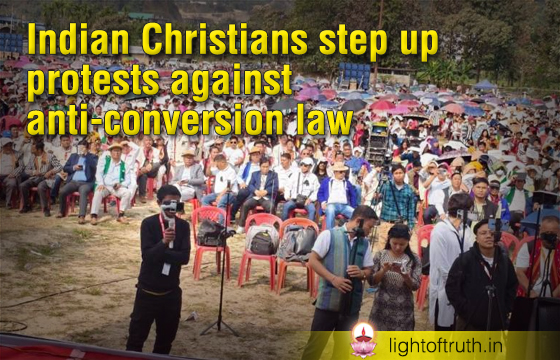
Indian Christians step up protests against anti-conversion law
More than 50,000 Christians in India’s Arunachal Pradesh state gathered to protest a government plan to revive a stringent 40-year-old anti-conversion law, fearing its misuse to target and victimize them. “We oppose the Arunachal Pradesh Freedom of Religion Act, 1978 because it curtails our religious rights,” said Tara Miri, the president of the Arunachal Christian Forum (ACF). Christians from all 29 districts and different church denominations turned up for the March 6 protest and “filled all our 50,000 chairs” in an open ground state capital, Itanagar, Miri told on March 7. “There are 46 Christian denominations in the state, and members of all of them joined the protest because we feel the state government should not implement the law,” Miri said. The anti-conversion law was first introduced in 1978 to protect the traditional religious practices of indigenous communities from external influence or coercion. But it remained dormant for over 45 years as successive governments failed to frame the rules. On Sept. 30 last year, the Gauhati High Court’s permanent bench in Itanagar directed the state government to finalize the rules within six months after a public interest litigation by a citizen against the government’s failure to enforce the law. The law prohibits religious conversion “by use of force or inducement or by fraudulent means” and has provision for a two-year jail term or a fine up to Rs 10,000 (US$115) if found guilty. The law also mandates that every conversion has to be reported to the deputy commissioner, a top officer in the state’s districts. A failure to report an intended conversion shall attract a penalty.
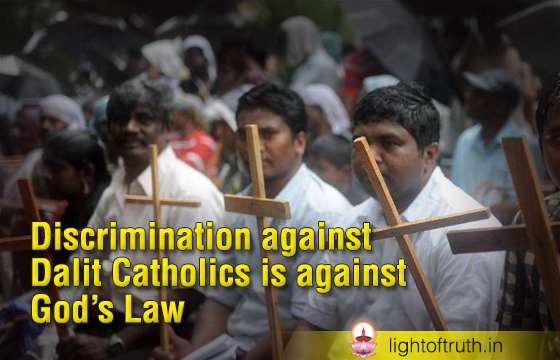
Discrimination against Dalit Catholics is against God’s Law
It is heartening to know that India’s Supreme Court has agreed to hear an appeal by some Dalit Catholics from Kumbakonam diocese in Tamil Nadu state in southern India. On the other hand, it is shocking that these poor Dalit Catholics had to approach the courts, as reported by UCA News, to give them their rights against caste discrimination, which is enshrined in the Indian Constitution and also goes against the very basic teaching of Catholicism. St. Paul, in his letter to the Galatians (3:27-28), points out, “You are baptized into union with Christ, and now you are clothed so to speak, with the life of Christ himself. So, there is no difference between Jews and Gentiles, between slaves and free, between men and women; you are all one in union with Christ Jesus.” Once baptized in Christ, people join the family of the Church and become one with all the People of God. They can no longer be identified or discriminated against by their caste, colour, race, or gender.