
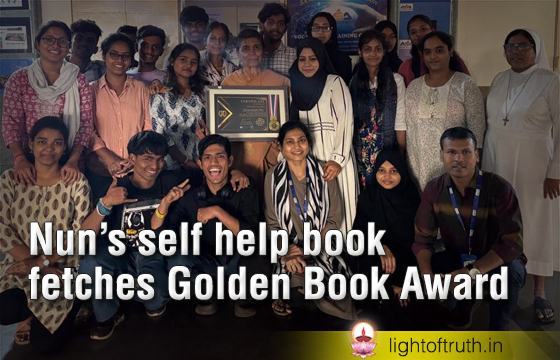
Salesian Sister Teresa Joseph, a Mumbai-based nun, has been conferred the Golden Book Award 2025 for her self-help and motivational book. The award is given by Wings Publication International, an international publishing company to recognize books and authors for their literary contributions.
Sister Joseph received the award at a function on January 31 in Mumbai. Sister Teresa’s book – “Dream Big Dream True – 35 Tips to make the best of your life” – first published in 2004, has made a significant impact on readers, spreading positivity and motivation, the award committee noted.
The book covers themes such as self-love, self-confidence, optimism, trust, forgiveness, and friendship among others. Receiving the award, Sister Teresa expressed her gratitude and said, “The Golden Book Award has given me another chance to experience the depth of my conviction. I’m delighted that my book passed the rigorous selection process.” Manika Singh, CEO of the Wings Publication International, congratulated Sister Teresa. “We’re honoured to feature you on our platform, recognizing your exceptional contribution to impacting readers across genres.”
The book, now in its 10th edition, has been translated into several languages, including Marathi, Hindi, Braille, and Khasi. It has received a Best-Seller award and five-star reviews on Amazon.
Professor Cosmas Rynshon, who wrote the foreword to the Khasi edition, said, “Such contents on self-help and motivation do not exist in Khasi.” Sister Teresa, who holds a doctorate in Education, credits her writing inspiration to her professors at Auxilium, Rome, who stressed the importance of writing for teachers.
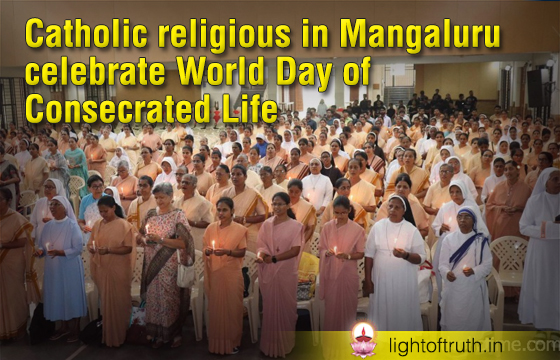
Catholic religious in Mangaluru celebrate World Day of Consecrated Life
Around 675 Catholic religious from various congregations in the Mangalore diocese of southern India have celebrated the World Day of Consecrated Life. The gathering held under the regional unit of the Con-ference of Religious in India (CRI) on February 2, the feast of Presenta-tion of the Lord, underlined the need for unity and brotherhood among religious community. “The Manga-lore diocese continues to be a cradle of religious vocations and we stand united to face the challenges of the modern world,” Providence Sister Severine Menezes, the president of the CRI Mangaluru unit, told the gathering at the Jesuit managed St Aloysius University in Mangaluru.
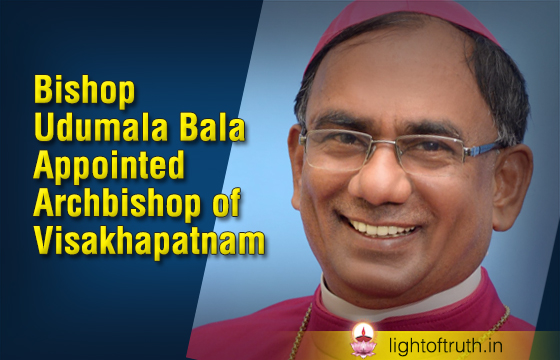
Bishop Udumala Bala Appointed Archbishop of Visakhapatnam
The Holy Father Pope Francis has appointed Bishop Udumala Bala Sho-wreddy (70) as the Abp of Vishakapat-nam in Adhra Prade-sh transferring him from the diocese of Warangal on February 8, 2025. He was appointed Bishop of Wara-ngal on April 13, 2013 and ordained Bishop on May 23, 2013. He was the Apostolic Administrator of the diocese of Khammam from 2022 to 2024. He was the Deputy Secretary General of the CCBI from 2006 to 2013 and the Chairman of the CCBI Commission for Vocations, Semina-ries, Clergy and Religious from 2015 to 2023.
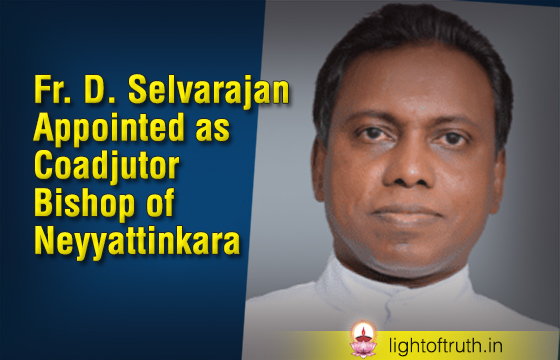
Fr. D. Selvarajan Appointed as Coadjutor Bishop of Neyyattinkara
The Holy Father Pope Francis has appointed Fr. D. Selvarajan (62) as Coadjutor Bishop of Neyyattinkara, Kerala on February 8, 2025. Since 2011, he has been the Judicial Vicar of Neyyattinkara, and since 2019, he has been the Parish Priest of St. Francis Xavier in Thiru-puram. He was born on January 27, 1962, in Valiyavila. He studied Philosophy and Theology at St. Joseph’s Pontifical Seminary in Alwaye and earned a License and Doctorate in Canon Law at the Université catholique de Louvain. He was ordained a priest on December 23, 1987, for the Archdiocese of Tri-vandrum of the Latins. The diocese of Neyyattinkara was erected on June 14, 1996, bifurcated from the Archdiocese of Trivandrum. Bishop Vincent Samuel is the first bishop of the diocese. The diocese consists of two taluks, Neyyattinkara and Nedumangad.

Indian Catholic bishop urges cordial relations with Sikhs
An Indian Catholic bishop has stressed the need to maintain harmonious relations with the majority Sikh community in northern Punjab state amid reports of rising conversions to Christianity. A Sikh youth group in the state has launched an awareness campaign to stop conversions and the establishment of new churches. “We are aware of the campaign, it is the result of activities of some house churches and their ministries that have damaged the reputation of mainstream churches,” said Bishop Agnelo Rufino Gracias, the apostolic administrator of Jullundur diocese. He told on Jan. 16 that the campaign to counter conversions “is a wakeup call for all of us to keep intact the rapport we have made with the Sikh community.”
The Sikh Youth Federation-Bhindran-wala said it aimed to expose the truth regarding various allurements, promises of miraculous healing, and other fraudulent practices adopted by Christian groups to convert people, reported the Times of India newspaper on Jan 15. Its president Bhai Ranjit Singh said, “The rise in conversions and establishment of new churches, particularly in the districts of Amritsar, Gurdaspur, and Pathankot, prompted us to act.” He said there was an urgent need to engage with Sikh and Hindu people in the state and “understand why they are changing their faith, and encourage them to remain committed to their own religion.”
Gracias, the Auxiliary Bishop Emeritus of Bombay who was appointed apostolic administrator of Jullundur diocese in 2023, said that “there is nothing wrong with the campaign” by the Sikh youth group. “It may have been disturbed by the house church ministries that are very aggressive, but as far as the Catholic Church is concerned it does not believe in forced conversion,” the prelate said. Gracias further said that because of a few house church pastors “we cannot and should not make our relations complicated with the Sikh people.”
Sanwar Bhatti, president of the Protestant United Church of Northern India Trust Association, said the campaign by the Sikh youth group has been going on for the past six months or so. “It will have no impact on our relations with the Sikh community. We have shared a good rapport with them in the past and present, and will continue to do so in future,” he told. Bhatti said the activities of certain church ministries are creating a misunderstanding among Christians and Sikhs in the state. “But we have to sit together and find a solution,” he added.

Indian court jails first Christians under anti-conversion law
In a first in India, a court has jailed a Christian couple for five years for attempting to convert people in a northern state, considered a hotbed of anti-Christian activities.
A special court in Uttar Pradesh’s Ambedkar Nagar district, which deals with cri-mes against socially poor castes, convicted Pastor Jose Pappa-chan and his wife, Sheeja Pappachan on Jan. 22.
They were sentenced to five years imprisonment and each fined 25,000 rupees. “This is the first time we have en-countered such a sentence for a suspected conversion attempt,” said A.C. Michael, a Christian leader who monitors anti-Chri-stian activities in the country.
He said the verdict and punishment “for a suspected attempt to convert will not stand the scrutiny of a higher court.” An attempt to convert is “not a recognized crime under the law,” Michael said.
Pastor Joy Mathew, who has been assisting the couple, said the judgment was “biased.” “We will challenge it in the High Court, the top court in the state,” Mathew told.
“There was no evidence on record to substantiate the con-version charges, but still, they were convicted,” he said.

Fire destroys church in northeast India amid hostility
A fire has burnt down a village Church in India’s north-eastern Assam state amid right-wing Hindu group’s campaigns against Christian missionaries, but police are yet to confirm if it was an arson attack or an accident.
Tezpur diocesan Father Ambrose Musahary told that the church of his St. Teresa parish in Jhakar Gao village had been “burnt down to ashes.” The five-decade-old church in the Udalguri district has about 160 Catholic families, “most of them coming from Indigenous backgrounds,” the priest said.
The priest added that Hindus and Christians in the village lived in peace, and “we never had any disturbance or hatred among different communities.”
Bishop Michael Akasius Toppo of Tezpur, who visited the spot on Jan. 17, told that police and Church officials “are not sure whether someone deliberately set the church on fire or it was an accident.” “We have no evidence” for either case and “we can say anything about it” only after the police investigation is completed, the bishop said.
The fire happened three days after the parish celebrated the first Mass of two newly ordain-ed diocesan priests who belong to the parish’s indigenous families.
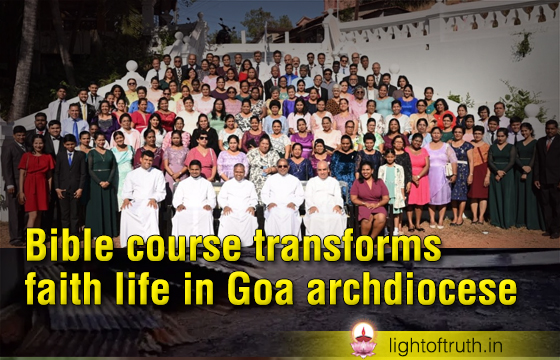
Bible course transforms faith life in Goa archdiocese
Bible study classes are transforming people’s lives besides deepening their understanding of the Scri-ptures, say the graduates of this year’s Bible course conducted by the Archdiocese of Goa and Daman. “Little did I know that it would change my daily walk with Christ. It was one of the best decisions we ever made and it turned out to be a life changing experience,” said Rupa Colaco, a dentist who was among the 133 graduates who received the certificate on January 26 at a program in the Aldona parish. As many as 925 graduates received the certificates at various centres and parishes in the archdiocese on the day marking the Sunday of the Word of God. The participants came different walks of life – teachers, parents, children, youth, catechists, nurses and doctors, said Father Mariano D’Costa, the director of Diocesan Centre for Biblical Apostolate that conducts the annual nine-month course. Doctor Colaco, who received baptism at the age of 16 after an encounter with Christ, said she had “a profoundly enriching experience that impacted my spiritual growth.” The course has “deepened my understanding of the Scriptures and its relevance in my life,” added the 44-year-old woman, who attended the classes with her three children aged 11, 13, and 16. Selma, another graduate of this year, described the course as the “best” that changed her life as a nurse as well as her family life.
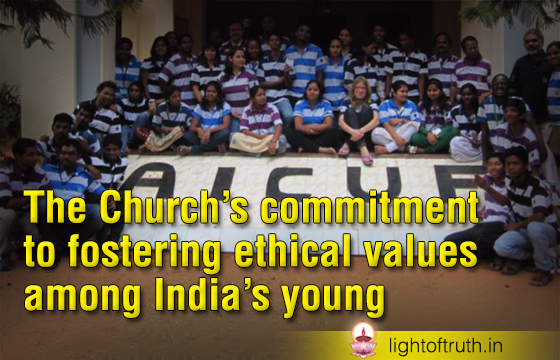
The Church’s commitment to fostering ethical values among India’s young
In our rapidly evolving world, the Church’s role in nurturing ethical values among young people is more crucial than ever. In India, various Catholic religious orders, notably the Jesuits, Salesians of Don Bosco, and the Holy Cross Fathers have establi-shed numerous youth programs and educational initiatives aimed at shaping the moral character of the next generation. Through organizations like the All India Catholic University Federation (AICUF) and a network of schools and colleges, the Church strives to develop leaders grounded in ethical principles, compassion, and a commitment to social justice. India’s former president Dr. A.P.J. Abdul Kalam once remarked, “The ignited mind of the youth is the most powerful resource on Earth.” His emphasis on the potential of young people aligns with the Church’s vision of investing in youth to create a more just and ethical society. By focusing on education, mentorship, and character formation, the Church seeks to empower young individuals to become ethical leaders and respon-sible citizens.

BEC animators undergo media training at Bandel pilgrim center
Basic Ecclesial Community (BEC) animators from eastern India are atte-nding a media training to strengthen their groups in parishes.
As many as 24 representatives from 13 eastern India dioceses are attending the January 27-31 program at Bandel Basilica Retreat Centre, about 40 km from north of Kolkata.
Media has central place in the lives of all Christians presently, said Sister Christin Joseph from Kolkata. So, we want to train our BEC anima-tors how best they can use the social media to proclaim the Gospel, added the Holy Cross nun who is involved in BEC promotion for the past three decades in eastern India.
Jesuit Father Sebastian Kanekattil, one of the facilitators and a media expert from Patna, said the training will enable the participants to under-stand the great influence of social media among youth.
Besides the training, the partici-pants will have a chance to make pilgrimage to the Bandel Basilica during this Jubilee year, said Father Sameer Kerketta from Hazaribag diocese in Jharkhand.