
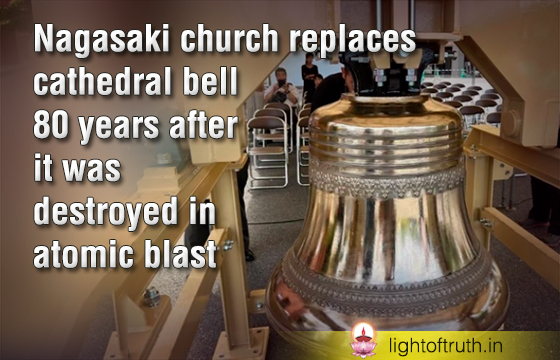
Catholics in Nagasaki, Japan, have replaced a bell in a cathedral bell tower there almost exactly 80 years to the day after it was destroyed by the atomic blast that leveled most of the city at the end of World War II.
An international effort to fund the construction and installation of the bell at Urakami Cathedral raised $125,000 in just over a year, with the funds coming from over 600 individual donors, according to Williams College Professor James Nolan.
Nagasaki was one of the two Japanese cities, along with Hiro-shima, largely destroyed by the U.S. atomic bombings at the close of World War II. The city was bombed on Aug. 9, 1945, marking the second and last time an atomic bomb was used as an act of war.
Nolan told CNA last year that parishioners at Urakami Cathe-dral managed to dig up one of the original bells after the bombing and save it; the bell was installed in the cathedral’s right bell tower after it was rebuilt in 1959.
The remaining bell, however, was destroyed, with the second rebuilt tower remaining empty for decades.
Nagasaki Archbishop Peter Michiaki Nakamura blessed the bell on that date and named it the “St. Kateri Bell of Hope,” accor-ding to the Associated Press.
The bell will be officially installed on Aug. 9, eight decades after the parish was leveled by the atomic bomb. Nolan said it will be rung at 11:02 a.m., the exact moment in 1945 when the bomb detonated around 1,600 feet west of the church.
At the bombing location, a section of wall from the old, destroyed cathedral sits in Nagasaki Peace Park. At the rebuilt parish to the east, meanwhile, Nolan said he hopes the bell “will bear the fruit of fostering hope and peace and solidarity between American and Japanese Catholics.”
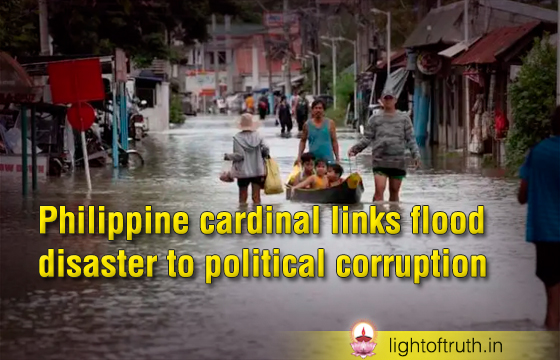
Philippine cardinal links flood disaster to political corruption
Widespread corruption in government infrastructure pro-jects contributed to the severe flooding that paralyzed parts of Manila, especially the low-lying areas, according to Cardinal Pablo Virgilio David, president of the Catholic Bishops’ Conference of the Philippines.
“We are told it’s the climate – yes, climate change is real, and it is devastating. But let us be clear: the real disaster here is corruption,” said the cardinal, also Archbishop of Kalookan.
Despite spending billions of pesos for flood control projects, several areas in the city continue without “an iota of improve-ment,” he said in a four-page pastoral letter addressed to Catholics in his diocese.
The July 25 pastoral letter emphasized that unless corruption is addressed, no long-term solu-tions to flooding will be possible. According to government records, more than 5 billion pesos (appro-ximately US$87 million) has been allocated to flood control projects in the worst-affected areas of Malabon and Navotas since 2023, the letter said.
However, residents in these areas still face problems with non-functioning floodgates, clogged canals, and poor construction, it added. “This is not a new crisis – it is a recurring one. And this year, the delays are even worse. How many more cycles of damage and neglect must our communities endure before real accountability is demanded?” it asked.
Additionally, the cardinal also cited 142.7 billion pesos in alleged “questionable insertions” in the 2025 national budget, which some opposition politicians described as “new face of pork,” a slang term for political spending. “Mean-while, our people wade in sewage and sleep in damp evacuation centers,” the cardinal said. David called on the public, especially the youth, to speak up against corruption, saying it is the only way to protect their future.
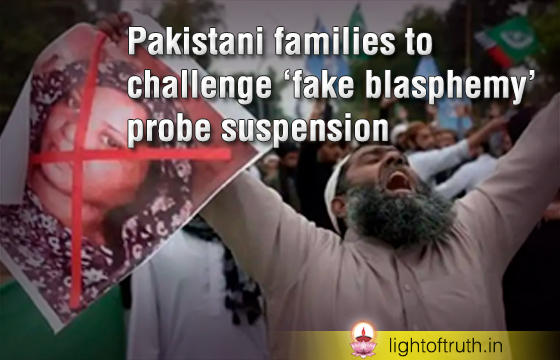
Pakistani families to challenge ‘fake blasphemy’ probe suspension
Families of victims of a “blas-phemy gang,” which allegedly entrapped hundreds of mostly young people in fake cases to extort money, have vowed to challenge a Pakistan court deci-sion suspending a probe into misuse of the controversial blasphemy law.
The families and their lawyers say the decision by the Islamabad High Court in the national capital to overturn its earlier order about forming a commission to conduct an investigation was frustrating, so it will be challenged in the Supreme Court. On July 24, an appellate bench of the Islamabad High Court, which has jurisdiction over lower courts in the Islamabad Capital Territory, issued an interim order to overturn the earlier verdict by Judge Sardar Ejaz Ishaq Khan. Khan’s July 15 verdict asked the government to form a commission within one month. The commission was directed to complete the probe and submit a report within four months.
The order was in response to a petition filed by 101 families in September that alleged that a criminal network in collaboration with the Federal Investigation Agency (FIA) has been responsible for the arrest of 450 people on fabricated blasphemy charges. At least five accused died in police custody. Among those detained are ten Christians, according to Christian rights activists.
The families of victims will challenge the suspension in the Supreme Court, said Rana Abdul Hameed, a lawyer representing some of the petitioning families.
“The original verdict was based on merit. It’s highly irregular to issue an interim order while proceedings are ongoing,” he told UCA News on July 28. The lawyer said that the network behind the blasphemy entrapments has been exposed through live-streamed testimonies.
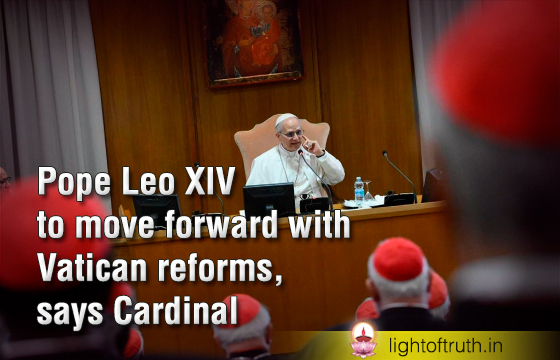
Pope Leo XIV to move forward with Vatican reforms, says Cardinal
Pope Leo will announce reforms to the Roman Curia in the autumn, Archbishop of Westminster Cardinal Vincent Nichols has predicted, saying that one of the reasons the Pope was elected was that he knew the Church’s administration from the inside. And according to the Cardinal, discussions among cardinals at the time of the Pope’s election in May focused on the continuing problems of the Curia.
Cardinal Nichols made his remarks after giving the St George’s House annual lecture in St George’s Chapel, Windsor. Addressing an invited audience, which included the Princess Royal, he talked about the need for hope, the place of religion in a secular society, and encouraging signs of young people’s growing interest in the Catholic faith – what he called “a response to the spiritual side of our human nature”.
Cardinal Nichols, who was one of the 133 cardinal electors who chose Cardinal Robert Prevost to be the next Pope, said that the General Congregations held with both the cardinal electors and the cardinals too old to vote, highlighted the qualities they believed the next Pope needed – and Prevost clearly had them all.
They believed that the successor to the throne of Peter needed to evangelise – and Prevost was a member of a missionary order; he needs intellectual ability – and Prevost was a scholar; that he needed to be aware of the world’s needs – and Prevost as leader of his own Augustinian order twice had travelled the world; that he was a pastoral leader – he had been bishop of a poor diocese; and he had curial experience – he had been prefect of the Dicastery for Bishops from 2023.
“I do think nobody else had all that experience”, he told the audience, “So that is why the voting [in the conclave] did not take long,” referring to Pope Leo being elected on the second day of the conclave and reaching the two thirds majority required for election on the fourth ballot. “A lot our discussion was about addressing the Curia”.
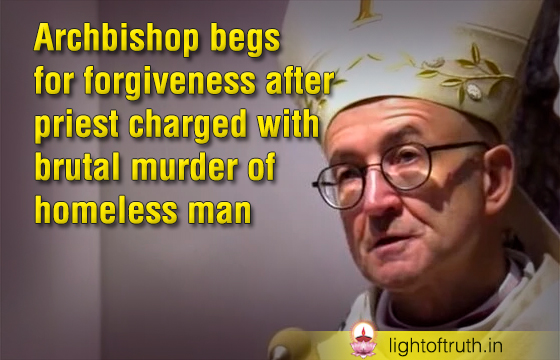
Archbishop begs for forgiveness after priest charged with brutal murder of homeless man
Miroslaw M, aged 60, who is being held in custody pending trial, pleaded guilty to the brutal mur-der of the 68-year-old homeless man, identified as Anatol Cz, following an argument over the victim’s housing and care. Accor-ding to the Radom district prose-cutor’s office, the priest and the victim had previously signed a donation agreement transferring a property to the clergyman who had agreed to provide lifelong assistance and care for the home-less man.
In the evening of 24 July, M. struck his victim with an axe and doused him with petrol, setting him ablaze while he was still alive. A cyclist discovered the body in the village of Lasopole in the central Mazowieckie province in east-central Poland and alerted the police who identified the suspect through the licence plate numbers of a car seen leaving the scene without lights, leading them to the parish rectory. Authorities plan to upgrade the charges to murder with exceptional cruelty, a classification used in Polish law for murderers who subject their victims to addition unnecessary suffering. If convicted, the priest faces life imprisonment.
The Catholic Church in Poland is in a state of shock. In a statement addressing the crime released on 25 July, Archbishop Galbas said the archdiocese would co-operate fully with law enforce-ment and initiate all necessary canonical procedures: “I have no words of comfort for you today, let alone any explanation or justification … I am devastated and crushed by the news that one of my priests has brutally murder-ed a man – a poor and homeless man. As bishop of the Church in Warsaw, I feel morally responsi-ble for everything that happens in this Church, both the good and the bad. Also for this terrible crime. I apologise to you.”
He asked the faithful to pray for the soul of the deceased and his victims and for priests in the diocese to “undertake personal penance and prayer of reparation, starting today”.
He added: “The blood of our murdered brother cries out to God. Let us beg God for forgiveness and beg forgiveness from people. I myself beg for it.”

One Million Young People Are Expected in Rome for the Youth Jubilee: Here’s the Detailed Program
From Monday, July 28, to August 3, 2025, the Youth Jubilee will be celebrated, the most anti-cipated and attended Jubilee event of the Holy Year 2025, with the arrival in Rome of hundreds of thousands of young people from 246 countries. Specifically, appro-ximately one million pilgrims are expected to attend the Prayer Vigil with Pope Leo XIV at Tor Ver-gata, Rome, on Saturday, August 2. This number will increase with the Holy Mass on Sunday, August 3, at 9:00 AM, presided over by the Holy Father at Tor Vergata, Rome.
Approximately 370 parishes, 400 schools, and 40 extra-curri-cular spaces, including Civil Pro-tection Centres, municipal sports centres, and gymnasiums, have been set up to welcome the young pilgrims. Fiera Roma [Rome Fair] will host 25,000 young people and offer its facilities to ensure a safe and comfortable stay. Thanks to the operational support of the National Department of Civil Protection, the facilities will be-come a true “city within a city,” with medical facilities and ser-vices available 24 hours a day. This organizational structure demonstrates the collective commitment to offering young pilgrims not only a place to sleep, but also a true community experi-ence, lived in complete safety.
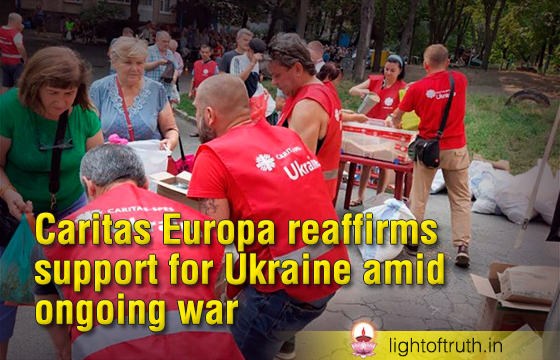
Caritas Europa reaffirms support for Ukraine amid ongoing war
As Ukraine continues to grapple with the ongoing conse-quences of war more than three years after the full-scale Russian invasion in February 2022, a delegation from Caritas Europa, led by its President, Msgr Michael Landau, visited the country to express solidarity, assess current needs, and renew support for the local Caritas network. The visit included stops in Ivano-Frankivsk and Lviv, where representatives from 14 countries met with national and local Caritas offices and visited ongoing humanitarian projects.
In an interview with Vatican News, Tetiana Stawnychy, Presi-dent of Caritas Ukraine and Vice-President of Caritas Europa, described the mission as a moment of encounter, encouragement, and planning. “It was a solidarity visit together with many of our partners from all over Europe,” she said. “This encounter between the local and national Caritas in Ukraine and our partners from abroad has brought us a great deal of energy and encouragement.”
The timing of the visit was significant. “There was a rather large-scale attack the day before the meetings,” Stawnychy recall-ed. “Even during our meetings, there was an air alarm, so we moved into a shelter area and continued the work of exchange and scenario planning.”
During the visit, Caritas Europa representatives had the opportunity to observe the work of local teams providing shelter, psychosocial assistance, support for displaced persons, and services for children and elderly evacuees. According to Caritas Europa’s official statement, these encount-ers revealed not only the scale of suffering but also the resilience of communities and the essential role of local humanitarian actors.
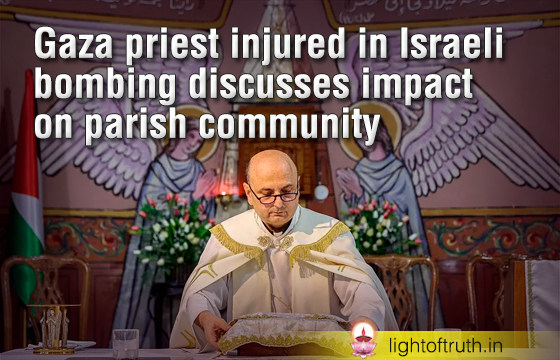
Gaza priest injured in Israeli bombing discusses impact on parish community
“Thanks be to God more people weren’t harmed,” said Father Gabriel Romanelli in an exclusive interview with EWTN on July 24 in the wake of the July 17 bombing of his parish, Holy Family Church in Gaza, which left three dead and 15 wounded, including himself.
“It was a shocking experience,” Romanelli told “EWTN Noticias” in the Spanish-language inter-view, noting that while the parish grounds were struck toward the beginning of the war in December 2023, last week’s attack marked the first time the church itself was hit. The front of the church was hit in a strike that Israeli officials have said was an accident. “That iconic cross you’ve seen – it’s about 2 meters [6.5 feet] tall – was heavily damaged,” the priest said of the crucifix fixed atop the church structure. “Shrapnel flew in all directions,” he recounted.
“The area is quite small, and while we hear bombings daily and metal fragments often fall, there hadn’t been such a severe incident since the war began,” Romanelli continued, adding: “The recent strike has left a deep mark.”
Romanelli sustained an injury to his leg during the strike, which he shared is healing despite “a minor infection.” Of the others injured, Romanelli revealed only two are now no longer in life-threatening condition: one who suffered a punctured leg and another who sustained internal organ damage.
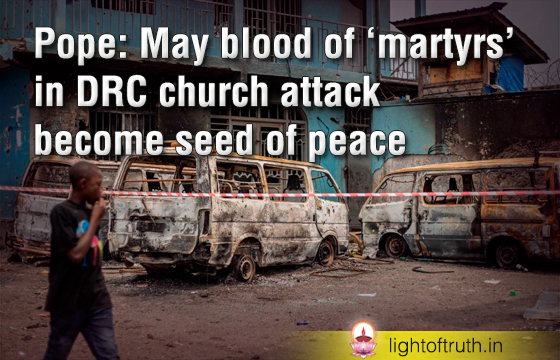
Pope: May blood of ‘martyrs’ in DRC church attack become seed of peace
“May the blood of these martyrs become a seed of peace, reconciliation, fraternity, and love for the Congolese people,” the Pope writes in his message following a brutal attack on a Catholic Church in Komanda town in the Democratic Republic of Congo. Nearly 40 people were killed Sunday in eastern Congo’s Ituri province when rebels stormed a Catholic church during a vigil and opened fire on worshippers. At least 38 people, including women and children, were confirmed dead in the church, while another five were killed in a nearby village. In a telegram addressed to Archbishop Mugalu, President of the Congolese Bishops’ Conference on the Pope’s behalf, Cardinal Pietro Parolin says, “His Holiness Pope Leo XIV learned with dismay and deep sorrow of the attack perpetrated against the Parish of Blessed Anuarite in Komanda, which caused the death of several faithful gathered for worship.” This tragedy, he continues, “calls us even more urgently to work for the integral human development of the martyred population of that region.”
According to Congolese authorities, the attacks in Komanda town in the conflict-battered region were carried out by the Allied Democratic Force, a rebel group backed by the Islamic State that has mostly targeted villagers in eastern Congo and across the border in Uganda.
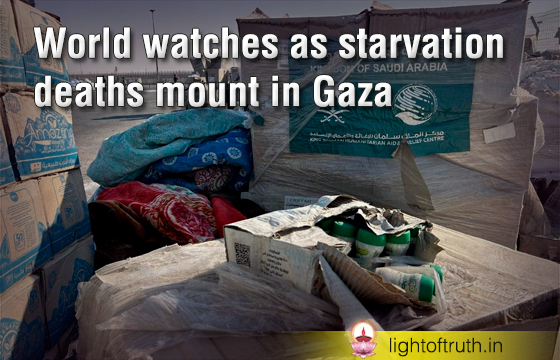
World watches as starvation deaths mount in Gaza
The rising toll of malnutrition in Gaza is drawing global concern, the total number of deaths from starvation in the enclave has reached 147 — 88 of them are children, health officials say. However, more than 120 trucks carrying food and humanitarian aid entered the Gaza Strip on July 27, marking the first major delivery in weeks amid a declared tactical pause in fighting. The aid convoy was coordinated by the United Nations and international relief organizations. Some aid was also air dropped into the enclave at the weekend – but it was a fraction of Gaza’s urgent needs.
Humanitarian organisations warn that while the aid was a positive step, far greater volumes were needed to prevent famine and a deepening health crisis. A total of 49 Qatari aid trucks arrived in Egypt and Jordan on Sunday, delivering humanitarian assistance to the Palestinian people, the Foreign Ministry announced. Provided by the Qatar Fund for Development with support from Qatar Charity and the Qatar Red Crescent, the aid is being handed over to the World Food Programme for distribution in Gaza via the Rafah and Kerem Shalom crossings. The shipment includes 4,704 food parcels, 200 tons of supplies, 174 tons of flour, and 5,000 units of infant formula.