Don Bosco Church, Lingarajapuram, a Bengaluru suburb, has reached out to those affected by the nationwide lockdown in their neighborhood. Parish priest Father Aloysius Santiago, who has led the aid work, termed the impact of Covid-19 outbreak on the Indian population as alarming and shocking, forcing people to alter their lifestyle. The middle class have adjusted to the situation, but the poor and marginalized such as migrant workers, slum dwellers, single parents, widows, elderly and children, find it as nightmare, the priest told Matters India on May 19.
Salesians in South Asia add 83 new members this year
South Asia region of Salesians of Don Bosco this year has a total of 83 novices making their first profession. They were trained in five novitiates in India – Chennai, Darjeeling, Dimapur, Kerala and Shillong – and one in Colombo, Sri Lanka.
Salesian South Asia region consists of India, Bangladesh, Sri Lanka, and Nepal.
Of the new novices, 79 took their first vows on May 24 after completing one year novitiate formation that comprises prayer, discernment and learning the Salesian life.
Claretians’ Banga-lore Provincial Replaced With Delegate from Rome
The Claretian congregation has replaced its Bangalore provincial with a Vatican official as the delegate of the superior general.
According to the website of the Claretian Missionaries (Congregation of the Missionary Sons of the Immaculate Heart of Mary or Cordis Marie Filii), the decision to replace Father Jacob Arakkal with the delegate was taken on May 16 by the congregation’s Rome-based General Government.
Chinese bishop who suffered years of forced labour dies at 98
A Chinese underground bishop who was sentenced to 10 years of forced labour in the 1980s for bringing Catholics on pilgrimage to the Marian Shrine of Our Lady of Sheshan died at the age of 98. Joseph Zhu Baoyu, bishop emeritus of Nanyang, made headlines in February for reportedly being the oldest person to recover from the coronavirus. Three months after his release from the hospital, Zhu died in his sleep on May 7 under the care of the Sisters of the Immaculate Conception.
He was one of three elderly underground Chinese Catholic bishops remembered in a Holy See communiqué on May 23 following their deaths over the past six months. All three died over the age of 90 after lives that spanned some of the most tumultuous periods for the Catholic Church in China.
Zhu was born in Pushan, Henan, in 1921, at a time of extraordinary growth of Christianity in China. This was also the year that the Chinese Communist Party was founded in Shanghai.
After his father died, Zhu’s mother enrolled him in a Catholic orphanage in Jingang at the age of six. Two years later both he and his mother were baptized. Zhu enrolled in a minor seminary. During the Chinese Civil War, he moved to the regional seminary to study philosophy and theology in the Archdiocese of Kaifeng in 1946.

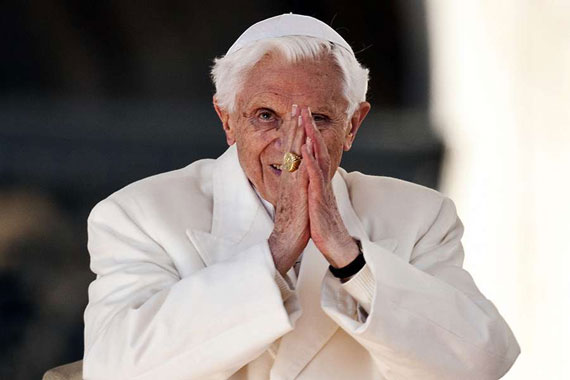
In new biography, Benedict XVI laments modern ‘anti-Christian creed’
Modern society is formulating an “anti-Christian creed” and punishing those who resist it with “social excommunication,” Benedict XVI has said in a new biography, published in Germany on May 4.
In a wide-ranging interview at the end of the 1,184-page book, written by German author Peter Seewald, the Pope emeritus said the greatest threat facing the Church was a “worldwide dictatorship of seemingly humanistic ideologies.”
Benedict XVI, who resigned as Pope in 2013, made the comment in response to a question about what he had meant at his 2005 inauguration, when he urged Catholics to pray for him “that I may not flee for fear of the wolves.”
He told Seewald that he was not referring to internal Church matters, such as the “Vatileaks” scandal, which led to the conviction of his personal butler, Paolo Gabriele, for stealing confidential Vatican documents.
In an advanced copy of “Benedikt XVI – EinLeben” (A Life), seen by CNA, the Pope emeritus said: “Of course, issues such as ‘Vatileaks’ are exasperating and, above all, incomprehensible and highly disturbing to people in the world at large.”
“But the real threat to the Church and thus to the ministry of St Peter consists not in these things, but in the worldwide dictatorship of seemingly humanistic ideologies, and to contradict them constitutes exclusion from the basic social consensus.”
He continued: “A hundred years ago, everyone would have thought it absurd to speak of homosexual marriage. Today who-ever opposes it is socially excommunicated. The same applies to abortion and the production of human beings in the laboratory.”

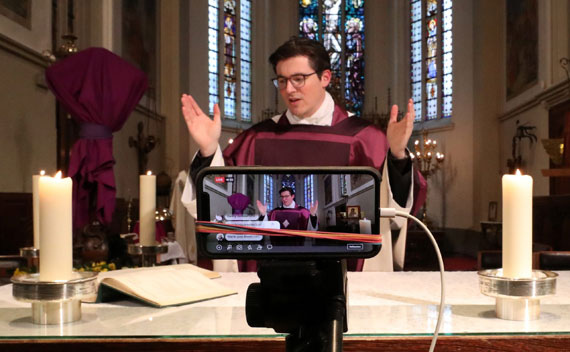
Liturgists say online Mass is fine, but no substitute for the real thing
This year’s Holy Week celebrations resulted in a major spike of new viewers tuning in to watch Vatican liturgies – an increase from 1.5 million online viewers last year to 5.5 million this year – and a trend matched by ordinary parishes throughout the world forced to go virtual during the COVID-19 pandemic.
Yet as technology has allowed many Catholic Churches to transition to a new schedule of online rosary groups, live streamed adoration, and televised Masses, parishioners and priests alike have struggled to adjust to the new normal.
For Catholics, who are used to the physical realities of participation in the Mass – from the kneeling to the sign of peace to, most importantly, the reception of Holy Communion – it’s been an abrupt change and theologians have differing opinions on whether, to use the language of Vatican II, one can engage in “full, conscious, and active participation” in a Mass if they are watching via television or online.
“If you turn to a TV Mass with the same attitude that you binge-watch the latest season of [Netflix series] The Crown, then this is not a real act of participation,” said Timothy O’Malley, the academic director at the University of Notre Dame’s Centre for Liturgy. “Of course if you attend Mass as a spectator, hoping to hear some nice music, to see some of your friends, this is not the ideal sense of participation either.”

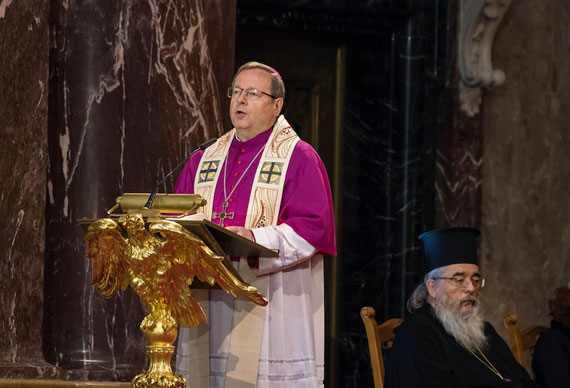
Role of German bishops in Second World War ‘shameful’
In preparation for the 75th anniversary of the end of the Second World War, the German bishops conducted an in-depth study of the behaviour of their predecessors under the Nazi regime. On 29 April, the German bishops’ conference presented the conclusions they had come to in a declaration entitled “German bishops during World War II.”
They had been encouraged to undertake the study by repeated complaints that the Catholic bishops in Hitler’s Germany had left German Catholic soldiers alone to cope with the moral dilemma they were in at the time. The bishops came to the conclusion that despite individual opposition to Hitler on the part of one or two bishops, the Catholic Church remained part of society during the war. Its patriotic willingness to mobilise the Church’s material, personal and mental resources for the war effort remained unbroken until the very end, they say.

Poll: The ‘Trump bump’ is over, especially among white Christians
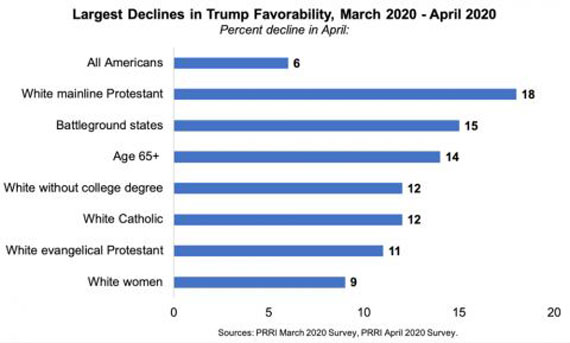
President Trump’s job approval ratings among some faith groups jumped in March as the number of coronavirus infections began to spread across the country. But that “Trump bump” has all but disappeared.
A new poll released on April 30 from PRRI shows Trump’s approval has fallen on average by 6 percentage points and is now more in keeping with 2019 levels among most demographic groups.
Among white evangelicals, Trump’s favourability ratings fell to 66% from a high of 77% in March. White Catholic approval ratings of the president dropped to 48% from 60%. Perhaps the largest drop was among white mainline Protestants. Only 44% approved of the president in April, down from 62% in March. (Among non-white Protestants, Trump’s favourability ratings did not change). Overall, 43% of Americans hold mostly or very favourable views of Trump (about the same as in February shortly after he was acquitted of impeachment charges).
In mid-March, it was 49%.
“The jump we saw in March was unusually high, particularly for white evangelicals,” said Natalie Jackson, research director at PRRI. “It was one of the highest favorability records we saw for Trump among that group. What we’re seeing in April is a return to where they had been previously.”
Jackson attributed the March bump to a “rally around the flag” effect, as more Americans saw Trump on TV daily responding to the virus as part of the White House briefings.
The poll also found that white Christians in counties less affect-ed by the coronavirus are more likely to view Trump favourably than those in more affected counties (63% vs. 50%).
“There is no such difference among other religious groups,” according to the survey.
Trump’s favourability among white Christians in battleground states — Arizona, Florida, Michigan, North Carolina, Pennsylvania and Wisconsin — dropped to 48% from 75% in March. Over-all, the president’s approval rating in battleground states dropped from 53% in March to 38% in April.
Polls Show Faith Is Getting Americans Through The Coronavirus Crisis
Two separate polls show that Americans are relying more on their faith to help persevere through the coronavirus pandemic.
The Pew Research Centre, in a survey released on April 30, showed that nearly one-fourth of all Americans say their faith has grown stronger during the pandemic, while only 2 percent said it had grown weaker.
Catholics, according to Pew, are very much in line with the overall survey results. Among Catholic respondents, 27% said their faith had grown stronger with 2 percent saying it had gotten weaker. In addition, 63% said their faith had not changed much at all, and another 7% said the question was not applicable because “I am not a religious person and this hasn’t changed.”
A poll by Fordham University released on April 28 showed that Americans are being helped by their religious or spiritual faith during the pandemic, and the more often they go to church, the more they feel it has helped.
For those who go to church regularly, 68% said they have been “helped a lot,” and another 22% said they have been “helped somewhat.”
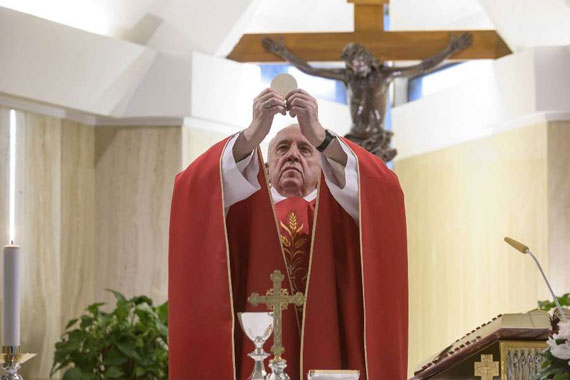
Pope Francis calls people of all religions to pray for end of pandemic
Pope Francis urged people of every religion to fast and pray on May 14 for an end to the coronavirus pandemic and “other pandemics” of hunger and war.
“Today all of us, brothers and sisters of all religious traditions, pray in a day of prayer and fasting, of penance, called by the Higher Committee of Human Fraternity. Each of us prays… united in the brotherhood that unites us in this moment of pain and tragedy,” Pope Francis said in his homily on May 14.
The Pope said that this interfaith day of prayer, fasting, and charity is not an expression of “religious relativism,” but “a day of fraternity” and prayer.
“Perhaps there will be someone who will say: ‘This is religious relativism and it cannot be done.’ But how can we not pray to the Father of all?” Pope Francis said in the Santa Marta chapel.
He continued: “Everyone prays as he knows, how he can, as he has received from his own culture. We are not praying against each other, this religious tradition against this, no. We are all united as human beings, as brothers, praying to God, according to our culture, according to our own tradition, according to our beliefs, but brothers praying to God. This is the important thing.”