- Valson Thampu
Modi has an uncanny knack for spinning slogans and labels. He is a past master at naming. To name something is to re-define its original signification. It is to morph at will, to suit one’s convenience: a privilege exclusive to the elite in every society.
The BJP-led NDA has an impressive track-record in re-naming roads, hospitals, cities, etc. By re-naming Irwin Hospital, Delhi as Lok Nayak J.P. Naryan Hospital, the impression was created that something new has been brought into being. Never mind, nothing changed on the ground. But the public felt as though something new and significant has been added to their facilities. That’s the power of naming.
All of human creations, in a way, is a ‘re-naming’. Fundamental creativity -creating out of nothing- is a divine, not human category. Creation, or inauguration, of the radically new is a form of elite power-phantasy. Truth to tell, we all run fast, only to remain stationary in respect of fundamentals.
So, when Modi and Co. would have us believe that they are creating a New India out of nowhere (cf. India became independent only in 2014) most sensible people are inclined to be puzzled and amused. History doesn’t begin like a jhatka. It is more like the flow of the Ganges, bearing at its bottom the sludge of continuity-and-change.
Modi has minted many catchy slogans and names in the past decade and more. Good days (ache din) were announced, as though everything in India before 2014 was bad and jaded. This did not mean -nor was it meant to mean- that better days would follow in any respect. It was as if we were grateful that a new dawn had been spoken into existence. It is the political counterpart of ‘God said, ‘Let there be… and there was’; except that, in this instance it read: Modi said: ‘Let there be… and there wasn’t.’
Rahul Gandhi was squeezed into the Pappu-stereotype. Whether or not he fitted the bill did not matter. Tinkering with his parentage followed thereafter. Thus, Pappu, the political adversary, was invented to be of hypothetical mystifying Muslim descent.
Dissenters got their share as well. They were renamed ‘Urban Naxals’. As Urban Naxals, they deserved no sympathy. So, when the prominent among them, including Fr. Stan Swami, were shut up in jails, the public remained unmoved. As an Urban Naxal, the 84-year-old Stan did not even deserve a drinking straw, though he was a victim of Parkinson’s disease. He had to die before the worthy judges trying his case would dare to acknowledge how unjustly and inhumanly that man of God was treated.
The strategy at work in this rhetoric of attack is roughly as follows. You want to discredit a person because he is an inconvenience to you. Unfortunately for you, he has no chink in his armor. Should that be a problem? No, not at all. Here’s what you can do. Look for a category that stands discredited, stigmatized, and feared in public perception. ‘Naxal’ is such a category. Alas, the persons you intend to discredit have had nothing to do with Naxals in theory or practice. All you have to do is: create a metaphoric connection between them and Naxals. They are thinkers, right? And, it is as thinkers that they are a bee in your bonnet? Naxals also are a nuisance. So, call them Naxals. Real Naxals are in jungles. Solve that problem with a factual adjective. These ‘Naxals’ live in cities. So, the weapon of attack is now ready to pop out of the forge! Urban Naxals!!
Are they, by any stretch of imagination, Naxals? Is there even a far-fetched resemblance between the two? No. But that doesn’t matter; thanks to the power of naming. Call someone an Urban Naxal a few times. A miasma of suspicion envelops him in public perception. He comes to be what you name him.
You protest: “I am no Naxal. I abhor violence. My body may be in a city, but my heart is with rural-tribal India.” No use! You have been named. It is not you, but the label that matters. Labels is, after all, a mark of appearance. Labeling a person or a people-group is a matter of modifying, by arbitrary action, the appearance of the target concerned. Especially in the ambiance of post-truth politics, it is appearance alone that matters. Who cares who you really are? You are named ‘Urban Naxal’. That’s all you are. Nothing more. Nothing less. So, as Modi said in an election speech, you shall be judged by what you wear. You are your cap. Your beard. A label.
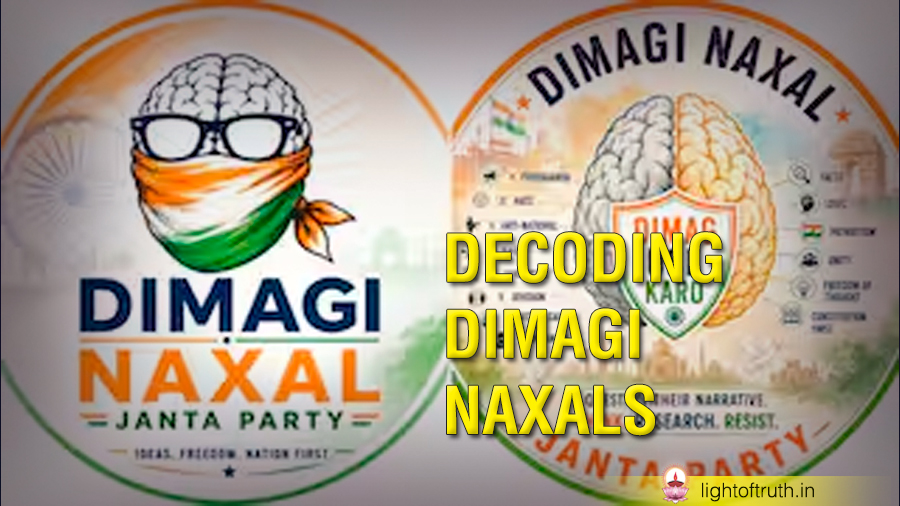
Now we have the latest from the Modi mint: Dimagi Naxals! You don’t agree with me? You won’t toe my line? You dare not only to think, but also to bring your baggage of thought into the public domain? Well, I’ll damn you with a word. From now onwards you are not citizens; or children of Mother India under the umbrella of Vande Mataram. You are a dangerous element: the proverbial enemy within, deservedly shunned by the patriots of my ilk.
You dare to think! And thinking makes you dissent? All right then: face the consequences. Henceforth you shall be branded: Dimagi Naxals. If true desh bhakts (aka, andh bhakts) abuse you or maul you whenever and wherever they see you, don’t blame me. Blame yourself. Farewell.