- Dr. Vincent Kundukulam
India is heading towards celebrating the 80th Independence Day on 15 August 2026. It is heard that the celebrations shall be revolved around the theme, ‘Developed India’ with threefold focuses: Indigenous technologies, Green Transition and Atmanirbhar (independent) Defence. The theme is apparently attractive but it does not fit to the reality that Indians experience in the day-to-day life. Because, none except the Hindutva forces will claim that India is a developed country. The countries in the world are classified into the developed, developing and undeveloped. Until 1990s, India was in the third category, and seeing the economic boom happening in the nation, international agencies now include her in the second section. But never India is considered to be a ‘developed nation’ at the international level.
The BJP is smart in propagating pseudo truths and its ideology itself is laid on the myth that the Hindutva is the most universal and the utmost tolerant ideology of the world. A country is placed as a developed nation on the basis of economic, social and structural indicators. Generally, the Per Capita Income (PCI), the Gross Domestic Product (GDP), the human and social development, economic structure and industrialization, governance, institutions and quality of life are checked before judging whether a nation is developed or not. In the case of India, only in GDP, she has a remarkable development, acquiring the 5th rank in the world. But, in the PCI, India is varying between 121 and 141th position in the world. Needless to say, about the quality of life of people.
The claim that India is the greatest democracy of the world is fake due to the fact that it has become the land, where a major section of the demoralized people of the world lives in. The verb demoralize denotes the act of making somebody lose confidence or hope. In sociology, demoralisation refers to the collapse of shared moral standards, social cohesion and collective purpose within a group, institution or nation resulting in individual’s loss of faith in the law, order and values of the given unit. A nation is considered to be demoralised when its public institutions fail in functioning effectively and transparently, and thereby people, feeling powerless, withdraw from engaging meaningfully in the nation to achieve the collective goals. Since the advent of BJP government at the centre in 2014, people of India have reached to such a mental state on the basis of a series of events in which they felt deceived by the public institutions, controlled by the Hindutva forces. Here we mention only those cases connected with the functioning of the Election Commission, which is bound to protect the democratic fabric of the nation by conducting free and fair elections.
In the editorial of Political Economic Weekly (May 11, 2024), the author enumerated several instances in which the Election Commission could be accused of non-transparent and unfair behaviour. One of the prominent cases is the Election Commission’s negligence in taking timely action against those leaders who have been using religion for seeking votes. Both in the regional and national elections, while certain leaders of the Sangh-Parivar communally polarized the Hindu votes by the use of religious symbols in their discourses, the Election Commission did not take any step until the voting was over to restore sanity and decency to the electoral process. The success of BJP is the outcome of the communalized politics and not of growing democratic culture in the country.
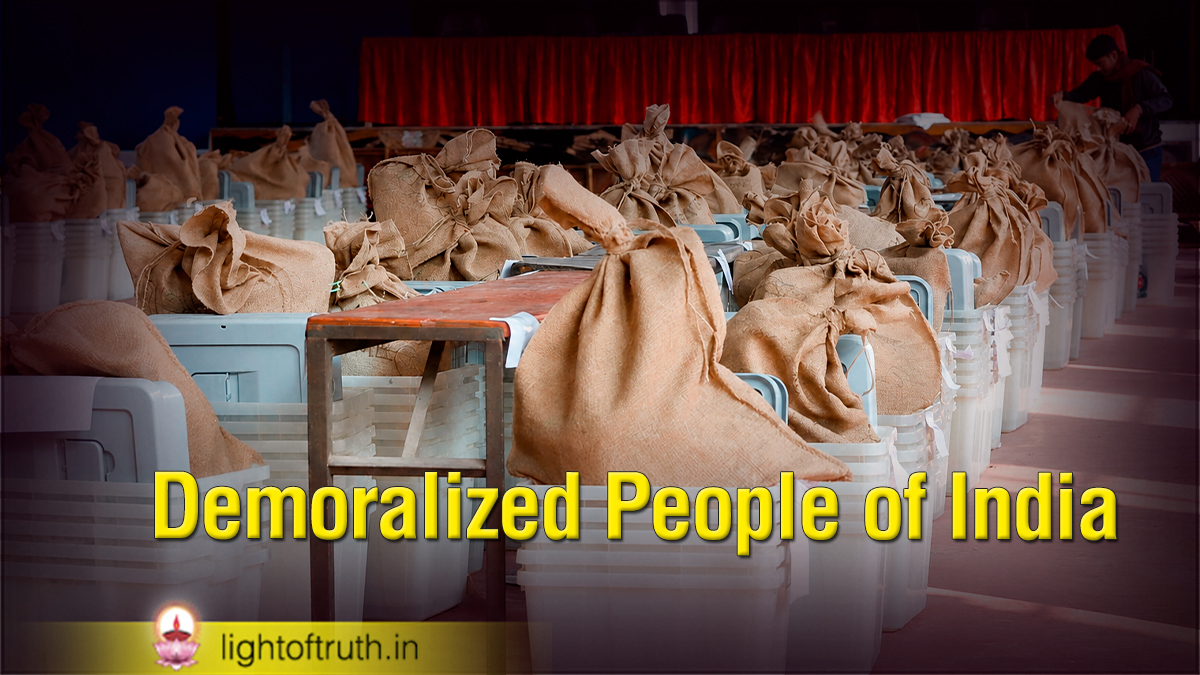
The major allegation against the Election Commission is on the managing of EV machines. Usually, about two -three weeks before the polling, EVMs are sent to every Lok Sabha constituency. Inspection of these machines is supposed to be conducted in the presence of the representatives of all parties in the fray and a seal is put on the machine with their approval. On the day of voting, EVMs reach the polling booth at 6 am, and there is a demonstration of the machines before the polling agents. Once the election is over, before the voting machines are sent to the strong rooms, the returning officer must give a certificate, known as 17-c, which states exactly the initial and final numbers and percentages of the polled votes with the gender break-up, to the agents of every political party at the polling booth.
The suspicion about the process at any of these stages may lead the voters to passivity because what is in question is the value of their own vote in the system of democracy. At times, there happens a delay in transferring this data to the agents and it paves the way for insinuation about votes being added to the machines. In such occasions, if there arise allegations, the critics cannot be accused of prejudices because they have the right to know what happens to their votes. All these actions and omissions have contributed to the erosion of credibility of the Election Commission in the eyes of people. The procedural lapses in the electoral process have thrown the people of India into suspicion and passivity; they have really become a demoralized people.
- kundu1962@gmail.com