
Catholic Sisters Help Children Living with HIV Build a Better Future
Faith Brings New Hope to Assam Village Once Known for Alcoholism
Cardinal Tagle: Friendship reveals the face of Jesus and the Church
Israel prepares ‘extensive’ West Bank operation after deadly shooting near Tal
Pope: Visit to Türkiye and Lebanon teaches that peace is possible
Thousands protest corruption in Philippines as Church leaders call for accountability
Pope: Nicaea invites Christians to unity in face of violence, conflict
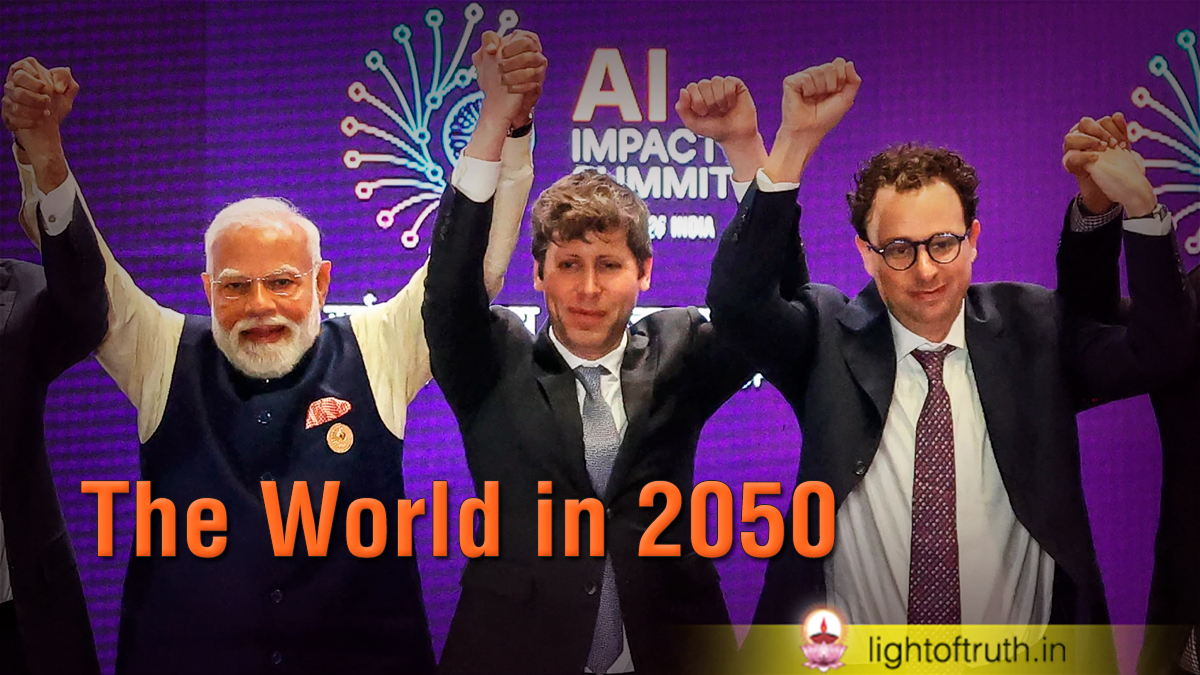
The AI submit held in Delhi recently had an enviable participation of more than 100 countries, 250,000 guests, 20 heads of state, including French president Emmanual Macron, Brazil’s president Lula D’ Silva and more than 50 ministers of different countries. To top it all, more than 40 CEOs of tech giants, including Google’s Sundar Pitchai, Anthropic’s Dario Amodei, Open AI’s Sam Altman and Adobe’s Shantanu Narayan graced the submit. The submit was intended to send a signal that India is ready to be a global player in AI, that the Global South seeks a strong voice in how AI evolves, and that AI governance isn’t just about innovation and profit, but also about ethics, equity, inclusivity and public good.
Organisational flaws that plagued the submit made us cut a sorry figure. Adding insult to injury, Galgotias University exhibited a Chinese made robot and a South Korean made drone as its inventions. This is the same university that tutored Modi on banging plates to chase away Corona virus, on making the claim that the elephant headed Ganapati was proof for India’s prehistoric tradition of plastic surgery, on extracting cooking gas from drains, and on making fighter planes invisible by flying them through clouds. Unfortunately, the scientific temper that Nehru worked hard to instil in us and laid the foundation for our scientific progress in many fields is being replaced by the Hindutva temper that is an insult to the human intellect and a drag on scientific progress.


We lack the colossal amounts of money and electricity that would be needed to catch up with America and China in AI development. Except for Google’s Sunder Pitchai reiterating his earlier commitment to invest 7 billion dollars in Vishakhapatnam, no other offer of investment was made at the summit. What’s more, the Modi government is putting in only a paltry sum of Rs. 10,000/- over a period of 5 years, far less than it spends on building statues. India’s greatest advantage is a vast pool of talent that can be outsourced for AI development and its practical application in various fields.
As at the Delhi summit, the pros and cons of AI have become a hot topic of discussion worldwide, especially after credible claims of AI making progress at breakneck speed towards becoming Super Intelligence that may dwarf humans by 2050. The advantages of AI are vastly improved health care, aided by invention of wonder drugs, quicker and more accurate diagnosis, creation of synthetic body organs and their flawless transplant – all contributing to a healthier life and highly enhanced longevity. We will also have much less polluted environment and a lot of free time – Elon Musk even claims that work will become optional. All risky jobs, including fighting wars, will be taken over by AI-driven robots. By 2050, we may also have all the knowable secrets of the universe revealed, leaving little scope for research. The world will become a new Garden of Eden where robots will cancel out the punishment God gave to Adam: “You shall earn your bread by the sweat of your brow.”
AI could also cause a lot of havoc. It is by nature a tool that authoritarians can use to strangle democracies to death. The claim of Anthropic’s CEO Dario Amodei that AI is on the verge of being able to do coding of data on its own has rung alarm bells. That could erase up to 60% of entry level tech jobs, which will hit us harder than any other nation. As of now, a tussle is going on between America’s defence establishment and Anthropic, which wants to put restrain on Pentagon using its AI model ‘Claude’ for mass surveillance and for making autonomous weapons that will have no human control. How on earth will humans deal with giant swarms of autonomous drones or a million strong army of autonomous robotic soldiers! AI may lead us to a wonderland where all the comforts of life are on offer, but where will the unemployed whom it replaces get the money to buy them? We will be left with a situation of higher productivity but lower demand.
Claims have already been made that AI has achieved self-awareness or consciousness. That foretells horrifying possibilities. Consciousness and conscience are two very different things. Consciousness is self-awareness or the capacity for subjective experience. Conscience is, on the other hand, is the fountainhead of ethics. It makes one distinguish right from wrong and feel guilty of wrong doing. In an encounter with conscious humanoids conscientious humans will be at a huge disadvantage. Does it make any sense for humans to speak reason to AI powered humanoids that come charging at them? Biology and physics represent two different levels of reality which may influence each other but cannot be a substitute for each other.
Perhaps the biggest threat AI poses is the making and releasing of vicious viruses that could erase the human race from the face of the earth. To solve the problem of AI going rogue, Anthropic’s Dario Amodei proposes that we enter codes that prevent it from doing harm to humans. He also proposes that all countries of the world agree to a constitution or set of rules that is drafted towards that end. But where is the guarantee that no nation will go rogue and break those rules? The father of AI, Geoffrey Hinton, goes a step further and proposes that we feed AI with data that will equip it with the maternal instincts that will compel it to be as caring of humans as a mother is of her child. But wouldn’t that lead to humans preferring ever pleasant humanoid robots over bothersome partners and children?
In his book The Physics of Immortality published in 1994, Frank J. Tipler opined that AI may become a reality in a century at the earliest and in a millennium at the latest, but it took no more than three decades. And that has made us dizzy, unable to grasp where it is headed to.





Leave a Comment