
Catholic Sisters Help Children Living with HIV Build a Better Future
Faith Brings New Hope to Assam Village Once Known for Alcoholism
Cardinal Tagle: Friendship reveals the face of Jesus and the Church
Israel prepares ‘extensive’ West Bank operation after deadly shooting near Tal
Pope: Visit to Türkiye and Lebanon teaches that peace is possible
Thousands protest corruption in Philippines as Church leaders call for accountability
Pope: Nicaea invites Christians to unity in face of violence, conflict
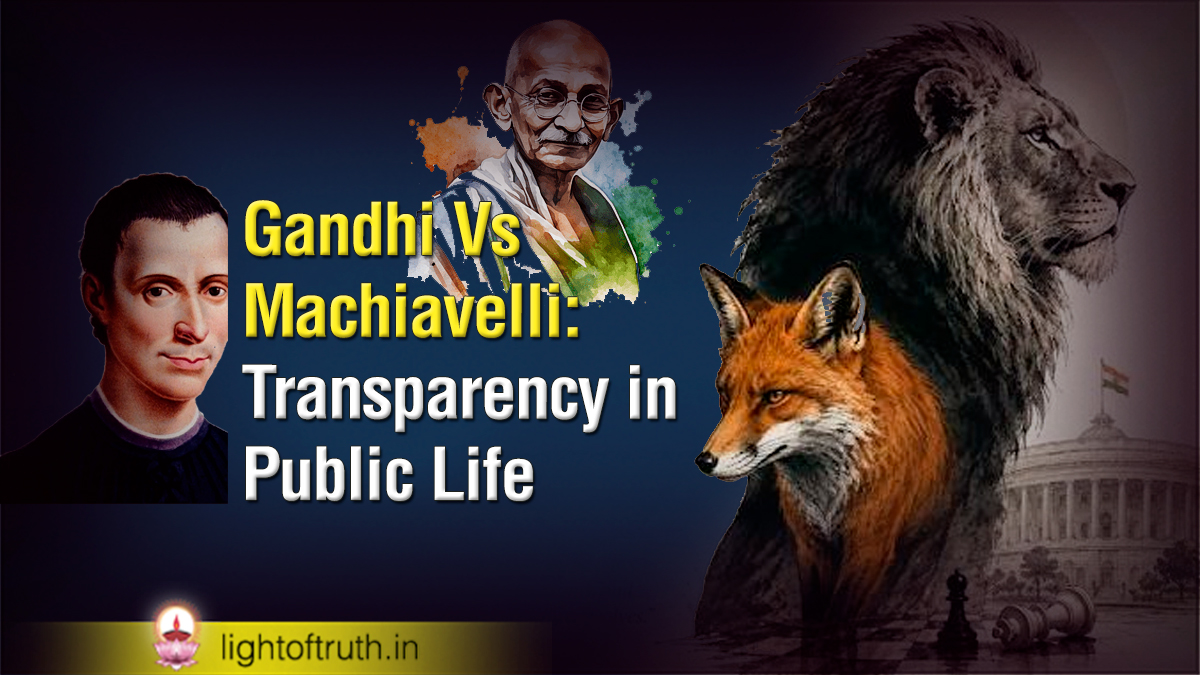
 Niccolò Machiavelli, the Florentine political thinker of the 15th century, is well known for his cunning strategies in political life. In his (in)famous work, The Prince, he set forth a shrewd maxim: A ruler must have the strength of a lion and the cunning of a fox. By divorcing politics from morality, Machiavelli championed pragmatic efficacy – strategies that political schemers in later generations would master and put to use.
Early political philosophers consistently championed political idealism. The cornerstone of political idealism is the deep conviction that politics must be guided by ethical considerations. Thinkers such as Plato, Aristotle, Cicero, and Saint Augustine were foremost proponents of this vision. From Plato, who posited that a philosopher-king ought to rule, to subsequent political idealists asserting that politics should be steered by ethical principles, all stood for a clean, value-based political sphere. However, with the emergence of thinkers like Machiavelli during the 15th and 16th centuries, political realism arrived on the scene, uprooting this pure, ethical politics. Machiavelli’s realism is fundamentally an opportunistic stance that justifies any means to achieve immediate gains. When political leaders, relying solely on the lion’s strength and the fox’s cunning, sacrificed ethics and civic virtue on the altar of opportunism for short-term advantage, we lost the noble ideal that the means must justify the ends.
In The Republic, his treatise on the ideal state, the Greek philosopher Plato observed that a philosopher-king – a royal sage – must govern the populace. He insisted that a philosopher-king should possess no private wealth, reasoning that attachments to personal property inevitably lead rulers toward corruption and nepotism. Plato understood early on that “if the high priest steals a little, the temple attendants will loot everything.” Today, however, we witness the bitter irony of our own political leaders stealing even the deity’s gold.
Once politics was separated from morality, immediate results became the sole measure of success. Consequently, contemporary politics became dominated by relentless attempts to attain goals through any means necessary. Electoral politics in modern India reflects the very resurrection of these Machiavellian tactics. The shameless efforts to seize power by any method – whether in local panchayats or in parliament – and to cast aside morals for petty gains prove that Machiavelli’s ghost has possessed our political class. Samuel Johnson’s mocking remark that “politics is the last refuge of a scoundrel” rings remarkably true for contemporary society.
Before rising to power, Mussolini claimed to be an ordinary man, the son of a humble blacksmith; yet once in office, he allied himself with corporate powers. We see similar figures in India as well. When the fundamental truth that power exists for public service is forgotten, Machiavelli is glorified while Gandhi is cast aside. When Nehru asked Gandhi what principle should anchor his policies, Gandhi replied that whenever conceiving a plan, one should proceed only if it serves the welfare of the poorest and weakest individual. In today’s corporate-dominated world, Sabarmati feels far away, while Machiavelli’s Florence is uncomfortably close. As Machiavelli’s Prince – wielding the strength of a lion and the guile of a fox -vanquishes the Mahatma’s experiments with truth, the common man’s cry fades into silence.





Leave a Comment