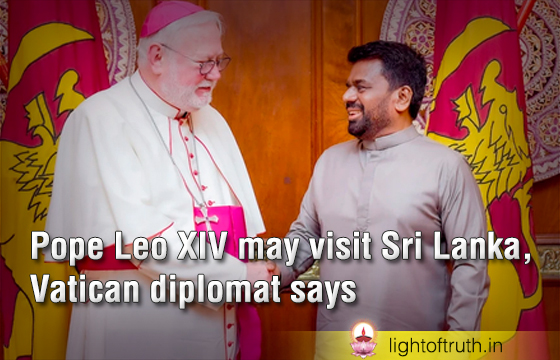
Pope Leo XIV may visit Sri Lanka, Vatican diplomat says

A top Vatican diplomat has raised the possibility of a papal visit to Sri Lanka as the two nations marked 50 years of diplomatic relations this month, a milestone reached as the island nation emerges from years of political turmoil and economic crisis.

Archbishop Paul Richard Gallagher, the Vatican’s secretary for relations with states and international organizations, visited Sri Lanka Nov. 3–8 to commemorate the diplomatic ties established Sept. 6, 1975. During meetings with President Anura Kumara Dissanayake and other key officials, Gallagher said Pope Leo XIV may consider visiting the country in recognition of its progress toward peace and stability.

The visit came at a pivotal moment for Sri Lanka, which is rebuilding after a devastating civil war that ended in 2009 and a severe economic collapse in 2022 that forced the president’s resignation. The country also saw Easter Sunday terrorist attacks in 2019 that killed 269 people at Catholic churches and hotels.

On Nov. 4, Gallagher met Dissanayake at the Presidential Secretariat. During the meeting, the president briefed the archbishop on the country’s progress under his administration, according to the President’s Media Division.

Dissanayake thanked the archbishop for his visit, calling it “a blessing for Sri Lanka.” The president lauded the Vatican’s contributions to Sri Lanka’s education sector and its humanitarian assistance following the 2004 Indian Ocean tsunami.

Gallagher responded that Pope Leo XIV is impressed with Sri Lanka’s progress in promoting peace and unity among religious and ethnic groups. He added that the pope may consider visiting Sri Lanka in the future, given the Vatican’s ties with the country and its progress on many fronts.
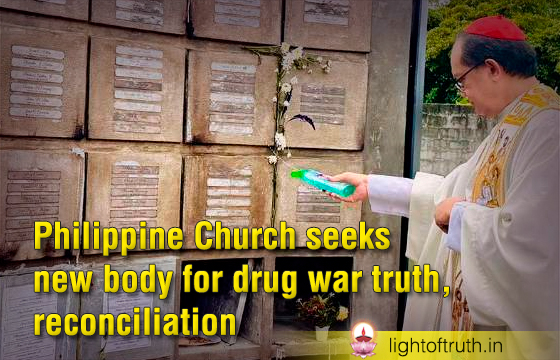
Philippine Church seeks new body for drug war truth, reconciliation

The Catholic Bishops’ Conference of the Philippines has urged President Ferdinand Marcos Jr. to establish a national body to investigate the thousands of killings committed during former President Rodrigo Duterte’s bloody war on drugs and to promote national reconciliation. Conference president Cardinal Pablo Virgilio David, in a Nov. 7 letter, asked Marcos to create a “National Truth and Reconciliation Commission.” Such a commission, he said, will “restore dignity to victims’ families who continue to seek justice and closure,” the conference’s news service reported.

The proposed commission, he said, “would not seek vengeance but truth, accountability, and compassion,” and would help the nation “move forward with honesty and moral clarity.” It could also provide victims and witnesses with a safe space, review unresolved cases, and recommend reparations, support, and institutional reforms to prevent future abuses.

“Truth-telling is not an act of reopening wounds — it is the only path by which wounds can finally heal,” David wrote. “Silence breeds resentment and fear; truth restores dignity, trust, and moral coherence to our democracy.”

Human rights groups estimate some 12,000-30,000 extrajudicial killings were carried out by police and vigilantes during Duterte’s anti-drug campaign (2016–2022). Most victims were poor urban residents accused of drug-related crimes.

Duterte was arrested by Interpol on March 11 and transferred to the International Criminal Court (ICC) in The Hague, where he faces crimes against humanity charges related to the drug war and his alleged leadership of the “Davao Death Squad” during his tenure as mayor. His lawyers and supporters have dismissed the arrest as politically motivated.

David said creating the commission would send “a powerful message that the country chooses courage over fear, accountability over impunity, and reconciliation over silence.” “It would reaffirm a principle that lies at the heart of our democracy and faith traditions — that every human life has dignity and worth,” he added.

The prelate heads the Diocese of Kalookan, which is described as “ground zero” of the drug war killings. He said he continues to meet widowed mothers and orphaned children traumatized by the violence. Many families, he noted, have lost not only loved ones but also trust in public institutions, their sense of safety, and their livelihoods. “They deserve closure. Our institutions deserve restoration. Our nation needs healing,” David stressed.

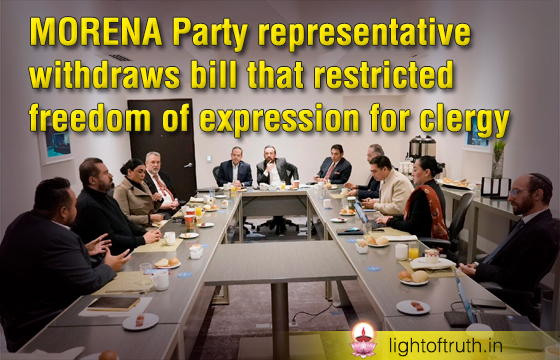
MORENA Party representative withdraws bill that restricted freedom of expression for clergy

Mexican legislator Arturo Ávila announced November 10, that he was withdrawing a controversial bill that sought to impose new restrictions on priests, pastors, and other religious leaders online. The decision followed an extensive consultation with representatives from across Mexico’s diverse faith communities, including Islamic, Jewish, Mormon, and Christian organizations, as well as the Catholic hierarchy. Ávila framed the withdrawal as a step toward “building, together with all stakeholders, a responsible and consensual regulatory framework” that addresses the challenges posed by digital communication while safeguarding religious liberty. The law in question aimed to add a third paragraph to Article 16 of the Law on Religious Associations and Public Worship, which historically barred religious institutions from owning or operating traditional media outlets such as radio and television. Ávila’s proposal would have extended these restrictions to the internet, effectively subjecting sermons, social media accounts, live-streamed homilies, and other digital expressions of faith to government oversight through the newly created Agency for Digital Transformation and Telecommunications, in coordination with the Interior Ministry.

 The backlash was swift and wide-ranging. Critics warned that the bill risked turning Mexico into a nation where religious leaders could face penalties for expressing moral or social viewpoints online, echoing past eras in which ecclesiastical voices were heavily monitored and censored. Civil society organizations spearheaded signature campaigns against the measure, arguing that it threatened to chill public discourse and infringe upon the constitutional protections of freedom of religion and expression. During Monday’s consultations, representatives of various faith communities voiced shared concern over the proposal’s potential to impose a digital ceiling on spiritual speech. They emphasized that modern religious ministry increasingly relies on online platforms to reach communities, particularly in a country where internet access allows clergy to serve remote or marginalized populations. Ávila acknowledged the validity of these concerns, noting that “the digital challenges of our times require careful, nuanced debate to strengthen the secular state while fully guaranteeing religious freedom.”

Observers see this episode as a bellwether for how Mexico will navigate the intersection of technology, governance, and faith. The initial bill reflected broader anxieties among lawmakers about regulating social media and curbing online hate speech, but its approach—singling out religious actors for special restrictions—was widely criticized as heavy-handed and constitutionally suspect. Legal analysts note that while the government may continue to explore mechanisms for moderating harmful content online, targeting religious expression specifically could provoke serious legal challenges and deepen tensions with faith communities.

For now, the immediate threat to online religious speech in Mexico has been averted, yet the debate remains far from over. Ávila’s withdrawal demonstrates the power of civic engagement and the importance of dialogue with affected stakeholders, but it also highlights the delicate balance between regulation, freedom of expression, and the protection of religious practice in the digital era.

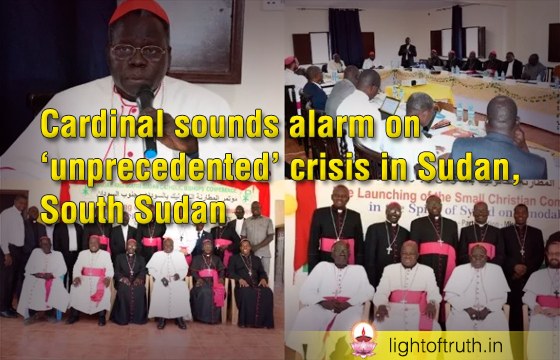
Cardinal sounds alarm on ‘unprecedented’ crisis in Sudan, South Sudan

The president of the Sudan and South Sudan Catholic Bishops’ Conference (SSS-CBC) raised alarm over the deepening humanitarian crisis in the two neighbouring countries of Sudan and South Sudan.  In his opening remarks to SSS-CBC members in the Catholic Diocese of Malakal in South Sudan, Cardinal Stephen Ameyu urged Catholic leaders to strengthen unity, foster nonviolence, and reinforce pastoral structures as the Church responds to the plight of the people of God in Sudan and South Sudan.

Ameyu described the meeting as “a sign of communion that binds us as the body of Christ; a communion that strengthens the bonds of unity, charity, and peace, which unite us in the college of bishops.” He prayed that deliberations during the meeting would be “guided by the gospel of nonviolence and the call to be servants of Christ and a steward of the mysteries of God.”

“The people of Sudan and South Sudan are enduring profound suffering, displacement, loss of life, destruction of churches and properties, and a humanitarian crisis of unprecedented scale,” Ameyu, who also serves as the archbishop of Juba, said on 10 November.

He acknowledged with appreciation the spirit of endurance among the Sudanese people, saying: “Amidst these trials, the dioceses have demonstrated resilience, providing shelters, food, and spiritual care through charities and other agencies.”

He continued: “It is our pastoral priority that we work for peace and justice. We are called to build this important institution of justice and peace in our secretariat but above all also in our different dioceses,” he said, adding that the Church is deeply committed to humanitarian assistance, which has become a daily part of service in Sudanese Catholic dioceses.

“We provide support not only materially but also morally, offering solidarity to refugees and returnees who are coming back home,” Ameyu said. “We are together standing to evangelize these people, to have this catechesis for the people who are stressed.” Ameyu urged the governments of Sudan and South Sudan to prioritize peace above all else. He emphasized that true peace in Sudan and South Sudan can only be achieved when citizens overcome tribal divisions and embrace unity.

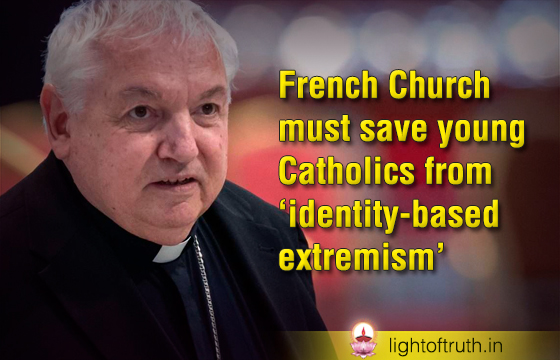
French Church must save young Catholics from ‘identity-based extremism’

The Archbishop of Marseilles Cardinal Jean-Marc Aveline told France’s bishops not to leave the growing number of young Catholics to turn to “seductive forces that have fuelled identity-based extremism in our country.” In his first address as head of the French bishops’ conference, speaking at its autumn assembly, the cardinal proposed more profound discussions of identity, education and the role of religion in a secularised and polarised society. French bishops usually avoid criticism of the rising far-right or comment on the complex political scene.

Aveline also mentioned laïcité, the official separation of Church and State that marks its 120th anniversary late next year, observing that “each party bears its share of responsibility” for dialogue. France is in “a period of multiple elections, which themselves have become unpredictable”, he observed. Citing resurgent antisemitism and “skilfully orchestrated propaganda”, he warned: “Democracy itself seems to be in danger.”

He suggested making a deeper theological study of the sexual abuse crisis to understand “what it reveals as flaws in our ecclesiology”, when some clerics and laymen become “too certain of the illusory impunity conferred upon them by their ordination or position”. The result could be as courageous a reassessment of the Church’s self-understanding, he said, as John XXIII brought about by having the Second Vatican Council rethink Catholic-Jewish relations in the historic declaration Nostra Aetate. 

Aveline addressed the “great and complex challenge” of integrating the surprising number of young adults baptised in recent years. “This desire for identity gnaws at the hearts of many young people, and we must consider it positively, understand it, and nurture it, so that it is not exploited to serve as an alibi for dangerous identity-based tensions,” he said. A three-year synodal review of Catholic education should strengthen the role of religious schools “to rebuild trust in a world marked by conflict and fear”.

The bishops also began a delicate discussion of whether and how to reintegrate clerics who have served time for abuse convictions. This is due to last several more assemblies.  In August, the conference unexpectedly asked the Archdiocese of Toulouse reverse its reappointment of a convicted sexual abuser – who served four years in prison for raping a student in the 1990s – as chancellor. The Ecumenical Patriarch of Constantinople Bartholomew I was the session’s special guest, bringing his trademark ecumenical message and warnings about current international tensions that Cardinal Aveline seconded.

Pope Leo XIV warns about new addictions: pornography and internet abuse

Pope Leo XIV warned about new addictions of recent times such as compulsive gambling, betting, and pornography as consequences of excessive internet use.

The Holy Father issued his warning in a video message addressed to participants in the seventh National Conference on Addictions, organized in Rome by Italy’s Presidency of the Council of Ministers.

In his Nov. 7 message, the pontiff emphasized that in recent times, in addition to addictions such as drugs and alcohol — which continue to be the most prevalent — “new forms have emerged, since the growing use of the internet, computers, and smartphones is associated not only with clear benefits but also an excessive use that often leads to addictions with negative consequences for health.”

These addictions, the pope explained, are related “to compulsive gambling and betting, pornography, and almost constant presence on digital platforms. The object of addiction becomes an obsession, conditioning behaviour and daily life.”

He emphasized that these phenomena are “a symptom of the mental or inner distress of the individual and a social decline in positive values and references, particularly in teenagers and young people.”

In this context, he stressed that this time of youth “is a time of trials and questions, of the search for meaning in life,” sometimes marked by drug use, the pursuit of easy money through slot machines, or internet addiction, which demonstrates “that we live in a world without hope, where there is a lack of vigorous human and spiritual proposals.”

Consequently, he lamented that many young people “think that all forms of behaviour are equal, as they are unable to distinguish good from evil and do not have a sense of moral limits.”

For this reason, the Holy Father urged everyone to value and encourage “the efforts of parents and various educational agencies, such as schools, parishes, and oratories, aimed at inspiring spiritual and moral values in the younger generation so that they behave responsibly.”

Patriarch Sako: Vatican does not respect Eastern Churches

Vatican officials do not understand the situation of Christians and must learn to “work with the local churches, not above”, according to the head of the Chaldean Catholic Church. The Chaldean Patriarch of Babylon Cardinal Louis Raphaël I Sako told The Tablet that the Dicastery for Eastern Churches fails to treat Eastern Catholic patriarchs as heads of their own sui iuris Churches. “They should know they are there to serve the Churches,” the patriarch said. “They have to respect our identity.”

He complained of “a lot of bureaucracy”, with correspondence unanswered for months at a time, and a lack of respect for the patriarchs who “precede all bishops of any degree everywhere in the world” according to the Code of Canons of the Eastern Churches.

Dealings with the patriarchs “should be very polite and very respectful”, Sako said, suggesting the dicastery does not understand their status and the difficulties of their situation. “We are like fathers,” he continued. “We are not businessmen. We are pastors.”

Sako said Pope Leo understands the situation of Eastern Catholics. He spoke frequently to the then-Cardinal Robert Prevost during the conclave in May this year. “I had time to explain to him what we are,” the patriarch said, recounting their historic character, their “mission towards Muslims” in the modern day and how “our presence is threatened now”.

The Pope addressed pilgrims for the Jubilee of the Eastern Churches on 14 May, days after his election, urging the Latin Church “to preserve and promote the Christian East” and telling Eastern Catholics: “You are precious.”

Leo will hold a private meeting with the five Catholic patriarchs at the nunciature in Beirut on 1 December, during his six-day visit to Turkey and Lebanon.   Since his election, he has given private audiences to the Maronite Patriarch of Antioch Cardinal Béchara Boutros Raï and the Syriac Catholic Patriarch of Antioch Ignatius Joseph III Younan. 

In his remarks to The Tablet, the patriarch suggested curial officials were not best placed to advise the Pope about Eastern Churches. “The Pope should be well informed by the dicasteries,” he said, complaining of a lack of local understanding and “practical experience” in the Vatican, with little representation from the Middle East and Asia. “When they speak, they speak occidental speech.”

He said that while the prefect of the Dicastery for Eastern Churches Cardinal Claudio Gugerotti knows Eastern Christianity from his academic background and experience as a nuncio, “he has his own ideas, fixed ideas” about the Churches. The Vatican’s approach, he continued, “should be academic, but also realistic” about the situation of Eastern Churches. It “should do more [to intervene with local leaders], not only speeches” because it can “make an impact on political life in the Middle East”.

In Rome, the patriarch attended the episcopal ordination of Archbishop Mirosław Stanisław Wachowski in St Peter’s on 26 October, following his appointment as apostolic nuncio to Iraq in September. Sako said he would offer “a map for the new nuncio” to follow. Pope needs ‘good people’ to work with Eastern Churches, says Chaldean patriarch.

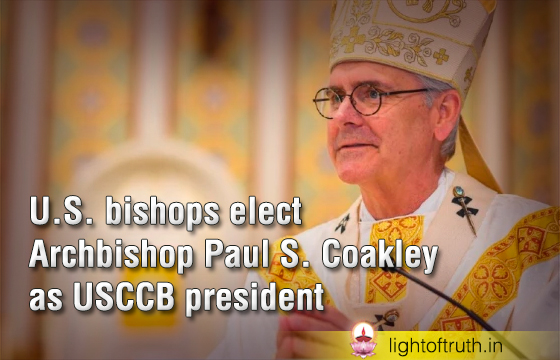
U.S. bishops elect Archbishop Paul S. Coakley as USCCB president

        Archbishop Paul Coakley of Oklahoma City was elected to serve as the next president of the United States Conference of Catholic Bishops (USCCB) in a secret ballot on Nov. 11. Bishops chose Bishop Daniel Flores of Brownsville, Texas, to serve as vice president. Flores, who serves in the southernmost diocese in Texas, finished second in balloting for president. Coakley subsequently won a runoff.

Coakley, who was previously secretary of the USCCB, will serve a three-year term as president, succeeding the former president, Archbishop Timothy Broglio. The bishops held the election at the Fall Plenary Assembly in Baltimore.

He has a history of promoting a culture of life, opposing gender ideology, and supporting migrants. The archbishop, who turned 70 years old in May, became a bishop in 2004. He has served in the Oklahoma City Archdiocese since 2011. He holds a licentiate in sacred theology.

Coakley’s defense of a culture of life is a continuation of Broglio’s leadership on the subject. Under Broglio, the bishops maintained that abortion is the “preeminent priority” in elections. In 2022, Coakley praised Oklahoma lawmakers “for supporting pro-life measures” following a law that banned nearly all abortions. He said, to build a culture of life, one must recognize “the inherent dignity of every person [and it] requires the protections afforded by pro-life legislation and a profound change of heart.” Coakley has criticized the Oklahoma government for its support of the death penalty. In 2022, he said: “The use of the death penalty only contributes to the continued coarsening of society and to the spiral of violence.”

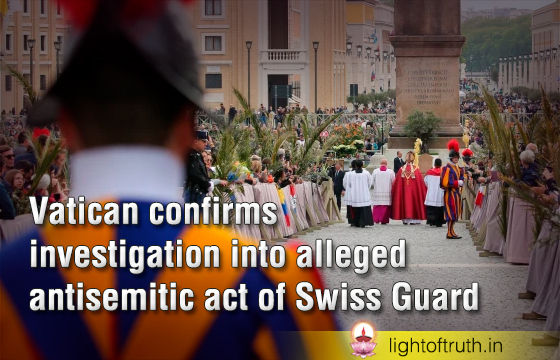
Vatican confirms investigation into alleged antisemitic act of Swiss Guard

The Pontifical Swiss Guard this week opened an internal investigation to clarify an alleged act of antisemitism committed by one of its guards against two Jewish women in St. Peter’s Square, the Vatican confirmed. 

“The Pontifical Swiss Guard received a complaint regarding an incident that occurred at one of the entrances to Vatican City State in which elements interpreted as antisemitic were allegedly detected,” Holy See Press Office Director Matteo Bruni stated on Monday.

The reported incident took place during Pope Leo XIV’s Oct. 29 general audience commemorating the 60th anniversary of Nostra Aetate, the 1965 declaration on the Church’s relations with non-Christian religions.

According to a Nov. 7 report published in Italian newspaper La Repubblica, Israeli writer and theater director Michal Govrin said a Swiss Guard “hissed at” her and a female colleague, saying “les juifs, the Jews,” before “making a gesture of spitting in our direction with obvious contempt.”

The two women were part of an international Jewish delegation in Rome to participate in Nostra Aetate anniversary celebrations, which included the Oct. 29 audience with Pope Leo in St. Peter’s Square.

During that audience dedicated to interreligious dialogue, Pope Leo XIV emphasized that “the Church does not tolerate acts of antisemitism in any form” and reiterated “the Holy See’s commitment to friendship and respect towards our elder brothers in faith.”

According to the Vatican’s preliminary investigation, the complaint stems from “a dispute that arose regarding a request for a photograph while on duty.” Members of the Pontifical Swiss Guard are strictly prohibited from taking photographs with tourists or pilgrims while on duty.

Bruni on Monday explained that “the case is currently the subject of an internal verification procedure” and that this process “is being carried out in accordance with the principles of discretion and impartiality, in compliance with current regulations.”

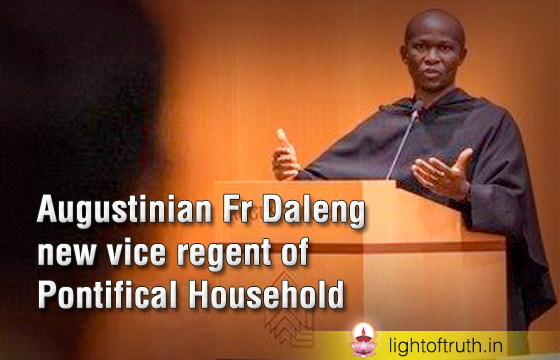
Augustinian Fr Daleng new vice regent of Pontifical Household

Pope Leo XIV has appointed Augustinian Father Edward Daniang Daleng, O.S.A., as the new vice regent of the Prefecture of the Pontifical Household. He has previously served as General Counsellor and Procurator General of the Order of Saint Augustine.

Born on April 4, 1977, in Yitla’ar, Kwalla, Plateau State (Nigeria), he made his first profession in the Order of Saint Augustine on November 9, 2001, and his solemn vows on November 13, 2004. He was ordained a priest on September 10, 2005, and obtained a Doctorate in Moral Theology from the Alphonsian Academy in 2012.

In an interview with Vatican media shortly after the election of Pope Leo XIV, Father Daleng spoke of the special bond that the new pope has with Africa. “He has Africa in his heart,” Daleng said. “He has visited all our African missions several times and has come to my country, Nigeria, on at least ten occasions, including in 2016, when we celebrated for the first time the intermediate General Chapter.”