
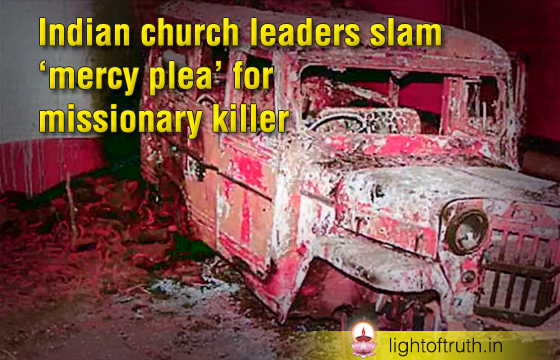
Christian leaders and activists have criticized a petition seeking a presidential pardon for Rabindra Kumar Pal, known as Dara Singh, the main convict in the 1999 murder of Australian missi-onary Graham Staines and his two children. “A plea for mercy must never come at the expense of truth or the suffering of victims,” Father Ajay Singh, a rights activist who has been following the case, told on July 24.
Mahendra Hembram, the only other convict imprisoned in the same case, submitted the mercy petition to President Droupadi Murmu on July 15. Hembram himself was released last April for his “good behaviour” after spending 25 years in prison. The mercy petition “cannot be morally justified” unless the murderer shows “sincere repentance” and acknowledges “the gravity of the crime,” said the priest from the Archdiocese of Cuttack–Bhubaneswar in Eastern Odisha state.
However, neither Hembram nor the prime convict has expressed any sense of “remorse” for burning to death the missionary and his two sons, aged 6 and 10. A district court initially convicted 13 people, including Dara Singh and Hembram. However, the Orissa High Court acquitted 11 of them. Dara Singh was initially sentenced to death, but it was later commuted to life in prison, the same punishment given to his accomplice Hembram.
Daily Archives: August 1, 2025
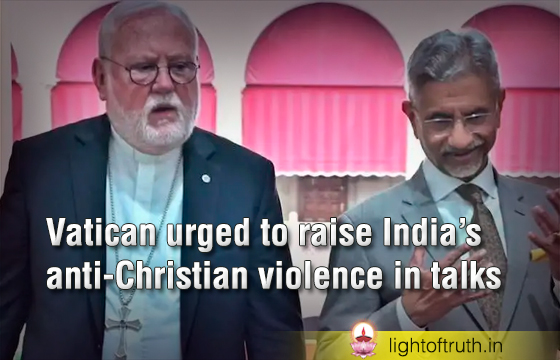
Vatican urged to raise India’s anti-Christian violence in talks
Vatican’s Secretary for Re-lations with States, Archbishop Paul Richard Gallagher, met with India’s External Affairs Minister S. Jaishankar amid calls to make increasing attacks against Chri-stians a bilateral discussion point. Gallagher, on a week-long visit to India, met Jaishankar in New Delhi on July 17, the third day after arriving, following some church functions and meetings with church officials. Jaishankar, in a social media post, said he was “pleased” to meet the Vatican official. It was “a good conver-sation about the importance of faith, and the need for dialogue and diplomacy to address conflicts,” the post said. Neither the Vatican nor India issued any public statements on the issues the officials discussed. Church officials in India also refused to comment on the “conflicts” Jaishankar mentioned in his post.
However, the archbishop was asked to take up the increasing Hindu attacks against Christians in bilateral dialogues with Indian officials in a memorandum that an ecumenical Christian group submitted. The violence against Christians “should be taken up in bilateral human rights dialogues with India, specifically highligh-ting the targeted use of anti-con-version laws on religious minori-ties,” said the memorandum United Christian Forum (UCF) submitted to Gallagher. The Vatican’s engagement should not be limited to the federal govern-ment but also include state govern-ments that “aggressively enforce” anti-conversion laws, it said.
Archbishop Anil Joseph Couto of Delhi submitted the memora-ndum on behalf of the group during a meeting with Gallagher at the Vatican Nunciature in New Delhi on July 17. The memoran-dum wanted the Vatican to issue official statements “condemning the rising incidents of violence and systemic discrimination against Christians in India.”
It also wanted the Vatican to take steps to “ensure judicial transparency” in trials under anti-conversion laws and to have “monitoring and fact-finding missions” to assess ground realities, particularly in states witnessing recurring violence. “Anti-Christian violence has been consistently increasing,” A. C. Michael, convenor of the ecumenical forum, told UCA News, pointing to the numbers in the memorandum. The forum, which documents violence targeted at Christians in the country, recorded 834 incidents in 2024, from 734 incidents in 2023.
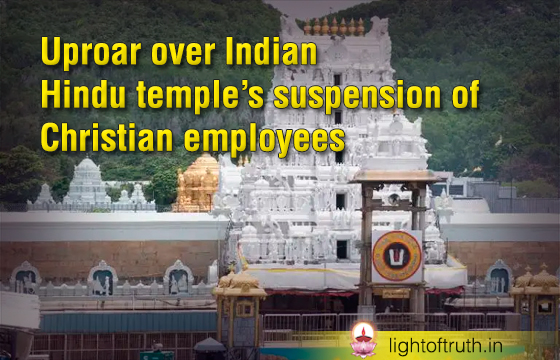
Uproar over Indian Hindu temple’s suspension of Christian employees
Church leaders have criticized the authorities of one of India’s most famous Hindu temples for suspending four employees because of their Christian faith. The managers of the Sri Venkates-wara temple, popularly known as the Tirupati temple, in southern Andhra Pradesh state, announced on July 19 the suspension of employees for “following other religions.” The Tirumala Tirupati Devasthanams (TTD), a trust managed under the state govern-ment, manages the temple, billed as India’s most popular and richest.
“The employees were reportedly following the Christian faith, which violates the code of conduct,” of the temples, TTD said in a statement posted on social media. The decision was taken following a vigilance report and review of supporting evidence, the trust said. The temple report-edly owns assets and properties worth about US$30 billion, making it one of the richest in the world. The TTD’s administrative board manages 12 temples and sub-shrines, employing some 14,000 people. Father Robinson Rodri-gues, public relations officer of the Catholic Bishops’ Conference of India (CBCI), termed the deci-sion a violation of constitutional rights.
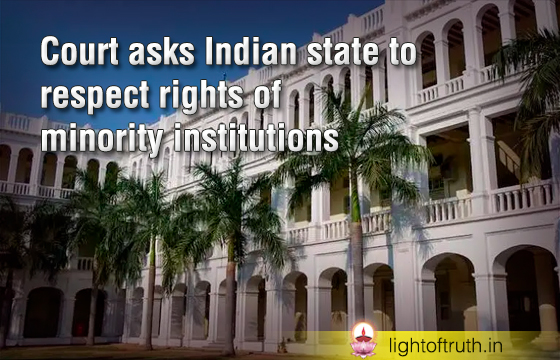
Court asks Indian state to respect rights of minority institutions
A verdict by the Madras High Court in the state of Tamil Nadu could serve as a guide to resolve several cases across India where state officials have delayed staff appointments at Church – run educational institutions, Church officials say. Father Maria Charles, secretary of the Indian Catholic bishops’ Office for Education, called the court order “a blessing,” as many Christian-run, government-aided educational institutions face staffing problems nationwide. Charles told on July 23 that the verdict from the highest court in the southern state regarding staff appointments at Jesuit-run Loyola College could be des-cribed as a “guiding verdict safeguarding the rights of religious minorities.” The court ordered the state government on July 14 to grant approval for 19 appointments –18 assistant professors and one librarian – made by Loyola College, an autono-mous institution for higher education based in the state capital, Chennai.
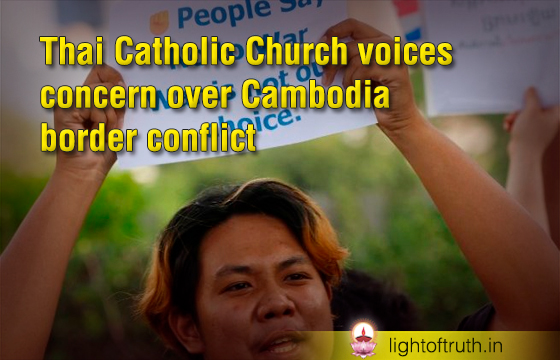
Thai Catholic Church voices concern over Cambodia border conflict
“The Thai Catholic Church views the current military tension along the border with profound concern”, Archbishop Francis Xavier Vira Arpondarattana of Bangkok and President of the Thai Catholic Bishops’ Conference told the Italian Catholic news agency AgenSir in an interview published July 26.
Tensions across the Thai and Cambodian border erupted on Thursday, July 24, in ongoing clashes that have resulted in at least 33 people dead and more than 168,000 displaced. The 800-kilometer frontier between the two countries has been disputed for decades, but past confrontations have been limited and brief
“The Church is fully aware that border disputes, although presented as mere territorial issues, are often exploited for political purposes”, Archbishop Arpondarattana explained in the interview. He said “these tensions may be manipulated to stoke nationalist sentiments”, distract the population “from domestic issues” and “serve the interests of specific political actors”. According to the Archbishop this places “short-term political opportunism” above the well-being of the population and hinders a peaceful, sustainable long-term resolution.
He also said that the Church has often warned against “the dangers of extreme nationalism” and that border conflicts like this one stem from historical complexities and disagreements which need to be considered and understood in order to promote “genuine reconciliation and fair solutions” that lead to a more peaceful future.
The President of the Bishops’ Conference underlined that the Church “strongly supports dialogue, negotiation, and international mediation as pathways to lasting peace”.
He also said the Church is close to the ordinary people who live in the border areas. “They suffer displacement, loss of livelihoods, and constant threats of violence”, he said, emphasizing that “our faith calls us to recognise the inherent dignity of every human being, regardless of nationality or ethnicity”.
“We must resist divisive ideologies and instead foster a culture of solidarity and genuine fraternity”, he continued.
“The Church unequivocally condemns all acts of violence against civilians”, Archbishop Arpondarattana said. “We reiterate that international humanitarian law must be respected, and that non-combatants – including women, children, and the elderly – must always be protected”.
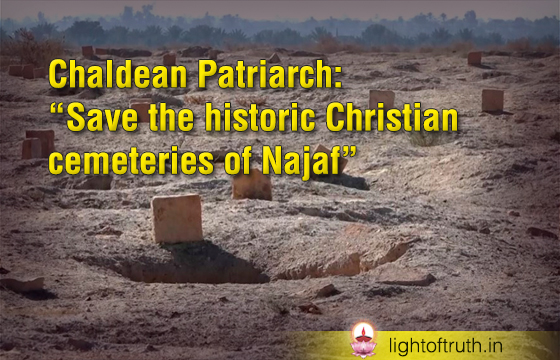
Chaldean Patriarch: “Save the historic Christian cemeteries of Najaf”
In an attempt to safeguard Iraq’s fragile Christian heritage, the Chaldean Patriarch of Bagh-dad has launched an urgent appeal to Prime Minister Mohammed Shia al-Sudani to stop what he calls ‘attempts to destroy historic Christian cemeteries’ in the province of Najaf.
In their place, Cardinal Louis Raphael Sako denounces in a reflection published on the pa-triarchate’s website, local autho-rities want to support commercial development plans that would end up erasing a historical testimony of great value.
According to the Chaldean Church leader, ‘reliable sources in Najaf’ – a city 160 km south of the capital – are sounding the alarm about ‘attempts to transfer control of historic Christian cemeteries’ to investors and entrepreneurs with the aim of ‘carrying out projects’ in the construction sector. Hence the initiative of the cardinal, who has appealed directly to the head of government to block the expro-priation and keep alive the me-mory of a Christian presence in the area.
According to the statement, Cardinal Sako asked al-Sudani to ‘intervene and stop the violation of Christian holy sites,’ speci-fically identifying the ‘Manathira cemetery’ and the ‘Umm Kheshm cemetery for Christian Mana-thira’ as being at risk of ‘imminent threat.’ ‘These historic sites,’ the cardinal continued, ‘must be guarded and fenced off. Further-more, they must not be tied to private investment projects, which would end up completely erasing them.’
Framing his appeal in terms of national interest, the cardinal argued that these areas have immense cultural and economic value that goes beyond the Christian community and concerns the entire Iraqi population, including Muslims. Cardinal Sako went on to emphasise that Iraq’s diverse history predates the Islamic era by a long way, encompassing ‘the Akkadians, Sumerians, Chaldeans, Babylonians, Assyrians, Arabs, Persians, Christians and finally Muslims.’
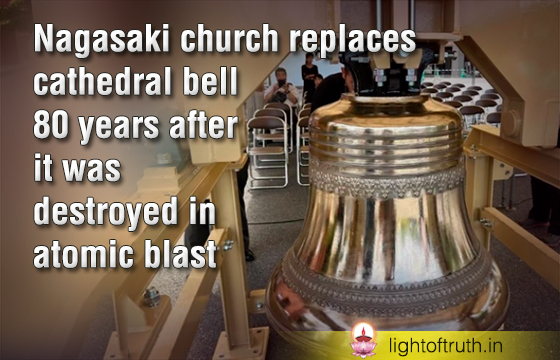
Nagasaki church replaces cathedral bell 80 years after it was destroyed in atomic blast
Catholics in Nagasaki, Japan, have replaced a bell in a cathedral bell tower there almost exactly 80 years to the day after it was destroyed by the atomic blast that leveled most of the city at the end of World War II.
An international effort to fund the construction and installation of the bell at Urakami Cathedral raised $125,000 in just over a year, with the funds coming from over 600 individual donors, according to Williams College Professor James Nolan.
Nagasaki was one of the two Japanese cities, along with Hiro-shima, largely destroyed by the U.S. atomic bombings at the close of World War II. The city was bombed on Aug. 9, 1945, marking the second and last time an atomic bomb was used as an act of war.
Nolan told CNA last year that parishioners at Urakami Cathe-dral managed to dig up one of the original bells after the bombing and save it; the bell was installed in the cathedral’s right bell tower after it was rebuilt in 1959.
The remaining bell, however, was destroyed, with the second rebuilt tower remaining empty for decades.
Nagasaki Archbishop Peter Michiaki Nakamura blessed the bell on that date and named it the “St. Kateri Bell of Hope,” accor-ding to the Associated Press.
The bell will be officially installed on Aug. 9, eight decades after the parish was leveled by the atomic bomb. Nolan said it will be rung at 11:02 a.m., the exact moment in 1945 when the bomb detonated around 1,600 feet west of the church.
At the bombing location, a section of wall from the old, destroyed cathedral sits in Nagasaki Peace Park. At the rebuilt parish to the east, meanwhile, Nolan said he hopes the bell “will bear the fruit of fostering hope and peace and solidarity between American and Japanese Catholics.”
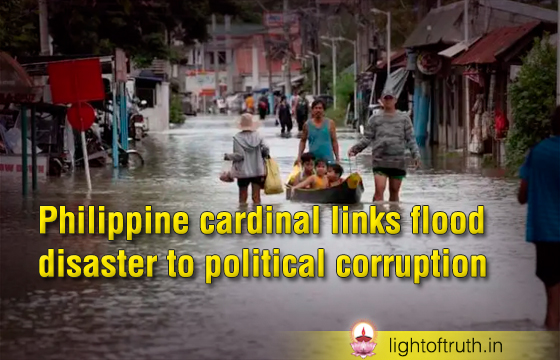
Philippine cardinal links flood disaster to political corruption
Widespread corruption in government infrastructure pro-jects contributed to the severe flooding that paralyzed parts of Manila, especially the low-lying areas, according to Cardinal Pablo Virgilio David, president of the Catholic Bishops’ Conference of the Philippines.
“We are told it’s the climate – yes, climate change is real, and it is devastating. But let us be clear: the real disaster here is corruption,” said the cardinal, also Archbishop of Kalookan.
Despite spending billions of pesos for flood control projects, several areas in the city continue without “an iota of improve-ment,” he said in a four-page pastoral letter addressed to Catholics in his diocese.
The July 25 pastoral letter emphasized that unless corruption is addressed, no long-term solu-tions to flooding will be possible. According to government records, more than 5 billion pesos (appro-ximately US$87 million) has been allocated to flood control projects in the worst-affected areas of Malabon and Navotas since 2023, the letter said.
However, residents in these areas still face problems with non-functioning floodgates, clogged canals, and poor construction, it added. “This is not a new crisis – it is a recurring one. And this year, the delays are even worse. How many more cycles of damage and neglect must our communities endure before real accountability is demanded?” it asked.
Additionally, the cardinal also cited 142.7 billion pesos in alleged “questionable insertions” in the 2025 national budget, which some opposition politicians described as “new face of pork,” a slang term for political spending. “Mean-while, our people wade in sewage and sleep in damp evacuation centers,” the cardinal said. David called on the public, especially the youth, to speak up against corruption, saying it is the only way to protect their future.
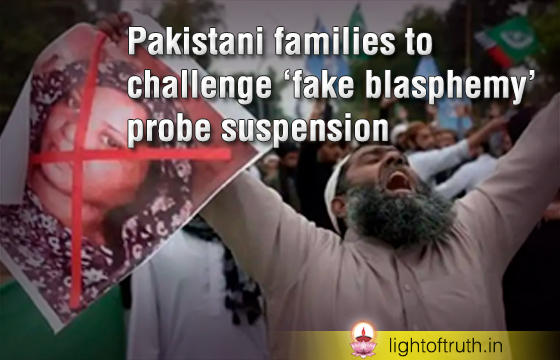
Pakistani families to challenge ‘fake blasphemy’ probe suspension
Families of victims of a “blas-phemy gang,” which allegedly entrapped hundreds of mostly young people in fake cases to extort money, have vowed to challenge a Pakistan court deci-sion suspending a probe into misuse of the controversial blasphemy law.
The families and their lawyers say the decision by the Islamabad High Court in the national capital to overturn its earlier order about forming a commission to conduct an investigation was frustrating, so it will be challenged in the Supreme Court. On July 24, an appellate bench of the Islamabad High Court, which has jurisdiction over lower courts in the Islamabad Capital Territory, issued an interim order to overturn the earlier verdict by Judge Sardar Ejaz Ishaq Khan. Khan’s July 15 verdict asked the government to form a commission within one month. The commission was directed to complete the probe and submit a report within four months.
The order was in response to a petition filed by 101 families in September that alleged that a criminal network in collaboration with the Federal Investigation Agency (FIA) has been responsible for the arrest of 450 people on fabricated blasphemy charges. At least five accused died in police custody. Among those detained are ten Christians, according to Christian rights activists.
The families of victims will challenge the suspension in the Supreme Court, said Rana Abdul Hameed, a lawyer representing some of the petitioning families.
“The original verdict was based on merit. It’s highly irregular to issue an interim order while proceedings are ongoing,” he told UCA News on July 28. The lawyer said that the network behind the blasphemy entrapments has been exposed through live-streamed testimonies.
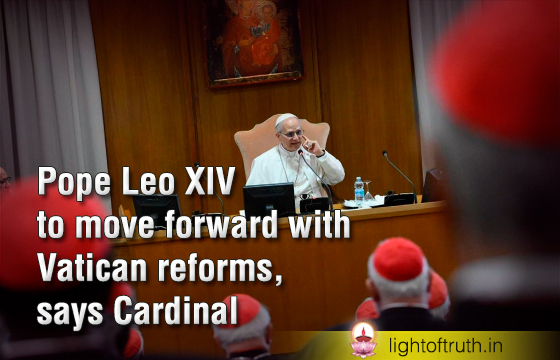
Pope Leo XIV to move forward with Vatican reforms, says Cardinal
Pope Leo will announce reforms to the Roman Curia in the autumn, Archbishop of Westminster Cardinal Vincent Nichols has predicted, saying that one of the reasons the Pope was elected was that he knew the Church’s administration from the inside. And according to the Cardinal, discussions among cardinals at the time of the Pope’s election in May focused on the continuing problems of the Curia.
Cardinal Nichols made his remarks after giving the St George’s House annual lecture in St George’s Chapel, Windsor. Addressing an invited audience, which included the Princess Royal, he talked about the need for hope, the place of religion in a secular society, and encouraging signs of young people’s growing interest in the Catholic faith – what he called “a response to the spiritual side of our human nature”.
Cardinal Nichols, who was one of the 133 cardinal electors who chose Cardinal Robert Prevost to be the next Pope, said that the General Congregations held with both the cardinal electors and the cardinals too old to vote, highlighted the qualities they believed the next Pope needed – and Prevost clearly had them all.
They believed that the successor to the throne of Peter needed to evangelise – and Prevost was a member of a missionary order; he needs intellectual ability – and Prevost was a scholar; that he needed to be aware of the world’s needs – and Prevost as leader of his own Augustinian order twice had travelled the world; that he was a pastoral leader – he had been bishop of a poor diocese; and he had curial experience – he had been prefect of the Dicastery for Bishops from 2023.
“I do think nobody else had all that experience”, he told the audience, “So that is why the voting [in the conclave] did not take long,” referring to Pope Leo being elected on the second day of the conclave and reaching the two thirds majority required for election on the fourth ballot. “A lot our discussion was about addressing the Curia”.