

It is with regret that we observe in these last few hours, once again, that peace is sought through preventive attacks instead of committing to dialogue around the negotiating table,’ writes Cardinal Dominique Joseph Mathieu, Archbishop of Tehran-Ispahan of the Latins, to AsiaNews.
The prelate’s comments come in the wake of Israel’s night-time attack on Iran and Tehran’s subsequent response. The Jewish state claims to have struck Iranian nuclear sites, as well as leading military and scientific figures, including the head of the Revolutionary Guards, Hossein Salami, as part of Operation Rising Lion. Tehran responded by launching a hundred drones against the Jewish state. ‘We pray,’ the cardinal continued, “that peace through dialogue based on a consensus will prevail. May the Holy Spirit guide this process,” as negotiations in Oman between the United States and Iran for a nuclear agreement appear to be faltering. This morning, in fact, Tehran announced that it will not participate in the sixth round of talks.
Cardinal Mathieu is deeply concerned at this time of great regional and global tension, because the much-feared escalation that risks dragging the entire Middle East into a devastating conflict seems to be materialising.
Speaking of ‘the cross and hope,’ the cardinal emphasised the two distinctive traits of the Christian community in Iran, which had a ‘strong bond’ with Pope Francis, whose death was ‘a profound sorrow’ and which today looks with confidence to his successor, Leo XIV. ‘Among Iranian Catholics,’ he continued, ‘there is great hope, combined with incredible anticipation.’ The current Jubilee Year is also being lived in this perspective, ‘which is why we can say that we are full of hope.’
Cardinal Mathieu recalls the importance of Pope Francis’ pontificate, including in relations with the Muslim world and the Iranian authorities, describing him as the pontiff who ‘opened many doors’ and now ‘the time has come to organise the space behind these doors’.
Daily Archives: June 14, 2025

Tens of thousands make Marian pilgrimage in Vietnam
To celebrate the conclu-sion of the Marian month of May, over 10,000 people from the various parishes and co-mmunities in the diocese of Da Nang–spanning more than 10,000 square kilo-meters – made a pilgrimage to the Shrine of Our Lady of Tra Kieu. According to the Vatican’s Fides news agency, the Marian Shrine commemorates an apparition of the Virgin Mary 140 years ago. Local tradition holds that Mary appeared to console, encourage, and help her children in times of difficulty.
Pilgrims took part in the journey on the Solemnity of the Visitation of the Virgin Mary, which Archbishop Joseph Dang Duc, Coadjutor of the Archdiocese of Hue, described as “an event of love, faith, commitment, and service, an opportunity to profess one’s faith in the face of the challenges of the present time.” Abp Dang Duc described the pilgrimage to the Marian shrine of Tra Kieu as “not only an individual act, but a communal act to renew our vocation and mission, since we are all the people of God and we are all walking together in faith, in love, toward evangelization.” The Diocese of Da Nang has long been considered the cradle of Catholicism in southern Vietnam as it has roots to three Jesuit missionaries who arrived in Hoi An in 1615 to evangelize. In the 17th and 18th centuries, the diocese of Da Nang was one of the main centers of the diocese of Cochinchina in southern Vietnam as a place from where missionaries departed. Vietnam now has their first martyr, Blessed Andrew of Phu Yen, a catechist beatified by Pope St. John Paul II.

Catholic business leaders launch faith-driven executive program in Thailand
Catholic business leaders from Thailand and the Philippines gathered at the Baan Phu Waan Pastoral Training Centre on June 7–8 for the inaugural session of the Catholic Business Wisdom Enhancement Program, a new formation initiative aimed at aligning business leadership with Christian values. Organized by the Catholic Business Executives and Profe-ssionals (CBEP) in Thailand and the Brotherhood of Christian Businessmen and Professionals (BCBP) in the Philippines, the program is part of a broader collaboration under UNIAPAC, the International Christian Union of Business Executives. The network represents over 45,000 executives from 38 countries and promotes faith-driven leadership across global markets. The CBEP Academy is designed as a spiritual and ethical roadmap for business, emphasi-zing discernment, responsible ste-wardship, and the understanding of work as a vocation. In the Philippines, the initiative has already reached more than 20,000 BCBP members.
“Work is not a consequence of sin, it is part of God’s plan,” said Bobby Lavina, chairman of Phinma Foundation Inc., during one of the sessions. He said work is “a noble thing and part of what it means to be human.” He challenged participants to reflect on the moral dimensions of modern business practice. ”What is the greatest challenge in your opinion to make the way business is done now reflect more the face of Christ?” he asked. Joey Avellana, president of Avellana & Associates, echoed this spiritual framing. He said God Himself “is a worker… the first worker.” “Because God created man in His own image, therefore God created man as a worker. We are God’s coworkers. We are God’s co-creators,” he added.
Disastrous flooding adds to Myanmar’s humanitarian emergency
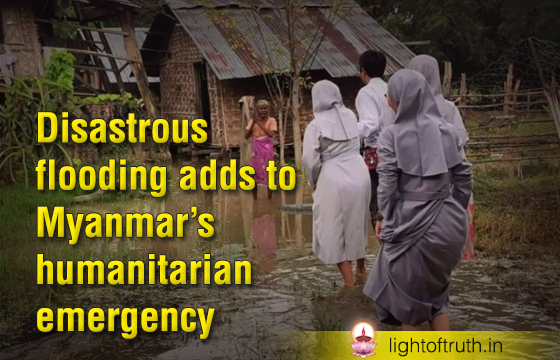
The ongoing humanitarian emergency in Myanmar is being compounded by devastating floods in the north of the country, accor-ding to the Vatican’s Fides news agency, which is operated by the Pontifical Mission Societies. The flooding came as a result of roughly a week of intense rains that espe-cially affected Myanmar’s Saga-ing region and Kachin State, leading to further suffering for the nation’s civilian population, which has already been extremely tried by the ongoing civil conflict.
The Sagaing region had already been under severe strain following the March 28 earth-quake, which killed more than 3,700 people, displaced thousands of others, and caused immense damage to homes and infrastru-cture. Meanwhile, Reuters is reporting that Myanmar’s ruling military junta said it has extended a temporary ceasefire to June to support reconstruction and relief efforts following the quake.
Days after that natural disa-ster, in early April, the junta announced a ceasefire to support relief efforts, following similar moves by anti-junta armed groups. In addition, the opposition groups have also extended their ceasefire to the end of June. Despite the ceasefire announcement, the agency reports, military airstrikes and artillery attacks have conti-nued in some parts of the country.
A new report issued by the United Nations High Commi-ssioner for Human Rights, cited by Fides, confirms the worsening humanitarian crisis in Myanmar, especially due to military viol-ence and the collapsed economy. Set to be presented at the next session of the UN Human Rights Council in early July, the document calls the situation “increasingly catastrophic, marked by incessant atrocities that have affected all aspects of life.” Moreover, it details how the economic plight is compo-unding the nation’s emergency.

Rice fields and greenhouse gases: a plan to reduce emissions in Asia-Pacific
The Asian Development Bank (ADB), in collaboration with CGIAR and with the support of the Gates Found-ation (the private American foundation founded by Bill Gates and Melinda French Gates) launched a project to boost investments in sustainable rice production.
The initiative includes an initial allocation of US$ 1.5 billion to the Asia-Pacific region, shared between Bangladesh, Cambodia, China, Pakistan and the Philippines. The plan is part of a broader plan, announced in May, to mobilise US$ 40 billion by 2030.
The goal is to make the rice sector more resilient to climate shocks, thanks to more efficient cultivation methods that increase productivity while reducing environmental footprint.
Rice, a staple in the Asian diet, is now at the centre of a heated debate in many parts of the region. In the Philippines, the government has declared a state of “food security emergency” to deal with soaring prices, while in Indonesia, more and more land is being allocated to rice.
In Japan, the authorities are grappling with a major crisis that has had serious political repercussions. The drastic drop in harvest yields is one of the main causes of the emergency in the wake of excessively high temperatures recorded in the summer of 2023.
Bishops mourn victims of Air India plane crash
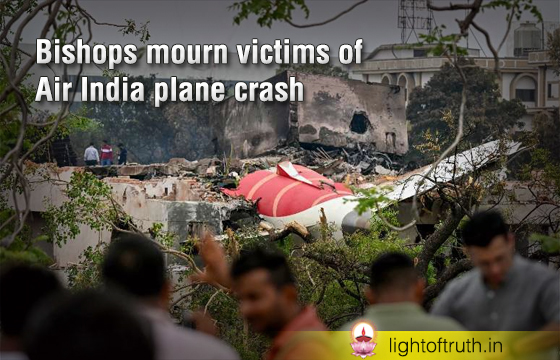
The Catholic bishops in India have offered condolences and expressed solidarity with the victims and the families of an Air India flight that crashed on June 12, shortly after taking off from the western city of Ahmedabad. At least 241 of the 242 people on board were killed when the Boeing 787-8 Dreamliner crashed in a residential area, just outside Ahmedabad Airport in the state’s commercial capital. “The death toll may increase” as several on the ground and nearby buildings are affected, G.S. Malik, Ahmedabad Police Commissioner, told the media. The only surviving passenger, Vishwas Kumar Ramesh, a 40-year-old British citizen of Indian origin, is recovering in a hospital. “The entire Catholic Community of Gujarat is aghast,” Archbishop Thomas Macwan of Gandhinagar, based in the state capital, told UCA News on June 12. He said he was in his office, barely 20 kilometres away from the crash site, “when the news came in, and my heart was crying.” The prelate said he also learnt that five to six Indian Christians, including a recently married Christian couple from a village in the Ahmedabad diocese, had died in the crash. Macwan said he had known Gujarat state’s former chief minister Vijay Rupani, who tragically died in the mishap, and described him as “a good man.”

Thousands gather for declaration of India’s first Eucharist miracle
Some 10,000 Catholics gathered in a tiny village parish in southern India recently to witness the official declaration of a Eucharist miracle, billed as the first such Vatican-approved miracle in India. The May 31 event came more than 11 years after the miracle — the face of Christ appearing in the holy host during a Eucharistic celebration — occurred at Christ the King Church in Vilakkannur parish, in Thalassery archdiocese on Nov. 15, 2013. The Vatican approved the miracle two months ago, following a theological analysis and scientific evaluation, which allowed the archdiocese to install the miraculous host in the parish. The official declaration came after prolonged studies, both theological and scientific.
In March, the Dicastery of Doctrine of Faith declared that “nothing prevented the declaration of the Vilakkannur Eucharist as an extraordinary event.” The incident was first studied by a doctrinal committee of the Syro-Malabar Church, and its report was submitted in December 2013. Following further studies, the Dicastery of the Doctrine of Faith in 2018 requested that the consecrated host be sent to the Vatican through the nuncio for closer examination. In September 2023, the Vatican sought to conduct scientific studies on the host to establish that no foreign substance was present, forming the image of Jesus on it. Following the Vatican’s instructions, the host was taken to Bangalore’s Christ University for scientific studies in January 2024. A team of theologians and scientists at the university, which is run by the Carmelites of Mary Immaculate priests, conducted the studies. The studies in India and abroad “have established that the sacred image was formed by the same substance as that of the host and there is no other trace of any other material,” archdiocesan chancellor Mutta-thukunnel told local media.
New church gives hope to India’s most persecuted district
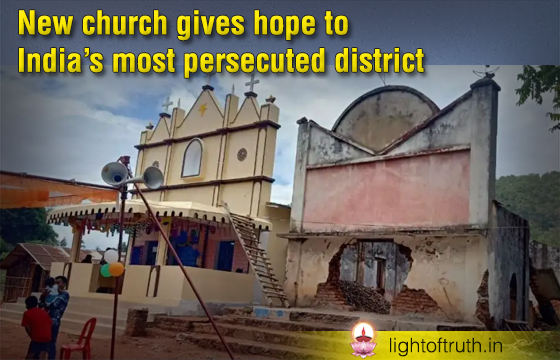
A new church built beside a destroyed one, where a Protestant Christian was burnt alive in Kandhamal – the epicentre of the 2008 anti-Christian riots in eastern India’s Odisha state – is a sign of hope and renewed faith, say Church leaders. The Catholic Church of Archangel Michael in Gudrikia, a substation under the Padangi parish in Kandhamal district, was blessed on May 26 by Archbishop John Barwa of Cuttack-Bhubaneswar. The new church was built near an old church, which was attacked during the 2008 anti-Christian riots. The rioting Hindu mob destroyed the church after burning alive Mathew Nayak, a school teacher, for refusing to give up his Christian faith. “The new church is a sign of hope and faith among Christians, as it comes following the worst anti-Christian violence,” said Father Sebastian Thottamkara, the parish priest in Padangi.
Indian court upholds Christian army officer’s termination over prayers
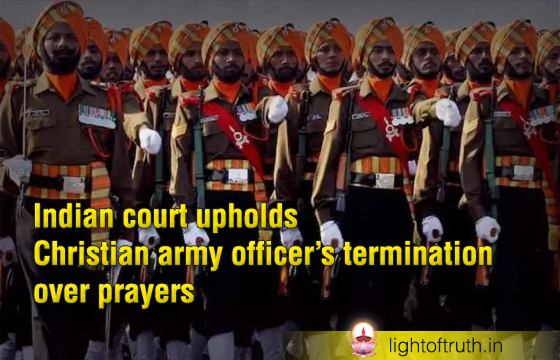
A court in India’s national capital has upheld the termination of a Christian army officer for “indiscipline,” after he persi-stently refused to lead a weekly religious parade, considering it against his faith.
Officer Samuel Kamalesan “has kept his religion above a lawful command from his superior. This clearly is an act of indiscipline,” said the Delhi High Court in its May 30 order. The court upheld the termination.
Kamalesan, a Protestant Chri-stian, was terminated in March 2021, four years after he joined the army, without providing him any benefits, such as a pension or gratuity. He joined the force as a Lieutenant and was appointed the troop leader of a squadron com-prising Sikh soldiers.
As the leader of his troop, Kamalesan was required to lead the troop in a weekly parade to a Gurudwara, a Sikh temple, and join prayers inside the innermost temple, its sanctum sanctorum, with temple priests. Kamalesan refused, stat-ing that his Christian faith does not permit him to do so, according to court records.
Kamalesan’s petition in the High Court challenged his termination and sought rein-statement.
The federal government opposed the petition. Government attorney told the court that Kama-lesan’s refusal was “only on the ground of his religious beliefs” and it “has an adverse effect on the morale and motivation of the troops he commands.”
The court ruled Kamalesan’s “persistent refusal to fully parti-cipate in weekly regimental reli-gious parades, despite extensive counseling and opportunities for compliance, justified the action taken by the respondent.”
Kamalesan said that several Christian troop leaders, including himself, have led and continue to lead troops to the regiment’s Hindu temples, and conduct prayers, offerings, and the Arati as ritual worship inside the inner-most temple. “Without the army uniform, I may be a Catholic. But with the uniform, I’m part of my regiment and will follow the disciplines of the force. Our regimental identity is above reli-gion, caste, and community,” he told on June 2.

Indian Christians urge president to end abuse by Hindu radicals
Indian Christians have sought President Droupadi Murmu’s intervention to end the rising religious persecution against them by hardline Hindu groups in many parts of the country. Christians of different denominations, united under the banner of the national front Rashtriya Christian Morcha, handed a memorandum addressed to Murmu to the district collector of Jabalpur in the central Indian state of Madhya Pradesh on June 9. Atul Joseph, who led the 50-member delegation, said the top district official assured them that he would forward their petition to the president for her consideration. “We were forced to write to the honorable president as Christians continue to face violent attacks and false cases of conversion in different parts of the country daily,” Joseph told on June 10. The four-page memorandum stated that Christians, who comprise 2.3 percent of India’s 1.4 billion people, “always upheld the constitutional values” and “secular and democratic principles” of the country. “Despite this right-wing Hindu groups constantly targeted us to the extent that in many states, even holding a routine prayer meeting has become troublesome for us,” it said. The memorandum further highlighted the plight of Christians of Dalit (former untouchables) and indigenous origins, saying, “they have been discriminated against and forced to bear increasing hostilities and violence.” The Christians also sought Murmu’s intervention in stopping the gross misuse of anti-conversion laws in many states, such as Uttar Pradesh in northern India, and central states like Chhattisgarh and Madhya Pradesh. Christian churches and prayer gatherings are targeted by hardline Hindu mobs by wrongly labelling them as religious conversion activities.