
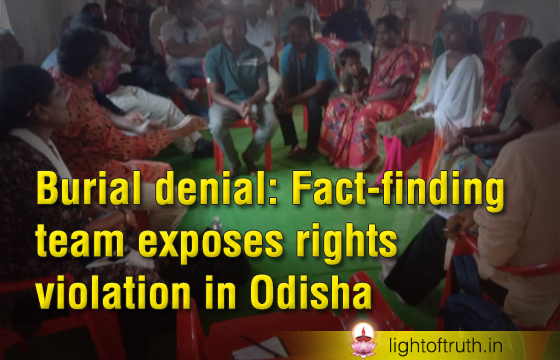
A joint fact-finding team has uncovered widespread human rights violations against Dalit and Adivasi Christians in the Nabarangpur district of Odisha state in eastern India. The team, comprising the members of the Odisha Lawyers Forum and activists, visited the region April 26 and 27 and documented multiple cases of families being barred from burying their dead according to their Christian faith. In several instances, the victims were allegedly coerced into either renouncing their religion or “converting” the deceased to Hinduism in order to gain access to burial spaces, the team reported. Many of the violations have occurred within the Assembly constituency of the state minister for Scheduled Castes, Scheduled Tribes, and Minorities, it pointed out.
Daily Archives: May 15, 2025
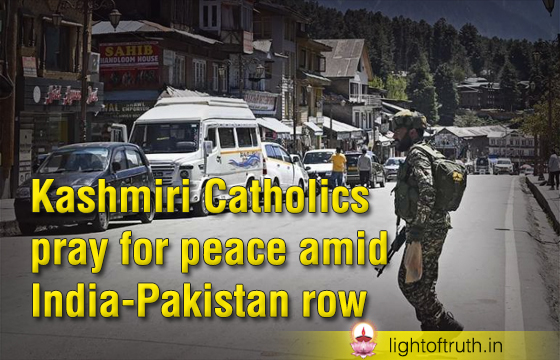
Kashmiri Catholics pray for peace amid India-Pakistan row
“The Catholics of Kash-mir are praying incessantly for peace. They pray in churches and homes. And they are marching the streets alongside other people of goodwill, carrying lit torches to shine the light of God and the flame of reconciliation and peace,” said Bishop Ivan Pereira of Jammu-Srinagar, Fides news agency reported on April 29. The diocese has about 9,000 Catholics in the Indian administered Kashmir. The disputed region is administered partly by India and Pakistan. Tensions and diplomatic rows sparked between arch rivals India and Pakistan after armed terrorists killed 26 Indian tourists on the Indian side of Kashmir on April 22. Both countries have withdrawn their diplomats, revoked visas, banned the use of their airspace, and asked armed forces to remain fully prepared. Media reports of exchanges of fire between Indian and Pakistani soldiers have been reported. “We are experiencing a moment of tension and fear that is affecting the entire popu-lation,” Pereira told Fides. “We know there are cease-fire violations in the border area. And according to widespread reports, the Indian police have destroyed several houses belonging to militants and terrorists. This is not an easy time for us here, and many are reliving the night-mare of conflict,” he said.
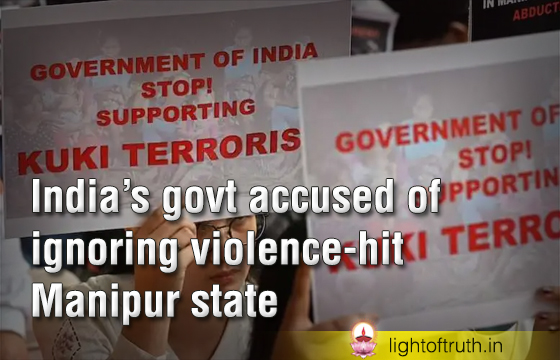
India’s govt accused of ignoring violence-hit Manipur state
Leaders of a group involved in ethnic-violence in India’s strife-torn Manipur state have criticized the federal government of Prime Minister Narendra Modi for its inability to find a solution to the unrest, two years after it broke out. Ahead of the second anniversary of the outbreak of violence on May 3, the Hindu Meitei groups jointly said that New Delhi seems to lack interest in finding an amicable solution to the violence between them and the Kuki-Zo, a Christian majority tribal group. “The Indian government seems to differ in dealing with its citizens in different parts of the country,” said Athouba Khuraijam, convener of the Coordinating Committee on Manipur Integrity (COCOMI), an influential body of Meitei civil society organizations. The Modi government in October last year imposed federal rule after the state government failed to end violence that has claimed 260 lives and displaced more than 60,000 people, mostly Kuki-Zo Christians. “Our fundamental rights and constitutional rights have been violated and suspended for two years,” Khuraijam told the media on April 29 in Imphal state. He said that federal rule has become “ineffective and symbolic.” People expected federal rule to bring law and order, “but instead, we have seen continued chaos.” The violence began on May 3, 2023, when Meitei people attacked a Kuki-Zo march protesting a Meitei demand for indigenous status. Indigenous status would allow the Meiteis, a politically and socially powerful group, to access benefits from the government’s affirmative action plans, including reserva-tions in government jobs and education, among other things, for the disadvantaged.
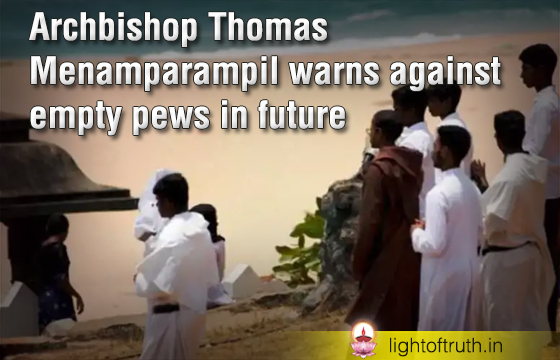
Archbishop Thomas Menamparampil warns against empty pews in future
Archbishop Thomas Menam-parambil has urged Indian Church authorities to be more attentive to the diverse voices within and the needs of the new generation, while cautioning against a gradual decline in faith among Catholics in the country. Archbishop Tho-mas Menamparampil of Guwa-hati, in the northeastern state of Assam, warned Church authorities on May 10 about an impending fate similar to that of the Euro-pean Church, where priestless parishes, empty altars, and pews are sad realities. “Unless timely efforts are made to settle internal conflicts and indifference among the faithful,” the Church in India may face a similar fate in the future, Menamparampil said. The prelate was addressing some 4,800 priests, brothers, and nuns working as missionaries across the globe from the Diocese of Palai in the southern Indian state of Kerala on May 10, at the St Augustine’s Church compound in Pravithanam.
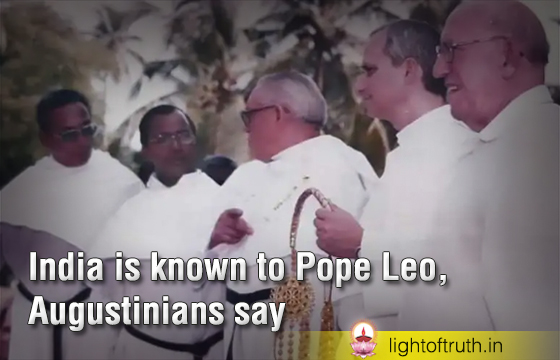
India is known to Pope Leo, Augustinians say
Pope Leo XIV is familiar with India, having visited the country twice and spent nearly a fortnight as prior general of the Order of St. Augustine, according to an Augustinian priest in India. Augustinian Cardinal Robert Francis Prevost, who was elected pope and took the name Pope Leo XIV, visited several places in the southern Indian states of Kerala and Tamil Nadu in 2004 and 2006, says Father John Bosco, who teaches at St. Augustine’s Study House in Aluva, central Kerala. In 2004, the Augustinian prior general’s programs included the ordination of six deacons, including the then Deacon Bosco. “I feel so great and blessed,” Bosco told on May 12, adding: “I never imagined the future pope was attending my priestly ordination.” “He is so down to earth and has great concern for the poor and those living in the periphery,” the priest said. “He likes to listen more rather than speak,” Bosco said. “As prior general of the order, he kept visiting houses of the order in as many countries as possible and made it a point to interact with as many people as possible, including the general public,” the Kerala-based priest recalled. During the 2004 visit, he spent time with people in Kerala. However, during his 2006 visit, he toured a school run by the order in Pollachi, a town in Coim-batore district in the southern Indian state of Tamil Nadu.
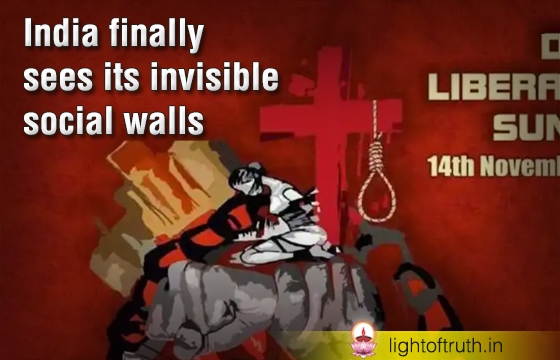
India finally sees its invisible social walls
On April 30, the Indian government announced a decision that will reverberate through the nation’s social fabric for genera-tions: the upcoming national census will include comprehensive caste data for the first time since 1931. This watershed policy shift, declared by Federal Information Minister Ashwini Vaishnaw, promises to reshape how India understands and addresses its most persistent social divisions. Since indepen-dence, India’s leaders have deliberately avoided counting caste in national censuses, except for Scheduled Castes and Tribes. The idealistic hope was that by not measuring caste, India might eventually transcend it. Reality proved more stubborn. Caste has remained a powerful force in Indian life – influencing marriages, job opportunities, political alliances, and educational access. The absence of data did not diminish caste’s impact; it only made addressing caste-based inequalities more difficult. For religious minorities, including Christians, the census represents both promise and uncertainty – a chance for greater visibility and inclusion, but also potential vulnerability in a political climate often charged with religious tensions. For all Indians, it offers a more honest reck-oning with social realities that have persisted despite decades of constitutional commitments to equality. In choosing to count caste after decades of avoidance, India acknowledges a fundamental truth: meaningful progress requires honest confrontation with social realities, however uncomfortable. If imple-mented with integrity and sensitivity to the complex interplay of religious and caste identities, the census could mark a significant step toward the more equitable and inclusive society that India’s founders envisioned.
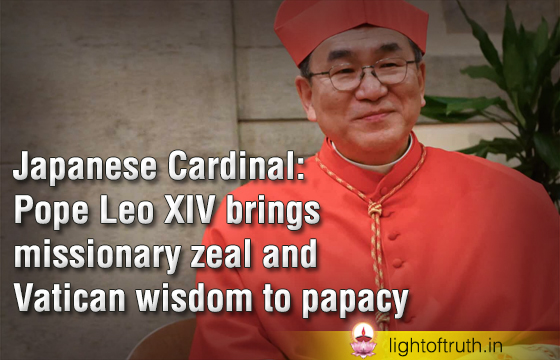
Japanese Cardinal: Pope Leo XIV brings missionary zeal and Vatican wisdom to papacy
Japanese Cardinal Isao Kikuchi of Tokyo says Pope Leo XIV’s previous work as a mi-ssionary and as a Vatican official were important reasons he will make a good pontiff. Speaking to the Catholic Herald, the cardinal gave his reflections on the election of American Cardinal Robert Francis Pre-vost, a member of the Augusti-nian order, to the Chair of Peter on May 8.
“Pope Leo XIV has a rich background in missionary work, especially in Peru, where he served both as a missionary and later as a bishop. He also led the Augustinian Order as its Superior General and most recently served as Prefect of the Vatican’s Dicastery for Bishops, giving him deep experience in both pastoral and administration in the Church and also as an effective and reliable leader,” Kikuchi said.
“During the general con-gregation, many cardinals reflected on the importance of the leadership of Pope Francis, especially his courage and wisdom to lead the People of God,” the Japanese cardinal said. “However, we all understood that we were not looking for a second Pope Francis, photocopy of Pope Francis, but a true successor to Saint Peter, who would faithfully guide the Church according to God’s will and responding to the trust given by Jesus,” he said.
“Many expressed that we need a pope who has deep experience and knowledge in both pastoral and administration of the Church with deep spirituality. Many expressed the need to have pastoral minded Pope to continue the footpath of Pope Francis and deepen the path of synodality,” Kikuchi continued.
“Many expressed that we need Pope to run the Curia well with the mind of restructuring began by Pope Francis. Also many expressed that we need a pope with deep spirituality and sound understanding of the faith to unite all in the Church. There were not so many cardinals among us who could be fit into this category and Cardinal Prevost was just the man to fulfill all these requirements,” he explained. Kikuchi said that after some votes, it was clear for all cardinals in the conclave that Prevost “is the one who had already chosen by Jesus himself: We finally found him.
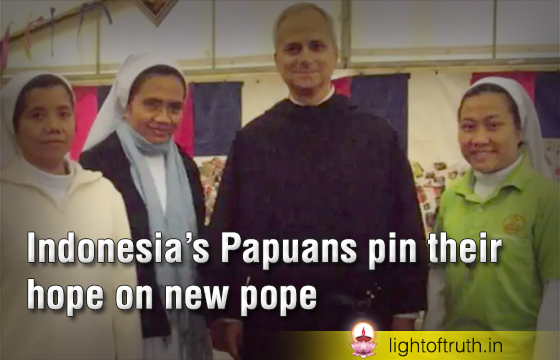
Indonesia’s Papuans pin their hope on new pope
People in Indonesia’s Chri-stian-majority, strife-torn Papua expressed hope that newly elected Pope Leo XIV, who visited the region twenty years ago, will pay attention to their ongoing plight and challenges. The optimism sparked after Cardinal Robert Francis Prevost was elected the successor of late Pope Francis in the Vatican on May 8, becoming the first pope from the United States.
Following the election, several photos from his visit to Papua in 2003 have been widely shared on social media sites, triggering enthusiastic reactions from Papuan netizens. One photo shows Father Prevost posing for a photo with several nuns, another shows he is eating a Papuan dish called papeda and talking to native Papuans.
Prevost visited Papua as the head of the Order of St. Augustine (OSA) to join the 50th anniversary of the order’s arrival in the region. Over the past decades, the order has been involved in various social services including running seminaries and schools.
Both online and offline, Papuans expressed optimism that the new pope’s experience and under-standing of Papua will allow him to pay attention to their problems. Activists, church circles, and academics have often called for dialogue between Jakarta and Papua as an effort to end the conflict. During Pope Francis’ visit to Jakarta in September last year, Papuans expressed their concern by carrying out the ‘Way of the Cross’ rally.
Bishop-elect Bernardus Bofitwos Baru of Timika says the new pope is aware of challenges Papuans face every day because he knows the ground situation from Augustinian members. “Pope Leo XIV has the opportunity to help reduce the conflict in Papua with his position as the highest leader of the Catholic Church,” Baru told.
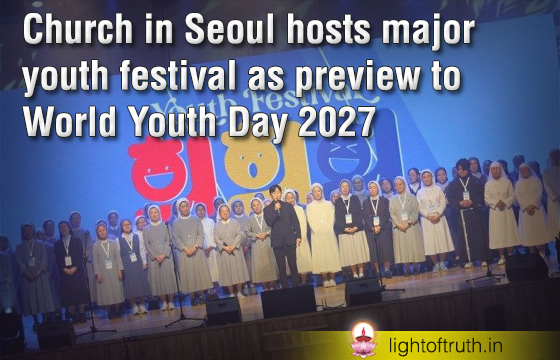
Church in Seoul hosts major youth festival as preview to World Youth Day 2027
More than 30,000 people took part in the “Hee Hee Hee” Youth Festival in Seoul, South Korea, from May 9 to 11, a large-scale, youth-led celebration organized by the Archdiocese of Seoul and the Local Organizing Committee for World Youth Day (WYD) 2027. Organizers said the festival aimed to offer “a vibrant, youth-led celebration of faith, vocation, and community” through programs inspired by the Korean characters for “Light,” “Hope,” and “Joy.”
Young people played a central role in planning and executing the festival, which featured thematic zones, concerts, liturgical cele-brations, and interactive exhibits. According to organizers, the event welcomed “people of all ages, nationalities, and religious back-grounds, creating a space of shared joy and intercultural dialogue.”
Structured to mirror elements of WYD, the Seoul gathering included catechesis, witness talks, creative performances, a prayer vigil, and a concluding Mass held on May 11 at the Catholic Uni-versity Sungsin Campus, also known as the “Truth Zone.”
Presiding over the Mass, Archbishop Peter Soon-taick Chung of Seoul urged young people to listen to God’s call. “In a special way this year, as we journey toward the 2027 World Youth Day within the grace of the Jubilee Year, I earnestly hope that the ‘Hee, Hee, Hee’ Youth Festival will inspire more young people to open their hearts to the Lord’s call and respond with courage and faith,” he said in his homily.
“The Church thrives and bears fruit when it gives rise to new vocations,” he added. “In many ways, the world is, perhaps unknowingly, yearning for ‘witnesses of hope’—those who testify through their very lives that following Christ is the wellspring of true joy.”
An estimated 3,500 people attended the Mass, which featured music, testimonies, and a strong focus on vocational discernment.
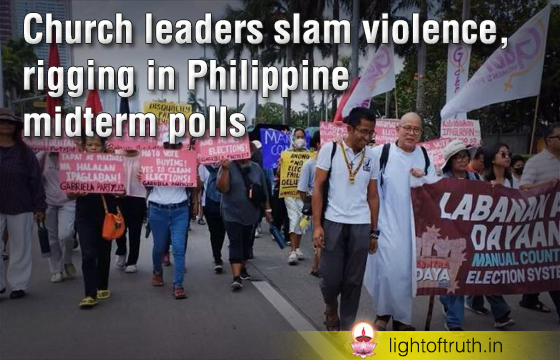
Church leaders slam violence, rigging in Philippine midterm polls
Church leaders joined poll watchdogs and activist groups in denouncing the violence, vote-buying and rigging reported during the May 12 midterm ele-ctions in the Catholic-majority Philippines. “The people have spoken, but it was not a perfect discourse. Money tainted it. Blood stained it. It was blotted by lies,” Archbishop Socrates Villegas of Lingayen-Dagupan wrote on social media on May 13.
Villegas, a former president of the Catholic Bishops’ Conference of the Philippines, said the midterm election ”was coloured with vulgarity.” “Really and truly, no elections are perfect. We keep on hoping. We have leveled up a bit, but the mountain peak is still far from sight. Be critical so that govern-ment services can level up even more. There is so much to impro-ve on,” the archbishop added. He further said that losing or winn-ing in the elections has “lessons to teach” and urged Filipinos “not to get carried away by the glee or the grief. Commission on Elections (Comelec) chairman George Erwin Garcia said the May 12 mid-term polls have been the most peaceful so far in terms of election-related violence. The poll body chief claimed at a press conference in Manila on May 12 that the 44 incidents of violence were much lower compared with the 128 incidents in 2019 and around 120 in 2020.
A day after the midterm elections, some 200 members of various groups led by poll watchdog Kontra Daya and progressive group Makabayan, protested in the capital, Manila, against alleged irregularities and voter disenfranchisement.