
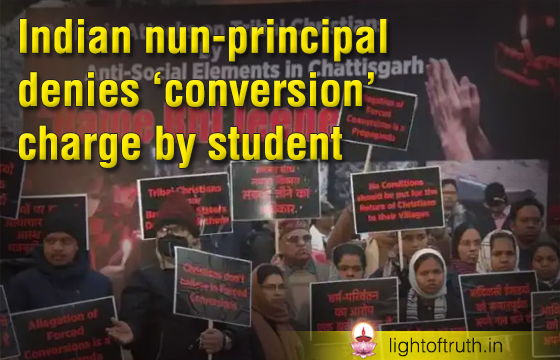
A Catholic nun-principal of a nursing college in the central Indian Chhattisgarh state has denied as “false and baseless” the charges of trying to convert a female student. Police on April 6 registered a case of “attempted forced conversion” against Sister Bincy Joseph, principal of Holy Cross Nursing College at Kunkuri in the state’s Jashpur district. A police official at Kunkuri police station refused to disclose the case details. “All I can confirm is a case is registered against the nun, and the probe is on,” he told on April 8. The complainant student told the local media that she was barred from taking her final exam of the nursing course and denied entry to the campus for resisting attempts to convert her. In an April 7 statement, the nun said the “student’s allegations are a calculated attempt to defame the institution and cover up her own academic shortcomings.” Joseph, a Sisters of Mercy of Holy Cross member, said the complainant was a general nursing and midwifery student. She had completed a three-year course but skipped the practical sessions, which are mandatory to take the final exam as per the rules framed by the state’s nursing council. “The complainant’s attendance was only 32 percent in practical sessions,” while the guidelines require a student to have 80 percent attendance in theory and practical sessions.
Daily Archives: April 15, 2025
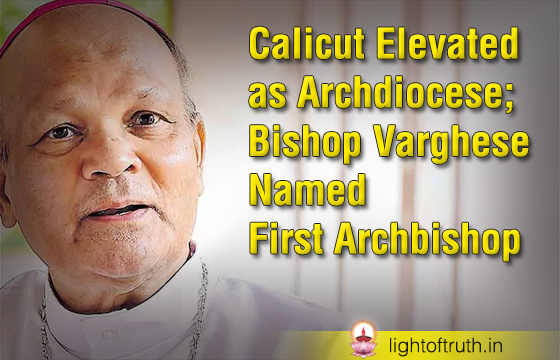
Calicut Elevated as Archdiocese; Bishop Varghese Named First Archbishop
In a historic decision, Pope Francis has elevated the Diocese of Calicut to a Metropolitan Arch-diocese on 12 April 2025, also names Bishop Varghese Chakka-lakal (72) as the first Metropolitan Archbishop of Calicut. The dio-ceses of Kannur and Sultanpet will serve as their suffragans.
The diocese of Calicut in Malabar region has a deep-rooted legacy that dates back over 500 years. Evangelization began in 1498 with the arrival of Trinita-rian missionary Pedro Covilham and others. The first church, dedicated to St. Andrew, was built on the Malabar coast in 1500. In 1878, Pope Pius IX separated territories that now include Mangalore, Kannur, and Calicut from the Vicariate Apostolic of Malabar, handing it to the Jesuits of Venice in Italy. Calicut later emerged as a separate diocese in 1923 under Pope Pius XI, formed from parts of Mangalore, Mysore, and Coimbatore. The diocese played a key role in the Church’s mission in Kerala. In 1954, the Oriental faithful were placed under the new diocese of Telli-cherry. Later, in 1998, Pope John Paul II carved out the Diocese of Kannur from Calicut. Initially under Jesuit leadership, Calicut saw bishops such as Paul Perini, Leo Proserpio, Pancratius Zano-lin, and Aldo Maria Patroni. In 1980, diocesan clergy took over with Bishop Maxwell Noronha. He was followed by Bishop Joseph Kalathiparambil in 2002, and then by Bishop Varghese Chakkalakal in 2012. Archbishop Chakkalakal brings decades of pastoral expe-rience. Born in Mala-Pallipuram in the Diocese of Kottapuram, he studied in Mala and Mangalore and was ordained a priest in 1981. He became the first bishop of Kannur in 1998.
and served there until his transfer to Calicut in 2012. Archbishop Chakkalakal served as Secretary General of the Kerala Catholic Bishops’ Council (KCBC) and the Conference of Catholic Bishops of India (CCBI) and currently leads the Kerala Regional Latin Catholic Bishops’ Council (KRLCBC) and the CCBI Commission for Vocations, Seminaries, Clergy, and Religious.
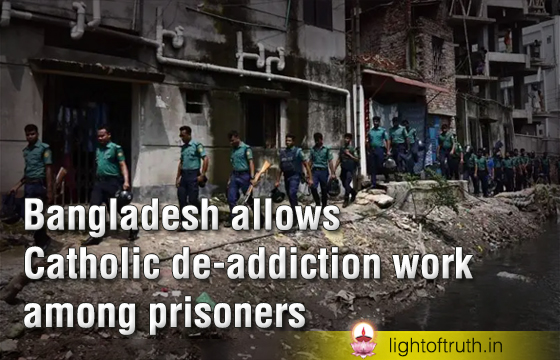
Bangladesh allows Catholic de-addiction work among prisoners
The Bangladesh government has allowed a Catholic-run de-addiction centre to use its training programs and therapy to help inmates addicted to drugs in the country’s largest prison. Holy Cross Brother Francis Nirmal Gomes, director of the Church-run Bangladesh Rehabilitation and Assistance Centre for Addicts, said the government permission came on April 7, making it an “important day” for the organization. The permission allows the centre to work in Dhaka Central Jail in Keraniganj, a suburb of Dhaka, the capital of the Muslim-majority nation. According to media reports, the facility has about 4,500 inmates, including several hundred drug addicts. Gomes said in a social media post that the permission from the Ministry of Home Affairs came “after many years of efforts.” The ministry also oversees the Department of Narcotics Control. He thanked the government and said it is an opportunity for the organization to offer professional support to drug-addicted prisoners. Gomes also thanked his Holy Cross Congregation for supporting him with financial assistance. His centre is among the first professional treatment and rehabilitation organizations for drug addicts in the country. Late American Holy Cross Brother Ronald Drahozal founded it in 1988. The centre has successfully rehabilitated more than 5,000 drug-addicted individuals. It also runs four centres for street children vulnerable to crimes and drug addiction. Over the years, the centre has won various awards.

Philippines: Church calls for discernment ahead of elections
Nearly 70 million Filipinos will head to the polls on 12 May, 2025, to vote in midterm elections, electing lawmakers and representatives for local governments with over 18,000 candidates vying for legislative, local, and regional posts. As the Philippines head for critical midterm elections in May, the Church in the country warns against hate speech and fake news. Ahead of the election the Philippine Bishops’ Conference (CBCP) has issued a Pastoral Letter urging voters to use their voices to uphold freedom and ensure the common good. In the letter entitled “Be Concerned for the well-being of others” the bishops reminded voters that the “primary responsibility of a public servant” is to improve the lives of the Filipino people “especially the poor and the vulnerable.” We need competent leaders and legislators with sincere intentions who serve the good of our parishes, cities, provinces, and the entire country,” the bishops said. The May elections will also contest 317 congressional seats and thousands of local posts.

Christians in Iraqi Kurdistan gather for ecumenical Palm Sunday procession
The Christian faithful of Ankawa, a suburb of Erbil in Kurdistan Region, Iraq, came together on Saturday, 12 April, to witness their faith and ecumenical unity during the annual Palm Sunday Procession. Organized by the Catechetical Committee of the Chaldean Catholic Archdiocese of Erbil, the event was organized under the theme: “Hosanna in the highest, blessed is He who comes in the name of the Lord.” The event drew hundreds of participants in a celebration rooted in shared faith and common witness, bringing together leaders and faithful from various Christian denominations in a shared act of worship and unity, culminating in prayer at the Shrine of Mar Elia.
The procession commenced at the Patriarchal Cathedral of St. John the Baptist of the Assyrian Church of the East and proceeded toward the historic Shrine of Mar Elia, a sacred site for the Chaldean Catholic faithful. Leading the event were high-ranking Church leaders, including His Holiness Mar Awa III, Patriarch of the Assyrian Church of the East, Abp Bashar Warda, Chaldean Catholic Archbishop of Erbil, Abp Nicodemus Daoud Sharaf of the Syriac Orthodox Church, and Archbishop Natha-nael Nizar Agam of the Syriac Catholic Church. They were join-ed by priests, deacons, catechists, and representatives from the Kurdistan Regional Government, all united in prayer and song.
The procession was marked by the active participation of children enrolled in catechetical programs, many of whom led the faithful in hymns and carried palm and olive branches—symbols of peace, hope, and the triumphant entry of Christ into Jerusalem. Syriac Orthodox Scouts and Syriac Catholic catechism students accompanied the march with chants and spiritual songs.
Upon arrival at the Shrine of Mar Elia, the faithful gathered for a concluding prayer service, offering gratitude for the gift of Christian fellowship and the enduring presence of Christ in their midst. The procession, now in its 14th consecutive year, has become a cornerstone event in the life of the Christian community in Ankawa—an annual moment of renewal, identity, and interchurch collaboration.
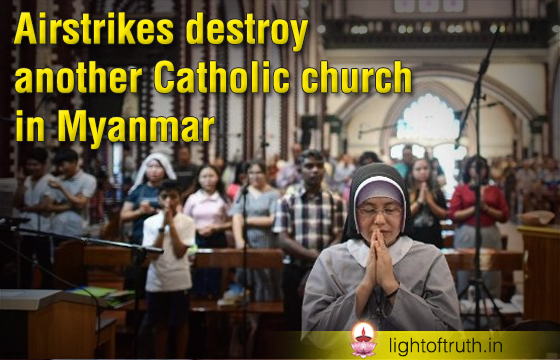
Airstrikes destroy another Catholic church in Myanmar
As fighting between the military junta and resistance forces continues despite the recent earthquake, the regular army bombs the Church of Christ the King in the town of Falam, Chin State. Airstrikes by the regular army have destroyed another Catholic church in Chin, Myanmar’s only Christian-majority state, marking yet another tragic chapter in country’s ongoing civil war between the military junta and resistance forces that continues to severely impact Christians and their places of worship.
The Church of Christ the King in the town of Falam, part of the Diocese of Hakha, was hit on April 8. According to Fides local sources the church’s roof and interior have been devastated, but the building’s walls are still standing. The church had only been recently built with great sacrifice to meet the needs of the local Catholic community of around one thousand faithful. It had been consecrated and opened for worship in November 2023, replacing a small chapel that had existed for 75 years. “There is great sadness now in the community, but also the desire and determination to rebuild,” the source told Fides.
Southeast Asia: Traffickers pose as Christian missionaries, pilgrims to exploit victims
Investigations have revealed that Human traffickers in Southeast Asia are increasingly posing as missionaries or pilgrims to deceive authorities and avoid detection at international borders. According to a report by the Vatican’s Fides News Agency, this emerging tactic involves victims and traffickers disguising themselves as Christian missionaries or volunteers engaged in religious activities abroad.
Police operations, supported by wiretaps and coordinated investigations, have uncovered several cases using this “religious cover.” Police described a method where “a regular traveler, acting as a smuggler, accompanies groups of passengers under false pretenses, who become victims of trafficking.” Law enforcement agencies across Southeast Asia–including the Philippines, Indonesia, Malaysia, Thailand, and Cambodia–have intensified joint operations to combat these networks.
In the Philippines, the Catholic Foundation PREDA (People’s Recovery, Empowerment, and Development Assistance), founded by Irish missionary Fr Shay Cullen, has long denounced trafficking schemes that exploit young women. Fr Bryand Restituto, Assistant to the Secretary General of the Catholic Bishops’ Conference of the Philippines, strongly condemned these deceptive practices. ”We strongly condemn individuals and trafficking networks that exploit vulnerable populations and use language, clothing, and presumed religious practices to commit criminal acts,” he said. In Thailand, Sister Marie Agnes Buasap of the Hospitaller Sisters of Saint Paul of Chartres and coordinator of the Talitha Kum Thailand network, is among those leading anti-trafficking efforts. Talitha Kum promotes awareness among youth, families, and educators, and supports the reintegration of survivors.
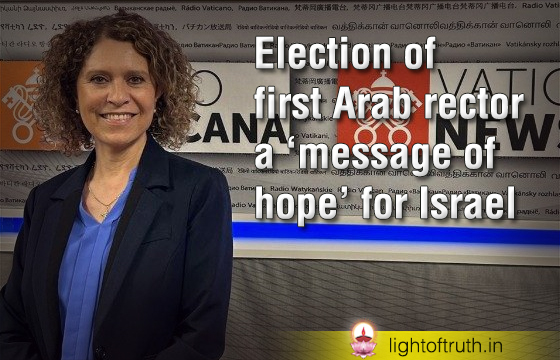
Election of first Arab rector a ‘message of hope’ for Israel
Mouna Maroun was appointed Rector of the University of Haifa, becoming the first member of Israel’s Arab minority – an underprivileged group that, according to rights organisations, continues to face structural discrimination – ever to hold the role at an Israeli university.
Maroun is also a Christian, hailing from a small Maronite Catholic village on the slopes of Mount Carmel. Christians make up only around 7% of the total Israeli Arab population, which in turn represents about one fifth of Israel’s total, and Maroun’s tale of success – as a woman, an Arab, and a Christian – is therefore a noteworthy one.
Her election was “a miracle”, Maroun tells Vatican News, coming as it did only a few months after Hamas’ 7th October attacks and rising tensions between Arabs and Jews within Israel. In April 2024, she had been appointed the University of Haifa’s Rector, or chief academic officer, a role second only to the President in the university hierarchy.
Speaking recently to the Vatican News Maroun describes her appointment as a “message of hope” and a sign that “things can be different in Israel”, that Jews and Arabs “can succeed together and can live together”.
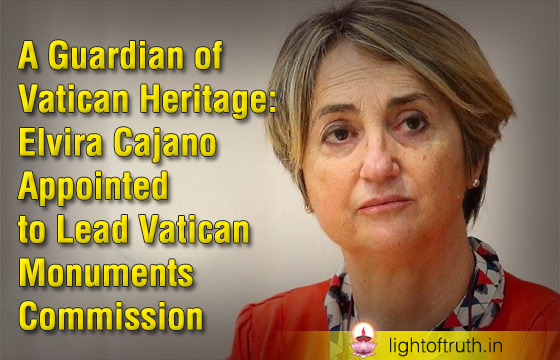
A Guardian of Vatican Heritage: Elvira Cajano Appointed to Lead Vatican Monuments Commission
Professor Elvira Cajano has been appointed President of the Permanent Commission for the Protection of Historical and Arti-stic Monuments of the Holy See. The announcement was made on April 10 by Cardinal Secretary of State Pietro Parolin, marking a new chapter for the century-old institution charged with safe-guarding some of the most trea-sured sites and artworks in Chri-stendom.
Cajano, an esteemed archi-tectural historian born in Parma in 1955, brings decades of expertise to her new role. With an academic background that bridges architecture, history, and conservation–earned at the Uni-versity of Rome “La Sapienza”–she has long stood at the inter-section of scholarship and public service. Her leadership roles within the Superintendency of Archaeology, Fine Arts, and Heritage of Umbria, coupled with her tenure as a visiting professor at the Pontifical Gregorian University, position her uniquely to take on the complex responsi-bilities of the Commission.
More than an administrative role, the presidency of the Co-mmission represents a stewardship of memory and meaning. Cajano succeeds Francesco Buranelli, a former director of the Vatican Museums and a leading figure in art conservation. Under Cajano’s direction, the Commission will continue to serve not only as a regulatory body but also as a cultural conscience for the Vatican–evaluating restoration projects, overseeing architectural developments, and shaping the ways sacred art is preserved and presented both within Vatican City and in extraterritorial sites under its jurisdiction.
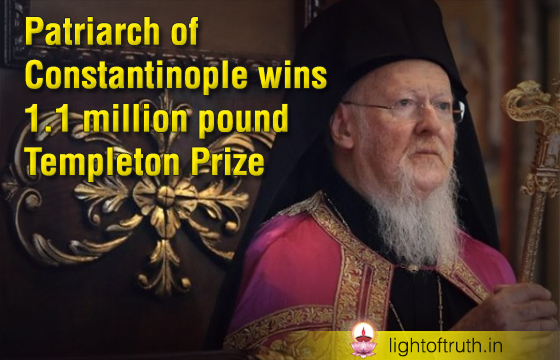
Patriarch of Constantinople wins 1.1 million pound Templeton Prize
The 2025 Templeton Prize has been awarded to Ecumenical Patriarch Bartholomew of Constantinople, the spiritual leader of Eastern Orthodoxy and a visionary voice in the global movement for ecological justice. The £1.1 million prize honours a lifetime of prophetic leadership that has redefined the moral dimensions of environmental stewardship and challenged both faith communities and secular institutions to see the Earth not merely as a resource, but as a sacred inheritance. Often referred to as the “Green Patriarch,” Bartholomew is not only the first among equals in the hierarchy of Orthodox Christian leaders, but also one of the first major religious figures to consistently frame environmental degradation as a spiritual crisis. Decades before climate change entered mainstream conversation, he had already begun weaving together theology and ecology in a call for moral responsibility toward creation.
The John Templeton Foundation, which announced the award on April 9, praised Bartholomew for “pioneering efforts to bridge scientific insight and spiritual wisdom in our relationship to the natural world.” The foundation highlighted how his tireless engagement with scientists, theologians, and policymakers has helped reframe environmental harm not simply as a technical or political issue, but as a profound ethical and spiritual failure.