

All the dioceses of the world are now experiencing the local opening of the Holy Year 2025, which by the will of Pope Francis has as its theme “Pilgrims of hope”. The celebration is also involving many Churches in Asia with significant gestures.
In Shanghai, the opening Mass of the Holy Year was presided over by Bishop Shen Bin in Xujiahui Cathedral. In his homily, Bishop Shen Bin urged all priests and faithful to put into practice the call to hope, fanning the flame with the power of the Word of God. He also called for transforming this hope into concrete actions to become peacemakers, bearers of life, and to bring hope to those in need: to needy brothers and sisters, the poor, the sick, the young, migrants and the lonely elderly.
In the Vietnamese capital Hanoi, the Jubilee was opened with a celebration presided over by Archbishop Joseph Vu Van Thien. Priests administered the Sacrament of Reconciliation in the courtyard of the archbishopric. Then in procession, crossing Nha Chung Avenue, the community reached the cathedral forecourt where the renewal of baptismal promises took place, followed by Mass on the Feast of the Holy Family.
In Tokyo, Card. Tarcisio Isao Kikuchi presided over the opening celebration of the Jubilee in St Mary’s Cathedral. For the big metropolis, as many as 15 churches have been designated as destinations for the Jubilee pilgrimage.
In the Philippines, Cardinal Pablo Virgilio David, Bishop of Kalookan and President of the Bishops’ Conference, appealed for the release of at least political prisoners in the Holy Year. He did so on 26 December, celebrating Mass in the Bagong Diwa prison in Bicutan on the day Pope Francis opened the Holy Door in the Rebibbia prison. “I will consider it a wonderful gesture on the part of the government,” said Card. David – if at the beginning of the Jubilee Year of Hope 2025, the last political prisoners still languishing in prison after several decades of waiting for trial will be granted amnesty, pardon or permanent release on humanitarian grounds”
Daily Archives: January 3, 2025
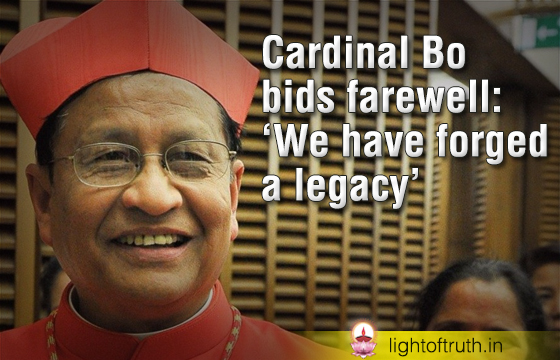
Cardinal Bo bids farewell: ‘We have forged a legacy’
Myanmar’s Cardinal Charles Maung Bo of Yangon has issued a farewell message as he concludes his second three-year term as the President of the Federation of the Asian Bishops’ Conferences (FABC), saying he is “filled with profound gratitude and humility.” “Our journey together,” he reflected, “has been one of profound growth, learning, and shared commitment to the Christian values that unite us.” As he thanked all those who have been crucial to helping the FABC in this sense, he noted that “we have been motivated by Jesus and a Christological vision for Asia.”
“Through our collective efforts,” Cardinal Bo observed, “we have made significant strides in fulfilling our mission.” “Amo-ng our greatest achievements has been the ongoing synodal journey, where we have embraced the spirit of collaboration, dialogue, and mutual understanding,” he said, adding that it has “not only strengthened the bonds within FABC but has also allowed us to discern more clearly our shared vision and purpose.” Moreover, he commended the FABC’s continued engagement “in mean-ingful conversations that have led to concrete actions in many areas, ensuring that our faith remains vibrant and relevant in the contemporary world.” Cardinal Bo recalled that, over the course of the last six years, much has been accomplished and much progress has been made.
Sri Lankan cardinal mandates male-only altar servers in Colombo Archdiocese
Sri Lankan Cardinal Malcolm Ranjith has mandated that girls are not permitted to serve as altar servers in parishes within the Archdiocese of Colombo. “No girls should be invited to serve at the altar, as altar servers, in the archdiocese,” Ranjith wrote in an October 22 letter to parish priests that was made public in December. According to the letter, the cardinal issued the order because serving as an altar server can be a pathway to the priesthood and should therefore be a position reserved for boys.
“It should always be young boys because this is one of the main sources of vocations to the priesthood in Sri Lanka and it will affect the number of candidates entering the seminaries, which [is a] risk we cannot take” the letter continues. “Since females are not allowed to be ordained priests, we have made that decision.”
Ranjith noted in the letter that “several parishes” within the archdiocese have been “appointing girls as altar servers” but told the priests that this order “cannot be changed at your discretion.” “Please carry this out as faithfully as possible and do not think that it is your faculty to [use your own discretion],” the letter adds. “I thank you in anticipation of your usual cooperation and wish you God’s blessings.” Ranjith said in the letter that he had first told the priests about this order during a presbyteral meeting held on Oct. 21, the day prior to the letter.
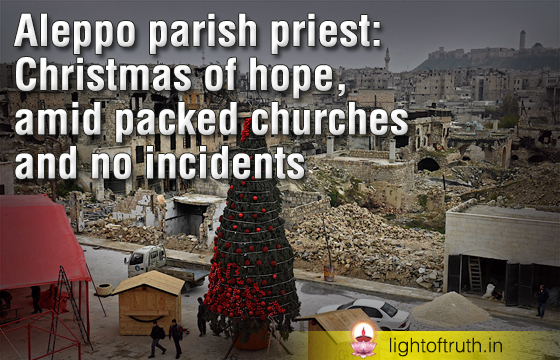
Aleppo parish priest: Christmas of hope, amid packed churches and no incidents
A ‘very peculiar’ Christmas amid ‘reassurances’ from the new authorities that the faithful will be able to ‘continue to practise’ and episodes of sectarian violence in the days leading up to the holiday. Despite fears and uncertainties, Syrian Christians participated in the celebrations, as emerges from the account given to AsiaNews by Fr Bahjat Karakach, parish priest of the Church of St Francis of Assisi in Aleppo. A community that ‘groaned’ in the churches amidst imposing security measures as the country ‘moves towards a real rebirth’, albeit with the fear of ‘intrusions’ by forces ‘that are interested in destabilising Syria’. Nevertheless, he adds, ‘there is no lack of positive signs of curbing these tendencies’.
In less than two weeks, the militias of Hay’at Tahrir al-Sham, once affiliated with the al-Nusra Front (formerly al-Qaeda), overthrew the regime of Bashar al-Assad, who had managed – with the support of Russia and Iran – to remain in power despite 14 years of civil war. They were led by Hts leader Abu Mohammed al-Jolani, who in these days of Christmas celebrations has repeatedly assured tolerance towards all Syrians, including Christians, promising ‘to protect all sacred places to whatever religious community they belong to’. Meanwhile, militias launched an operation in the coastal area of Tartous, an Alawite stronghold linked to the former president, where 14 policemen had been killed the day before.
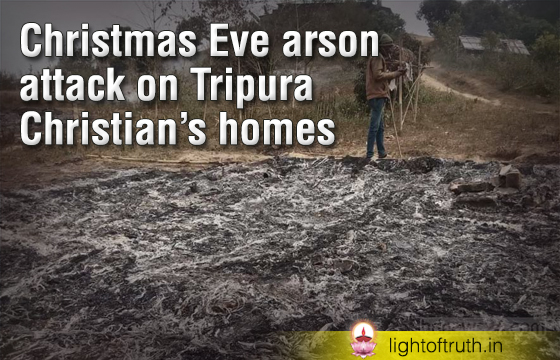
Christmas Eve arson attack on Tripura Christian’s homes
A fire engulfed the houses of 17 Christian families of the Tripura ethnic group in the area of Sarai Tangojhiri, in the upazila lama of Bandarban, in southeastern Bangladesh, late in the evening of 24 December.
The villagers claim that the fire was an act of arson, possibly related to extortion demands made earlier by some thugs. The tragic incident occurred in the Notun Betchhara Tripura neighbourhood, while the villagers had gone to attend Christmas celebrations at a nearby church in the Tangojhiri area, as their neighbourhood does not have its own church. When they returned, they discovered their houses reduced to ashes. The fire destroyed all their belongings, including furniture, solar panels, household utensils, clothes and important documents. The displaced families were left homeless and took shelter under the open sky in the charred remains of their neighbourhood.
Villagers reported seeing the flames around 1 a.m., but could not identify the perpetrators, as the neighbourhood was uninhabited at the time. Of the 18 families residing in the area, only one house was spared from the flames, as its occupants were present and able to deter the attackers. Residents claim that this attack is part of a long-standing pattern of oppression against the indigenous hill communities in the three hill districts. Influential groups are often involved in these incidents, creating an atmosphere of fear and insecurity. The victims demand justice and immediate support to rebuild their lives.

Indian Christians witnessed increased hostility in 2024
Christians in India will look upon 2024 as a year that challenged their faith and resilience with increased hostility, internal conflicts, scandals, power struggles, and natural cala-mities. Attacks against and harassment of Christians swelled this year amid growing hostility, particularly against those in remote villages of Hindu-dominated northern states, Christian leaders say. January through Sept-ember, Christians suffered 585 incidents, an all-time high, according to the United Chri-stian Forum (UCF), which documents violence against Christians based on the information they receive through its helpline calls.
Northern Uttar Pradesh, the country’s most populous state, has become the worst place for Christians as the BJP-led state government added more teeth to its draconian anti-conversion law in August. The amend-ment added a provision of life imprisonment or up to 20 years in jail for religious conver-sion and toughened the bail provisions. It also allowed anyone to complain about a law violation, changing the earlier provision that allowed only a victim of conversion or a close relative to do so. Uttar Pradesh reported 156 of 585 anti-Christian incidents, the highest among India’s 28 states to report such cases. Scores of Christians are arrested on charges of violating the anti-conversion charges. Several of them continue in jail, waiting for bail. In northeastern Manipur state, an ethnic violence that erupted on May 3, 2023, conti-nues between minority indigenous Christians and the Meitei Hindu majority. Christian groups accuse the state’s BJP-led government of supporting violence against Christians. The violence has so far killed at least 250 and displaced some 60,000, most of them Chri-stians who live in government shelter homes, clueless as to when they can return to their homes that are either in ruins or burnt down. With Hindu groups holding a firmer grip on political institutions, antagonism of Christians has spread across governing systems, with many taking legal measures to harass Christians and deprive them of the benefits they have enjoyed thus far. India’s Supreme Court on Nov. 7 backed a 2014 federal Income Tax Department order requiring nuns and priests working in government-aided Christian schools to pay tax on their salaries. The top court dismissed 93 appeals against the order.
Indian bishops upset over media leaking closed-door discussions
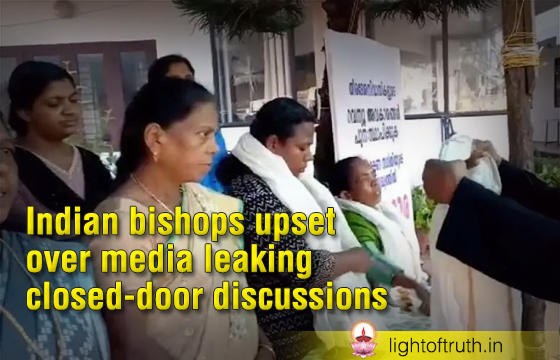
The Catholic Bishops Confe-rence of India has expressed disappointment over the media spreading selective details of its officials’ closed-door meeting with Christian parliamentarians in New Delhi. “The selective dis-semination of details has created confusion and misrepresented the nature of the discussions held,” said the conference in an official statement on Dec. 13, ten days after the meeting in New Delhi. The conference president, Arch-bishop Andrew Thazhath, and other officials met with about 20 Christian parliamentarians on Dec. 3, including George Kurian, the federal minister of state for minority affairs. The Church officials included secretaries of different conference commissions. The bishops are “deeply dis-heartened by the breach of trust and the release of selective infor-mation to the media by an un-named source,” the statement said. The media widely reported, quoting unnamed sources, that the parliamentarians had asked the bishops to abandon their opposition to the Waqf (Amendment) Act. This act has allegedly become a tool for a Muslim charity to claim some 400 acres of land in Mu-nambam village in Kerala state. “These media reports are fig-ments of their imagination; there is no truth in them,” said Father Robinson Rodrigues, the confe-rence spokesperson. “We did discuss Munambam, not seeing it as an issue of a rift between Chri-stian and Muslim communities. It [the claim on the land] is a clear case of human rights viola-tion,” the priest told.

PM Modi creates history, celebrates Christmas at bishops’ headquarters
Narendra Modi created hist-ory on Dec. 23 when he became the first Indian prime minister to visit the headquarters of the Catholic Bishops’ Conference of India (CBCI) in New Delhi. The prime minister took part in the Christmas celebrations hosted by the bishops at the CBCI Centre premises. He also interacted with key leaders from the Christian community, including cardinals, bishops and prominent lay leaders of the Church. Addressing the program, Prime Minister Modi said Christ teaches love, harmony, and brotherhood and urged everyone to work towards streng-thening these values in society. He said attempts to spread vio-lence and cause disruption in society pained him. The prime minister stressed that only a hu-man-centric approach, as adopted by India, could take a 21st-century world to new heights. Citing the Christmas market attack in Ger-many and the 2019 Easter bom-bings in Sri Lanka, Modi said it is important to come together and fight such challenges. The prime minister recalled “a very satis-factory moment for me when we safely brought Fr Alexis Prem Kumar from war-torn Afghanistan a decade back.” Fr Kumar, a member of the Jesuit Refugee Services, was working in western Herat province of Afghanistan when gunmen took him into custody on June 2, 2014. It was PM Modi to announce the Jesuit’s release first through a tweet on February 22, 2015.

Church denies backing candidate in Indian state poll
Christians in Madhya Pradesh state in central India have slammed an order from the state’s child rights body asking children to seek written permission from parents to participate in school events. Father Thankachan Jose, an academician based in Jabalpur diocese, said the order holds “an ulterior motive” of targeting Christian-run schools in the state that has seen a rise in hate crimes against the community in recent years. “This is an indirect way of targeting Christmas functions in our schools where children dress as Santa clause, wear Christmas caps, and join other events linked to Christmas,” Jose told . In a Dec. 12 order, the Madhya Pradesh State Commission for Protection of Child Rights directed schools across the state to obtain the parents’ prior written permission before involving students in various events or activities.
The order also states that schools should seek parents’ permission before children wear different dresses or are even shortlisted to play different characters. “The administration is trying to harass us by issuing such an order close on the heels of Christmas,” Jose told.

Violence mars Christmas celebrations in India
Christmas celebrations were disrupted by violent incidents across India. Reports of attacks on Christians have come from Manipur in northeastern India, Rajasthan, Uttar Pradesh and Punjab in the north, and Kerala, south. The violence was allegedly carried out by rightwing Hindu groups, or Sangh Parivar organizations, such as the Vishwa Hindu Parishad (World Hindu Council) and Bajrang Dal (Brigade of the stout). In one incident, a Pentecostal pastor was attacked by a man named Sonu Singh in Ludhiana, Punjab, on accusations of trying to convert people. In Rajasthan’s Jodhpur and Jaisalmer cities, activists unleashed violence against teachers and students of schools celebrating Christmas. In a bizarre incident at Indore in the central Indian state of Madhya Pradesh, an employee of Zomato food delivery company, dressed as Santa Claus, was beaten up by the activists of the Hindu Jagran Manch (Forum for Hindu Awakening). The activists also released a video threatening Zomato workers. Violent incidents were also reported from Manipur, where ethnic clashes have raged since May 3, 2023. Widespread violence was reported in various parts of the state on Christmas Day, with firing in Sinam Kom village in the eastern part of the state capital of Imphal. In Kerala, three Vishwa Hindu Parishad activists attacked Christmas celebrations at a government school in Palakkad, leading to widespread protests. The violence has reportedly tarnished the Christmas diplomacy efforts of the Bharatiya Janata Party (BJP) in the state. The BJP Kerala leadership has demanded an investigation into the violence, which occurred on Dec 23, the same day Prime Minister Narendra Modi celebrated Christmas with Christian leaders in Delhi. However, several bishops have criticized the Sangh Parivar’s strategy of appeasement and violence, calling it “useless.”