
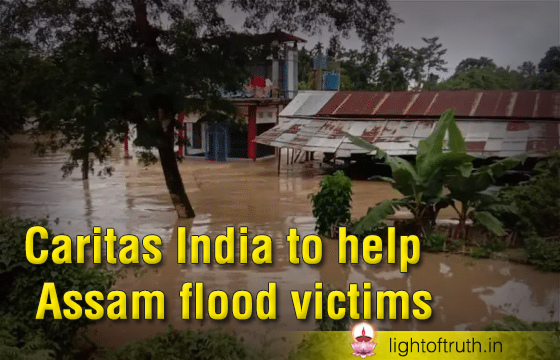
Caritas India, the social service wing of the Catholic Church in the country, has geared up for rescue and relief work in Assam state in the northeast, which has been badly hit by floods. The media reported 46 deaths on July 4 while a report from the Assam State Disaster Manage-ment Authority (ASDMA) said the floods had affected over 1.6 million people in 2,800 villages across 29 districts in the state. Thousands of people were evacuated and sheltered in relief camps as heavy rainfall damaged homes and civic infrastructure. The worst affected districts are Nagaon and Darrang in central Assam and Karimganj in the Barak valley, reports said. The Assam government on July 4 issued an alert in Kamrup district as major rivers, including the Brahmaputra, Digaru and Kollong, were flowing above the danger mark. “Our team is ready. At present, we are assessing the severity of the situation with the help of our NGO network,” Jonas Lakra, zonal program lead of Caritas India in Northeast India told. He said the flood situation was grim and the Caritas team would begin work “as soon as we get the green signal from the government.” At present, government agencies are busy with rescue operations and setting up relief camps. A total of 181 relief camps and 334 relief distribution centers have been set up for the 25,744 displaced people so far. Lakra said the assessment carried out by the NGO network revealed loss and damage to houses, businesses, schools, water, electricity and road infrastructures. “This is also time for paddy cultivation but swathes of agricultural land is inundated. This will mean a huge loss for farmers,” he added. Meanwhile, Assam Chief Minister Himanta Biswa Sarma on July 4 assured the people that the flood situation was “under control.” He, however, added that “everything depends on the weather conditions during the next few days.” The flood-affected people are being provided relief and plans are being drawn up for their rehabilitation along with the repair of damaged infrastructure, the chief minister said.
Daily Archives: July 13, 2024
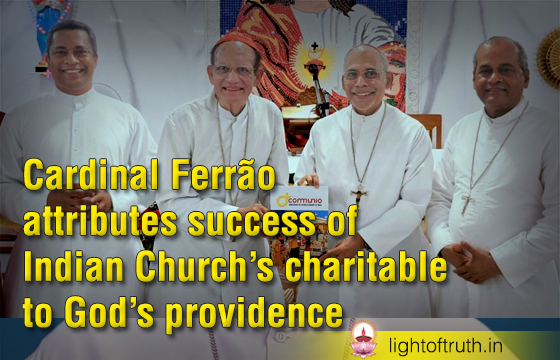
Cardinal Ferrão attributes success of Indian Church’s charitable to God’s providence
The head of the Conference of Catholic Bishops of India (CCBI) attributed the remarkable growth of the charitable initiative ‘Communio’ to divine providence during an event at Sacred Heart Church in Pethapur, Gujarat. “Communio embodies the spirit of solidarity, echoing the early Church’s unity and the power of the Holy Spirit,” said Cardinal Filipe Neri Ferrão.
The gathering celebrated the release of Communio’s report book, which details the organization’s ex-tensive contributions to rural development projects across India, according to a report by Catholic Connect. Communio, established in 2017 by the CCBI, has initiated and supported over 250 projects aimed at improving conditions in rural communities, with 100 projects currently active. The event was attended by ecclesiastical leaders, including Cardinal Oswald Gracias, Archbishop of Bombay, who received the first copy of the report book.
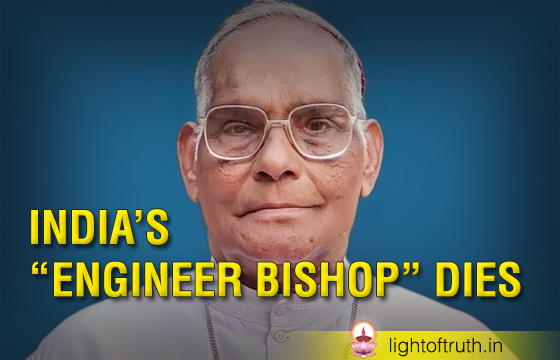
INDIA’S “ENGINEER BISHOP” DIES
Bishop George Mamalassery, who had helped transform a remote and hazardous northeastern Indian region into a modern place, died July 5 due to severe respiratory issues. He was 92. He served the diocese of Tura for 28 years from 1979. The government of Meghalaya had honored Bishop Mamalassery with the Pa Togan Sangma award that was set up in honour of a Garo tribe leader who had fought the British in the late 19th century. The University of Science and Technology, Meghalaya, conferred him an honorary doctorate in 2019 for his contributions to education, healthcare, and socio-economic development. Mourning the death, the Catholic Bishops’ Conference of India hailed Bishop Mamalassery as a prelate with “unparalleled commitment” a man of visionary leadership” who helped transform the northeastern Indian region’s socioeconomic and educational landscape. “His compassionate efforts during the 1971 Bangladesh Liberation War and the founding of Holy Cross Hospital are testament to his enduring legacy,” the statement added. Bishop Mamalassery was born on April 23, 1932, at Kalathoor in the southern Indian state of Kerala, as the youngest of three children to Kurian and Elizabeth Mamalassery.
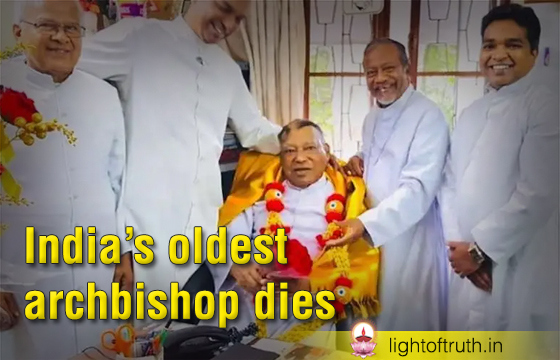
India’s oldest archbishop dies
Christians in India have mourned the death of the nation’s oldest Archbishop Alphonsus Mathias, who attended the Second Vatican Council as a participant bishop. The 96-year-old retired archbishop of Bengaluru died at St. John’s Medical College in Bengaluru, the capital of southern Karnataka, due to age-related ailments. “We have lost a great visionary who introduced local languages in place of Latin after the Second Vatican Council amid opposition from the local Church,” said Archbishop Peter Machado of Bangalore (now Bengaluru), who currently succeeds him. A statement from the Indian bishops conference said the late prelate “attended the Second Vatican Council as a Council Father,” convened by Pope John XXIII from 1962 to 1965. Mathias was president of the Conference of Catholic Bishops in India (CCBI), the national forum of the Latin rite bishops, in 1989 and 1993. “We celebrated his diamond jubilee of episcopal ordination in February, a rare for any bishop,” Archbishop Machado told UCA News on July 11. Mathias had “a special love for the poor and the needy,” Machado said. He added that the late prelate also did not want to publicize his charity works. Mathias championed inter-religious harmony and had “many friends and followers” in other religions, observed Machado. Mathias was appointed as the first bishop of Chikmagalur diocese in Karnataka in 1964 at the age of 35. He was made an archbishop in 1986 to lead the Bangalore (now Bengaluru) archdiocese until he retired voluntarily in 1998, citing poor health. His leadership extended to various international bodies. He was chairman of the Commission for Social Communications of the Federation of the Asian Bishops’ Conference and President of Radio Veritas, the radio project of the Asian bishops based in Manila, the Philippines’ capital. He was also a member of the Pontifical Commission for Social Communications and the Council for Justice and Peace in the Vatican. The late prelate, a native of Karnataka, was the fourth child of his parents, Diego Mathias and Philomena D’Souza. His funeral is yet to be finalized.
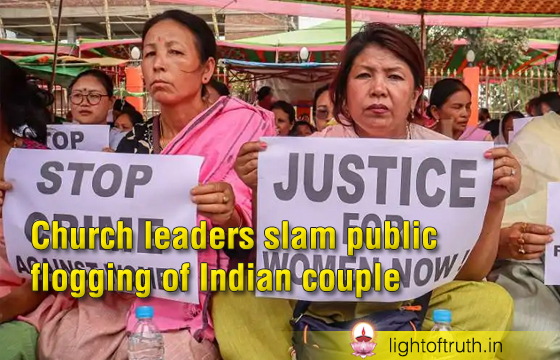
Church leaders slam public flogging of Indian couple
Church leaders and rights activists have condemned the public flogging of a man and woman accused of adultery in a northern Indian state. “The public flogging of man and woman is terrible and has disturbed me… I have read media reports and watched the video. No one can take the law into their own hands in a civilized society,” Archbishop Thomas D’Souza of Calcutta in West Bengal state told. D’Souza said the incident should not have happened in West Bengal as the state is headed by a woman chief minister Mamata Banerjee. On June 28, a mob led by Banerjee’s Trinamool Congress party members attacked the couple with bamboo sticks. A video of the incident went viral and showed more than 200 men watching the flogging. Lying on the ground, the couple were seen pleading for mercy and the man leading the assault was identified as Tajmul Islam, a Trinamool party leader in the Chopra area in Dinajpur district. According to the police, the flogging was ordered by a kangaroo court over allegations of an illicit relationship and Islam was arrested on June 30. The prelate has written to Derek O’Brien, a member of parliament and Trinamool party leader, “to take suitable action” against those involved in the crime. The National Human Rights Commission issued a notice to the West Bengal government after the couple was mercilessly beaten in Dinajpur in full public view. India is notorious for violence against women. The state-run National Crime Records Bureau’s annual reports have revealed a harrowing surge in crimes against women in India. “It was stated [in the video] that the woman was asked to end the affair! Why not the man?” asked Virginia Saldanha, a theologian and former secretary of the Office of Laity and Family of the Federation of Asian Bishops’ Council (FABC). ” This is an unjustified, condemnable action, a mob rule, free for all with no parameters whatsoever and worse than barbaric,” Michael Saldanha, a former justice of the Bombay High Court, told.
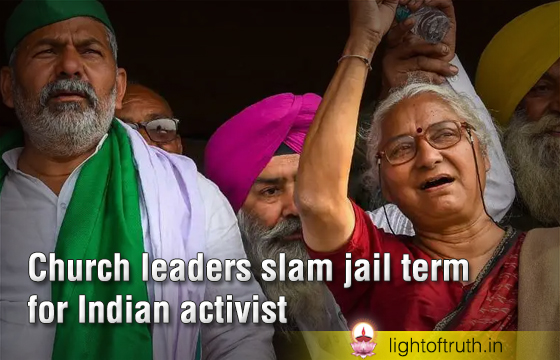
Church leaders slam jail term for Indian activist
Church leaders have condemned an Indian court order to jail for five months a well-known social activist at the center of a 23-year-old libel suit. Medha Patkar, a renowned human rights activist, was sentenced by a metropolitan court in the national capital New Delhi on July 1 in a case filed by the current Delhi Lieu-tenant Governor Vinai Kumar Saxena in 2001.
The court directed Patkar to pay 1 million Indian rupees (some US$12,000) in compensation to Saxena, a leader of the right-wing Bharatiya Janta Party of Prime Minister Naren-dra Modi whose administration is known for targeting social activists, writers, students, lawyers, and journalists. “Convicting Medha Patkar is a travesty of justice,” activist priest Fr Cedric Prakash told on July 2. After all, it is a 23-year-old case, Prakash noted. In 2000, Saxena, who headed an NGO in the western Indian state of Gujarat, published an advertisement against Patkar’s Narmada Bachao Andolan (NBA), a movement that opposed the construction of dams over the Narmada River in western India. After the advertisement, Patkar issued a statement alleging that Saxena was “mortga-ging the people of Gujarat and their resources before Bill Gates.” Subsequently, Saxena filed a libel suit against her in a Gujarat court in 2001. The case was transferred to Delhi in 2003 on the orders of the Indian Supreme Court. Prakash said that Patkar “spoke the truth,” and her statement does not constitute defamation. “The conviction order reeks of vindictiveness,” said the Jesuit priest, who is based in Ahmadabad, the capital of Gujarat, Modi’s home state. Patkar came to prominence with the protest against the Sardar Sarovar Project, a terminal dam on the Narmada River in Gujarat that is due to be completed in 2025. According to the government, the project will provide drinking water to 30 million people. However, Patkar said it would displace more than 100,000 people in 245 villages.

Ways to end political isolation of Christians in India
Western-centric, religiously jingoistic, evangelical, insular, and apolitical are dominant constructs of Indian Christians. Often cocooned in the comfort of church pastoralism and doctrine, they are mostly active in community-centered social outreach, recreational activities and social relationships, and often responsive to societal concerns expressed through acts of charity, mercy and prayer. However, the 32.2 million Indian Christians (2024) who constitute India’s diverse national tapestry, and are spread across its vastly different geographic terrain are also heterogenous. Their diversity manifests in economic, social, cultural, and ethnic status, political engagement, and denominational membership.
While conversion to Christianity accompanied the westernization in parts of 16th-century India, Christianity also encountered local cultural assertion, generating a unique mix of Indian-Christian practice marked by local socio-cultural traditions and sometimes religious syncretism. “The Christian community’s contribution to India’s socio-economic-political life is anchored in Gospel values,” says retired Auxiliary Bishop Allwyn D’Silva of Mumbai.
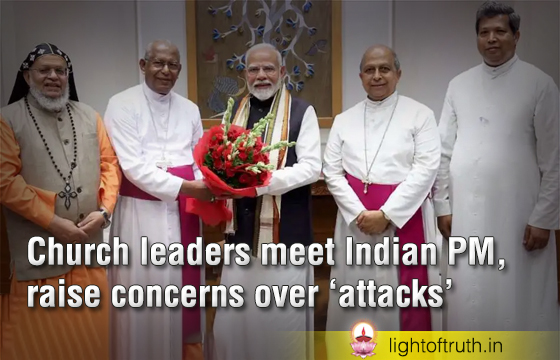
Church leaders meet Indian PM, raise concerns over ‘attacks’
A delegation of Church lead-ers met with Indian Prime Mi-nister Narendra Modi on July 12, a month after he was elected to power for the third consecutive term, and expressed concerns about the increasing hostility Christians face in the country. Archbishop Andrews Thazhath of Trichur, president of the Catholic Bishops’ Conference of India, led the four-member delegation along with federal minister Suresh Gopi, a parliamentarian elected from southern Kerala state and a mem-ber of Modi’s Bhartiya Janata Party. The 45-minute meeting at the prime minister’s office “was cordial, and the prime minister gave us a good hearing,” Thazhath told the media at the bishops’ conference office in New Delhi. The delegation submitted a me-morandum expressing anxiety over the increasing attacks on Christians, the false allegations of forced conversions, and the misuse of anti-conversion laws, Thazhath said. The leaders wanted Modi’s intervention to stop the atrocities on minorities and hara-ssment of Christians. The memo-randum also sought for Christians of Dalit origin the special benefits meant for socially poor Dalit peo-ple. These concessions are denied to them on the ground that Chri-stianity does not follow the caste system.
The memorandum said Dalit Christians face double discrimination as society discriminates them as lower caste, and the government excludes them from welfare measures. The Church delegation wanted governmental steps to extend reservation bene-fits to Dalit Christians.
Indian court denies bail to prelate, priest in excess fees case
The top court in a central Indian state has granted bail to a woman school principal but denied it to a Protestant bishop, a Catholic priest, and 12 others accused of charging exorbitant school fees.
A single bench of Justice Maninder S Bhatti of Jabalpur High Court of Madhya Pradesh state has ordered the release of Soma George, principal of a Catholic school in Jabalpur. It also granted anticipatory bail to a Catholic priest named in the complaint but not arrested. This consideration, however, was not extended to Bishop Ajay Umesh Kumar James of Jabalpur Diocese of the Church of North India (CNI) and Fr Abraham Thazhathedathu of the Catholic Diocese of Jabalpur. Bail pleas of the bishop, the priest and the others were rejected because they were part of the decision-making process as members of the school management. “We are disappointed with the top court order,” said Fr Davis George, vicar general of Jabalpur diocese. The priest denied that diocesan schools were charging extra money from students. “We will file an appeal,” he told. A total of 22 persons from different institutions were arrested on May 27 after they were accused of charging exorbitant school fees. The state police cracked down on the schools following an allegation of charging excessive fees. The right-wing Bharatiya Janata Party runs the state government. Eleven private schools, including seven run by the Church, have faced the wrath of the district administration. The police registered cases against 51 persons, including the textbook seller, accused of selling books at outrageous prices.
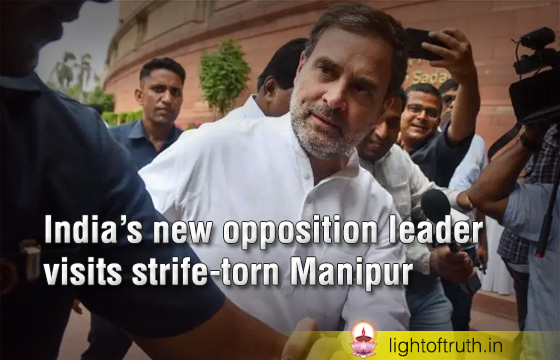
India’s new opposition leader visits strife-torn Manipur
Indigenous people in Manipur have sought the support of India’s new opposition leader, Rahul Gandhi, to end a 14-month-old sectarian strife in their northeastern state, where tribal Christians are pitted against dominant Hindus. Gandhi visited the violence-hit state on July 8 after being elected opposition leader on June 26. “We appreciate Rahul visiting us and taking stock of our plight,” a Christian leader, who sought anonymity, told. The constitutional post had remained vacant for a decade in the Indian parliament, which was dominated by Prime Minister Narendra Modi’s right-wing Bharatiya Janata Party. However, Modi’s party lost the majority in the just concluded general election and formed a coalition government. Gandhi was elected the leader of the opposition. “During previous visits, Gandhi was merely a parliamentarian. But now he is the opposition leader,” the Church leader observed. “Everything is in bad shape” in Manipur, noted the leader based in the sectarian strife-hit northeastern Indian state bordering civil war-affected Myanmar. A delegation from the Indigenous Tribal Leaders’ Forum (ITLF) called on Gandhi to seek his help to settle the sectarian violence that began on May 3 last year after a court move to confer tribal status on the prosperous Hindu Meitei community. The tribal status would help the Meiteis avail themselves of benefits under India’s affirmation action, something the tribal people from the state opposed. Gandhi visited several places, including relief camps in the worst-affected Churachandpur district, where the communal conflict originated. Visiting Manipur for a third time within 14 months, Gandhi lamented the plight of the displaced people, pegged at more than 50,000, and met family members of those killed, numbering more than 220. However, Prime Minister Modi has not visited the state, which is also ruled by his party. “What is of paramount importance at the moment is the restoration of peace,” Gandhi said and countered Modi’s claim in the Rajya Sabha (upper house of parliament), that normalcy was returning to Manipur.