

Popes seem to have a habit of visiting Kazakhstan amid major crises and conflicts that risk fracturing regional stability and splintering its diverse religious and ethnic communities, and Pope Francis’s visit this week is no exception.
When Pope John Paul II visited Kazakhstan in 2001, it was just 10 years after the country gained independence amid the dissolution of the Soviet Union, and roughly 10 days after the Sept. 11 terrorist attacks in the United States that levelled the Twin Towers and claimed thousands of American lives.
Shortly after, U.S. President George W. Bush declared his global War on Terror, which John Paul II had tried to prevent, and which heightened the prospect of a further escalation of geopolitical and interfaith tensions.
At the time, Kazakh citizens were still grappling with how to craft a new society in the post-Soviet era and tensions with Islam were at an all-time high in the majority-Muslim nation, where Christians are a small minority.
In his speeches and homilies throughout the visit, John Paul II offered encouragement to those still disillusioned by the breakup of the Soviet Union, and he also sent a clear message of tolerance, praising the central Asian nation as a place of harmony where different religious confessions were able to work together in building a world without violence.
Two years later, in 2003, the first Congress of Leaders of World and Traditional Religions was launched by former President Nursultan Abishuly Nazarbayev – a Soviet and Kazakh politician who served as first president of Kazakhstan from its independence in 1991 until his formal resignation in 2019 – in an effort to foster stronger ties among Kazakhstan’s different religious communities and to shed light on the unique inter-religious history of the country. Pope Francis, who is poised to arrive in Kazakhstan on September 13 for the seventh edition of the congress, finds himself in a similar situation of regional instability and uncertainty, as the country is in many ways caught in the middle of the Ukraine-Russia war, the region’s most violent conflict since the World War II.The war, which erupted after Russia’s Feb. 24 invasion of Ukraine, has so far caused around 12 million people to flee their homes and has claimed thousands of civilian lives, including those of children.
Daily Archives: September 14, 2022
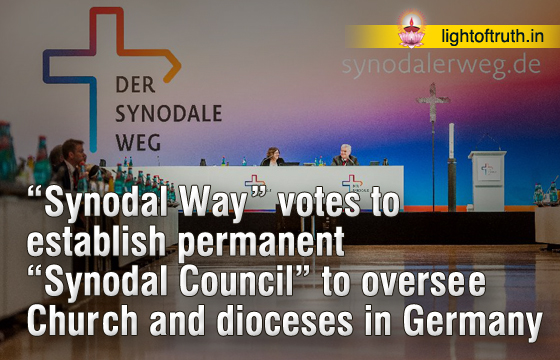
”Synodal Way” votes to establish permanent “Synodal Council” to oversee Church and dioceses in Germany
In a move aimed at achieving what critics have compared to communist councils in the Soviet Union, participants of the Ger-man “Synodal Way” on Saturday voted to create a “Synodal Council” that would permanently over-see the Church in Germany.
At the Frankfurt meeting on September 10, the controversial suggestion won almost 93% of all votes. Only five bishops rejected the document, CNA Deutsch, CNA’s German-language Partner agency, reported.
The bishops’ names are a matter of public record because the vote was not by secret ballot — a change of proceedings after bishops blocked a pro-LGBT document earlier.
Like others arising from the controversial German event, also known as the “Synodal Path,” the proposal has met fierce criticism. In June, Cardinal Walter Kasper, a theologian considered close to Pope Francis, said there could be no “Synodal Council,” given Church history and theology.
“Synods cannot be institutionally made permanent. The tradition of the Church does not know a synodal church government. A synodal supreme council, as is now envisaged, has no basis in the entire history of the constitution. It would not be a renewal, but an unheard-of innovation.”
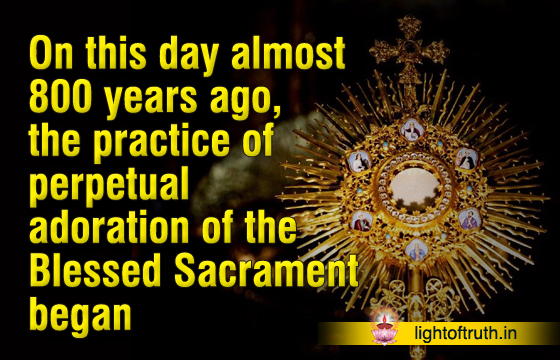
On this day almost 800 years ago, the practice of perpetual adoration of the Blessed Sacrament began
This Sept. 11 marks 796 years since perpetual adoration of the Blessed Sacrament began in Avignon, France, a practice that has now spread throughout the world.
According to the Catholic Encyclopedia, perpetual adoration refers to adoration of the Blessed Sacrament without interruption or with pauses for only short periods of time.
The term is used “in a moral sense, when it is interrupted only for a short time, or for imperative reasons, or for circumstances beyond control, to be resumed, however, as soon as possible,” he added.
The encyclopaedia indicates that many experts attribute the beginning of the practice of ado-ration of Jesus in the Eucharist to the moment in which the feast of Corpus Christi was established in 1246 by Bishop Roberto de Thorete, at the suggestion of St. Juliana de Mont Cornillon.
However, the first recorded perpetual adoration was in Avignon in 1226.
On Sept. 11, King Louis VII asked to expose the Blessed Sacrament as a way to celebrate victory over the Albigensians, a sect that flourished in southern France in the 12th and 13th centuries. “In thanksgiving, the Blessed Sacrament covered with a veil was exposed in the Chapel of the Holy Cross” in Orleans, reads the encyclopedia.
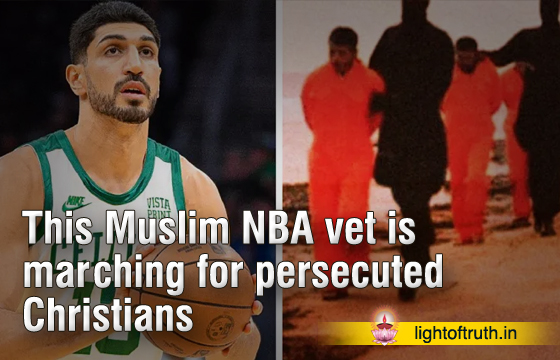
This Muslim NBA vet is marching for persecuted Christians
NBA veteran Enes Kanter Freedom has been using his plat-form as a professional basket-ball player to take direct aim at the Chinese Communist Party for its egregious human rights abuses.
“People need to understand this … the Chinese Communist Party does not represent the Olympic values of excellence, of respect, of friendship. The whole world knows that they’re a brutal dictatorship and they engage in censorship, they tread on freedoms, they do not respect human rights, and they hide the truth,” Freedom told Fox News’ Laura Ingraham in February.
But with no team signing a contract with the 6-foot-10, 250-pound center since February, he, and others, say that he’s paying the price for his activism — activism that includes explicitly calling out the NBA, his former team the Boston Celtics, and other players in the league for hypocrisy, citing their relationship with, and failure to condemn, China.
The 30-year-old seems more determined than ever to work in defence of human rights.
Freedom, a practicing Mu-slim from Turkey, will be speaking on September 24 at the March for the Martyrs in Washington D.C., an event dedicated to raising awareness of the plight of persecuted Christians around the world.
But why did Chacon choose a Muslim to speak at an event advocating for persecuted Christians?
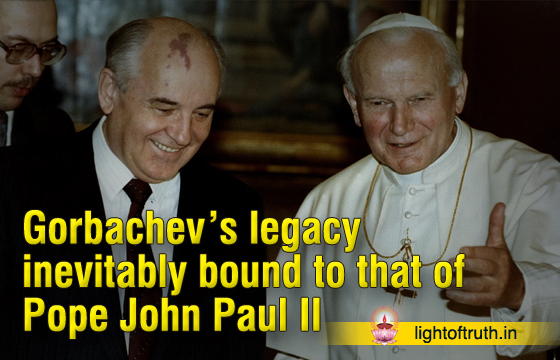
Gorbachev’s legacy inevitably bound to that of Pope John Paul II
This week’s death of former Soviet Premier Mikhail Gorbachev at the age of 91 has triggered an avalanche of commentary and tribute around the world, mostly focusing on Gorbachev’s role in the peaceful dissolution of the Soviet system for which he received the Nobel Peace Prize in 1990.
A sidebar to the story that probably deserves more prominence than it’s received, however, is that the Mikhail Gorbachev the world is now lauding, meaning the reformer and change agent, arguably never would have come to be without the moral and political pressures on the Soviet system created by Pope John Paul II.
Let’s recall the tick-tock in the Gorbachev story.
Born in 1931, for most of his career Gorbachev followed the path of the typical Soviet apparatchik. He became a member of the Community Party’s Central Committee in 1978, the same year the Archbishop of Krakow was elected to the papacy, and a few months later Gorbachev became a member of the Politburo – the same time, as it turns out, the new pontiff was making his historic first visit to Poland, showing the world a people collectively asserting an alternative vision of life to official Soviet ideology.