

Representatives of different faiths in New Delhi have begun work to establish peace between Christian and Sikh minorities at loggerheads in Punjab over religious con-versions. The growing number of churches and churchgoers in the Sikh-majority state in north India has led to sporadic friction with Sikh religious organizations who accuse Christians of using forceful and fraudulent means of conversion.
A C Michael, convener of the Concerned Citizens Group in New Delhi said in a press note issued on Aug. 12 that the group at its recent meeting decided to meet Delhi Chief Minister Arvind Kejriwal, who is also the founder and leader of the Aam Adami Party (AAP) that rules Punjab.
The interreligious group “feels that the good offices of Mr. Kejriwal could play an important role in bringing about a much-needed peaceful atmosphere between two clashing groups as Mr. Kejriwal enjoys the goodwill of both communities,” Michael said. AAP’s Punjab Chief Minister Bhagwant Mann had called the latest attack on a church “unfortunate” and assured he will not allow anybody to disturb the communal harmony in the state.
In the attack on Aug. 31, masked men had vandalized a church in Tarn Taran district, on the border with Pakistan, and set the pastor’s car on fire.
A day before the Tarn Taran incident, Giani Harpreet Singh, head of Akal Takht, one of the highest seats of power for the Sikhs, had condemned alleged forced con-versions by Christian groups and demanded a law against such activities.
Earlier, a group of armed Nihang Sikhs reportedly disrupted an event organized by Christians at a village in the Amritsar district on August 28.
The group in Delhi in their attempt to build peace brought together representatives of Christians, Sikhs, Hindus and Muslims to work out an action plan.
It also proposes to have Christians, both denominational and non-denominational groups, initiate a dialogue among themselves.
The group also has plans to visit Punjab for a dialogue with all affected people and to undertake a fact-finding mission to establish the truth behind the alleged religious conversions in the state.
Daily Archives: September 14, 2022
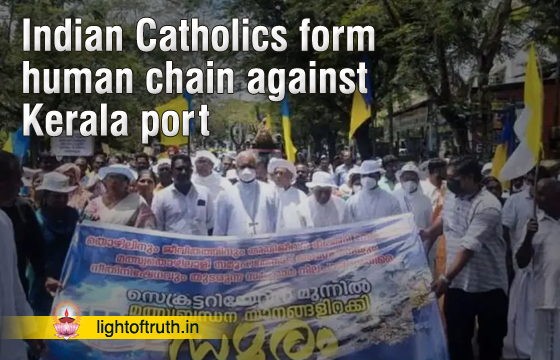
Indian Catholics form human chain against Kerala port
Catholics in the southern Indian state of Kerala formed a 17-kilometre-long human chain to support an ongoing fishermen’s protest against a multi-billion dollar Vizhinjam port project.
The human chain along the Chellanam-Fort Kochi coastal corridor on Sept. 10 was a show of solidarity against the project, which is a “man-made disaster,” said Father Jacob G Palakkappilly, spokesman of the Kerala Catholic Bishop’s Council (KCBC).
Thousands of fishermen and their families including women and children have been protesting since July 20 demanding an immediate halt to work at the site of the Adani port at Vizhinjam, close to the state capital Thiruvananthapuram.
The Latin Archdiocese of Trivandrum is spearheading the protest as a majority of the fisher-men are Catholics and members of the archdiocese.
Archbishop Thomas J Netto in his latest pastoral letter appeal-ed to Catholics to expand the protest across Kerala as the state government refused to stop construction work.
The letter was read out in churches across the archdiocese during Sunday Mass on Sept.11.
The unholy nexus between the politicians and the corporate company led to legal clearance”
The protesting fishermen, their families, bishops, priests and nuns from the archdiocese, are not alone as the entire Catho-lic community in the state is with them,” Father Palakkappilly told on Sept. 12.
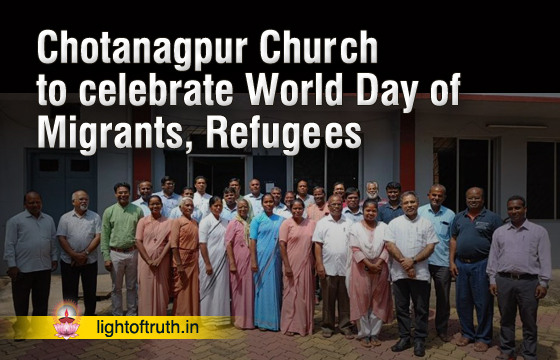
Chotanagpur Church to celebrate World Day of Migrants, Refugees
Distress migration from the east-central Indian region has prompted a Jesuit network to join the Latin rite bishops to organize programs to educate Church people about the exploitation of poor tribal people. A meeting organized by the Central Zone of the Migrants’ Assistance Information Network and the Commission for Migrants of Conference of Catholic Bishops of India (CCBI) has observed that thousands of tribals leave villages in Jharkhand and Chotanagpur areas to work in cities and other states in the country.
Their migration saw an increase year because of agriculture failure because of a drought, said the organizers of the September 10 meeting at Manresa House, the Jesuit provincial house in Ranchi, the capital of Jharkhand state.
The meeting has decided to celebrate the World Day of Migrants and Refugees on September 25 in all parishes and religious congregations in the region to create awareness about the distressing migration of poor tribal people from the region.
The Vatican section of the Migrants and Refugees have been organizing the World Day of Migrants and Refugees on the last Sunday of September. The message of Pope Francis for this year’s World Day of Migrants and Refugees is “Building the Future with Migrants and Refugees.” In his message the Pope explains that people cannot think of building a future that is not inclusive.
“We are all called to commit ourselves to building a future based on a new global system that better responds to God’s plan, a world where everyone can live in peace and prosperity.”

Odisha Church commemorates Father Arul Doss’ martyrdom
The Catholic Church in Odisha has observed the 23rd anniversary of the martyrdom of Father Arul Doss.
Father Doss, a priest of Balasore diocese, was killed by Hindu radicals on Sept. 2, 1999, in a remote village parish in Mayurbhanj district of the eastern Indian state.
More than 3.000 people, along with 30 priests and some 50 nuns and brothers, from Balasore and neighboring dioceses paid homage to the martyr at Jambani village that comes under Bagdapha parish.
Archbishop John Barwa of Cuttack-Bhubaneswar, head of the Odisha Church, in his homily said the large gathering proved the famous saying of Tertullian, “The blood of the Martyr is the seed of the Church.”
Archbishop Barwa paying tribute to Fr Arul Doss The Di-vine Word prelate also reminded the faithful the Jesus was victo-rious against the evil one. “We as His followers also will be able to overcome all evils by remaining steadfast to our Lord. We will never be defeated as long as we are with and in the Lord. Let’s therefore continue to practice and express our faith boldly, freely and share our faith with others so that one day they also will know Christ the redeemer.”
Father Jadu Marandi, former vicar general of Balasore and the current parish priest hailed Father Doss as a champion of the poor, needy and underprivileged Ho people. “Father Arul Doss has become a medium of God’s abundance blessings for the people of Odisha,” he added.
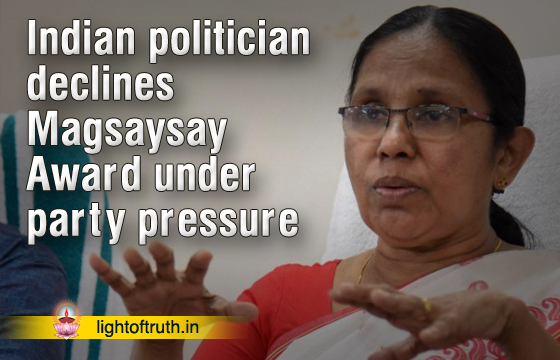
Indian politician declines Magsaysay Award under party pressure
A Marxist politician in a southern Indian state has declined the prestigious Ramon Magsaysay Award for 2022 reportedly under party pressure.
The Ramon Magsaysay Award Foundation had selected K.K. Shailaja, former health minister of Kerala state, for the 64th Magsaysay award for her commitment and service towards ensuring an accessible public health system and effectively managing the Nipah and Covid-19 outbreaks in the state. The award, a prestigious international honour, is regarded as the Asian equivalent of the Nobel Prize. It is named after Ramon Magsaysay, the seventh president of Philippines president, who died in a plane crash in March 1957. If Shailaja had accepted the award, she would have become the first woman from Kerala to receive Magsaysay. Under her tenure as the health minister, Kerala had won global recognition for its effective handling of the Nipah outbreak and the Covid pandemic.

Japan’s ruling party concedes Unification Church ties
Around half of Japan’s ruling party law-makers have had dealings with the Unification Church, an official said on September 8, after the assassination of ex-premier Shinzo Abe heightened scrutiny of the religious organization also sometimes known as the Moonies.
The man suspected of shooting Abe dead in July allegedly targeted the former prime minister believing he was linked to the sect.
Liberal Democratic Party Secretary-General Toshimitsu Motegi said a probe found some lawmakers had accepted support for election campaigns from the church and its spin-off groups.
Other LDP lawmakers had attended meetings or paid fees to the organization, whose members are sometimes colloquially referred to as “Moonies” after Korean found-er Sun Myung Moon.
Of 379 elected LDP lawmakers, 179 “had some sort of links” with the Unification Church, Motegi told reporters.
“We take the results seriously. We honestly feel sorry, and we’ll make sure the party no longer has any relationship at all” with the church, he said.
Last week, Japan’s Prime Minister Fumio Kishida said LDP members must cut ties with the group, following controversial revelations of its links with a raft of Japanese politicians.
The Unification Church has condemned Abe’s murder and denied accusations of coer-cive fundraising tactics among its members, but Kishida’s government has seen its approval ratings drop in recent weeks as more de-tails have emerged.
“Nearly 90%” of LDP lawmakers that attended gatherings hosted by organizations linked to the church told the probe they were not aware of the hosts’ affiliation, Motegi said. “Our awareness was lacking, and that’s all the more reason that more efforts need to be made to raise awareness” of the issue, he added.
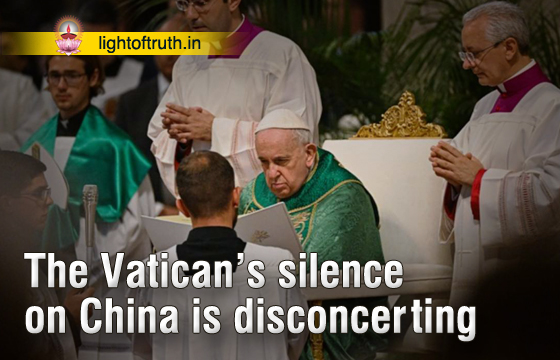
The Vatican’s silence on China is disconcerting
On September 3 , as a new consistory began in Rome, Pope Francis created 20 new Cardinals. Six came from Asia — Singapore, Mongolia, Timor-Leste (East Timor), South Korea, and two from India.
New cardinals came from five continents, ensuring that the universality of the Church is really, truly, global. And three new religious members were appointed, from the Congregation of Jesus and Mary (Eudists), the Consolata Missions Institute and the Legionaries of Christ.
Among religious orders re-presented in the College of Cardinals, the largest are the Salesians, who now number ten.
This is all very good news and I applaud the Holy Father for these appointments. I began my human rights work in Timor-Leste, during Indonesia’s brutal and bloody occupation, and worked there throughout and beyond its transition to independence.
I have had the privilege of meeting the current Bishop of Dili, Virgilio do Carma da Silva, and am so pleased he has been made his country’s first cardinal. It is a signal of solidarity and respect for that beautiful, benighted and often forgotten half-island that fought for freedom and human dignity for a quarter of a century with immense sacrifice and has risen from the ashes over the past two decades in an inspiring way.

Indonesian Christians decry stalled church project
The denial of building permit to a Protestant church in Cilegon city in Indonesia’s westernmost province of Banten goes against the spirit of religious moderation, Christian leaders say.
The Communion of Churches in Indonesia (PGI) criticized the refusal of permit for the construction of a church by the Batak Society Christian Church (HK-BP) Maranatha in Geram village.
“This incident harms the 1945 Constitution, which guarantees equality of every citizen to adhere to a certain religion and to worship freely in accordance to their own religions,” Reverend Jeirry Sumampow, a spokesman of PGI, said in a statement on Sept-ember 9.
He said the politics of identity had become worse and was threatening religious tolerance. “It is sad to see that there are still groups of people who hurt their brothers and sisters,” he added.
The opposition to the church came from a group of Muslims calling themselves the Committee of Local Wisdom Savior in Cilegon. They staged a protest on Sept. 7 demanding denial of per-mission based on then Serang district head’s 1975 decree providing for the closure of Christian places of worship in the area.
They later met with Cilegon Mayor Helldy Agustian in his office and pressured him to sign on the dotted line. A video of the incident went viral on social media.
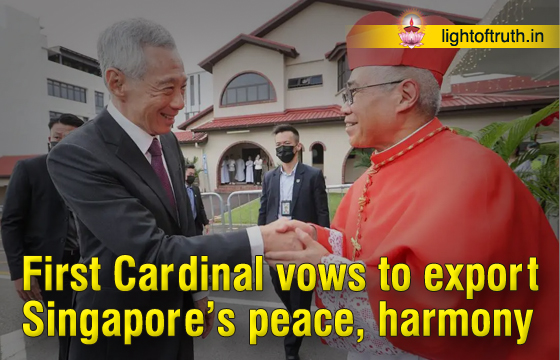
First cardinal vows to export Singapore’s peace, harmony
Cardinal William Goh has vowed to promote the model of Singapore’s peace and harmony among religions in Asia and the world during a thanksgiving Mass celebrating his elevation as a cardinal by Pope Francis.
“Singapore is an icon for religious harmony in the world, where religious leaders and government work hand in hand for the good of the society, instead of being at odds with each other,” Cardinal Goh, 64, said during his homily at St. Joseph’s Church at Bukit Timah on Sept. 8.
Goh said that his appointment as a cardinal was “beyond his expectation” and “a very humbling experience.”
He said he wants “to spread such peace and unity to the rest of Asia by fostering dialogue between different religions.”
Top government ministers and officials including Prime Minister Lee Hsien Loong, some 23 leaders of various religions and religious organizations, and more than 3,500 Catholics attended the event. Bishops representing Catholic Bishops’ Conference of Malaysia, Singapore, and Brunei also participated in the pro-gram.
A commemorative booklet — “That They May Live” — was released to mark the occasion. The book outlines four thrusts of Cardinal Goh’s pastoral view for his cardinalate: Faith in Asia, Aid to the Poorest and the Least, Climate Action and a New Way of Inter-religious Dialogue for Human Fraternity, says a press release from Singapore Archdiocese.
The Singapore prelate was among 20 new cardinals of the Catholic Church created by Pope Francis in a consistory at the Vatican on Aug. 27. He is among the six new cardinals from Asia. “He doesn’t take it as a personal honour, he does it as service.” Premier Lee said he was happy to join the event to celebrate Archbishop William Goh becoming a cardinal, a rank second only to the pope in the Church hierarchy.
“I wish Cardinal Goh all the best in his new appointment and am confident he will continue working with fellow religious leaders in our multi-religious landscape, to maintain our unity and harmony, especially as we build a new social compact for the country,” Lee posted on his official Facebook page after the event.
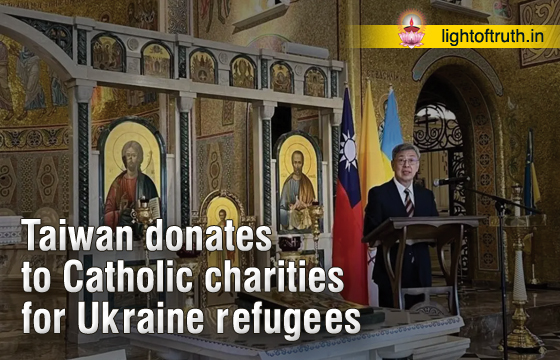
Taiwan donates to Catholic charities for Ukraine refugees
Taiwan has donated a total of US$ 89,600 to various Catholic groups in Europe to support humanitarian aid to refugees who fled Russia’s invasion of Ukraine.
Former Taiwanese Vice President Chen Chienjen handed over the donation on behalf of the government following a Mass for peace in Ukraine at the Minor Basilica of Santa Sofia, a Ukrainian Church in Rome on September 5, Focus Taiwan reported. Chen, 71, a Catholic and member of the Vatican’s Pontifical Academy of Sciences, donated the funds to three Catholic groups and the Minor Basilica of Santa Sofia. During his address after the Mass, Chen praised Ukrainians for their unyielding resistance against Russia’s aggression. He stated that Taiwan deeply sympathized with the suffering of Ukrainians and would learn from Ukraine’s example to firmly defend themselves in the face of “China’s intimidation and military threats.”