
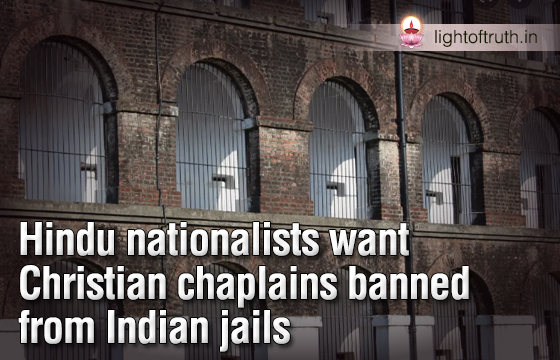
Hindu nationalists in India want Christian chaplains banned from visiting prisons, claiming they are trying to convert the prisoners.
The Vishwa Hindu Parishad (VHP) and Bajrang Dal groups complained to police in the southern Indian state Karnataka about the distribution of Bibles to the prisoners in the Gadag district jail and demanded the immediate suspension of all Christian prison chaplains in the state.
The April 6 declaration came after a Hindu chaplain had met a prisoner and seen a Bible in the jail. According to the complaint, a seven-person team of Christian evangelists visited Gadag District Prison on March 12 to pray with prisoners and distribute copies of the New Testament.The Hindu activists alleged Christian chaplains were trying to carry out religious conversions and said they should not have been permitted to distribute religious texts, despite the fact that Hindu religious literature is often distributed in jails. Archbishop Peter Machado of Bangalore said the complaint looks like a double standard.
“If Hindu preachers are allowed to meet Hindu prisoners, what is wrong with Christian preachers meeting Christian prisoners. If there’s evidence of forceful or fraudulent conversions of others, let them take action according to the law, with proofs of conversion at hand,” he told Crux. Karnataka is ruled by the Bharatiya Janata Party (BJP), which has also ruled India since 2014. The BJP is linked with the the Rashtriya Swayam-sevak Sangh (RSS), a Hindu nationalist group.Hindu nationalists often accuse Christians of using force and surreptitious tactics in pursuing conversions, and such “illegal conversions” can be punished with fines and jail time.Christians leaders have noted that despite the fear-mongering of some Hindu groups, the percentage of Christians is actually going down in the country. According to the government’s census data, the percentage of the Christian population in India in 2001 was 2.34%, but in 2011 it had dropped to 2.30%. A similar decrease was noted in Karnataka, where the percentage dropped from 1.91% to 1.87%.
Daily Archives: May 2, 2022
False and misleading: Bangalore archbishop on Bible in class row
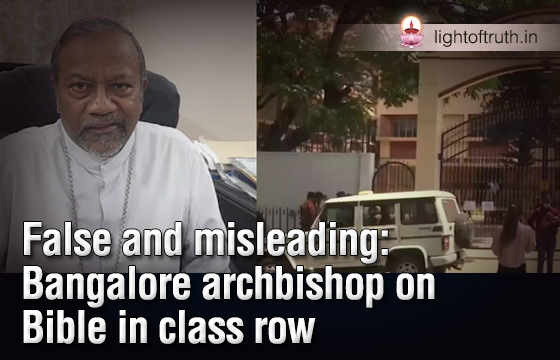
Archbishop Peter Machado of Bangalore on April 26 dis-missed as false and misleading the media reports that some Catholic schools in the southern Indian city force children to buy Bibles and bring them to class.
According to an ndtv.com April 25 report a row erupted in Karnataka after a Catholic school in Bengaluru, the state capital, had allegedly taken an undertaking from parents that they would not object to their wards carrying the Bible to class.
The news portal also said the Hindu Janajagruti Samiti (Forum to awaken Hindus) accused Clarence High School of making it mandatory for students to carry the Bible.
The group’s state spokesperson Mohan Gowda alleged that the school has asked non-Christian students to compulsorily carry and read the Bible adding that it violated Articles 25 and 30 of the Constitution.
“It has been brought to my notice that the Christian Institutions are once again being target-ed for conversion in the allegation of the children being forced to buy Bibles and bring them to Schools in Bangalore. This allegation is false and misleading,” asserts Archbishop Machado in a press statement.
The prelate says Clarence High School’s management has clarified that such a practice existed in the past but since last year, no child is required to bring the Bible to the School or asked to read it by force.

Be vocal about minority rights: Nuncio
Apostolic Nuncio to India Archbishop Leopold Girelli has urged the Indian Catholics to speak up for the rights of all minority groups in the country.
“In this kind of struggle, if you want to call it that, we should remember that we are not standing up for just our rights as Catholics. We are standing for all minorities and the rights provided to minorities under the Indian constitution,” the Pope’s ambassador told a gathering of priests and Catholics April 23 in Bengaluru, southern India.
The nuncio was on a two-day pastoral visit to the capital of Karnataka state that ended April 24. It was his first visit to the city of gardens.
Archbishop Peter Machado of Bangalore presided over the event.
Indian Christians appeal for peace after communal clashes
Indian Christians have appealed for peace after sectarian clashes broke out in national capital New Delhi, leaving many people and police officers injured. Police arrested 23 suspects after violence erupted on April 16 during a Hindu religious procession in Jahangirpuri, a predominantly Muslim suburb. Residents said the situation remained tense on Easter Sunday in Jahangirpuri, the home of some 10,000 Muslim families who reportedly migrated from Bangladesh.
Indian tribal people renew struggle against firing range
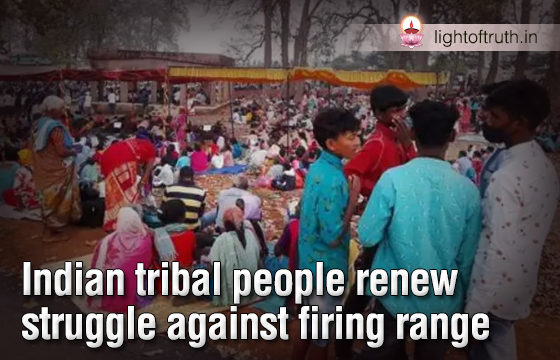
Tribal people including Christians will undertake a grueling 200-kilometre march against the creation of an army firing range at Netarhat in eastern India’s Jharkhand state.
The march will begin at Tattapani in Latehar district on April 21 and reach the state capital of Ranchi on April 24.
“We will meet Jharkhand governor Ramesh Bais on April 25 to press our demand for cancellation of a notification on the firing range,” Ratan Tirkey, one of the organizers of the march, told.
The struggle against the firing range goes back to the early nineties when the state government issued a notification ear-marking 1,471 square kilometers in the Netarhat Hills in Gumla and Latehar districts for field firing practice by the Indian army.
The project could have dis-placed over 200,000 tribal people in about 250 villages but for the strong resistance from the tribal communities that forced the government to defer the action.
The area was notified for periodical field firing and artillery practice in 1992 and again in 2002. As the deadline for renewal of the notification nears in 2022, the tribal communities are revamping their struggle.
But tribal communities in areas surrounding the firing range complained that the government ignored their rights and grievances for 27 years
Tirkey, a member of the Kendriya Jan Sangharsh Samiti (forum for people’s struggle) that led the struggle, said: “We are not sure what is in the mind of the current government but the previous Congress and Bharatiya Janata Party regimes repeatedly betrayed the tribal people.”
Jerald Jerome Kujur, secretary of Kendriya Jan Sangharsh Samiti, said tribal communities are afraid that the state government led by Jharkhand Mukti Morcha (Jharkhand Liberation Front) may extend the notification.
Hindus enact Passion of Christ
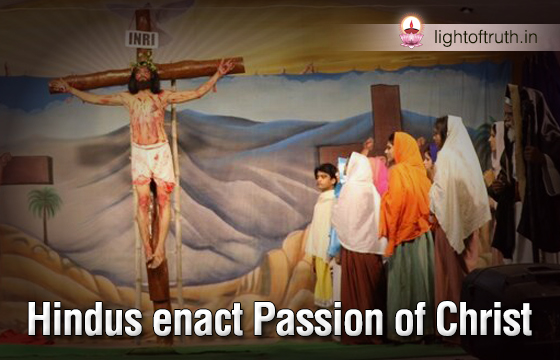
A group of 40 Hindu men and women on April 15, Good Friday enacted the Passion of Christ in the northern Indian city of Varanasi, the heartland of Hinduism. “Varanasi presented a soothing picture of religious harmony, peace and love amid a gloomy scenario of communal polarization,” says Father Anand Mathew, the brain behind the program who directs Vishwa Jyoti Communications in Varanasi.
An estimated 12,000 people watched the play staged at Matri Dham Ashram, the renowned spirituality center where thousands of people from various faith communities gather in large number.
“The most unique aspect of this passion play was that it was performed as part of the Good Friday liturgy, substituting the traditional passion reading,” Father Mathew, a member of the Indian Missionary Society, told on April 16.

All in the family: Philippine dynasties tighten grip on power
If the son of former Philippine dictator Ferdinand Marcos wins the May 9 presidential election, he will not be the only Marcos currently in power — and will almost certainly not be the last.
Elite families have long ruled the poverty-ravaged nation, holding on to positions of power for generations by dishing out favours, buying votes or resorting to violence.
Analysts say the system has become more pervasive in the decades since a popular uprising deposed Marcos and forced the family into exile. New dynasties have entrenched themselves in politics, smothering electoral competition, stunting economic development and worsening inequality.
“Power begets power — the more they stay in power, the more they accumulate power, the more powerful they get,” said Julio Teehankee, a professor at De La Salle University in Manila.
The archipelago has produced about 319 dynastic families, dating back to when the country was a US colony in the first half of the 20th century, Teehankee said.
“This is all dynastic. I wouldn’t be where I am today if I weren’t a Marcos”
Dozens have withered, but in 2019 members of at least 234 such families won positions in mid-term elections, he said.
They have flourished in a feudal and corrupt democracy where parties are weak, fragmented along clan lines and plagued by defections. Power, however, is not static. Families can win and lose it — and make a comeback. After the fallen dictator died in 1989, the Marcoses returned to their traditional stronghold of Ilocos Norte and began tapping local loyalties to get elected to a succession of higher positions.
Political families held 67% of seats in the House of Representatives, compared with 48 percent in 2004, and 53% of mayoral posts, up from 40%. Among the leading candidates for the 12 Senate seats being contested, at least three already have a relative in the chamber.

Asian Church pins hopes on papal visit to Kazakhstan
Pope Francis is set to visit Kazakhstan, a Central Asian state close to the epicentre of ethno-religious conflicts where bloody anti-government unrest early this year claimed 240 lives.
According to the office of President Kassym-Jomart Tokayev, Kazakhstan is set to host the 7th Congress of Leaders of World and Traditional Religions in September with Pope Francis as a star guest.
Bishops’ Conference of Kazakhstan president Bishop Jose Luis Mumbiela said the Church was “grateful” to the president of Kazakhstan for inviting Pope Francis 20 years after the visit of Pope St. John Paul II.
The papal visit will be a “breath of hope and strength,” said Father Guido Trezzani, director of Caritas Kazakhstan in the predominantly Muslim nation of 15 million.
While Muslims constitute 70 percent of the population, Christians, mostly Orthodox, number about 30%. However, Catholics are a tiny minority of hardly 2% of the population.
The papal visit to the country of some 300,000 Catholics is considered a major boost for the Kazakhstan Church. The country has a huge landmass of some 3 million square kilometers, making it the ninth-largest nation in the world.
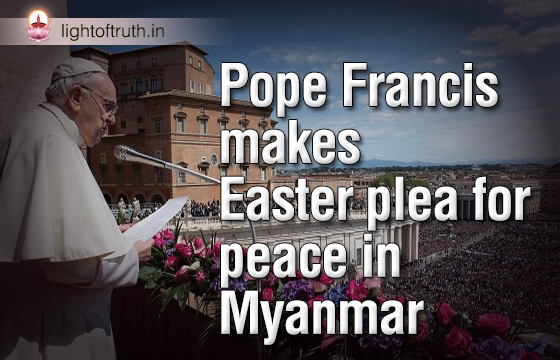
Pope Francis makes Easter plea for peace in Myanmar
Pope Francis has again plead-ed for peace and reconciliation in conflict-torn Myanmar where millions of people including Christians have been oppressed by the brutal military junta.
During his Easter plea for peace around the world, he cited the Southeast Asian nation where violence has persisted for more than a year after the military ousted the civilian government.
“I pray that God grants re-conciliation for Myanmar, where a dramatic scenario of hatred and violence persists,” he said. “We need the crucified and risen Lord so that we can believe in the victory of love, and hope for reconciliation.”
His attention to the people of Myanmar comes as the world is focused on the war in Ukraine.
Pope Francis has spoken several times about the crisis in Myanmar, which he regards with much affection after visiting the country in November 2017.
He has repeatedly called for military leaders to stop the violence, release all detained people and pursue dialogue to seek peace and reconciliation.
“Let our families be healed, let our nation be healed, let our world be healed. We greet the families that are coming out of many challenges”
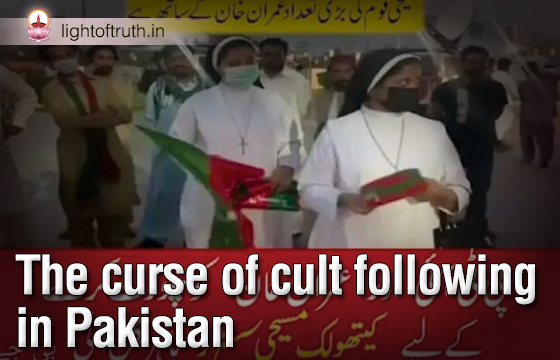
The curse of cult following in Pakistan
Ever since losing a vote of confidence moved by a united opposition this month, Pakistan’s former prime minister Imran Khan has divided the nation with his aggressive campaign — on the ground and online.
You either agree with him or risk being called a traitor to the country, a thief or lifafa (a journalist accepting bribes). The space keeps shrinking for free thinkers. However, nothing compares to the controversial content posted by his followers last week.
“Peace be upon him,” stated a Khan sticker on the back wind-shield of a car whose photo was shared on Facebook.
The Islamic honorific, commonly used by Sunni Muslims, follows specifically after uttering the name of the Prophet Muhammad.
One can easily dismiss the image as being photoshopped. Well, guess again after reading the comments from diehard followers of Khan’s Tehreek-e-Insaf (PTI) party.
“Peace be upon you, brother. Peace be upon everyone. It’s a prayer for safety, everyone should give it to each other,” stated Mohammad Bahoo Sarwar, president of Bahoo Films Corporation. All hail the cricketer hero who led the national team to its first and only World Cup win on March 25, 1992. A cult of personality was born that day.
Sadly, most people in the Islamic republic are neither as liberal nor moderate as Sarwar thinks. Media outlets in Pakistan follow a strict editorial policy of using this expression whenever mentioning the Prophet Muhammad. Religious minorities can be easily accused of blasphemy for using the same title with their names.
C. Raja Mohan, a contributing editor on international affairs for The Indian Express, even compared Khan to the Biblical character Samson determined to bring down the house of Pakistan, dominated until now by the army.