
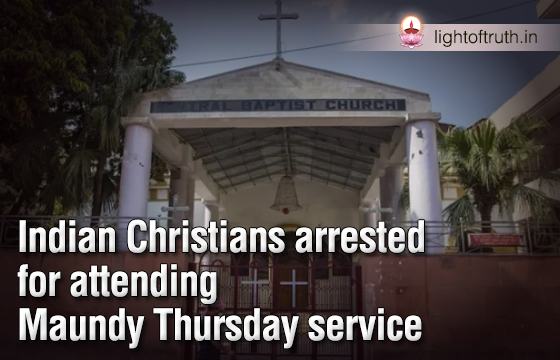
Police in northern India’s Uttar Pradesh state charged 55 Christians who took part in a Maundy Thursday service with violating a law that criminalizes religious conversion following complaints by right-wing Hindu groups.
Among them, 26 people were arrested and later released on bail, but police say they are searching for others included in the first information report (FIR).
Christian leaders denied the allegations and said the Maundy Thursday service on April 14 was “portrayed as a religious conversion activity and those who attended it were harassed for no fault of their own.”
Some 70 believers of the Evangelical Church of India gathered at their church in Fatehpur in Harihar Ganj district for the service to commemorate the Last Supper of Jesus with his disciples before he was crucified.
One Christian said right-wing Hindu activists who gathered outside the church locked its two main gates. “They then began to shout slogans like ‘Stop conversion’ among other things,” he said.
When police arrived at the scene after being alerted about the incident, they questioned the Christians about their details and kept them inside the church for close to three hours.
“We were told that we were kept in the police station for our own safety, but when we were taken for a medical examination we realized that we were being charged”
Hindu leaders also entered the church and demanded the personal details of the Christians.
Officers then took the Christians, including women and children, to the police station on the assumption that they were being taken to their homes.
Later that night, the women and children were allowed to go home while 26 males were kept in custody.
“We were told that we were kept in the police station for our own safety, but when we were taken for a medical examination we realized that we were being charged,” said one of the Christians.
Daily Archives: May 2, 2022

Church opens Indian state’s first palliative care centre
The Catholic Church has set up the first-ever palliative care centre in Nagaland, a Christian-majority state in northeast India.
The St. Joseph Pain and Palliative Care Centre at Chumukedima, near the state’s commercial hub of Dimapur, was inaugurated by Chief Minister Neiphiu Rio, a Baptist Christian, on April 24.
The centre is an initiative of the Diocese of Kohima and will be run by the Medical Sisters of St Joseph, Nirmala Province from Kerala, known for their dedicated service to the sick, the poor and the least of the brethren irrespective of caste and creed.
“This first fully fledged palliative care centre in Nagaland intends to provide service free of cost. The state government will extend all possible help to carry out this gratuitous service to the people,” announced Rio.
Nagaland, a predominantly Baptist Christian stronghold, along with the southern state of Tamil Nadu has the highest percentage of elderly people living alone without a spouse, children or any other support, according to the first Longitudinal Ageing Study in India released in 2021.
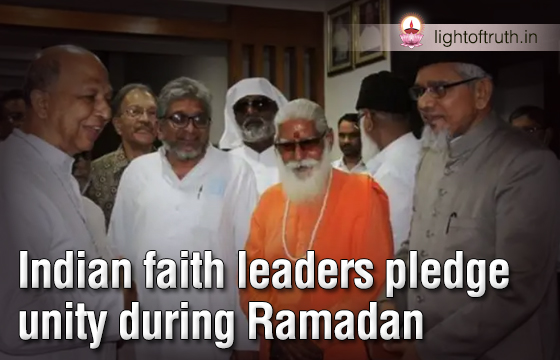
Indian faith leaders pledge unity during Ramadan
Leaders of different faiths at the first-ever iftar organized by the Archdiocese of Delhi pledged to remain united amid sectarian violence and growing unrest in India.
The iftar or evening meal with which Muslims end their daily Ramadan fast at sunset was a symbolic gesture to show solidarity with members of the national capital’s Islamic community who are fasting during the holy month.
“Through this program we wanted to spread love and peace among all people,” Archbishop Anil Joseph Thomas Couto of Delhi said at the interreligious event held by the archdiocese’s Commission for Ecumenism and Interfaith Dialogue on April 22.
The prelate said there was nothing to gain from what was happening in the country, where one community was pitted against the other in the name of religion, caste and creed.
“Let not the communal forces divide us,” said Archbishop Couto while urging all faith communities to come together and address the challenges before the country.
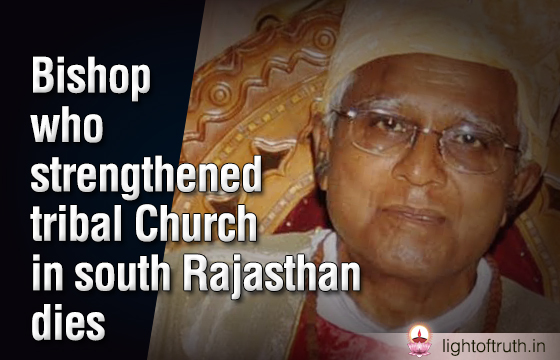
Bishop who strengthened tribal Church in south Rajasthan dies
Emeritus Bishop Joseph Pathalil, the first prelate of Udaipur diocese in Rajasthan, died April 14 after a long illness. He was 85. The death occurred at 12 noon at Paras KJ Hospital in Udaipur.
A message from Bishop Devprasad Ganawa of Udaipur said his predecessor had developed some breathing difficulties in the morning and was rushed to the hospital. “Due to a cardiac arrest, he breathed his last,” Bishop Ganawa added.
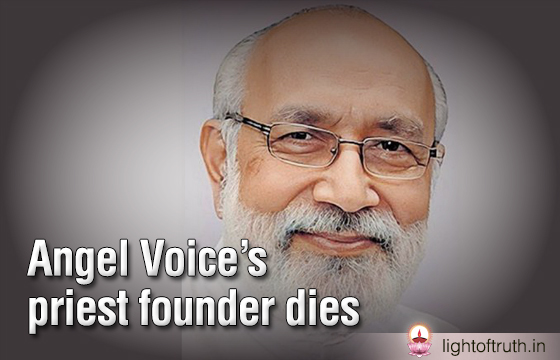
Angel Voice’s priest founder dies
Father Kuriakose Kachiramattom, the founder director of the nationally famous Christian music troupe – Angel Voice Gospel Music Group — died April 22. He was 79.
The death occurred in the after-noon at Lissie Hospital in Ernakulam, Kochi. Father Kachiramattom be-longed to Kothamangalam Syro-Malabar Eparchy.
Rani Maria film to hit silver screen soon
A Bollywood feature film on Blessed Rani Maria, a martyred social reformer, will be released in August, says director Shaison P Ouseph.
“This is the culmination of a 5-year dream and hard work, which is at the final stage of completion,” Ouseph told Matters India April 27.
Cardinal George Alencherry, head of the Syro-Malabar Church, released the film’s title – “The face of the faceless” – two days earlier.
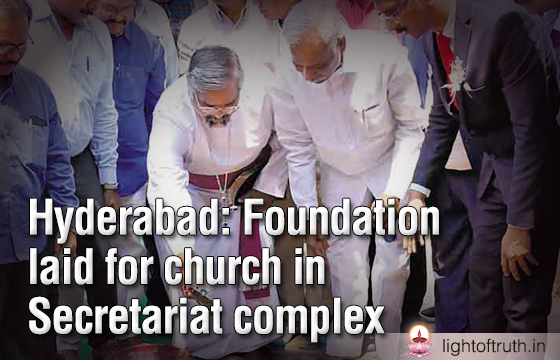
Hyderabad: Foundation laid for church in Secretariat complex
Medak Diocese Bishop Reverend AC Soloman said Chief Minister K Chandrashekhar Rao was safeguarding the secular fabric in Telangana by according equal importance to all communities.
The Medak Diocese Bishop along with MLC Rajeshwar Rao laid the foundation stone for a new church coming up at the new State Secretariat complex on April 28. Bishop Solomon participated in the ground-breaking ceremony of the new church and performed special prayers.
First women’s college on west coast turns coed
Come September, the first women’s college on India’s western coast will admit young men as students. The Apostolic Carmel congregation started St Agnes College in Mangaluru more than a century ago to exclusively educate women.
After its centenary celebrations in 2021, the college decided to start co-education, says principal Apostolic Carmel Sister M Venissa. “The college wished to extend its legacy of a century to male students at the undergraduate level. Finally, we are able to make it and admissions will commence from next academic year,” she told reporters. The principal also said they would admit about 30 percent male students in the first year. The number will be increased according to the demand.
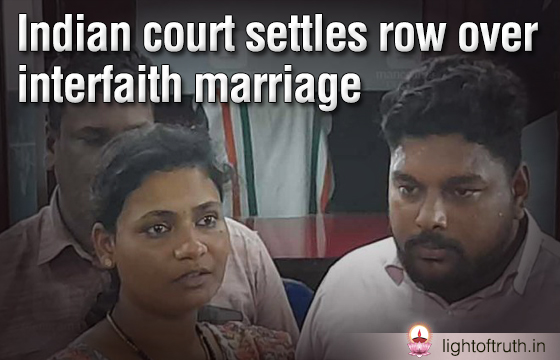
Indian court settles row over interfaith marriage
A top court’s refusal to intervene in the marriage of a Christian woman to a Muslim man has brought the curtain down on a snowballing controversy in the southern Indian state of Kerala.
The father of Jyotsna Mary Joseph, who worked as a nurse in Saudi Arabia, had filed a habeas corpus petition in Kerala High Court seeking a probe into his daughter’s “dis-appearance” after she walked out on her family and married Shejin, a communist youth leader belonging to the Muslim community, without their con-sent. The family leveled charges of suspected “love jihad,” a conspiracy theory that accuses Muslim men of targeting women from other religions for conversion to Islam by means of marriage, deception and force.
But the high court division bench of Justice V.G. Arun and Justice C.S. Sudha on April 19 declined to interfere in the couple’s decision to marry and disposed of the father’s petition. The court arrived at a decision after Jyostna appeared before it and categorically stated that she had married Shejin of her own free will and not under any compulsion.
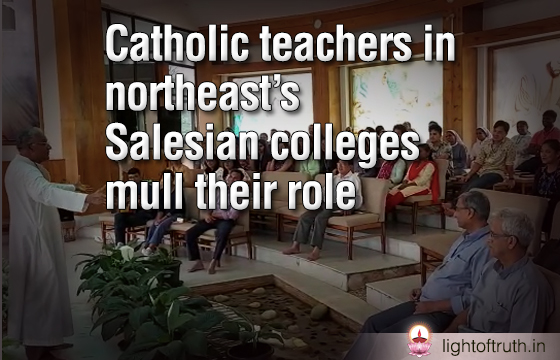
Catholic teachers in northeast’s Salesian colleges mull their role
More than 90 Catholic faculty members from 10 Don Bosco colleges in northeastern India spent four days reflecting on their role in higher education institutions. The ten participating Salesian colleges were Assam Don Bosco University Guwahati, Don Bosco Colleges of Maram, Bongaigaon, Gola-hat, Kohima, Siliguri, Sonada, Shillong, Tura and Government College Cherapunjee.
The program was held at Siloam Centre on Barapani Lake near Shillong, capital of Meghalaya state. Director of Siloam center Salesian Father George Palamattam complimented two principals and two vice-principals accompanying faculty members to the the program
Among the facilitators of the program were eminent resource persons from all over India including Archbishop emeritus Thomas Menamparampil of Guwahati, Archbishop Victor Lyngdoh of Shillong as well as youth leaders from Shillong.
The largest contingent of 27 participants came from Don Bosco (Autonomous) College, Maram, in Manipur.
The participants had immersion experience of major Holy Week liturgy.