A laity group in India has urged the Vatican to extend the primary synthesis stage of the Rome Synod for another three more months. “The third wave of corona pandemic is sweeping across the world. As such it is impossible for people to travel or organize physical gatherings, so critical to discerning God’s will for the future of the Church,” says a letter from the Indian Catholic Forum addressed to Sister Nathalie Becquart, the Under Secretary of the Synod in Rome.
Daily Archives: February 14, 2022

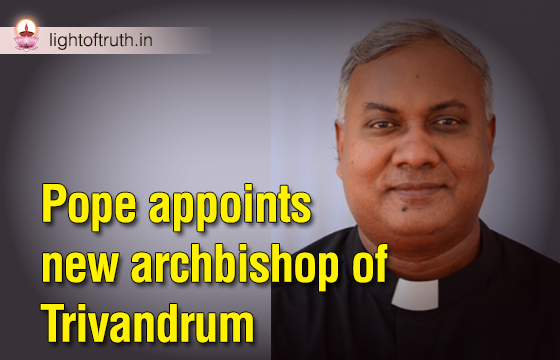
Pope appoints new archbishop of Trivandrum
Pope Francis on Feb. 2 appointed Msgr Thomas J Netto as the new head of the Trivandrum Latin rite Archdiocese.
The Pope has also accepted the resignation of Archbishop M Calist Soosa Pakiam, who headed the archdiocese since February 2, 1990.
These details were made public at noon time in Rome, says a press release from Father Stephen Alathara, deputy secretary general of the Conference of Catholic Bishops in India, the national body for Latin rite bishop in the country.
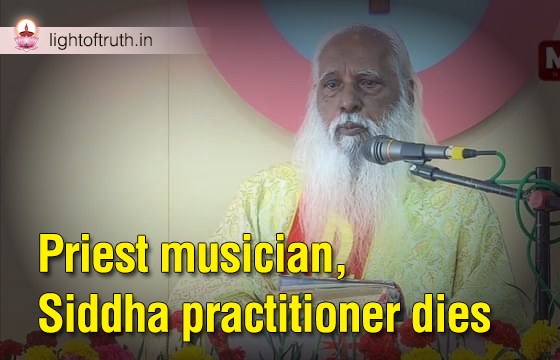
Priest musician, Siddha practitioner dies
Father A. Pitchaimuthu, a practitioner of Siddha medicine famous for composing the Catholic liturgy in folk style, died January 30 in Tamil Nadu, southern India. He was 82.
The death of the priest, who was also an educationist, occurred at 5:30 am in Viruthachalam town in Cuddalore district, some 225 km southwest of Chennai, the state capital.
Minorities support former VP’s views on India
Indian minorities have come out in support of former vice president Hamid Ansari, who is being criticized for his brief statement expressing concern over the rising trend of Hindu nationalism in the country.
Ansari was speaking at a virtual panel discussion on Jan. 27 organized by the US-based Indian American Muslim Council (IAMC) and is reported to have said how in recent years India had seen a rise in trends and practices that “dispute the well-established principle of civic nationalism and imaginary practice of cultural nationalism.”
He also expressed concern about how citizens were being distinguished “on the basis of their faith” amid “rising intolerance, disquiet and insecurity.”
Kerala bishop arrested for “illegal” sand mining in Tamil Nadu
A Catholic bishop and five priests from Kerala, southern India, have been arrested on charges of illegal sand mining in the neighboring state of Tamil Nadu.
Tamil Nadu’s Tirunelveli district court has remanded all the six in judicial custody, but Bishop Samuel Mar Irenios Kaattukallil of Pathanamthitta and Father Jose Chamakala were admitted to the Government Medical College Hospital in Tirunelveli after they fell ill.
Religious repression in Hong Kong could soon worsen, Christian cleric warns
Speaking anonymously during an online discussion, a Christian cleric in Hong Kong said he thinks it is likely that greater repression by the Chinese government of religious freedom in Hong Kong, particularly the freedom of religious schools, is about to occur.
The cleric, identified only as Reverend L, told the Hudson Institute’s Nina Shea on Feb. 10 that the Chinese Communist Party appears to be using ideological tactics, such as education, to chip away at the freedom of religion in Hong Kong, which came under Chinese control in 1997.
“In terms of restricting the rights of religious freedom, the CCP is doing it step-by-step,” Reverend L said, noting that China has in recent years imposed serious restrictions on the rights of assembly, press, and speech in Hong Kong. “Freedom of religion is the only remaining freedom in Hong Kong at this moment,” he said.
Hong Kong is a special administrative region of China, whose citizens have historically enjoyed freedom of religion, “comparable to any country in the free world,” Reverend L said. In contrast, on the Chinese mainland, religious believers of all stripes are routinely restricted, surveilled, and oppressed by the communist government.
However, Reverend L says that religious freedom has been particularly eroded in Hong Kong since 2019, thanks to the CCP’s efforts to control the populace through an “ideological war.”
Reverend L pointed to a Reuters report from late December documenting an October meeting at which Chinese bishops and religious leaders briefed senior Hong Kong Catholic clergymen on President Xi Jinping’s vision of religion with “Chinese characteristics.”
Reverend L opined that the meeting sounded like a “brainwashing session” to attempt to make the faith more Chinese, and thus more expedient for the CCP.
At the end of January 2022, the Chinese-language newspaper Ta Kung Pao, which Reverend L described as a CCP propaganda publication, published four articles about Catholicism in Hong Kong, one of them about Hong Kong archbishop emeritus Cardinal Joseph Zen.
Zen, 90, has been a strong advocate of the Hong Kong pro-democracy movement for years, and is a sharp critic of the 2018 Vatican-China deal on the appointment of bishops.
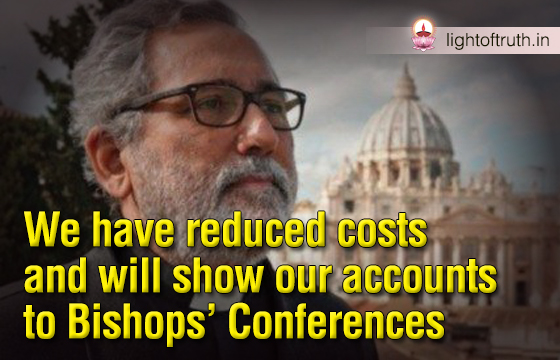
We have reduced costs and will show our accounts to Bishops’ Conferences
“To help the economy of the Holy See to meet its needs, taking care that economic activity does not distract or detract from the credibility of the Holy See’s mission of fostering unity in charity and the evangelising mission of the Church, which is what matters.”
In this interview with Vatican Media, Guerrero offers some data on the new budget of the Holy See, which has increased significantly this year due to the inclusion of new entities. Cost containment continues (further reduced by €4 million). The budgeted deficit is lower than that of last year, and the Prefect hopes to soon be able to provide data on the income and expenditure of Peter’s Pence as well, anticipating that this year too contribution of the faithful has decreased.
We are well aware that we have made major mistakes in financial management, which have undermined the credibility of the Holy See. We seek to learn from them and we believe we have remedied them so that they do not happen again. In recent years, encouraged by the Holy Father, we have taken important steps in the right direction in economic management: greater professionalisation, more teamwork, more transparency and less secrecy, establishment of oversight procedures, greater recognition of our weaknesses and attempting to remedy them… Important changes have been made with the publication of certain laws. But slowly, the culture is changing. We are working in the right direction.
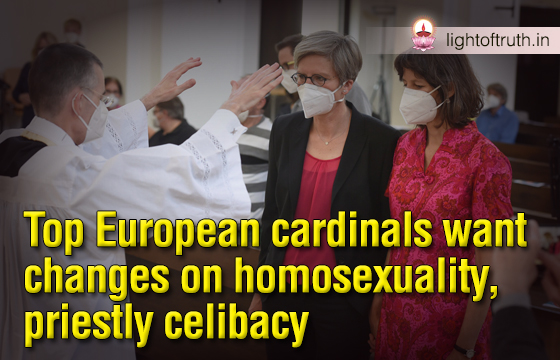
Top European cardinals want changes on homosexuality, priestly celibacy
Over the past week, two leading European Cardinals, both of whom enjoy broad favour with Pope Francis, have made public statements calling for a change in the Catholic Church’s current position on the issues of homo-sexuality and priestly celibacy.
In an interview published in Germany’s Catholic News Agency (KNA) earlier this week, Jesuit Cardinal Jean Claude Hollerich, Archbishop of Luxembourg, voiced his belief that the Church’s position viewing homosexual relationships is wrong.
“I believe that the sociological-scientific foundation of this teaching is no longer correct,” he said, saying the time has come to revise this position, and suggesting that Pope Francis’s own rhetoric on homosexuality could open the door for this change to take place.
Since the beginning of his pontificate, Pope Francis, who has also voiced concern over homosexuality in the priesthood, has taken a softer approach to the issue and has urged the Church to be more welcoming to homosexual individuals and to families with homosexual members.
In 2013, he signalled a new approach to the issue with his famous declaration that if a person “is gay and is searching for the Lord and has good will … Who am I to judge?”
In 2018, he said that the Church has to find a way to help the parents of gays and lesbians so that they “stand by” their children, telling parents with LGBT children, “Do not condemn. Dialogue. Understand.”
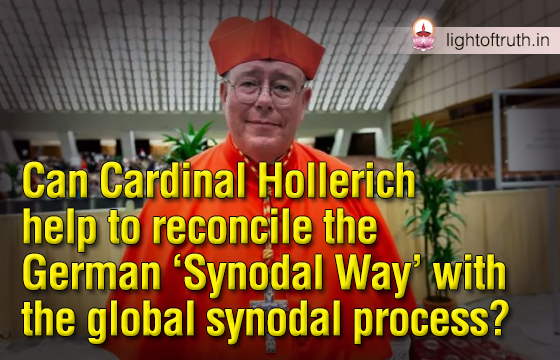
Can Cardinal Hollerich help to reconcile the German ‘Synodal Way’ with the global synodal process?
The German “Synodal Way” is moving forward boldly following a decisive meeting in Frankfurt at the start of February. But one important question remains unanswered: how does the initiative fit in with the two-year global synodal process launched by Pope Francis leading up to the 2023 Synod on Synodality?
Bishop Georg Bätzing, chairman of the German bishops’ conference, went some way to answering that question at the end of the three-day meeting of the Synodal Assembly, the supreme decision-making body of the Synodal Way.
“It was received with great approval and joy in the Synodal Assembly that we will establish a mixed discussion group between those responsible in the Roman Synod Secretariat and the presidium of the Synodal Way in our country,” he said on Feb. 5.
Bätzing made it known that he had a meeting in Luxembourg with Cardinal Jean-Claude Hollerich and Cardinal Mario Grech. Both men have critical roles in the worldwide synodal process. Pope Francis chose Hollerich, the archbishop of Luxembourg, to serve as relator general of the Synod on Synodality. The pope selected Grech, from Malta, as secretary general of the Synod of Bishops.
According to a source familiar with the work of the General Secretariat of the Synod of the Bishops, Grech’s presence at the gathering was “part of a series of meetings that the General Secretariat of the Synod intends to hold with the particular Churches,” with the will to “accompany them in the synodal process.”
In this regard, Grech also gave a speech at the last general assembly of the Italian bishops in November 2021. So, the Maltese cardinal is talking to multiple national bishops’ conferences about the global synodal process.
The idea of establishing a working group is part of a mediation effort that also aims to avert a possible schism of the Church in Germany. In June 2019, Pope Francis sent a 19-page letter to German Catholics high-lighting a “growing erosion and deterioration of faith” in the country. He urged Church members to resist the temptation to reorganize structures in the face of difficulties and engage instead in evangelization.
At the Synodal Assembly meeting on Feb. 3-5, participants voted in favour of draft texts calling for the abolition of priestly celibacy in the Latin Church, the ordination of women deacons and priests, same-sex blessings, and changes to Catholic teaching on homosexuality.
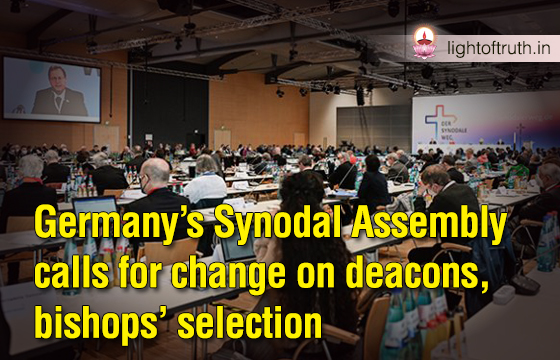
Germany’s Synodal Assembly calls for change on deacons, bishops’ selection
The Synodal Path of the Catholic Church in Germany wants laypeople to be able to participate in choosing bishops and wants the church to have women deacons. The third Synodal Assembly to bring about reforms to the Catholic Church ended Feb. 5 with the first concrete decisions of the process. Most German bishops signalled they are prepared to support far-reaching change in the Catholic Church.
For three days, nearly 230 delegates — lay and clerical — discussed reforms based on texts that had been drawn up in four working forums and reflecting theological arguments they hope to present to Rome in 2023, at the end of the Synodal Path process.
This third of five planned synodal assemblies marked the first time that the highest body of the Synodal Path adopted some fundamental texts in a second reading. The texts received approval of more than two-thirds of all delegates, in addition to the approval of more than two-thirds of the bishops. But two years after the Synodal Path process started, the Vatican has yet to give a clear signal of support. Limburg Bishop Georg Bätzing, president of the German bishops’ conference, announced that he met with Pope Francis in January and that he is in dialogue with Cardinal Mario Grech, secretary-general of the Synod of Bishops. Bätzing said a discussion group between the synod secretariat and the executive committee of the Synodal Path in Germany will be established.
The pope’s representative to Germany, Archbishop Nikola Eterovic, greeted the assembly and reminded delegates Pope Francis “is the point of reference and the centre of unity for more than 1.3 billion Catholics worldwide, 22.6 million of whom live in Germany.” He said the pope often speaks of synodality, but warns against “parliamentarism, formalism, intellectualism and clericalism.”