

A complete rebuild and expansion of the living quarters for the Swiss Guard will not only improve life for guards and their families, it will also allow for the future possibility of recruiting women.
Currently, applications to serve in the 15-year-old corps are open only to Swiss male citizens who served in the Swiss Army and are Catholic, under 30 years of age and athletic, stand at least 5 feet 8 inches tall and boast an “unblemished reputation.”
But, at least since the new millennium, the overriding obstacle that stood in the way of opening the door to women had been housing, not gender. There is one barracks with most men living in cramped and shared spaces.
“Sixty percent of our corps is under the age of 25; women in the same barracks (as the men) would create big problems,” Col. Elmar Mäder, then-commander of the Swiss Guard, said in 2004, explaining why he would never allow women in the guard at the time.
The succeeding commander, Col. Daniel Anrig, told reporters in 2008 that he would love to allow female recruits, but such a move could be con-sidered only “when the circumstances change,” specifically, the housing situation.
Those circumstances are now set to change in the coming years after a massive rebuilding project breaks ground with a projected completion by 2026 – the 520 anniversary of the founding of the Swiss Guard. It is scheduled to be inaugurated May 6, 2027 – the 500 anniversary of the Sack of Rome, when 147 Swiss Guards lost their lives defending Pope Clement VII.
Jean-Pierre Roth, director of the “Foundation for the Renovation of the Barracks of the Papal Swiss Guard in the Vatican,” told Catholic News Service by email Sept. 13 that the new project plans for 123 single rooms distributed over four different floors. Today there are only 12 single rooms, he said.
Daily Archives: October 2, 2021

Forced conversions a religious duty in Pakistan
Pir Abdul Haq, alias Mian Mithu, specializes in marrying off Hindu women to Muslim men in Pakistan and converting them to Islam simultaneously. His certificates preceded court verdicts before the partition of British India. “Even at that time, my father was jailed for four months when the local Hindus protested. The British gave us a logbook to keep a record of newly converted Muslim girls or any person and share its receipt,” he said at a Sept. 15 press briefing.
“I don’t return Hindu girls even if their community offers money. My faith is bigger than millions. I even refused Asif Ali Zardari [former president of Pakistan] on this issue. Do whatever you want, I told his minister. Allah will help me. I am performing his duty. I live and die for Islam.
“Girls, most of them housemaids, often come to us. Urgent marriages are organized so that they can live with a mehram [male guardian]. We keep the couple until the husband gets a job. I guarantee them protection at the seminary. Many courts forcefully return girls to Hindus. Those who protest these conversions have an agenda to defame Pakistan.”
Another speaker accused the Catholic bishops’ National Commission for Justice and Peace (NCJP) of getting foreign funding and raising an outcry. Their annual monitor is based on media reports of alleged victims of forced conversions, he said.
Mithu, 85, is the custodian of Dargah Bharchundi Sharif seminary, one of two major hubs in Sindh province for converting religious minorities to Islam. The former member of the National Assembly was a candidate of Zardari’s Pakistan People’s Party at the 2008 general election. In 2017, his photos with Prime Minister Imran Khan went viral on social media. He also leads mobs over blasphemy allegations.
“Women of this country, especially non-Muslim women, and especially underage girls, don’t stand a chance,” author Maria Rashid said in a recent tweet sharing photos of Mithu with Khan and Gen. Qamar Javed Bajwa.
The Council of Islamic Ideology invited him to discuss forced conversions during a session. The Ministry of Religious Affairs and Interfaith Harmony later rejected a bill that proposed regulations on conversions to Islam. On Sept. 24, Lahore High Court ruled that Muslim jurists regard the mental capacity of a child as of crucial importance for conversion to Islam. The age of discernment is generally reckoned as the age when one attains puberty, said Justice Tariq Nadeem while dismissing a petition filed by Gulzar Masih, a rickshaw driver from Faisalabad seeking recovery of his daughter Chashman Kanwal.
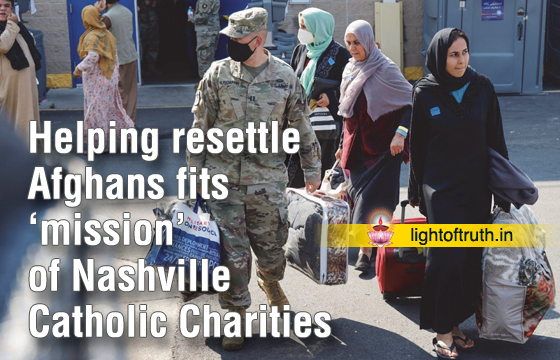
Helping resettle Afghans fits ‘mission’ of Nashville Catholic Charities
Over the course of the next six months, Catholic Charities in the Diocese of Nashville will help resettle 150 Afghans into local communities as part of the effort to help them escape Taliban rule under the U.S. State Department’s Afghan Placement Assistance Program.
“We serve people because we can address their needs, and addressing the humanitarian needs of refugees has been part of the mission of Catholic Charities in the Diocese of Nashville since its founding in the early 1960s,” said Rick Musacchio, diocesan director of communications. “Catholic Charities works in collaboration with federal partners to make the re-settlement process manageable and not overwhelming for local communities,” he added.
Kellye Branson, director of Refugee and Immigration Ser-vices, is heading the effort on behalf of Catholic Charities. “We had a really quick turnaround to think about it. We were asked how many we could accommodate,” Branson said.
“To get everybody’s thoughts about what might be possible,” she reached out to several entities, she said, including the Nashville mayor’s office, metro-area schools, health officials, the Tennessee Office for Refugees, the Nashville International Center for Empowerment and other local organizations that serve refugees.
“I looked at how many refugees we were projected to get over the next year, how many refugees we’ve served in the past and 150 was where we landed as a number that we felt comfortable accepting over the next six months, that we could garner enough support for, and that we could manage when it came to providing services,” she told. the Tennessee Register, Nashville’s diocesan newspaper.

Pakistani clerics oppose anti-forced conversion bill
Muslim clerics in Pakistan are voicing opposition to a draft bill that would only allow “mature people” to change their religion. The top trend on Twitter in Pakistan on Sept.15 was “#Islam mukhalif bill na manzoor [reject anti-Islam bill],” as a debate on the bill aimed at stopping forced religious conversions raged in the media.
Opponents of the bill seemed to direct their ire at Naveed Amir Jeeva, a Christian legislator who has been pushing the Prohibition of Forced Religious Conversion Bill, pending with the Standing Committee on Religious Affairs and Interfaith Harmony, since 2019. Some even shared the Pakistani politician’s profile on social media, spewing hate and condemnation.
Human rights and minority groups have been demanding the government resurrect and pass the bill that would criminalize the kidnapping, forced religious conversion to Islam and subsequently forced marriage of underage girls in Pakistan.
A parliamentary committee to protect minorities from forced conversions recommended in February that only a “mature person” (adult) may be allowed to change religion after appearing before an additional sessions judge.
The committee suggested that the judge set a date for an inter-view within seven days of receipt of the conversion application. An additional clause empowered the judge with the option to grant the person 90 days to undertake a comparative study of the religions concerned before return to his office with a final decision.

Indian Catholics help Myanmar Christian refugees
The Catholic Church in India’s Mizoram state has joined other Christian denominations and youth associations in assisting Christian refugees fleeing unrest in Myanmar.
According to media reports, over the past six months thousands of Christians from Myanmar have sought refuge in Christian-dominated Mizoram after the military junta intensified its crackdown on rebels in Chin state bordering India.
“At present there are around 15,000 refugees from Myanmar living in Mizoram, mostly in Champhai on the Indo-Myanmar border, a strategically important location,” Bishop Stephen Rotluanga of Aizawl told.
“The Church is engaged in humanitarian work along with several other denominations, Caritas India, Catholic Relief Services, the Young Mizo Association and NGOs. Our top priorities are to give them shelter, medicines and food and we have successfully executed our program along with the help of our partners.
“There is no problem for us to help the refugees because people from Myanmar
have been coming back and forth to Mizo-ram for decades. Many have relatives on both sides of the border, hence people can understand their suffering and welcomed them with open arms.
“Many refugees are staying with their relatives and others are in relief camps managed by churches and NGOs. The Young Mizo Association is very active and helping all the agencies to fulfil the requirements.”
Bishop Rotluanga said the state government has encouraged and appreciated the relief work and Mizoram’s chief minister had even asked the prime minister to help with emergency relief funds.
“There are several issues that have to be tackled with love and care as the refugees are in shock and are in trauma leaving their country. Many have lost their near and dear ones. Most of them are Christians at our camp but there are also a few Muslims,” he said.
“We are expecting more refugees in our state after fresh conflict flared up. We already have around 11,500 refugees in our state at present,” said C. Lalrosanga, a member of the lower house of parliament.

Christians decry profiling of faith leaders in central India
Christians in Madhya Pradesh state, central India, are outraged after government agencies began profiling Christian religious leaders working among indigenous people.
A revenue department official in the tribal-dominated Jhabua district summoned Christian leaders and asked them to provide personal information such as their appointment as a priest and the document related to their conversion. The official letter also asked them to certify if they were converted through allurement or force as the government wants to initiate legal proceedings against illegal conversions.
A state law criminalizes religious con-version through allurement or force, making it an offense punishable with up to 10 years in prison. The letter issued on Sept. 13 has also directed them to present details regarding their work in person before the official on Sept. 22 at noon.
“Our 16 pastors have received similar letters,” said Auxiliary Bishop Paul Muniya of Protestant Shalom Church in the district.
Christian leaders say their people face increased hostilities from right-wing Hindu groups opposed to their work in the district in their work among tribal people.
Earlier on Aug. 26, the additional superintendent of police, in a letter to police stations under him directed to assist activists from Vishwa Hindu Parishad (VHP), a right-wing Hindu outfit in their drive to close illegal Christian prayer halls and to contain illegal religious conversion activities in the district.

Christians appeal to India’s president for protection
Christians in the central Indian state of Madhya Pradesh have called on India’s president to provide protection amid open threats from Hindu activists to demolish their churches.
“Hindu activists mostly from Vishwa Hindu Parishad (VHP—world Hindu Council] have set a deadline to demolish our churches on Sept. 26, alleging they are illegal structures,” said Auxiliary Bishop Paul Muniya of the Protestant Shalom Church based in the state’s Jhabua district, which is dominated by tribal people.
VHP has also issued threats to the indigenous Christians against practicing Christianity and are forcing them to return to Hinduism, he told on Sept. 20.
“We handed over a memorandum to Indian President Ram Nath Kovind through the district collector on Sept. 17 seeking his urgent intervention to ensure the safety and security of the indigenous Christians,” the prelate said.
Bishop Muniya further alleged that local administrators were siding with the right-wing groups and harassing Christians who make up 4 percent of the one million population in the district, leading to a rise in anti-Christian violence.
Father Maria Stephan, public relations officer of the Catholic Church in Madhya Pradesh, said both the revenue and police administration of the district were biased against Christians.

Christians face ostracism in India’s Jharkhand state
Christian families in the eastern Indian state of Jharkhand have been ostracized by their village for embracing Christianity. The three families from Mangapat Sirsai village in West Singhbhum district, who became Christian a year ago, are being pressurized to return to the tribal Sarna belief system centered on the worship of nature.
The gram sabha or village council on Sept. 17 decided that the converted families will not be allowed to use common properties for free movement or grazing cattle. They will also not be invited to any social gatherings in the village and nobody will interact with them.
Gabbar Singh Hembrom, district president of the Adivasi Ho Samaj Yuva Mahasabha, a youth organization of local tribal people, warned the villagers to abide by the decision or end up paying a fine.
A meeting will be held every Sunday to check if the decision to ostracize the Christian families was being followed strictly by everyone.
Hembrom said: “The entire village follows the Sarna religion except for Raut Bankira, Rajendra Bankira and Hiralal Bankira, who converted to Christianity along with their families a year ago. We are ready to accept them if they return to our faith, but they refused.”
Mangapat Sirsai has nearly 200 households with a population of around 700 people.
Hembrom alleged that some Christian missionaries were luring the tribal people with land and money to convert them.
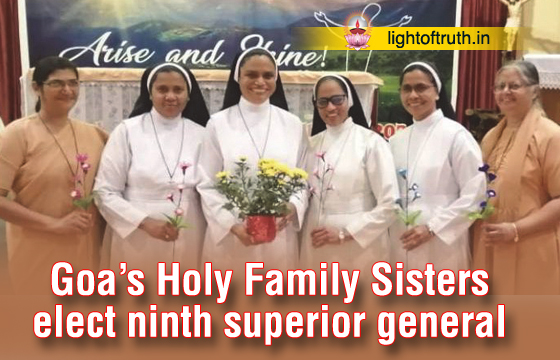
Goa’s Holy Family Sisters elect ninth superior general
The Goa-based Sisters of the Holy Family of Nazareth has elected Sister Berna Rodrigues as their ninth superior general. The election took place September 8, the last day of the congregation’s 12th ordinary general congregation held at St. Joseph Vaz Spiritual Centre, Old Goa.
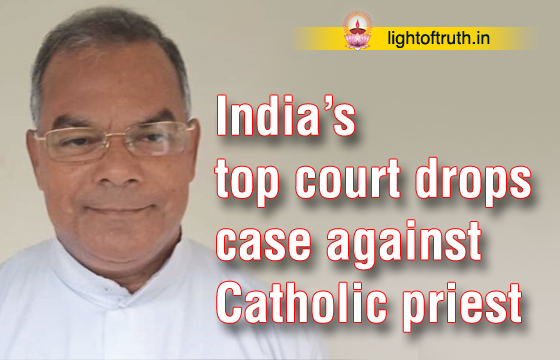
India’s top court drops case against Catholic priest
India’s top court has dis-charged a Catholic priest from a religious conversion case, registered against him in central Indian Madhya Pradesh state three years ago.
Father George Mangalapilly, a professor at St. Ephrem’s Theo-logical College in Satna diocese, was charged with converting Dharmendar Dohar, a Hindu, to Christianity by offering him a bribe of 5,000 rupees (some US$70) and other benefits back in December 2017.
“Apart from the testimony of the witness, there is nothing else on record which could potentially be relied upon against the appellant,” wrote the top court in its order while discharging the priest from the case. The priest along with his 32 seminarians and another priest were taken into police custody on Dec. 14 as they were on their way to sing Christmas carols while visiting Christian homes, a tradition they followed for decades. The Hindu activists, mostly members of the Bajarang Dal, also blocked officers of the police station and demanded action against the priests and all the seminarians for attempting to convert Hindus and.They also alleged ulterior motives to carol singing.