
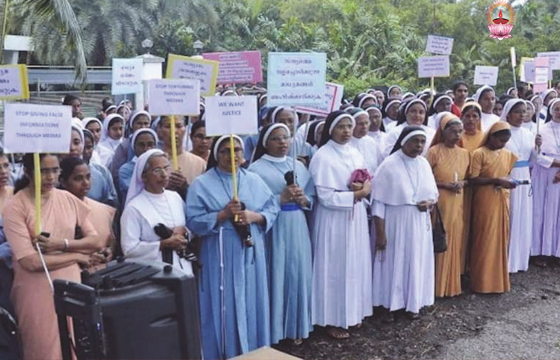
Catholic religious congregations in Kerala are to challenge a state court’s order which withdrew tax exemption that religious priests and nuns enjoyed as employees of government-aided educational institutions for decades. The court in the southern Indian state refused to accept their argument that they do not take their salaries for their personal use but instead they go to their respective religious societies.
“We have now decided to appeal against the order before the Supreme Court of India,” said Father Jacobi Sebastian, president of the Kerala Conference of Major Superiors.
Father Sebastian, a member of the Oblates of St. Joseph, told on Aug. 9 that they are also planning a larger meeting of church officials, major superiors and financial consultors on August 16 to chart the next steps.
The court quoted the Bible to say “Render unto Caesar the things that are Caesar’s, and unto God the things that are God’s.”
“We are reminded of the above teachings of Jesus Christ … while we consider an engrossing question on the liability of tax deduction at source from the salary paid to teachers who are nuns or priests of the religious congregations,” the court said.
The legal clash began in 2014 after the federal Income Tax Department ordered an end to tax exemption given to the Catholic religious priests and nuns since 1944. It asked the government treasury to deduct tax before paying salaries.
Three priests and a nun challenged the order soon after it was issued. A single bench of Kerala High Court dismissed their demand for exemption and upheld the Income Tax Department’s order.
The petitioners appealed before a higher bench of the court along with 49 others, but the court dismissed their demand on July 13.
The lawyers of the petitioners also quoted from the Church’s canon law to say that people who take “a perpetual vow of poverty” undergo a civil death and thereafter they are not considered persons under the Church’s laws.
Daily Archives: August 16, 2021
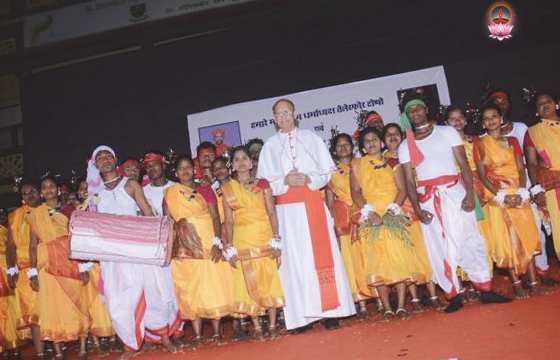
Card Gracias: Tribal groups suffer ‘injustice and exploitation’ around the world
In his morning Mass online, the Archbishop of Bombay (Mumbai) – and is also president of the Catholic Bishops’ Conference of India (CBCI) – spoke about his participation two years ago in the Synod of Bishops for the Pan-Amazon region, enjoined by Pope Francis.
On that occasion, the cardinal realised that “challenges faced by Indigenous people in South America were similar to the challenges faced by Tribals in India.”
Card Gracias also spoke about Fr Stan Swamy, who gave his life for indigenous tribes in India, and mentioned the many men and women religious who work among the Adivasis.
“We are present in Bihar, Chotanagpur and Raighad, to give them hope, education,
dignity and a future,” the prelate said. “But tribes around the world suffer injustice and exploitation.”
For the past three days, the CBCI has been holding webinars to mark the International Day of the World’s Indigenous Peoples, noted Father Nicholas Baria, executive secretary of the CBCI Tribal Affairs Committee.
On paper, the clergyman acknowledges that “The Constitution guarantees the rights of tribal people; in practice, how-ever, their land rights are not recognised” by the authorities.
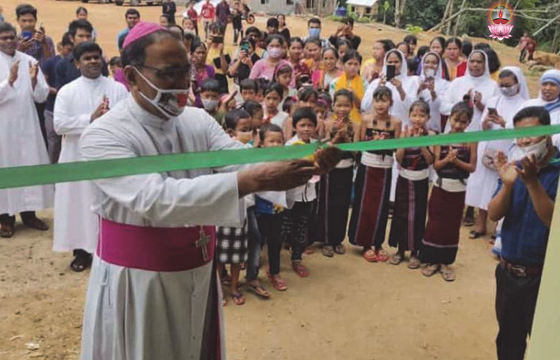
Bishop inaugurates first Jesuit residence in Indian state
Jesuits in India have opened their first residence in the north-eastern state of Tripura.
The Arrupe Inn in Jamtalibari was inaugurated in the presence of faithful by Bishop Lumen Monteiro of Agartala on July 31, the feast day of Jesuit founder Ignatius of Loyola.
“We welcome them to our diocese and wish them our prayers and support as they enter into new ministries. They will be engaged in social, pastoral and education fields in the diocese,” Bishop Monteiro told.
In 2018, two Jesuit missionaries, Babu Paul and James Morias, came to Jamtalibari from the southern state of Kerala.
“As we celebrate the 500th anniversary of the conversion of St. Ignatius, it is an important occasion for Jesuits to refocus on their life and mission,” said Father Irudaya Jyothi, who was part of a Right to Food campaign in West Bengal state before he joined the mission in Tripura.
“The Arrupe Inn is dedicated in a special way to the implementation of the universal apostolic preferences of the Society of Jesus.”
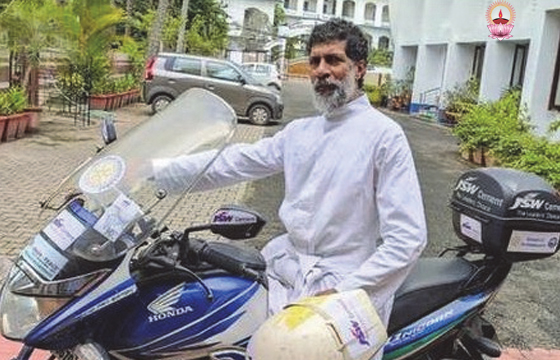
Priest’s all-India journey to promote peaceful, green world
Throughout his career as the principal of Sacred Heart College, in Kochi’s Thevara suburb, since 2010, he was known to use a bicycle to travel short distances, trying to inculcate a sense of ecological responsibility among his students and the general public. In fact, he has been known among people in Thevara as the “padiri” who rides his bicycle.
He has also been part of green activities in the southern Indian city of Kochi, promoting organic agriculture, garden-ing and creating concern for nature in young generation.
The 56-year-old member of the Carmelites of Mary Immaculate retired from his academic career earlier this year. He will now undertake a tour of India on his favorite motorbike. He said he was not using a car since it consumed too much fuel. “Using a motorbike is better, because it was lighter on the environment,” he said as he prepared to set out on the Trust-Green-Peace journey from August 10.
Father Palakkappilly was instrumental in acquiring about four acres of paddy fields in Arayankavu, near Kochi, under the aegis of the Sacred Heart College, as a center for biodiversity where students could be introduced to the basics of nature.
He said he was a “sanyasi” who would be available for any duty to be performed on the orders of his superiors.
The solo bike ride will be flagged off from Thevara and will reach Kottayam on the same day. He will cover Kashmir and Kolkata, Kutch and Konkan as the journey progresses over a period of two months.
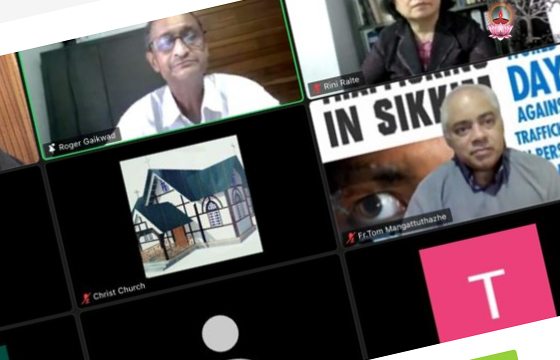
Churches in north-eastern India pledge to fight human trafficking
Representatives of various Christian denominations in north-eastern India on July 30 pledged to fight human trafficking in the region.
“Human trafficking is a serious concern all over the world. It is a sad truth that the northeast region has become the hub of cross-border human trafficking,” said Reverend Roger Gaikward, the former president of the National Council of Churches in India and present presbyter at Christ Church, Guwahati.
He was addressing an online meeting to mark the World Day against Trafficking in Persons. It was convened by the United Christian Forum of North East India, an ecumenical organisation.
Moderating the webinar, Reverend Gaikward said, “Listening to victims’ voices will lead the way to helping the region out of this sad reality.”
Among those present were representatives of Presbyterians, Baptists, Evangelicals, Church of North India and Catholics.
Reverend Gaikward points out that northeastern India’s proximity with international borders makes it easy for the human traffickers.
Many trafficked victims never see their homes again. More than 80 percent of them are pushed to flesh trade. Lack of education and awareness on the issue and poverty make the northeastern Indian youth soft targets, Reverend Gaikward added.
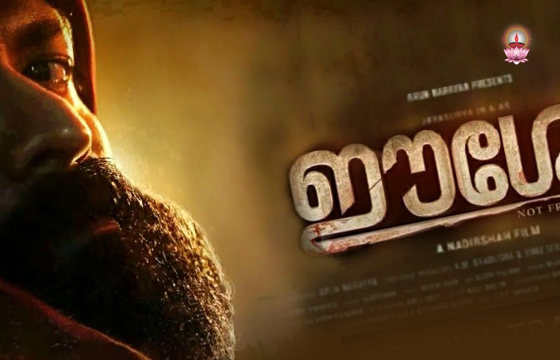
Movie titles referring to Jesus spark anger in India
A Muslim filmmaker’s two new movies with references to Jesus in their titles have taken a communal turn in southern India’s Kerala state, with a section of Christians viewing them as part of a larger plan to belittle Christ and Christians. Director Nadirsha began to face opposition after he announced his movie Eesho (Not from the Bible). Eesho and Yeshu stand for Jesus in the state’s Malayalam language. “We will not let this movie be screened anywhere in Kerala,” said politician P.C. George in a video post on Aug. 5, projecting it as part of a “well-orchestrated and deep-rooted conspiracy to malign Christianity.”
Credibility crisis wake up call for Indian Church: Theologians
The crisis of credibility is a wake-up call for the Church in India, and the best way to regain is to follow Jesus, who “lived what he taught and what he taught, he lived,” say Catholic theologians in the country. The eroding credibility the Church suffers now is caused by forces outside as well as factors inside, says a statement from the Indian Theological Association.
Although the Church has undertaken concerted efforts to present it as credible in an increasingly hostile environment, it lacks a professional approach to deal with attack in the media and other forums, said the annual meet of the association held online. As many as 45 theologians from across the country addressed the theme, “The Church in India Today: Credibility and Witness,” based on the papers presented by scholars.
The April 25-28 conference noted an urgency to deal with the crisis and reclaim the Church’s credibility so that it becomes authentic in its mission of proclamation and witness. The statement was released to the press on August 11.
According to the theologians, more vexing issues that trouble the Church come from within. The theologians have acknowledged that scandals and scams have severely affected the Church in India. The misuse of power and money, caste discrimination, Dalit and Tribal under-representation, gender discrimination and sexual abuse, and lack of financial accountability have added to the Church’s woes, they add.
“The unfortunate reality in India is that, such instances are not always honestly investigated, nor are the accused persons or bodies audited with transparency,” the statement bemoans.
Regarding the sexual abuse of children and women in the Church, the statement was forthright: “Shrouded in silence, this endemic evil has been kept hidden for a long time… It is not only an individual clergyman’s inappropriate sexual conduct that calls to question the credibility of the Church. It is also the approach taken by the ecclesiastical authority in dealing with this issue that puts at stake, all the more, the Church’s integrity and credibility.”
The statement also cautions about the increasing clericalism in the Church.
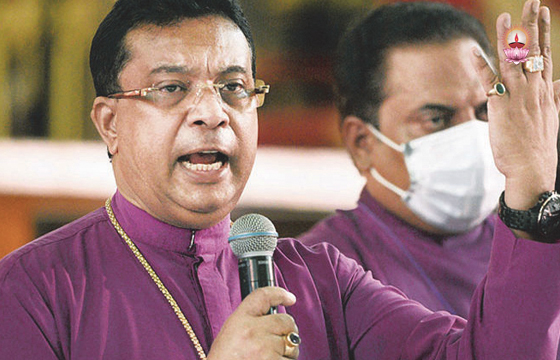
Time for minority voices to be heard: CNI bishop
The death of Father Stan Swamy has taught “minorities to be alive” and unite or else “your voice will not be heard,” says Bishop Paritosh Canning of Calcutta Church of North India diocese.
Father Stan, a Jesuit priest and tribal rights activist, died in judicial custody in July while waiting for bail. He was 84 and ailing.
Reverend Canning said Father Stan was a Christian priest but his work was “not only for Christians” but for “the tribals who are down-trodden,” in one way “minori-ty,” and he came forward to give them “new life” and tell them they had rights in their own land. Father Stan was condemned so that “tribals do not know their rights,” said Bishop Canning.
On August 5, the Bengal Christian Council, affiliated to the National Council of Churches in India, had called a meeting in remembrance of Father Stan. At the event at St Paul’s Cathedral, a minority forum was inaugurated with a call to all minorities to come together.
Speaking on the occasion, Bishop Canning said: “They (the tribals) should not be like us, they will be like tribals all the time. They will be like servants lifelong… This is the cause why Fr Stan… was kill-ed. It was not a normal death.”
Priests appeal Pope against uniform mode of Mass celebration
All the 456 priests of the Archdiocese of Ernakulam-Angamaly have written to Pope Francis saying they want to continue to offer Mass facing people, a practice that the Syro-Malabar eparchy has followed for the past 50 years.
The memorandum was sent to the prefect of the Oriental Congregation in Rome and the apostolic nuncio in in India on August 10, as the Syro-Mala-bar Synod prepared to discuss Pope Francis’ letter on the controversial issue of liturgy. The memorandum was also signed by some priests of reli-gious congregations working in the Syro-Malabar archdiocese, a priest, who did not want to be named, told.
The August 16-24 virtual synod is expected to decide the date to implement the uniform mode of celebrating Mass.
Pope Francis’s letter dated July 3 and made public three days later exhorts the clergy, religious and lay faithful to promptly implement the uniform mode for the greater good and unity of the Church.
The letter also said that Vatican regards implementing the code as an important step towards increasing stability and ecclesial communion in the Syro-Malabar Church.
The letter asked the bishops to persevere and confirm their ecclesial “walking together” with God’s people, trusting that “time is greater than space” and that “unity prevails over conflict.”
After 60 years of Indian rule, Goa’s Portuguese legacy disappears
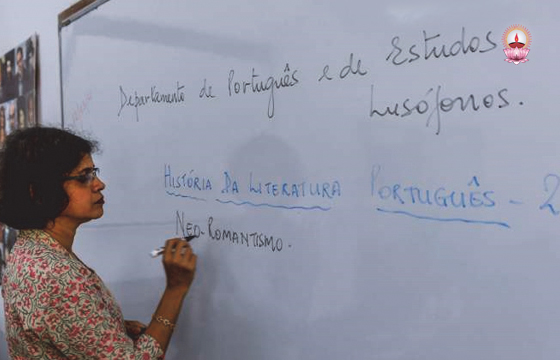
As Lorraine Alberto begins her Portuguese class at Goa University, students from the former colony are in short supply. Across Goa, a tiny coastal state once administered by Lisbon, there is little appetite for the territory’s 450 years of European heritage after a few short generations of Indian rule.
Ramshackle colonial homes and Bollywood’s increasing cultural dominance portend the disappearance of local history in a place where speaking Portuguese was once a passport to status and power.
My children don’t speak it at all,” Alberto told AFP. “They just don’t see the point of learning it.”
Those alive in 1961, when Indian troops marched into Goa and incorporated it into the rest of the country, recall an overnight transformation. India’s exit from the British empire in 1947 spurred many Goans to demand an end to Portuguese rule, but few expected so much to change so quickly.
“It was a very strange feeling … The changes came so fast,” said Honorato Velho, a retired school principal. The 78-year-old once lived next to the grandfather of Antonio Costa, Portugal’s current prime minister, and he fondly remembers a childhood peppered with European and local influences.
But his enthusiasm has not been inherited by the next generation.
“My wife and I still speak Portuguese out of habit, but never with our children,” Velho told AFP.