Using anti COVID vaccine is lawful even if it includes cell lines from aborted foetuses

The Congregation for the Doctrine of the Faith issue as press released, approved by the Pope, whereby it “is morally acceptable to receive COVID-19 vaccines that have used cell lines from aborted foetuses in their research and production process.”
The statement comes as a response to “several requests for guidance regarding the use of vaccines against the SARS-CoV-2 virus that causes Covid-19, which, in the course of research and production, employed cell lines drawn from tissue obtained from two abortions that occurred in the last century.”
The Congregation does “not intend to judge the safety and efficacy of these vaccines, although ethically relevant and necessary, as this evaluation is the responsibility of biomedical researchers and drug agencies. Here, our objective is only to consider the moral aspects of the use of the vaccines.”
“As the Instruction Dignitas Personae states, in cases where cells from aborted foetuses are employed to create cell lines for use in scientific research, there exist differing degrees of responsibility’ of cooperation in evil.” For example, ‘in organizations where cell lines of illicit origin are being utilized, the responsibility of those who make the decision to use them is not the same as that of those who have no voice in such a decision.’
“The fundamental reason for considering the use of these vaccines morally licit is that the kind of cooperation in evil (passive material cooperation) in the procured abortion from which these cell lines originate is, on the part of those making use of the resulting vaccines, remote. The moral duty to avoid such passive material cooperation is not obligatory if there is a grave danger, such as the other-wise uncontainable spread of a serious patho-logical agent – in this case, the pandemic spread of the SARS-CoV-2 virus that causes Covid-19.”
“It must therefore be considered that, in such a case, all vaccinations recognized as clinically safe and effective can be used in good conscience with the certain knowledge that the use of such vaccines does not constitute formal cooperation with the abortion from which the cells used in production of the vaccines derive.”
“It should be emphasized, however, that the morally licit use of these types of vaccines, in the particular conditions that make it so, does not in itself constitute a legitimation, even indirect, of the practice of abortion, and necessarily assumes the opposition to this practice by those who make use of these vaccines.”

Vatican City (AsiaNews)

Francis: Inculturated Zairean rite a ‘promising model’ for Amazon

Pope Francis is praising an inculturated African Mass rite as a model for a proposed Amazonian indigenous rite even though the African Eucharistic liturgy incorporates the pagan custom of “invocation of ancestors.”
“The Zairean rite suggests a promising way also for the possible elaboration of an Amazonian rite,” writes Francis in his preface for a new book titled Pope Francis and the Roman Missal of the Dioceses of Zaire: A Promising Rite for Other Cultures.
The Zairean Mass, sometimes called the “Congolese Mass,” is “until now the only inculturated rite of the Latin Church approved after the Second Vatican Council,” claims Vatican News — although the Vatican also approved “Twelve Points of Adaptation” for a Hinduized “Indian rite Mass” in 1969.
Commending the Zairean rite for its cultural vibrancy and spirituality, Pope Francis says that the liturgical inculturation in the Democratic Republic of the Congo (DRC) is an invitation for enhancing the different gifts of the Holy Spirit, thus enriching humanity.
“Animated by religious songs with an African rhythm, the sound of drums and other musical instruments constitute real progress in the rooting of the Christian message in the Congolese soul. It is a joyful celebration. It is a true place of encounter with Jesus,” observes Francis.
This is not the moment to include half-baked theological speculations in the liturgy.
The pontiff insists that liturgical inculturation in Africa and the Amazon is possible “without upsetting the nature of the Roman Missal, to guarantee continuity with the ancient and universal tradition of the Church.”
Francis commendation of the Zairean Mass comes a year after the pontiff celebrated a special Mass for Rome-based Congolese Catholics in St Peter’s Basilica using the Zairean rite. Liturgists, however, are disturbed by pagan elements in the Zaire Mass, especially the rite of the “Invocation of the Ancestors of Upright Heart (invocation ancetres au coeur droi),” together with the saints in the opening rites of the Holy Mass — particularly as the congregation may even invoke their pagan ancestors.
In comments to Church Militant, Dr Joseph Shaw, editor of The Case for Liturgical Restoration explained the biblical, theological and liturgical “absurdity” of incorporating the invocation of ancestors into the liturgy.

Pope forges ahead with financial reforms

Pope Francis is pushing forward with his reforms of Vatican finances with a new law that tightens oversight over Holy See invest-ments and ensuring greater transparency.
The move comes as the Vatican continues its investigation into a disastrous €350 million London property investment which had been overseen by the Secretariat of State, the body which sits at the heart of the Church’s central administration.
The new law, which cames into effect on 1 January 2021, removes the Secretariat of State’s power to manage investments and property holdings and hands that authority to the Administration of the Patrimony of the Apostolic See (APSA). APSA oversees the bulk of Vatican investments and also acts as the equivalent of a treasury.
The Pope has also ruled that APSA will also take over control of Peter’s Pence from the Secretariat of State. The Peter’s Pence fund is derived from donations made from Catholics across the world and its purpose is to help the Pope run the Holy See and fund charitable projects.
Francis’ legislation comes after a letter he wrote in November authorising that APSA would take over the management of the Secretariat of State’s funds. In that letter the Pope called for the Vatican to exit the investment in 60 Sloane Avenue “as soon as possible.”
By 4th February 2021, the latest law explains, the Secretariat of State must transfer all “cash funds” in Vatican or foreign bank accounts, “securities and real estate investments,” and investments in companies or investment funds to APSA to manage. In turn, APSA will be held accountable to the Secretariat for the Economy, which has a general oversight role.

DNA study suggests humans descended from two people

Disagreements between those who support creationism and those who support the theory of evolu-tion have been going on for decades.
The book of Genesis tells us that all of humanity is ultimately descended from just two people. Does science agree? According to the New Zealand Herald, a recent study says “maybe.”
The study was done by Mark Stoeckle and David Thaler of the University of Basel, Switzerland. They examined the “genetic barcodes” of over 5 million animals from 100,000 different species — and one of those species was humans.
Based on those barcodes, which are really just tiny bits of DNA from the mitochondria of living cells, the researchers concluded that their data are “consistent with” the hypothesis that all of humanity are the descendants of a single pair of adults who lived 100,000 to 200,000 years ago, writes the Herald. The study showed that there is very little genetic diversity among humans when you look at our mitochondrial DNA. Mitochondrial DNA is a part of our genetic code that is passed to us from our mothers and it doesn’t mix with our nuclear DNA, making it possible to trace a direct maternal genetic line.
Mitochondrial DNA is the small circular chromosome found inside mitochondria. These organelles found in cells have often been called the powerhouse of the cell. The mitochondria, and thus mitochon-drial DNA, are passed only from mother to offspring through the egg cell. The study, published in the journal Human Evolution in May 2018, sparked news outlets to declare “All humans are descended from just two people, scientists claim.”
Looking beyond the headlines, science journalist Michael Marshall notes in an article for Forbes that “DNA barcoding is not a perfect method of identifying species, but it works pretty well.” Marshall alludes to the limitations of “drawing big conclusions from mitochondrial DNA, and especially from a single gene.”

LANDMARK STUDY: DEVOUT MUSLIMS HATE WEST

A groundbreaking study strongly linking Muslim religiosity to prejudice and hostility towards the West is “distressing,” a Kuwaiti researcher who spe-cializes in the psychology of religion has revealed. Dr Bashar Albaghli, who studied Muslims from 17 Arab countries between 18–70 years of age, says he expected to find a link between Islamic fundamentalism and West hatred, but was shocked to dis-cover “even intrinsic (moderate) Muslim religiosity” strongly predicting prejudice towards the West.
“In fact, the only groups that had favourable attitudes toward the West were the secular and nonreligious Arabs,” Albaghli, a behavioural psychologist at the prestigious University of St Andrews, Scotland, explained on the Jihad Watch website.
Albaghli revealed that he was also “quite surprised by the response of many Western universities that were hesitant to invest in this research” titled “The Link between Muslim Religiosity and Negative Attitudes toward the West: An Arab Study” and published by The International Journal for the Psychology of Religion.

Jews, Muslims Decry Court Decision Backing Belgian ban on Kosher, Halal Slaughter

Despite concern that a Belgian law bans Jewish and Muslim religious slaughter practices, a European Union court has said the law is justified by the need to promote animal welfare even if it does not accommodate religious freedom.
“This decision goes even further than expected and flies in the face of recent statements from the European institutions that Jewish life is to be treasured and respected,” said Pinchas Goldschmidt, the head of the Conference of European Rabbis, BBC News reports.
The European Court of Justice, the highest court in the European Union, said the Belgian law requiring animals to be stunned limited the rights of Muslims and Jews but did not ban ritual slaughter. The law’s “interference with the freedom to manifest religion” met an “objective of general interest recognized by the European Union, namely the promotion of general welfare.” The law would not affect the sale in Belgium of kosher and halal meat produced in other countries, it noted.
Ben Weyts, the Flanders government’s nationalist welfare minister, welcomed the decision, saying “we’re writing history today.” The animal rights group Gaia also welcomed the decision.

Kenyan Christians Travelling for Christmas Fear al-Shabaab Bus Attacks

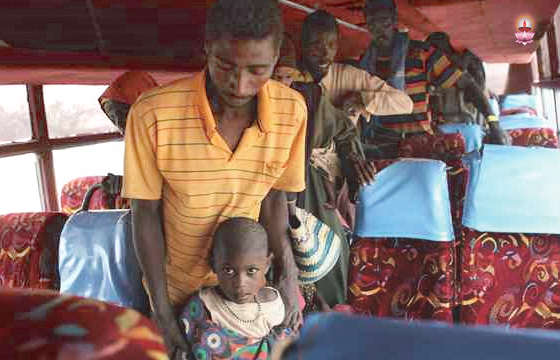
Christians travelling on buses for Christmas holiday close to the border with Somalia have recently become targets of the Somalian militant group, al-Shabaab.
According to Christians in the region, travelling has become a risky endeavour, as the militants have seized buses on remote roads. Locals in the mostly Muslim communities in the area have been accused of aiding the attacks, some of which have been fatal.
Kenyans are bracing for further attacks by al-Shabaab as the United States carries out plans to withdraw its troops from So-malia, which broke off diplo-matic relations with Kenya, say-ing Kenya was meddling in its elections.
In response to the attacks, Christian and Muslim leaders have stepped up interfaith dialogue in hopes of reining in the bus attacks and other threats to the border region’s small Christian community.
“We continue to pray and talk. The interfaith dialogue has brought a great change in this region,” Nicholas Mutua, a Catholic priest in Garissa, told Religion News Service. “The buses are moving. All is fine, but we have to be on alert. The militants are very unpredictable.”

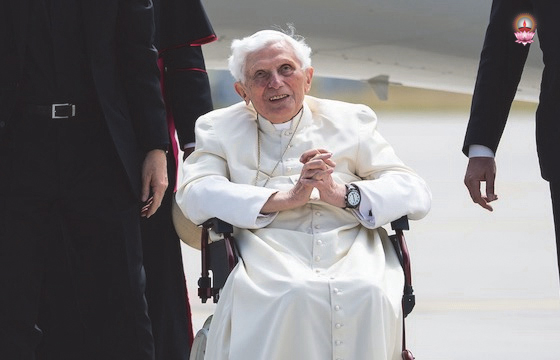
Pope Emeritus ‘deeply regrets’ his support for disgraced order 

The week after Pope Francis toughened up the rules on setting up new orders it became clear that Pope Emeritus Benedict XVI distanced himself from an order that he helped establish and recognised in 1977 when, as Cardinal Joseph Ratzinger, he was Archbishop of Munich and Freising.
Now Pope Emeritus Benedict XVI has expressed regret for his original support for the Catholic Integrated Community (CIC).

Crisis is healthy for Church, Pope tells Curia

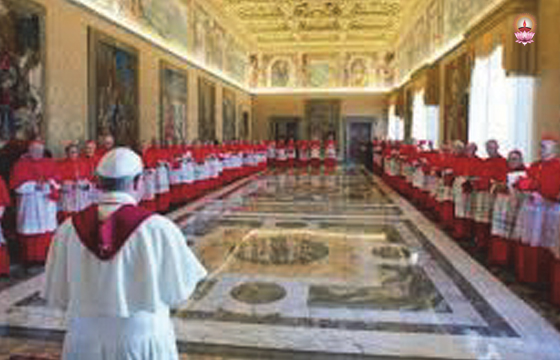
In his Christmas address to the Roman Curia, Pope Francis said that crisis can be beneficial to the Church, but conflict is always destructive. The annual address to the Vatican leadership has become a key indicator of papal priorities, and in past years Pope Francis has surprised his listeners with blunt criticism of what he has seen as deficiencies in the Curia. This year, his lengthy address took a different approach, advising against internal conflicts.
“Crisis generally has a posi-tive outcome, whereas conflict always creates discord and competition, an apparently irreconcilable antagonism that separates others into friends to love and enemies to fight,” the Pope said.
“Every crisis contains a rightful demand for renewal,” the Pontiff explained. The key to successful renewal, he said, is to see the problems facing the Church from the perspective of the Gospel. “Those who fail to view a crisis in the light of the Gospel simply perform an autopsy on a cadaver,” he said.
Authentic renewal, the Pope continued, requires “the courage to be completely open.” He contrasted that open attitude with the attitude of those who see a crisis in terms of conflict between different viewpoints.

One in 9 Russians curses frequently, over 60% do so from time to time – poll

Moscow, on December 15, Interfax – Eleven percent of Russians curse frequently; the share is the highest in the group aged from 31 to 45, the Public Opinion Foundation said in a statement seen by Interfax. The number of frequently cursing men is two times higher than the number of such women, 15% and 7%, respectively, the pollster said.
Sixty one percent of Russians use foul language on rare occasions, mostly in the group aged from 18 to 30 (71%).
According to the Public Opinion Foundation, 56% of Russians curse only if they experience strong emotions, 12% do not need such emotions to swear.
A quarter of respondents (26%) told the pollster that they never used foul language; the share was the biggest in the group aged 60 and up (46%), the statement said.
Over a third of respondents (37%) allowed for the occasional use of foul language in fiction books, 60% said that was inadmissible under any circumstances, and 3% were undecided.
The Public Opinion Foundation noted that 43% of Russians often heard foul language on the street, in public areas, and in public transport, and 51% heard people swearing from time to time. Three percent said they had never heard foul language being used in such places, and 3% could not say whether what they heard was cursing or not.