
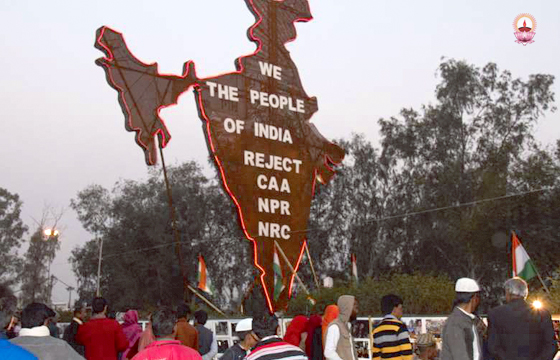
India has become increasingly intolerant towards religious minorities, especially the Muslim community, according to a new report.
The South Asia State of Minorities Report 2020 noted that the general public has come under attack from federal and state governments for criticizing the administration and institutions.
The report looks at the status of access to personal liberties, especially among minorities, in Afghanistan, Bangladesh, Bhutan, India, Nepal, Pakistan and Sri Lanka.
“It is true that we minorities are facing the onslaught of the Narendra Modi government very systematically. As a matter of fact, they have started framing laws that are against the spirit of secularism, democracy and the republic,” A.C. Michael, national coordinator of the United Christian Forum, told UCA News.
“Have you ever heard of a case anywhere in the world where two adults are stopped from getting married by the police? This is what is happening in Uttar Pradesh these days. The Uttar Pradesh police have filed almost two dozen first instance reports against interfaith marriages specifically targeting Muslims.
“Spreading hatred against minorities has become like a fashion for ruling party politicians to remain in power and acquire more. If they continue to succeed in tricking ordinary citizens and win elections, this trend of violence against minorities is going to continue.”
According to the report, “hate crimes against minorities have seen a spike — taking the form of mob lynching and vigilante violence against Muslims, Christians, and Dalits.”
The report said the pro-Hindu Bharatiya Janata Party (BJP) has “unveiled a new and now frontal attack on religious minorities. The persecution towards minorities had a chilling effect on civic space for Muslims and their organizations.”
Daily Archives: January 3, 2021

Fr Laborde: Inspiration behind “City of Joy” dies
Father Francois Laborde, a French Jesuit who spent decades among the poor of Kolkata, was buried on December 28 in a parish in the capital city of West Bengal.
Fr Laborde was considered the inspira-tion behind French author Dominique Lapierre’s “City of Joy,” a novel on the slums of Calcutta (now Kolkata).
He died of old age illness on Christmas Day in a hospital in Midnapore, near Kolkata, He was 93.
Archbishop Thomas D’Souza of Calcutta led the funeral services on December 28 at Saint John’s Church.
“Father Laborde worked silently and with great humility among the poor for more than 55 years. Religion, caste and creed did not matter to him as he reached the poorest of the society,” said Archbishop D’Souza in his condolence message.
According to the prelate, the Jesuit priest was always just a call away. “And when praised, he would humbly say, he was just doing God’s work,” added Archbishop D Souza.
Born on February 28, 1927, François was educated up to the baccalaureate with the Jesuits. After a year of philosophy at the Sorbonne, he joined the Prado institute in order to become a priest among the excluded and the poorest.
It was in Paris, his hometown, that his proximity to the poorest was awakened. He was then 9 years old. Coming from a petty bourgeois family, he suddenly discovered that his best friend lives in an even less favoured situation.
“When I was invited to his home for the first time, I was amazed. His family lived on the sixth floor and he slept on a folding bed in a loft. A few days earlier, he had left my house crying… Since that day, I understood that it was necessary to go to the poor in order to understand them.“
In one such visit, Father Laborde met Doctor Sen, who later extended a helping hand. “I took a sick child to him and when I offered him money, he got angry. He said it was inhuman to charge money from the child and I knew I got a friend,” Laborde added. Now that Lapierre is unwell, Laborde has a message for his friend. “I have heard that Lapierre is very unwell. All I want for him is a speedy recovery,” he said.
In 1969, Lapierre came to Kolkata to research his book. Father Laborde literally walked Lapierre hand-held through the alleys of poverty and distress in Pilkhana and other slums for his groundwork for ‘City of Joy.’
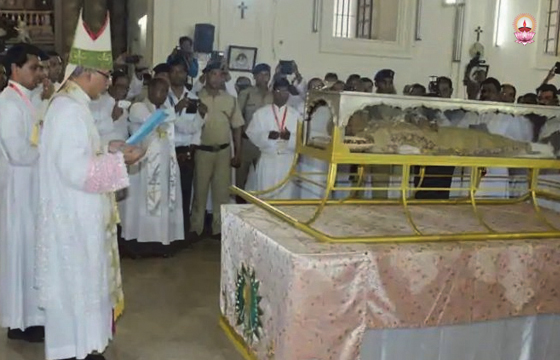
Archaeological Survey begins restoration of Xavier casket
The Archaeological Survey of India has begun the restore the four-century old silver casket that houses the relics of Saint Francis Xavier at the Basilica of Bom Jesus in Old Goa. The casket, which was last tended to in 1698, has been braving the elements within the basilica, which is part of the UNESCO declared heritage complex. Old Goa was once the capital of the Portuguese maritime empire and an important trade center. The restoration began on December 9.
Back in 2018 a team of three specialists was dispatched from “Opificio delle Pietre Dure e Laboratori di Restauro di Firenze” (A restoration laboratory in Florence, Italy), to study the artifacts from May 27 to June 3, 201. They had called for attending to the casket mas a top priority or it would fall apart within the next 10 years.
“The ASI Chemical Branch from Aurangabad, who are specialists in conservation, have taken the initiative under the mandate from ASI Dehradun to commence the work to conserve and restore the Mastrillian Casket. The negotiations began long back, ever since ASI Delhi ordered that the treatment be done by their specialists in India. The work will be done at the Basilica itself under strict security and will commence from December 10,” Father Patricio Fernandes, the Rector of the Basilica of Bom Jesus, said.
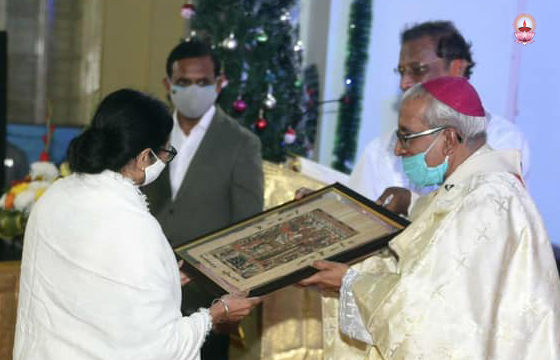
Mamata attends Christmas services at Kolkata Church
West Bengal Chief Minister Mamata Banerjee greeted the people on Christmas after attending services at a church in the city. Banerjee attended Christmas services at the Cathedral of The Most Holy Rosary in Kolkata and interacted with the people.
“The beauty of Bengal is that we celebrate all festivals, spreading peace, joy, and happiness. Christmas festivities have already started every-where in great spirit,” she said. “Merry Christmas to all of you once again,” she added.
Governor Jagdeep Dhan-khar also greeted the people of the state on Christmas. “Let’s spread message of peace and joy and illuminate lives of others,” he said.
The governor said Opposi-tion leader in state assembly Abdul Mannan and minister Firhad Hakim met him at Raj Bhavan separately to greet him on Christmas.
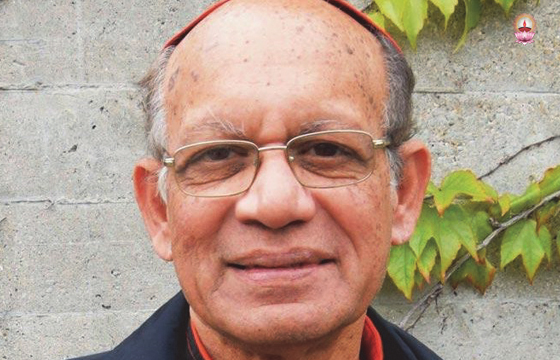
Spread Christmas joy with utmost caution : Bombay archdiocese
With Christmas just over a week away, Arch-bishop of Bombay Cardinal Oswald Gracias on Dece-mber 15 sounded a note of caution, asking churches and parishioners to follow the guidelines in place in view of the pandemic.
Issuing a slew of guidelines and Standard Operating Procedures (SOPs) for churches across the diocese for Christmas, Cardinal Gracias reminded the Council of Deans and the parishioners that Section 144 is still in effect in the city and an assembly of over 200 people is not permitted. Police have made no relaxations in this regard, he added.
“People expect a Mass on Christmas Eve. The government and police have permitted Mass inside the church, however, please stay in touch with your local police station,” wrote Card. Gracias, in a communication addressed to the Council of Deans, parish priests and priests in-charge.
He said “more than one Vigil Mass may be celebrated in our churches” to ensure guidelines on gathering are followed. “Similarly, the number of Masses on Christmas morning can be increased, and we are encouraged to have Mass on Christmas evening, too, for those who cannot come in the morning.”
Indian priest found with throat cut
A senior Catholic priest found on a railway track with his throat cut in Andhra Pradesh State in southern India was buried in his home parish on Dec. 12 even as mystery shrouds his death.
The body of 62-year-old Father Santosh Chepathini, priest of Chinta-kani Parish in Khammam Diocese in Telangana State in southern India, was found close to Vijaywada railway station in Andhra Pradesh early on Dec. 10 by a railway patrol team.
Abp Kalathiparambil appointed member of Vatican congregation
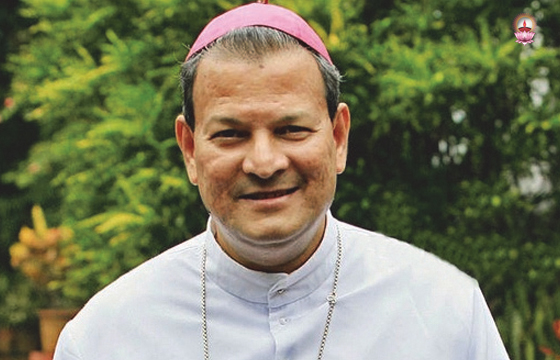
Pope Francis has appointed Arch-bishop Joseph Kalathiparambil of Verapoly as a member of the Congregation for the Evangelisation of Peoples for five years.
This is the second time the 68-year-old Indian prelate joins the congregation. Earlier, he had served the commission for five years from 2011, says a press note from the Conference of Catholic Bishops of India.
Bishop Lyngdoh promoted as Shillong archbishop
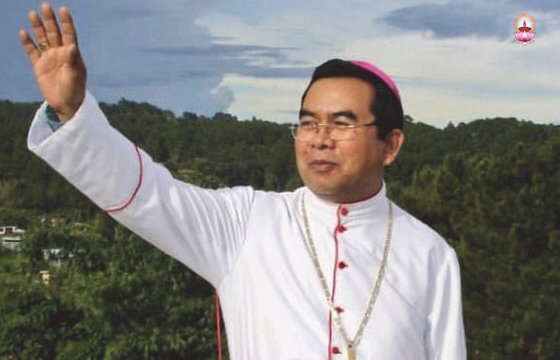
Pope Francis on December 28 promoted Bishop Victor Lyngdoh of Jowai as the archbishop of Shillong in the northeastern State of Meghalaya.
The appointment was made public at noon in Rome, corresponding to 4:30 pm in India.
Shillong archdiocese, the mother diocese of the Catholic Church in north-eastern India, was without a leader after the death of Salesian Archbishop Dominic Jala on October 10, 2019, in a road accident in the United States. Archbishop Jala, 68, was the first prelate from the Khasi tribe, one of prominent ethnic groups in Meghalaya.
BJP increases seats in Kerala local body elections
The Bharatiya Janata Party (BJP) seems to make slow but steady inroads into Kerala, an unassailable bastion for the saffron party so far, results of the recently held local body elections indicate.
Although the BJP failed to perform as expected in the Kerala civic elect-ions, it has significantly improved its 2015 tally, reports the Times of India.
Why is India denying prisoners spectacles and straws?
But in recent weeks, jail authorities in India have been called out for being especially cruel to prisoners, particularly the govern-ment’s critics who are described as “human rights defenders” by international rights groups.
Earlier this month, the Bombay High Court reminded officials of Mumbai’s Taloja jail that they needed to show some “humanity” while dealing with the needs of inmates.
“We need to conduct workshops for jailers. How are such small items denied? These are all human considerations,” Justices SS Shinde and MS Karnik said.
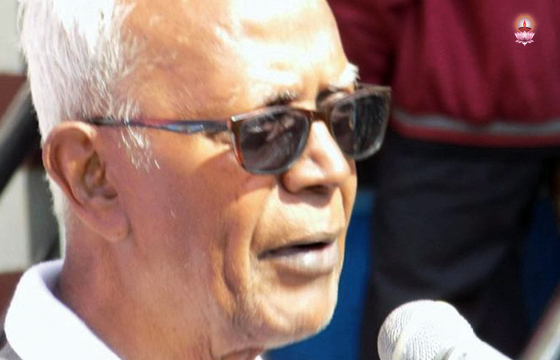
The “small items” here were spectacles that jailed activist Gautam Navlakha had been denied.
The judges’ comment came after his family told the press that his spectacles were stolen in prison and that when they sent a fresh pair, the authorities refused to accept them.
“He was allowed to call me on 30 November, three days after his glasses were stolen. He’s 68, he needs a high-powered lens and without them, he’s nearly blind,” his partner, Sahba Husain, told me.
Since the start of the pandemic in mid-March, India has stopped all visits by family or lawyers to jail. Inmates are not even allowed to receive parcels.
Husain says Navlakha told her that he had spoken to the jail superintendent and had been assured that he would receive his spectacles.
Husain, who lives in Delhi, quickly got a new pair made and posted them on 3 December.
“I checked three-four days later and realized that the parcel had reached the jail on 5 December, but had been refused and returned.”
It was only after the judges read out a lesson in “humanity,” and subsequent outrage on social media that jail authorities provided a new set of spectacles to Mr Navlakha.
A former secretary of the non-governmental organisation People’s Union for Democratic Rights, Navlakha is no ordinary prisoner. He’s spent a lifetime working for civil liberties and is respected globally.
He’s been in jail since the middle of April in connection with what is known as the Bhima Koregaon case.
He’s among 16 activists, poets and lawyers who have been arrested over the past two years on charges of instigating caste violence at a Dalit rally in Bhima Koregaon village in the western State of Maharashtra on 1 January 2018. They all deny the charges against them.