
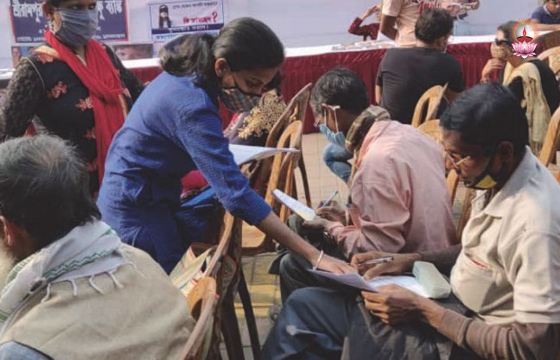
A post card campaign was launched on December 10, the human rights day, to seek the release of Jesuit Father Stan Swamy and those allegedly accused falsely in the Bhima Koregaon case
Under the campaign, the “Friends of Fr Stan Swamy” planned to send as many as 100,000 post cards to India’s Prime Minister and home minister demanding the immediate release of the 83-year-old Jesuit and others imprisoned in the case. The campaign also wants the draconian Unlawful Activities Prohibition Act (UAPA).
In Kolkata, eminent human right activist Sujato Bhadra opened the campaign by signing the first post card at Ranu Chayya Manch, near the historic Victoria Memorial. Before signing the card, Bhadra explained how the UAPA has been abused for vested interests.
He was accompanied by Kriti Roy, secretary of Banglar Manabadhikar Suraksha Mancha (MASUM, Bengal human rights protection front), the organizer of the event in Kolkata.
Jesuit human right activist Father Irudaya Jothi, one of the coordinators of the campaign, explained the reasons for the nationwide program and how it was planned nationally.
Father Jothi welcomed the Jesuit collaborators, teachers, students, parents and alumni of the hundreds of the Jesuit educational institutions who have joined the campaign.
The Jesuit food right activist in West Bengal expressed the hope all who value human rights would join the campaign transcending religion, caste, creed, gender and ethnicity.
Daily Archives: December 16, 2020
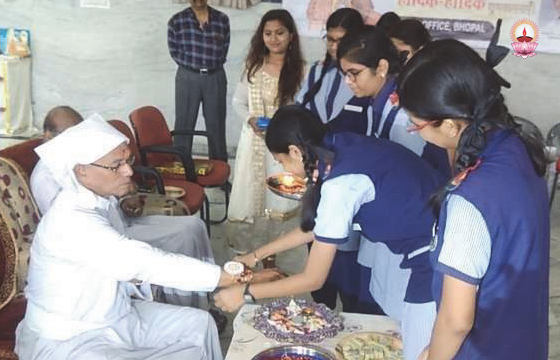
Indian state to criminalize interfaith marriages involving conversion
A Catholic leader in India’s Madhya Pradesh State sees a political ploy in a government move to criminalize interfai-th marriages that involve reli-gious conversion.
Archbishop Leo Cornelio of Bhopal, based in the state capital, said the state government’s proposal aims to appease the majority Hindu community rather than address any real issue.
Leaders of the pro-Hindu Bharatiya Janata Party (BJP), which runs the state government, said that during the legislative session starting in December they plan to make legal provisions to stop Hindus from becoming Muslims and Christians for marriage.
State chief minister Shivraj Singh Chouhan accused Christian missionaries of converting indigenous people while addressing gatherings in Umaria and Barwani districts, which are dominated by indigenous people.
He also advised missionaries not to offer their services in the hope of converting beneficiaries to their faith.
Madhya Pradesh is among states with strict laws to check religious conver-sion through allurement or force as punishable offenses. The law, ironically named the Freedom of Religion act, was enacted in the state in 1967.
The government has not yet released the bill’s draft to reveal the quantum of punishment and other details. It is also unclear if the government plans to amend the Freedom of Religion Act or to enact a separate law.
Rameshwar Sharma, the state assembly’s speaker, said the government plans to scrap quota benefits meant for women of lower castes or tribal people if they changed their religion and married Muslims or Christians, media reports said.
Archbishop Cornelio told UCA News on Nov. 30 that the Catholic Church is not involved in conversion “through force or allurement” and it “was wrong to paint” the Church’s charitable work as a facade for conversion.
“If the allegation was true, the Christian population would be much more than what it is today,” he asserted.
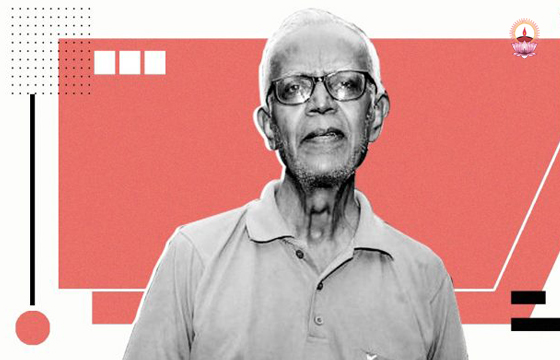
Stan Swamy given straw, sipper by jail authorities
The advocate of activist Father Stan Swamy, an accused in the Elgar Parishad-Maoist links case, on December 4 told a special court that Swamy has been given a straw and sipper by the Taloja jail authorities. Swamy, 83, on December 4 filed three fresh applications seeking a direction to the National Investigation Agency (NIA) to return his bag (seized by it at the time of his arrest), a clone copy of his hard disk (seized by it) and a direction to not transfer him from Taloja jail. Swamy claimed that he apprehends that he would be transferred from the Taloja prison near here in Navi Mumbai.
After the court rejected his bail application on health ground on Oct. 23, the elderly priest suffering from Parkinson’s disease on Nov. 26 filed a petition seeking regular bail. The court posted the application for Dec. 4 while seeking a response from the NIA.
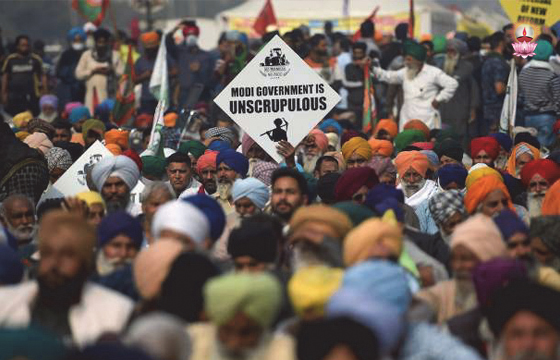
Kerala bishops back Indian farmers’ protest
As negotiations failed to end the week-long protest by Indian farmers in New Delhi, more than 40 Catholic bishops in Kerala have sought government action to address the farmers’ plight.
Federal agriculture minister Narendra Singh Tomar led the government team in negotiations lasting more than seven hours with 40 leaders of farmer unions on Dec. 3. Although talks failed, the teams are meeting again on Dec. 5.
“Millions of families of farmers in the country are worried about their future because of the new farm laws,” said Card. George Alencherry after a three-day session of Kerala Catholic Bishops’ Council attended by 42 bishops in the southern state.
Thousands of farmers, mostly from Punjab and Haryana States, have been protesting in the national capital since Nov. 29 to demand the repeal of what they termed as three anti-farmer laws.
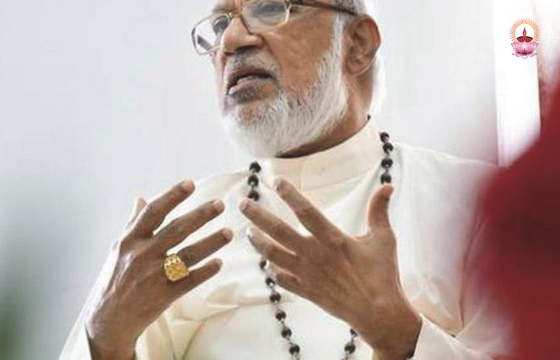
Give what’s due to all communities: Cardinal Alencherry
Cardinal George Alenche-rry, head of the Syro-Malabar Church, says India is going through a period of transformation in the democratic practice and the balance of power between major political fronts, essential to a democracy, has been lost.
But he is sanguine about pluralistic forces asserting themselves in a bid to cement the unity of the country through its diversity in the no-so-distant future. “India is a diverse country, but hardly any Indian would not like to be identified as one. Therefore, I am sure that the politically intelligent people will find ways and means to surmount this crisis. The pluralistic forces have to assert themselves to keep India’s democracy and that’s already emerging,” Card. Alencherry said in a free-wheeling chat with The Hindu on the prevailing sociopolitical climate.
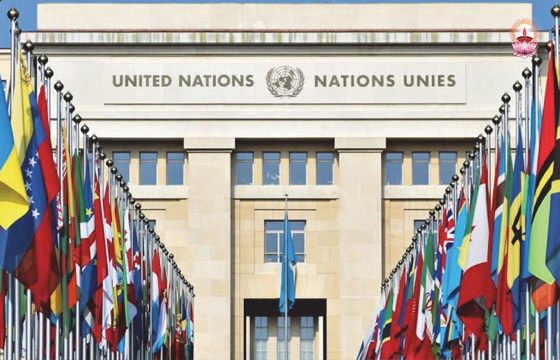
People have a right to demonstrate peacefully: UN
“People have a right to demonstrate peacefully and authorities need to let them do so,” said Stephane Dujarric, Spokesperson for the Secretary General of the United Nations on December 5, on being asked about the farmers’ movement that has continued despite talks with the Government of India.
The comment is the latest addition to a show of support for farmers who have been protesting in the outskirts of the national capital for the last ten days. The remark from the U.N. comes a day after the Ministry of External Affairs (MEA) described Canadian Prime Minister Justin Tru-deau’s support to the protest as “unacceptable interference.”
The comment from the United Nations came even as 36 British Members of Parliament sent a joint letter to U.K. Foreign Secretary Dominic Raab, calling upon him to bring up the concerns of British citizens over the protests in Punjab and in the outskirts of Delhi. In a two page letter, Tanmanjeet Dhesi, Member of Parliament for Slough, expressed concern about the well-being of the protesting farmers and said, “…These new laws (in India) present the Punjabis with a huge problem, with some describing it as a ‘death warrant’.”
Promoter of Christian-Muslim relations remembered
Colleagues and friends of Ataullah Siddiqui have recalled the UK-based Islamic scholar’s contributions to the promotion of Christian-Muslim relations. They shared their experience with Siddiqui at an online event organized by the Delhi-based Islamic Studies Association on November 29.
Siddiqui died on November 9 of cancer at Birmingham in the United Kingdom. He was 66. The online program began with a recitation from the Qur’an and a reading from the Bible.

Patna gets new archbishop
Pope Francis on November 9 accepted the resignation of Jesuit Archbishop William D’Souza of Patna.
This led to the automatic elevation of Coadjutor Archbishop Sebastian Kallupura as Patna’s metropolitan archbishop.
This was made public at 4:30 pm in India, says a press release from the Conference of Catholic Bishops of India (CCBI), the national body of the Latin rite bishops in the country.
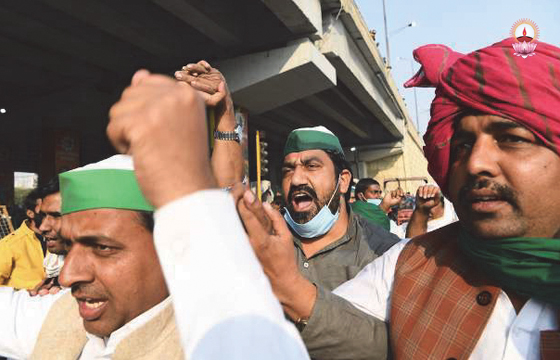
Church supports Indian farmers’ struggle against lopsided laws
Catholic Church leaders have pledged solidarity with thousands of Indian farmers who are protesting on the borders of New Delhi demand-ing the repeal of three controversial farm laws enacted two months ago.
Thousands of farmers from Punjab have blocked entry and exit points to New Delhi after police stopped their march to the national capital. Farmer unions on Nov. 29 threatened to block all roads to New Delhi if they were not allowed to demonstrate on a public ground within the city.
They want the federal government of Prime Minister Narendra Modi to unconditionally withdraw the laws enacted on Sept.20 as part of farm reforms.
“These laws are not meant for the welfare of the farmers, and if they are implemented in the current form, it will be disastrous for the small and medium-level farmers,” said Bishop Alex Vadakumthala, chair of the Indian bishops’ commission for labour.
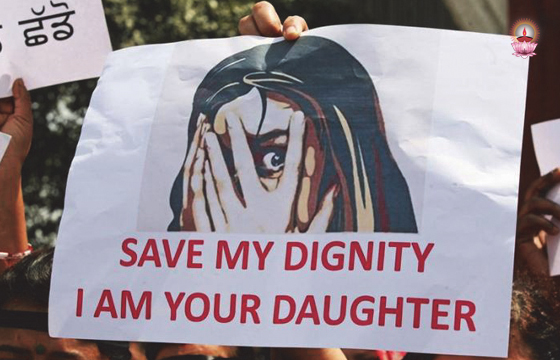
6-year-old Dalit child raped and murdered in magic ritual
A 6-year-old Dalit girl has been found dead in Kampur (Uttar Pradesh). The little girl had disappeared on the eve of the Deepavali festival (last November 15) from the Ghatampur area. She was found with signs of torture, rape, with an open ribcage and stolen lungs. Police say the little girl’s lungs were removed to perform some magical rituals, with the belief that this could help a woman give birth to a son. The suspects – Ankul Kuril, 20, and Beeran, 31, were arrested and confessed to giving the victim’s lungs to Parshuram Kuril to perform the ritual. The latter’s wife was also arrested because, despite knowing about the murder, she said nothing to anyone.
India is considered one of the country’s most at risk for women. According to official statistics, there is one rape every 15 minutes. In 2019, crimes against women grew by 7.9% compared to the previous year. But it is above all little girls who fall victim.
On November 16, also in Uttar Pradesh, in the district of Fatehpur, the bodies of two Dalit sisters aged 8 and 12 were found in a pond. Their family claims that their daughters went to the fields in the afternoon to pick vegetables, but they never came back. They were killed after a failed rape attempt. Both bodies have eye wound marks.
“These unspeakable attacks on girls have become a ‘chronic disease’,” says Msgr. Felix Machado, Secretary General of the Indian Bishops. “Our girls – he continues – are the most vulnerable in society and our Dalit girls are the most exploited and weakest in society and these violations are extremely worri-some. This is a Spiritual failure.”