
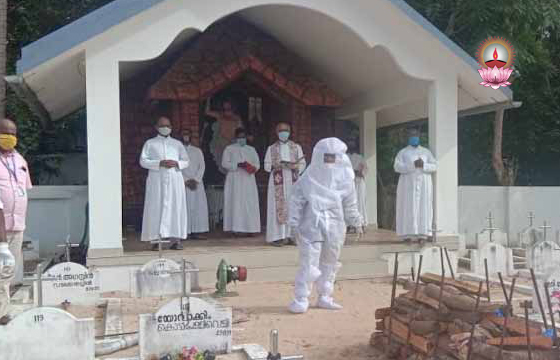
A funeral pyre in a Catholic cemetery is usually unimaginable in India, where Christians prefer burial to dispose of the bodies of their community members.
Contrary to this belief and centuries-old practice, a Catholic diocese in southern India has decided to cremate Covid-19 victims in parish cemeteries, indirectly adopting a Hindu way of disposing of the bodies of the dead. Thresiamma Sebastian, 62, a parishioner of St Augustine Church in Mararikulum village in the Diocese of Alleppey in Kerala State, became the first local Catholic to have a dignified cremation in a parish cemetery. The parish priest and Catholic volunteers, helped by an outsourcing agency, prepared her funeral pyre with firewood and placed her body on it in the July 27 cremation. Health officials monitored the entire process. Her body was reduced to ashes within two hours and her ashes were collected in an earthen pot and buried in her family tomb in the presence of one of her family members on the same day.
The Latin-rite Diocese of Alleppey is mostly based on the coast and most of its parishes face the same situation.
Daily Archives: August 15, 2020
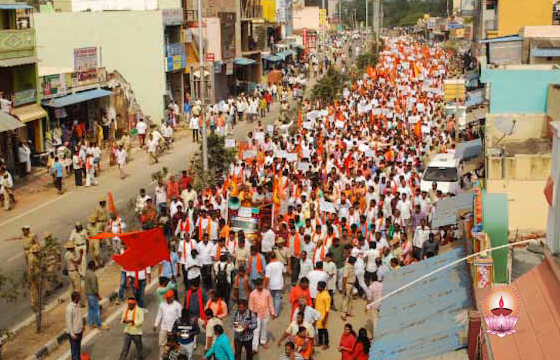
Anti-Christian violence on the rise in India
Two women were raped and killed among six Christians murdered for their faith in India in the first half of this year, according to a newly released report.
Three others — two Christian women and a 10-year-old girl — were raped for their refusal to give up their new faith, said the half-yearly report released on July 28 by Persecution Relief, a Christian group.
Persecution Relief, an ecumenical body that records Christians’ persecution in India, said its data shows “a very grim picture” of religious freedom in Hindu-majority India. “Hate crimes against Christians in India have risen by an alarming 40.87 percent despite a nationwide lockdown in place since March 25 in the country,” the report stated.
Between January and June, India witnessed 293 cases of hate crimes against Christians, including five rapes and six murders.
“Persecution against Christians has become very common,” said Shibu Thomas, who founded Persecution Relief, which assists Christians in distress, especially widows and orphans of those killed for their faith.
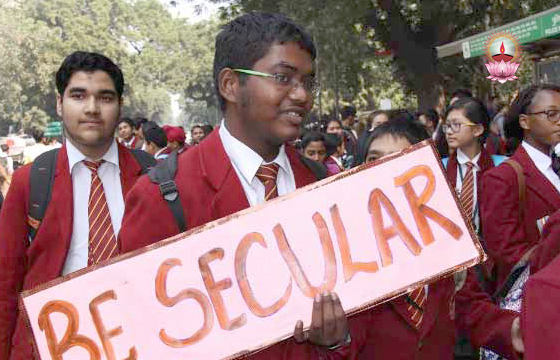
Dismay at removal of religious figures from Karnataka syllabus
Church and political leaders in India’s southern State of Karnataka have expressed dismay over the state removing chapters on Jesus Christ and the Prophet Muhammad from the school syllabus. The state run by the pro-Hindu Bharatiya Janata Party (BJP) has also removed chapters on prominent leaders like Tipu Sultan and Hyder Ali who once ruled the state.
“It is very sad to know that our children who are the future of this country will miss important subjects such as Christianity and Islam and their contribution to building brotherhood among all humanity,” Archbishop Peter Machado of Bangalore told.
“India is known for unity in diversity around the world. The respect and communal harmony among us is the best example in this world and if that subject in disturbed we will lose the secular India which we all are proud of.
“What India can give to this world is the uniqueness of our communal harmony, but depriving our children of this subject is an injustice to our children. We should teach them about brotherhood and communal harmony, which all religions teach.”
Archbishop Machado said the government is interfering with the constitution’s secular values and urged the state government “to take its decision back, if possible.”

Northern Indian bishops to launch migrant resource centres
Catholic dioceses in northern India plan to set up centres to help migrant labourers.
This was decided on August 7 during a virtual meeting organized by the Commission for Migrants under the Regional Bishops’ Council of the North (RBCN) in collaboration with its counterpart under the Conference of Catholic Bishops’ of India (CCBI).
The diocesan migrant resource centres along with helpline services to migrant workers will be prepared in collaboration with various CCBI commissions and coordinated by the conference’s secretariat based in Bengaluru.
The various commissions of CCBI will prepare a concept note on data collection, besides setting up the centres and launching helpline services to migrant workers.
The purpose of the centre is to collect data on migrants and make its services accessible and available to them. The concept note prepared at the online meeting has specified the quality of the data.
Other plans include engaging the migrants into mainstream society and encourage them to join the Church’s spiritual and welfare programs. It will also link them with the Church’s educational and healthcare insti-tutions that would accommodate and serve the migrants.
The migrant commission is to network with dioceses, reli-gious congregations, lay associa-tions and government for an integrated approach.

Funeral regulations aim to split Chinese Catholics
The Diocese of Shanghai on July 27 issued a circular saying that Catholic priests who officiate funeral prayers at the city’s Longhua Funeral Parlour should produce their identity cards to prove they are state-recognized priests. Across the globe, a Catholic priest’s approval comes from the Church and its Sacrament of Holy Orders. But in China Catholics face an absurd situation. The recognition of priests come from the state administration that functions under the atheistic communist party.
Members of the underground church, who do not submit themselves to the state administration, are not eligible to use the Shanghai funeral parlour because their priests cannot enter it. But if some among them insist on using the parlour, they will have to seek the help of a priest from the state-approved open church.
For many who are unfamiliar with communist machinations, it is a simple issue of limited funeral options. They would say the underground Catholics can use other funeral parlours in the city or have funeral prayers at home. “What is the big deal?” they might ask.
However, it not easy for an underground priest to conduct funeral prayers in a Chinese home. Several regulations and restrictions prevent them from holding prayer rituals in the homes of Catholics openly and honestly. It deprives the deceased of their right to have a decent funeral and burial or cremation.
The notice is even more devastating from another point of view. It has stirred up the conflict between the underground and open Catholic communities in the diocese. The notice came from state-approved diocesan officials, and naturally the underground community is upset by it. But those who are angry about it are falling into the trap of the government.
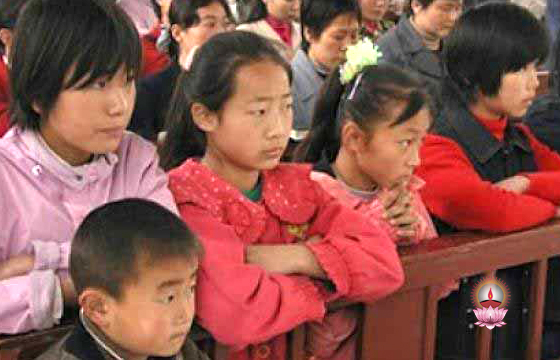
Sino-Vatican deal two years later: Priest calls on Holy Father ‘not to renew the Agreement’
“I call on the Holy Father not to renew the Agreement with China, because this could thre-aten the survival of the Church in China, driving us onto the path of despair,” writes Benedict, an underground Catholic in northern China. He and Fr John, a priest in northern China, have added their voices to AsiaNews‘s investigation into the situation of the Church in China a few months before the provisional agreement between China and the Holy See comes to an end.
Benedict’s bitter cry is complemented by the clergyman’s sober thoughts. The latter says he understands the motive behind the pontiff’s move, which is to show mercy towards the priests and bishops in the official Church, who are caught between the need to show obedience to the regime and their allegiance to the Church.
Two other elements emerge from these two stories. The first one is that the state’s repression against the Church is directed towards other religions as well, in particular Protestants. The second is that the crackdown is not uniformly applied across this vast country. Fr John notes that government officials, following their conscience, have protected the freedom of some communities, at their own risk and peril.
“In my opinion, Sino-Vatican talks and negotiations reflect the Pope’s concern and care for the Church in China. He has tried every way possible to break the chains that tie our bodies and hearts. For some, this makes sense because they no longer have to endure the problems of [legal or illegal] consecration or sacramental communion caused by China.”
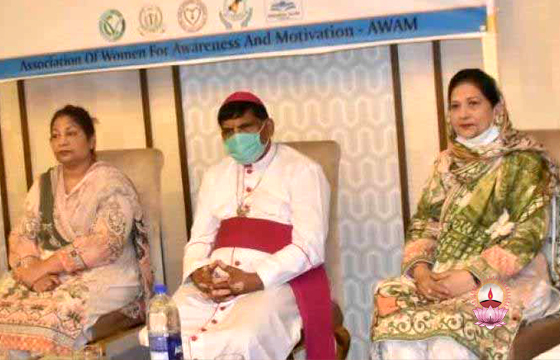
Bp of Faisalabad: Unjust laws and policies do not ensure equality in the country
A conference on ‘Collective efforts for advancing diversities’ was held, eve of Pakistan’s Mi-norities Day.
A number of speakers representing religious and civil society groups addressed the ga-thering. One of them was Bishop Indrias Rehmat of Faisalabad who said that “disparities of rights in policies and laws can never ensure equality of status and treatment.”
For the prelate and the other participants, the government has failed to take seriously the pro-blems minorities face, noting that quotas for minorities are a futile attempt to ensure political, reli-gious, social and economic equa-lity if they do not have proper enforcement mechanisms.
According to various sources, Ahmadis, Christians, Hindus, Sikhs and Shias are the most discriminated in Pakistan, a country of 212 million inhabi-tants, in which ethnic Punjabis and Sunni Muslims are the largest groups.
Catholics and Protestants number around 2 million each (just under 1 per cent of the popu-lation respectively).
Rizwan Ullah Kokab, who teaches history at the Government College University, points out that Pakistan is a land of many religions and different cultures. For this reason, the authorities’ “ethnocentric” approach is not useful to the cause of national unity.
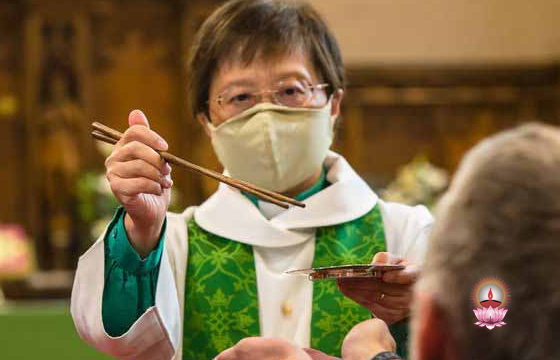
Anglican priest uses chopsticks to distribute communion
A Church of England vicar has tapped in to her Chinese cultural heritage and is using chopsticks to give bread to parishioners during Holy Communion.
The Rev Eileen Harrop took the unusual approach to the challenge faced by clergy who are reopening churches for public worship while sticking to Covid-19 safety protocols. The vicar of St Mary’s in Gainford and St Andrew’s in Winston, County Durham in North East England, decided that the best way to administer the bread at the Eucharist was to use extra-long serving chopsticks.
She has Chinese heritage, grew up in Singapore and has an enduring love of Asian cuisine, so felt confident in using the utensils for the sacred act and has now carried out services using them at both churches she serves.
Rev Harrop said: “Many of my parishioners were quite anxious at the thought of taking communion, even though we are only permitted to do so under strict guidelines to ensure that there is no chance of transmission of the virus.
I thought ‘Why can’t I use a long pair of chopsticks, real bread rather than wafers, and drop it into the communicants’ hands?”
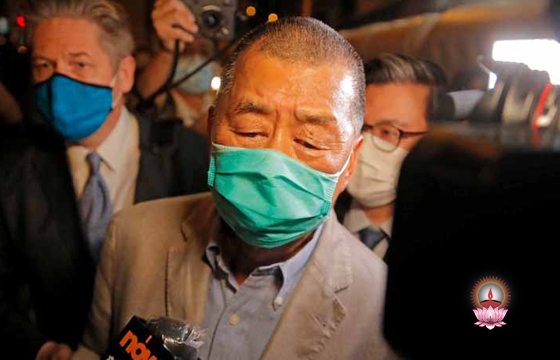
Catholic Hong Kong media tycoon’s arrest sparks fear Church could be next
Earlier prominent Catholic millionaire and media tycoon Jimmy Lai was arrested in Hong Kong along with two of his sons and two executives of his Next Media company on charges of collusion with foreign forces and conspiracy to defraud under China’s new national security law. The three were released on bail late on August 10 night and Lai was cheered as he walked into the offices of his Apple Daily paper.
Lai, 72, made his initial fortune through the fashion chain Giordano before investing his money into media organizations, Next Media and Apple Daily, Hong Kong’s most notorious anti-Beijing paper.
A Catholic, Lai is also a known supporter of prominent Catholic personalities in Hong Kong who have been outspoken in criticizing China over the new law, which went into effect June 30, as well as human rights abuses and limits to religious freedom, prompting speculation that these people could be next on Beijing’s blacklist.
One of the prominent figures Lai has supported is Cardinal Joseph Zen, bishop emeritus of Hong Kong.
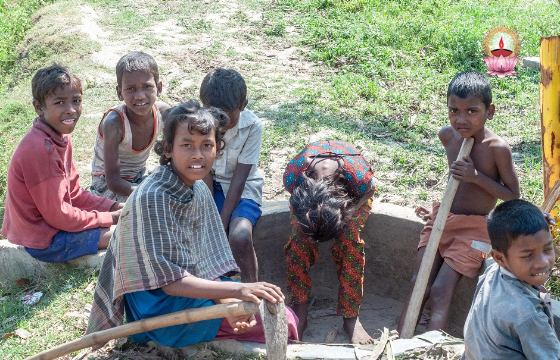
Church seeks rights for indigenous Bangladeshis
A Catholic official and activists have called for equal rights and justice for indigenous people in Bangladesh as millions of ethnic minorities marked UN-designated International Day for World’s Indigenous Peoples on August 9. They urged the government to ensure the basic constitutional rights of ethnic communities including recognition as Adivasi (indigenous peoples) and equal rights to food, employment, education in their mother language, healthcare and justice for abuse including torture, killing and sexual harassment.