Germany’s synodal assembly draws praise, criticism from participants

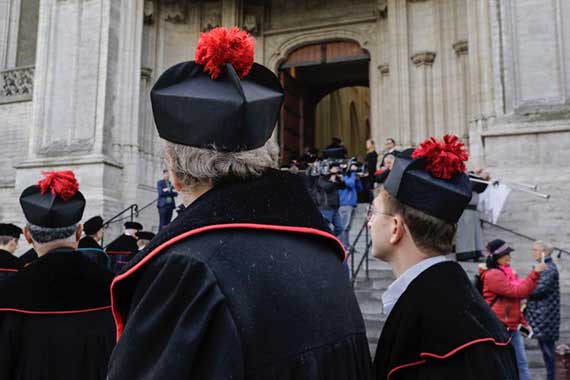
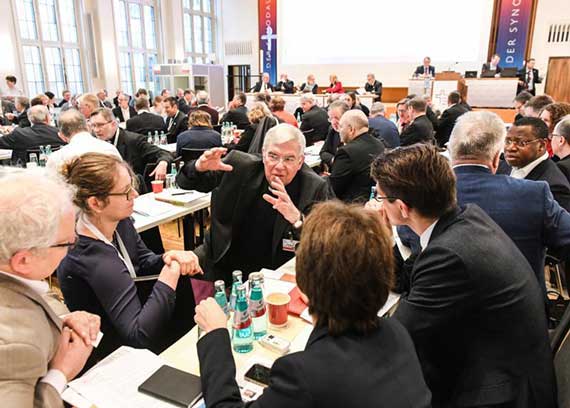
The first Synodal Assembly on the future of the Catholic Church in Germany drew both praise and some criticism, with many of the 230 participants lauding what they called a special atmosphere in the debates on key reforms. Cardinal Reinhard Marx, president of the German bishops’ conference, said the spirit of the talks had been “positive and encouraging” and referred to the synodal path process as a “spiritual experiment,” reported the German Catholic news agency KNA.

Thomas Sternberg, president of the Central Committee of German Catholics, which represents laypeople, said: “No one is disputing the other’s piety here.” A “new image of the Church” had been seen in the Frankfurt talks, he said.

But there was criticism too, particularly from Cologne Cardinal Rainer Maria Woelki, who said: “All my fears were confirmed, actually.” He said the synodal path had installed a form of Protestant Church parliament, and delegates who were skeptical of the reform process had found it comparatively difficult to have their say.

In an interview with KNA, the cardinal also said the talks had been marred by theological shortcomings.

“My impression is that much of what belongs to theological doctrine is no longer shared here with us, and instead one believes that one can shape the Church in a completely new and different way,” he said. Many arguments presented had not been compatible with the faith and teaching of the universal Church, he added.

The Synodal Assembly is the highest decision-making body of the synodal path, an effort by the bishops’ conference and Central Committee of German Catholics to restore trust following a September 2018 church-commissioned report that detailed thousands of cases of sexual abuse by Catholic clergy over six decades. Catholic observers from eight neighbouring countries as well as delegates from other denominations and churches monitored the Synodal Assembly in Frankfurt on Jan. 30-Feb. 1.

Letter from Rome: The shadow pontificate is drawing to a close

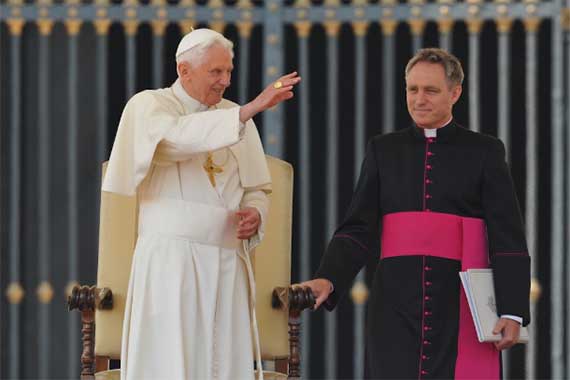
It was only a matter of time. Pope Francis has finally lost his patience and gotten rid of Arch-bishop Georg Ganswein as prefect of the Papal Household.
According to German weekly Die Tagespost, the Pope put the 63-year-old on “indefinite administrative leave.”

He did so, the paper said, because of the German prefect’s involvement in a controversial book that Benedict XVI co-authored with Cardinal Robert Sarah. It was a slim volume that most people saw as a warning to Francis that he dare not even consider allowing the ordination of married priests.

Ganswein, who lives with Benedict and is his long-time personal secretary, was seen – rightly or wrongly – as the man ultimately responsible for dragging the retired Pope into the book project.

Forum examines religious persecution 75 years after Auschwitz liberation

As the world recognizes the 75th anniversary of the liberation of the Nazis’ infamous Auschwitz concentration camp, the vows of “never again” after the Holocaust’s horrors became known threaten to be swallowed up by religious persecution against Christians, Muslims and other groups, said panellists at a Feb. 5 forum at the U.S. Holocaust Memorial Museum.

“The unthinkable is possible, and everyone must act,” said Naomi Kikoler, director of the museum’s Simon-Skjodt Centre for the Prevention of Genocide and panel moderator.

Omer Kanat, chairman of the World Uyghur Congress’s executive committee, said the crisis for Uighur Muslims began in 2017 as China’s crackdown on the minority ethnic group intensified, calling the “eradication of Uighur culture” an “extermination.”

There are 1.8 million to 3 million Uighurs in “concentration camps,” Kanat said. “The statements of government officials are going in this direction: ‘We cannot sustain the weeds among the crops. We have to spray a chemical, and kill all of them.’” He added not only are Uighurs within China traumatized by the ongoing repression, but Uighurs living outside China are despondent over “their inability to help their family back home.”

Belgian Catholic universities to help train imams

Belgium’s Catholic universities of Leuven and Louvain will begin educating imams this year in six-year programs that aim to transmit “knowledge of the fundamental values of the Belgian State and the resulting legal principles.”

Courses in Dutch will begin in Leuven in February and in French at Louvain in the autumn. Once one bilingual university, they split into two institutions along language lines in 1968. The goal, worked out by an official commission launched after Islamist attacks in Brussels in 2016, is to provide a university-level education in Belgium for imams, who will then be registered as clergy and paid by the state as are clerics from other religions.

Another aim is to reduce the influence of Middle Eastern countries, which now send imams to serve their ethnic groups in Belgium or offer western Muslims an Islamic education. Belgian officials suspect both to be a potential source of radical ideas.

The courses in law, politics, sociology of religion and history of the Muslim world have been worked out with the Muslim Executive of Belgium, the official Muslim interlocutor.

The Muslim partner will arrange Islamic theological studies in a separate academy run by Muslims. Catholic theology will not be part of either university’s course. “In every recognised mosque, there should be someone who has attended this training,” said Justice Minister Koen Geens. “The real purpose must be to have preaching by people educated in Belgium.”

France has a similar programme, with the Catholic Institute of Paris giving courses in the secular subjects and Muslim theology taught at the city’s Grand Mosque.
German efforts to train imams have been complicated by opposition from Turkish-financed mosques but state universities offer degrees in Islamic studies that qualify Muslims to teach Islam in religion classes in state schools.

Archbishop bans receiving host in the hand

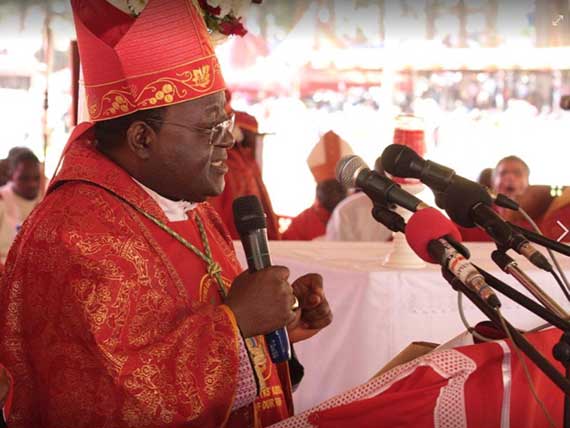
A Catholic Archbishop in Uganda has decreed that Holy Communion can in future be received only by mouth, and not in the hand. The conservative Archbishop of Kampala, the Most Rev Cyprian Kizito Lwanga, said this was because of “many reported instances of dishonouring the Eucharist that have been associated with reception of the Eucharist in the hands.” In addition, he said that those in “illicit marital co-habitation and those who persist in any grave and manifest sin” cannot be admitted to communion at all.

And in the same letter, released on 1 February and headlined: “Decree concerning the proper celebration of the Eucharist in Kampala Arch-diocese,” he said that Mass can no longer be celebrated in people’s houses or other “non-sacred places” unless “grave necessity” requires other-wise. He also stipulates that any priest who is not vested properly must sit with the laity and not the clergy.

In addition, lay people are no longer to be allowed to distribute, unless specifically designated an extraordinary minister of communion. “In celebrating and ad-ministering the Eucharist, priests and deacons are to wear the sacred Vestments prescribed by the rubrics (Can. 929). Following this canonical norm, it is strictly forbidden to admit as a co-celebrant, any priest who is not properly vested in the prescribed liturgical vestments. Such a priest should neither concelebrate nor assist at the distribution of Holy Communion. He should also not sit in the sanctuary but rather take his seat among the faithful in the congregation. Archbishop Lwanga issued the decree after meeting clergy and senior executive committees of parishes at Rubaga Cathedral in Kampala, Uganda’s PML Daily reported.

Pope’s top aides say door still open on married priests, women deacons

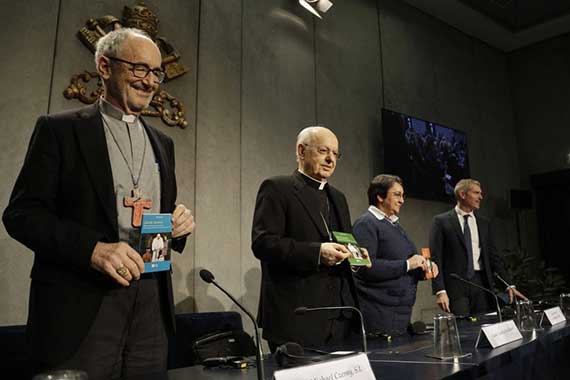
Although Pope Francis’s highly anticipated document on the Amazon bypasses the hot-button issues of women deacons and married priests, a number of the Pope’s close advisors have said the door is not definitively closed on either front. In his post-synodal apostolic exhortation, Querida Amazonia (Beloved Amazon), Pope Francis appears to leave the question of married priests open-ended, giving neither a clear yes or no.

Instead, he suggests a better distribution of priests in the Amazon and encourages missionary priests in the region to go to more rural areas, while also stressing the need for a priestly formation which better understands and appreciates local cultural traditions. Francis also skipped over the issue of women deacons, warning only against the temptation to “clericalize” women rather than empowering them through leading community roles which better “reflects their womanhood.” In comments to the press, Canadian Michael Czerny said the best way of looking at the Pope’s approach to married priests in the document, given that the October 2019 Synod on the Amazon proposed the ordination of Viri Probati, or tested married men, is that it is “part of a journey.”

“We are at a very important point in the synodal process. There are long roads ahead, as well as roads already traveled,” he said, and on the question of married priests, Francis “has not resolved them in any way beyond he has said in the exhortation.”

Pope shares with U.S. bishops his frustration with reaction to Amazon text

Pope Francis told a group of U.S. bishops that, like them, he is accused of not being courageous or not listening to the Holy Spirit when he says or does some-thing someone disagrees with – like not mentioning married priests in his document on the Amazon.

“You could see his consternation when he said that for some people it was all about celibacy and not about the Amazon,” said Bishop William A. Wack of Pensacola-Tallahassee.

“He said some people say he is not courageous because he didn’t listen to the Spirit,” the bishop told Catholic News Service on Feb. 13. “He said, ‘So they’re not mad at the Spirit. They’re mad at me down here,’” as if they assume the Holy Spirit agreed with them.

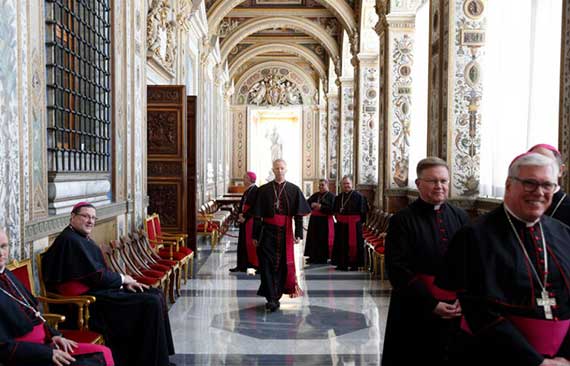
Bishop Wack was one of 15 bishops from Florida, Georgia, North Carolina and South Carolina who spent close to three hours with Pope Francis on Feb. 13 as part of their “ad limina” visits to the Vatican. They were joined by two from Arizona – Bishop Edward J. Weisenburger of Tucson and Auxiliary Bishop Eduardo A. Nevares of Phoenix – who had been unable to meet the Pope with their group Feb. 10.

Middle East patriarchs discuss plight of Christian minorities with Pope Francis

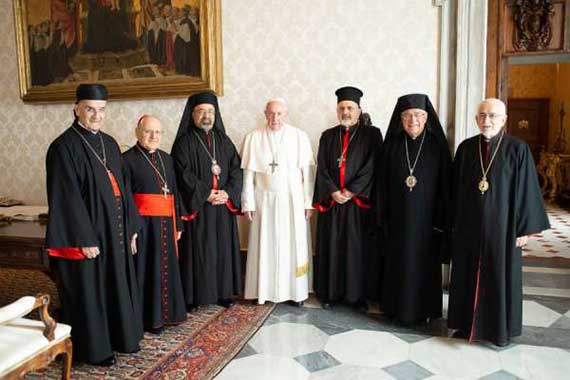
Six Catholic patriarchs from Lebanon, Syria, Egypt, and Iraq met with Pope Francis at the Vatican on Feb 7, 2020 to discuss the difficulties faced by Christians in the region and their mass emigration. In the morning of Feb. 7, the Pope met Cardinal Louis Raphael Sako, Chaldean Patriarch of Babylon; Cardinal Bechara Boutros Rai, Maronite Patriarch of Antioch; Coptic Patriarch Ibrahim Isaac Sedrak of Alexandria; Melkite Patriarch Youssef Absi of Antioch; Armenian Patriarch Gregoire Pierre XX Ghabroyan of Cilicia; and Syriac Patriarch Ignatius Youssef III Younan of Antioch.

Patriarch Younan told CNA that the patriarchs requested the meeting with Pope Francis because of the “dramatic situation of the Middle East in general, whether in Syria, Iraq, Lebanon” and because of the “migratory flux” of the Christian minorities from their homelands.

It is a “a threat to our survival,” he said, explaining that they are struggling to provide proper spiritual assistance to their faithful in other parts of the world, especially Western Europe.

Russian Church plans to end blessing nukes

The Russian Orthodox Church has proposed a stop to the practice of having priests bless weapons of mass destruction, though sprinkling holy water on planes and ships is still deemed appropriate.

The Church on February 3 published a draft document out-lining its role in blessing Orthodox Christians who “protect the Fatherland” and “carry out their military duty,” inviting internet users to discuss the proposal online.

Russians often ask priests to bless anything from new cars and flats to Soyuz spaceships in the belief that the gesture bestows divine protection.

Since the fall of the Soviet Union, priests have also begun blessing troops, planes and ships, and all sorts of weapons, from Kalashnikov rifles to nuclear-capable Iskander ballistic missiles.

But the document proposed that “blessing any type of weapons the usage of which can inflict an indefinite number of deaths, including weapons with indiscriminate effects or weapons of mass destruction… be removed from pastoral practice.”

At the same time, it remains “appropriate” to “bless transport used by soldiers on land, water and in the air,” to ask God to protect the men using them, it said.

Bishop in India ‘categorically denies the false allegations of forced conversion’

An archbishop in India is denying the accusations of a Hindu nationalist organization that “forced conversions” are taking place in the northern State of Uttar Pradesh.

The Vishwa Hindu Parishad (VHP) – meaning Universal Hindu Council – announced it had identified 30 places in eastern Uttar Pradesh where alleged “forced conversions” by Christian missionaries are taking place.

“I deny this report, that forced conversion is taking place in Uttar Pradesh or anywhere in India. Any conversion is voluntary, and everyone has the freedom to follow the religion of his own choice,” Bishop Gerald John Mathias of Lucknow told Crux.

Uttar Pradesh is the most populous State in India, with nearly 200 million people. However, only about 350,000 Christians live in the state, a miniscule 0.18 percent of the population. By comparison, Christians make up nearly 2.5 percent of the whole of India’s population.

Uttar Pradesh, like the national government, is run by the Bharatiya Janata Party (BJP), with strong links to the Rashtriya Swayamsevak Sangh (RSS), a militant Hindu nationalist organization.

The VHP is also one of the many organizations affiliated with the RSS.

Hindu nationalists often accuse Christians of using forceful and surreptitious tactics in pursuing conversions. They then storm into villages and lead “reconversion” ceremonies – called Ghar Vapsi, or “back to home” – in which Christians are compelled to perform Hindu rituals.

Mathias told Crux that “forcing people with organised Ghar Vapsi programs are forced conversion, and this must be stopped.”

In November, Uttar Pradesh proposed an anti-conversion law, imitating several other states in India. Christians say such laws violate India’s secular constitution, which guarantees freedom of religion.

“Christians in India have constitutional guarantees to practice our faith, share the Good News and the message of Christ, which is for all humanity. This is not conversion nor is anyone forced,” Mathias said.

“I categorically deny the false allegations of forced conversion.”