Church fights changes to Hong Kong’s extradition law

The Hong Kong government’s determination to pass a bill amending its controversial extradition law has compelled Christian communities to express their concern in a series of statements. Officially known as the Fugitive Offenders and Mutual Legal Assistance in Criminal Matters Ordinance, the law would allow people from the former British colony to be sent to mainland China to face trial. Secretary for Security John Lee Kachiu told reporters on May 20 that because the pro-democratic bloc and pro-government camp failed to cooperate on the matter, the bill would be submitted to the Legislature Council’s general assembly for a second reading on June 12.

There was hope of a compromise at a recent meeting of the Legislature Council’s Bills Committee, which was set up recently, but the ultimate result was a stalemate.

The Concern Group of Pastors, Hong Kong Christian Council (HKCC) and other Christian communities responded by urging Christians to pray for a speedy resolution.

The former recently collected 3,000 signatures and presented a petition to the Office of the Chief Executive on May 21.

It said the proposed amendment would jeopardize the “one country, two system” framework, deny Hong Kong’s normal connections with other regions, restrict people’s safety, and pave the way for abuse.

The group also worried that the rushed piece of legislation would deepen social conflict and make the people of Hong Kong more distrustful of the government of the Special Administrative Region (SAR), which in turn could harm Hong Kong’s long-term development.

“If the law is not amended, the suspect in [that] homicide case would escape trial and would not be brought to justice,” a representative of the church said in a recent media interview. He was referring to a case dating back to February 2018 when a 19-year-old Hong Kong citizen allegedly killed his girlfriend — who was three months pregnant at the time — during a vacation in Taipei and then dumped her body behind some bushes before fleeing home.

Manila tour promotes closer Muslim-Christian ties

Quiapo district in the Philippine capital Manila has always been a hub of commerce and a centre of piety among Filipino Catholics.

It is home to shops that offer low prices and to the centuries-old image of the Black Nazarene, which is housed in a church in the middle of a busy marketplace.

Unbeknown to many, how-ever, it is also a centre of inter-faith understanding, of living in tolerance of two major faiths in the country.

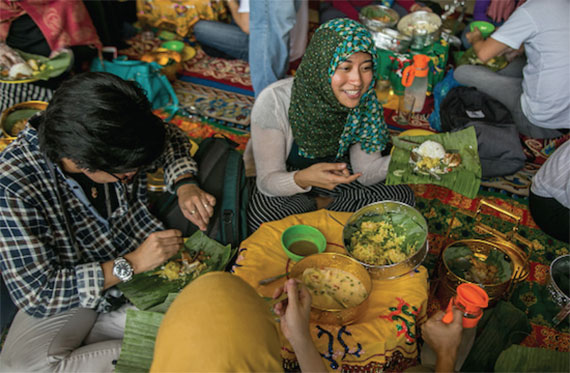
Early one June morning, a group of 25 Christians gathered at a small eatery that serves halal food.

While eating bread and drinking tea the visitors listened to a Muslim woman talk about culture, bridging religious under-standing and cultural exchange among peoples.

Then they went out to explore Quiapo’s “Muslim town,” a place in Manila that is often perceived as a “dangerous and dark place.”

Ann Marie Cunanan, one of the promoters of the tour, admitted that even those living around the area would advise visitors not to enter the Muslim community.

“We want to change that perception,” said Cunanan, who is from the southern Philippine city of Davao.

Vietnamese Catholics share Jesus’ love with the poor

Lovers of the Holy Cross Sister Anna Tran Thi Hien and four other nuns get up at 3.30 a.m. and prepare breakfast for hospital patients. They provide chao (rice cooked with meat or fish) for hundreds of poor patients and their relatives at a public hospital in Dong Ha city in Quang Tri province.

They teach basic education, catechism and how to play musical instruments to 45 orphans and children with physical disabilities aged 1-18. They also feed and wash babies.

Children are sent to local public schools and accommodated by the nuns at church-run Lam Bich Home. Many of the children are deaf or visually impaired and are from the Pako and Van Kieu ethnic groups who live in extreme poverty in mountainous areas. “We try our best to bring Jesus’ love to people in need through our services and loving care,” Sister Hien said.

The nun, who has worked with ethnic groups for four decades, said about 1,500 ethnic villagers have found happiness in their life and embraced Catholicism. Some use their houses as chapels for others to pray on a regular basis.

Tens of thousands of Pako and Van Kieu people live in Quang Tri and Thua Thien Hue provinces.

Cardinal Tagle Asks Students not to Bully

Cardinal Luis Antonio Tagle of Manila has asked the students to never bully others or allow bullying to happen in their schools or anywhere near them.

In his homily during the Mass of the Holy Spirit at the Manila Cathedral, he noted ton on June 19, 2019, the growing phenomenon of bullying, especially online. “Gossiping, vulgarity, to underestimate others, spreading fake news, and bullying are not the works of the Holy Spirit,” an article posted on Radio Veritas’ website quoted Tagle as saying.

Instead, he called on students to tap modern communication to spread the Gospel.

“Don’t be shy to proclaim Jesus,” he said.

Addressing the teachers, the cardinal urged them to expand not only their students’ intellectual dimension but also the human heart.

Catholics schools are called to lead their students to Jesus, according to him.

“Whatever is the subject matter, make sure that what you are teaching are ideas and concepts that lead the students to God,” Tagle added.

Christians face more persecution in Modi’s India

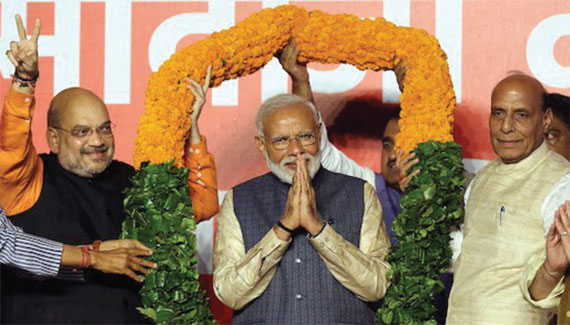
With Prime Minister Narendra Modi starting his second term after leading his pro-Hindu Bharatiya Janata Party (BJP) to victory in India’s recent election, complaints of violence are growing from the country’s persecuted Christians. Christians face a new wave of threats from Hindu groups after the BJP retained its grip on power in May.

“A second term for the BJP has for sure boosted the morale of Hindu groups, who keep threatening and intimidating minorities for being non-Hindus in India, which they think belongs to Hindus only,” Christian leader A.C. Michael, an official of the Indian chapter of the Alliance Defending Freedom, told ucanews.com.

The BJP won 303 seats in the 545-seat parliament in a landslide victory in the April-May national election following the completion of Modi’s first term that began in May 2014. On June 2, Hindu groups ordered pastors in Jagannath Nagar in Maharashtra not to hold any Sunday prayer services. The pastors were threatened with violence if they refused. A pastor and his wife were abducted by a mob of 150 Hindu activists who entered a church during Sunday prayers on June 2 in the Moradabad area of Uttar Pradesh. They were later released after the intervention of village elders but were warned not to hold prayers there again. “These are not isolated incidents but part of a great game by extremist Hindu groups to terrify minorities, particularly Christians, and render them as second-class citizens,” said Peter Sony, a social activist based in New Delhi. “They believe Christians and Muslims aren’t Indians but foreign settlers who should be shown their real place.” Concerns are growing that India’s secular constitution may be changed to establish a Hindu hegemony, Sony said.

Let’s stand up for defence of religious freedom for all: Pompeo

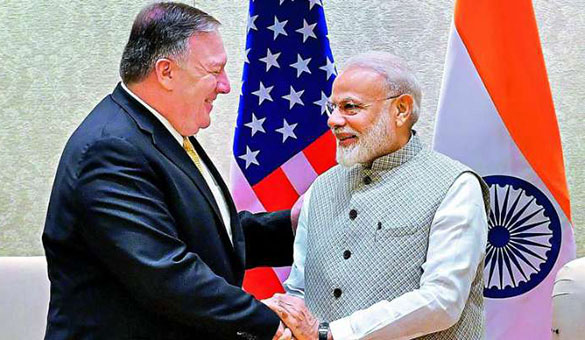
US Secretary of State Michael Pompeo on June 26 pitched for the “defence of religious freedom for all,” days after a report published by his ministry made critical remarks over the status of minorities in India.

At the same time, he hailed the rule of law prevailing in India, like in the US, and said both the countries believe in it.

“India is the birth place of four major religions of the world. Let us stand up together for defence of religious freedom for all. Let’s speak out strongly together in favour of those rights, for whenever we do compromise those rights, the world is worse off,” he said while delivering a speech here.

A few days back, the US State Department, in its annual 2018 ‘International Religious Freedom Report,’ said: “Mob attacks by violent extremist Hindu groups against minority communities, especially Muslims, continued throughout the year amid rumours that victims had traded or killed cows for beef.” India rejected the observations, saying the “foreign entity/government” had “no locus standi to pronounce on the state of our citizens’ constitutionally protected rights.”

In his speech, Pompeo said both India and the US “protect inalienable rights” of their people. Also referring to the Lok Sabha elections, he hailed the democratic exercise, saying “imagine if every country had the voice which Indian people recently expressed.”

He said India and the US “should see the world as it is and see each other what we are — great democracies, global powers and good friends.”

Cardinal Gracias, two bishops seek withdrawal of case

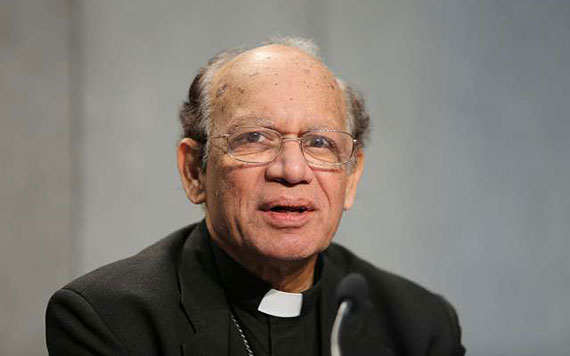
Cardinal Oswald Gracias and two auxiliary bishops of Bombay archdiocese are facing charges of inaction over a child abuse case complaint against a priest. The cardinal and Bishops Dominic Savio Fernandes and John Rodrigues recently app-roached the Bombay High Court to get the case withdrawn.

The bench of justices Ranjit More and Bharati Dangre, who heard the plea on June 17, has posted the matter for hearing at a later date. According to the police, a minor boy was sodomized on November 27, 2015, by Father Lawrence Johnson, who was then his parish priest. Three days later, the boy’s parents filed a complaint at Shivaji Nagar police station that the priest had abused their child.

Cardinal Gracias told the high court that he did not inform the police about the alleged abuse because the boy’s parents had already informed them, who then registered a complaint.

Mob lynchings spread to India’s tribal heartland

The mob lynching of a Muslim man in India’s Jharkhand State shows religious hate is spreading to the peace-loving people in the tribal heartland, church leaders and tribal activists say. The death of 24-year-old Tabrej Ansari was the third incident in the state in two years and the latest in a series of such incidents at the hands of Hindu groups who want to make India a Hindu-only nation.

Ansari was tied to a tree and beaten by a mob on June 18 after being accused of attempting to steal a motorbike. He was handed over to police but fell sick and died in hospital on June 22, police told media.

However, rights activist Afzal Anis, coordinator of Aman Biradri, which works for communal harmony, claimed that Ansari died of his injuries in police custody. “It is very unfortunate that for the past one or two years we have been hearing of mob lynching in our state where for centuries people have been living with harmony and brotherhood,” said Father Anand David Xalxo, based in State capital Ranchi.

Father Xalxo, public relations officer of Ranchi Archdiocese, said the state has been witnessing such incidents “for some time now as religion-based hate spreads” and “predators have no respect for the law.”

Modern crises result of desensitization of human conscience

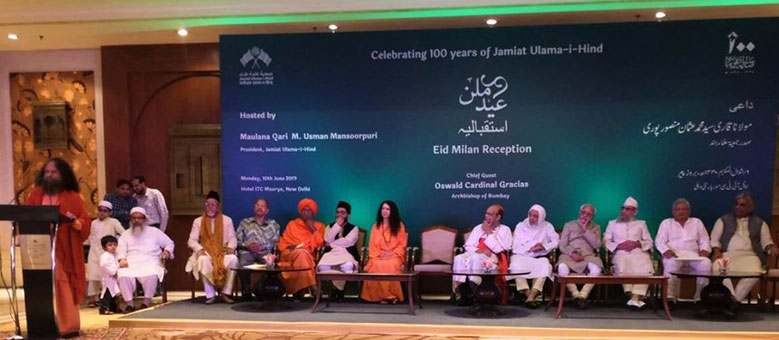
Cardinal Oswald Gracias, head of the Catholic Church in India, was the chief guest of the Eid Milap Function organized by Jamiat-ul-Ulema in New Delhi Eid Milan.

The religious festival after Ramadan was celebrated at the National Level on June 10. It was organized by Jamat Ulamai Hind, one of the biggest Muslim congregations in India.

Given below is the text of Cardinal Gracias’ address at the event:

At this moment, as we celebrate Eid Milan, we feel a strong bond of affection and unity among us all. God has brought us all together this evening, to celebrate this function. You have just completed your month of fasting Ramadan, this fasting has helped you to spend time, re-connecting with God in prayer, strengthening your feelings of love for the needy with the practice of Zakaat, also bonded every family together.

Ramzan the month of fasting, has not been a month of pain, but a period of joy because you experience the Peace of God in your homes and in your persons. Your Ramadan fast, reminds me of our own Christian fast at the time of LENT. Lent is similar in many ways to Ramazan, Lent is a time, to set aside Time for God, to re-connect and bond with the sufferings of Jesus Christ who was crucified on the CROSS, to make reparation for our sins.

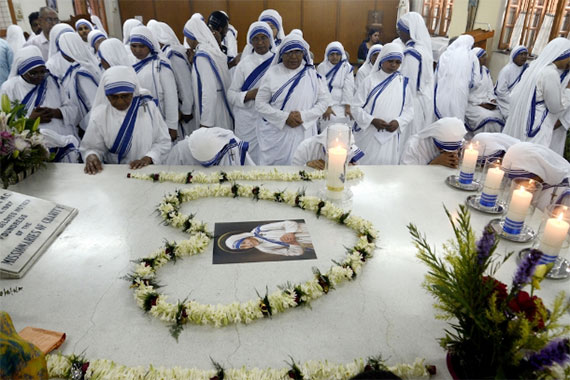
Mother Teresa nuns face probe over funding allegations

A federal investigation into the Missionaries of Charity Congregation of Mother Teresa has been recommended by India’s Jharkhand State following allegations that nuns diverted funds for unspecified objectives.

The state government run by the pro-Hindu Bharatiya Janata Party (BJP) has recommended the federal Home Ministry to conduct a Central Bureau of Investigation probe into foreign donations received and spent by Missionaries of Charity and all its subsidiaries, media reports said on June 19.

In the past 11 years, according to Hindi media, the five main subsidiaries of Missionaries of Charity have spent 9.27 billion rupees (US$154 million) on purposes other than those specified in donations, which is illegal according to Indian laws.

The five subsidiaries include both active and contemplative sections of Missionaries of Charity Brothers, Missionaries of Charity Sisters and Missionaries of Charity Fathers.

Hindu groups in Jharkhand have accused Christians of diverting overseas donations so that they can be used for converting socially poor Hindu Dalits and tribal people in villages.

However, Missionaries of Charity spokeswoman Sunita Kumar told ucanews.com that media reports were “totally false and misleading.”

“Every single pie of donations is properly accounted and utilized only for the specified objectives… annual returns are filed as per law. We have no idea why we are being probed,” said Kumar, who is based in Kolkata, the eastern city where Missionaries of Charity is based.

Abp. Thomas D’Souza of Kolkata also expressed dismay over the development.