Amazonia: Pope Francis meets with indigenous Chief Raoni

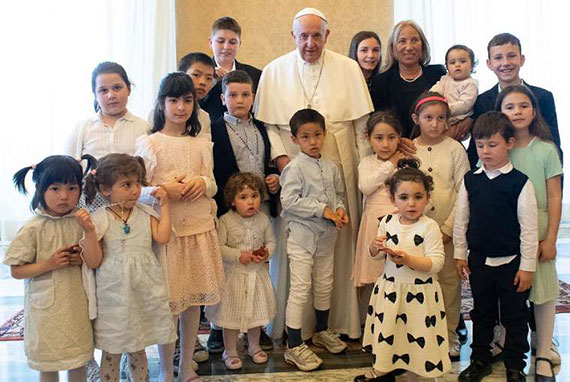
Pope Francis has met with Brazil’s indigenous chief Raoni, who is on a European tour to raise awareness about the dangers facing the Amazon. The pope’s meeting with one of the great leaders of the Kayapo people living in the Amazonian forest in Brazil, took place at the Vatican on May 27.

“Through this meeting, Pope Francis reaffirms his attention to the Amazonian peoples and environment and his commitment to the preservation of the common home,” the Holy See explained in a statement.

The Vatican also said that the meeting was part of the preparation of the next Synod of Bishops’ special assembly on Amazonia to be held next October in the Vatican.

The working document, which will serve as a basis for the debates of this assembly, is scheduled to be published in June, Cardinal Pedro Barreto of Huancayo (Peru) and member of the pre-synodal council, announced a few days ago.

Fears over Chinese ‘sharp power’

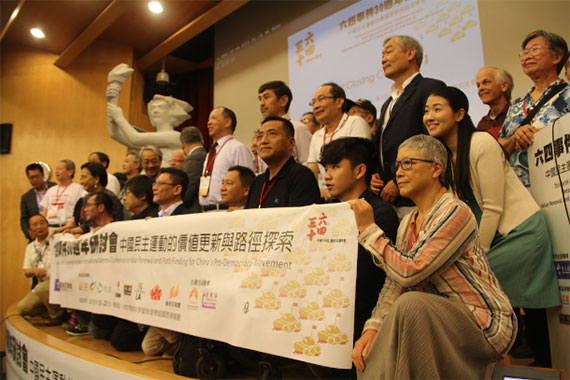
A conference in Taiwan has been told that China’s communist government is increasingly using so-called ‘sharp power’ to stymie international scrutiny of its poor human rights record, including the Tiananmen Square Massacre of 1989.

At the same time, the Beijing regime has been tightening controls on its own people, warned academics, student leaders and rights’ campaigners.

The term ‘sharp power’ was coined in December 2017 in a report of the United States non-profit National Endowment for Democracy to describe censor-ship and other tactics used to weaken independent institutions.

Wikipedia defines sharp power as the use of manipulative diplomatic policies by one country to influence and under-mine the political system of a target nation.

The May 18-20 conference in Taiwan marking the 30th anniversary of the June 1989 Tiananmen Square Massacre was organized by the Hong Kong-based New School for Democracy and the Hong Kong Alliance in Support of Patriotic Democratic Movements of China.

More than 50 scholars, student leaders and witnesses of the Tiananmen Square protest, as well as representatives of overseas support groups and Hong Kong democratic parties, were present as speakers and discussants.

Chinese Catholic-run charity pays tribute to Jean Vanier

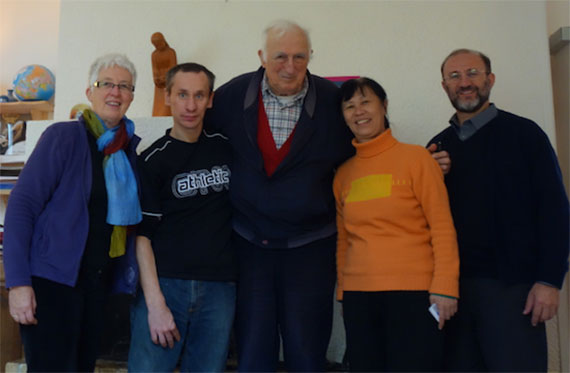
A Chinese charity called Huiling that supports people with mental disabilities paid tribute this month to Jean Vanier, the Canadian Catholic who inspired its creation, after he died in France on May 7 at the age of 90.

Huiling founder Meng Weinuo, a Chinese Catholic, said Vanier had recently been beset by health problems.

“He’d been in and out of hospital several times this year,” she said. “We knew it was just a matter of time before he returned to his heavenly home.”

The charity enjoys support from the Catholic Church. Meng set it up in the southern port city of Guangzhou in 1990 with Father Cagnin Fernando, a member of the Pontifical Institute for Foreign Missions (PIME).

Huiling gained a reputation as the first NGO to serve mentally disabled people in China during the 1980s. It now has 20 service points nationwide.

Meng said she was inspired by L’Arche, an international private voluntary organization that works for the creation of growth of homes, programs, and support networks for people with intellectual disabilities.

Vanier, a Catholic who was born in Canada but later migrated to France, founded L’Arche in 1964. He was also a co-founder in 1971 of Faith and Light, a similar organization.

Meng got to meet Varnier in France in May 2013 when she and Father Fernando visited a L’Arche community there.

“Huiling has always admired L’Arche. We really want to be a sister organization with you,” she recalled telling the elderly Canadian.

Varnier welcomed the move but said he had stepped down from running the organization. He referred her to the head of L’Arche International.

Six months later, the two agencies signed a partnership deal. L’Arche agreed to provide training and spiritual support to Huiling.

Kenyan bishops declare war on ‘dragon of corruption’

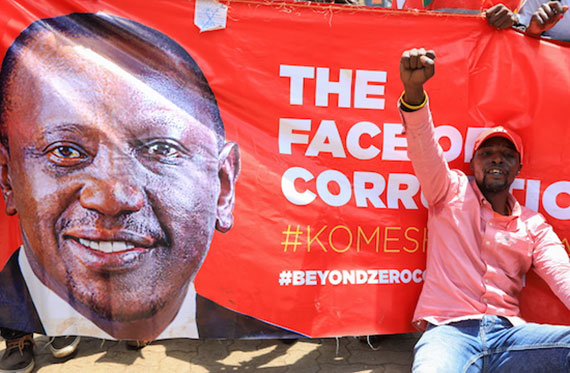
A Kenyan activist gestures next to a banner with a collaged image of President Uhuru Kenyatta and his deputy William Ruto during a march against corruption in Nairobi on April 30.

Kenya’s bishops have launched a campaign to slay “the dragon of corruption” in the East African nation.

Archbishop Philip Anyolo, chairman of the Kenya Conference of Catholic Bishops, said corruption has reached alarming levels and the only way to fight it is by starting from the grass roots.

“We have allowed the dragon of corruption to pull us down to the point where we have accepted it to be our way of life,” he said in a statement on behalf of the organization.

“We are also caught up in perennial, endless political bickering, maneuvers and utterings that slow our country in moving forward in a fresh direction that will bring meaningful development and national integration.

“We all know that corruption is a grave sin and therefore call upon our faithful and people of goodwill to externally commit freely and sincerely, appending their signatures where and when needed, for fighting corruption and corruption practices.”

Archbishop Anyolo said, Kenyan bishops will lead from the front by rejecting all forms of corrupt practices as he urged Kenyans to promote a culture of honesty.

“Kenyans seem to have lost their moral conscience of doing good. Why is it so difficult to resolve not to engage in bribes, either receiving or giving bribes? The war on corruption has to be won by each citizen, indeed each person; you and me,” he added.

Minorities languish in Indian jails

A disproportionate number of India’s minorities such as Muslims, tribal people and socially poor Dalits formerly known as ‘untouchables’ are imprisoned or sentenced to death. This is a central finding of research carried out by the National Dalit Movement for Justice, the Centre for Dalit Rights and the Social Awareness Society for Youths (SASY). A report on the investigation is to be presented to a session of the United Nations Human Rights Committee (UNHRC) in the first week of July.

The study quoted federal government data showing that by the end of 2015, India had 282,076 people incarcerated in various jails awaiting trial. Of that number, at least 21 percent were Dalits, officially called ‘Scheduled Caste’, and 12 percent were tribal people, the report said. Tribal people comprise only 8.2 percent of India’s population of 1.2 billion and Dalits make up 16 percent, according to the 2011 census.

That represents an over-representation of 33.33 percent for Dalits in relation to the number behind bars pending trial and and over-representation for tribal people in this situation of 51.22 percent.

Pakistan honours priest for promoting Christian-Muslim dialogue

A Catholic priest has been honoured by the Pakistan government for his “exemplary services” to promote interfaith harmony and peace in his own country and worldwide.

Father James Channan, a Dominican who has spent 50 years following the spirituality of St. Dominic, received an award at the Interfaith Conference 2019 in Lahore on May 17 that was attended by more than 300 people including Muslims, Christians, Hindus and Sikhs.

Noor-ul-HaqQadri, Pakistan’s federal minister for religious affairs and interfaith harmony, presented the award.

“Many people helped me to reach this place. I praise God, the Church, my community of Ibn-e-Mariam Vice Province of Pakistan, and all my friends,” said Father Channan.

“I especially thank my Muslim friends who always supported me and my work and keep on appreciating me to continue my mission to promote peace and harmony among the people of Pakistan.

“I am actively serving in this mission to build bridges between Christians and the people of other religions, especially with our Muslim brethren, but still I see there is an urgent need for interfaith dialogue.”

Father Channan said his work to promote peace and interfaith harmony brings him peace and mental satisfaction.

“I keep on thinking about ways to bring people of various faiths together, to help them to nurture and strengthen peace among them,” he said.

“Everybody is my neighbour, and being a follower of Jesus Christ I have to love everybody—it keeps me motivated and zealous. We always have to share this message that we are one human family, following different religions and faiths but living our faiths we have to promote love, unity and peace.”

Father Channan is the director of Lahore’s Peace Center, which was inaugurated by the late Cardinal Jean-Louis Tauran, then president of the Pontifical Council for Interreligious Dialogue.

“I work to provide facility to the people of various professions and age groups to come together for dialogue, which helps to remove discrimination, fundamentalism and extremism from our society,” he said.

Father Channan also serves as a regional coordinator of United Religions Initiative (URI) in Asia. URI is serving in 109 countries including Pakistan. “We have 63 active groups of religious leaders, lawyers, journalists, youth, women and children. Our Peace Center is always available for programs or events to promote peace, interfaith harmony, interreligious harmony and Christian-Muslim dialogue,” he said.

Facing terminal cancer, Polish man ordained priest in hospital bed

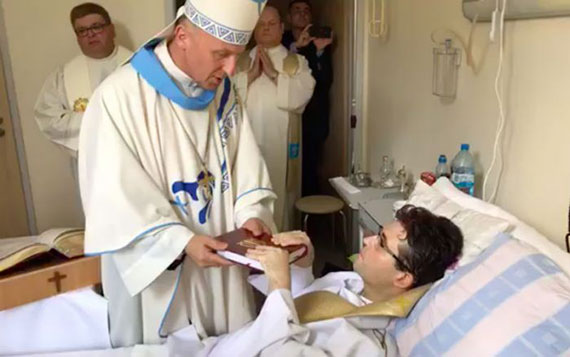
The ordination of Fr. Michal Los, FDP, a member of the Orionine Fathers, was far from typical ordination. Los was diagnosed with cancer a month ago, and is now in critical condition. On May 24, Los was ordained a priest in his Warsaw hospital bed.

Pope Francis granted a dispensation allowing him to be ordained both a deacon and a priest in the same Mass, and Los was ordained by Bishop Marek Solarczyk of the Diocese of Warsaw-Praga.

The day before his ordination, Los made perpetual vows in his religious community. Permission was granted to the director general of the congregation, Fr. Tarcisio Vieira, to whom Pope Francis sent a letter.

“The ceremony took place in an atmosphere of great and profound spirituality. After the initial prayer, the litany for the intercession of the saints followed for the life of Michal and for his congregation,” said Fr. Fornerod in a Facebook post about the event. The day after his ordination, Los celebrated his first Mass from his bed.

Pope Francis urges Catholics to help children by supporting adoption

Adoption is often a difficult and bureaucratic process, but there are many children who need homes and the Church should step up to help them, Pope Francis said. Speaking on May 24 to employees and patients of an Italian hospital for abandoned children, he said, “so many times there are people who want to adopt children, but there is such enormous bureaucracy,” such as high fees or, at worst, corruption.

“There are many, many families who do not have children and would certainly have the desire to have one with adoption,” he continued. “Go forward, to create a culture of adoption, because there are so many abandoned children, alone, victims of war and so on.” Pope Francis spoke about adoption in unprepared remarks during a Vatican meeting with 70 employees and children from the 600-year-old Hospital of the Innocents in Florence.

Francis also said there must be a goal, at various levels of responsibility, of ensuring “no mother finds herself in a position of having to abandon her child. We must also ensure that in the face of any event, even tragic, that may detach a child from her parents, there are structures and paths of welcome in which childhood is always protected and cared for, in the only way worthy: giving children the best we can offer them,” he said.

Pope Francis appoints new head of Vatican’s interreligious dialogue

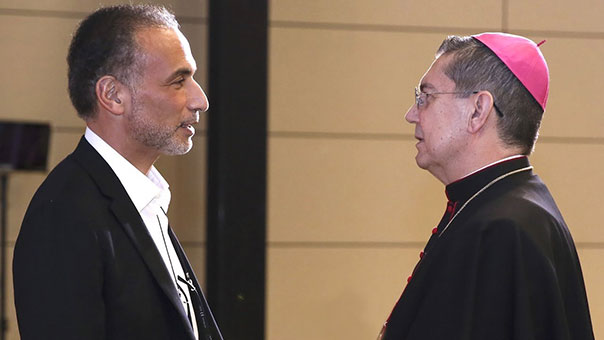
Pope Francis appoint-ed Spanish Bishop Miguel Ayuso Guixot Saturday as president of the Pontifical Council for Interreligious Dialogue. Guixot succeeds Cardinal Jean Louis Tauran, who led the Vatican dicastery for over ten years until his death in July 2018.

As a priest in the Comboni Missionary of the Sacred Heart of Jesus, Guixot served as a missionary in Egypt and Sudan. He has degrees in Arabic and Islamic studies, in addition to a doctorate in dogmatic theology from the University of Granada. Guixot, 66, served as the dean of the Pontifical Institute of Arabic and Islamic Studies in Rome until Pope Benedict XVI appointed him as secretary of the Pontifical Council for Interreligious Dialogue in 2012. In 2016 Pope Francis consecrated Guixot as a bishop. Originally from Seville, Guixot, speaks Arabic, English, French, and Italian, in addition to Spanish.

Interreligious dialogue has been a focus of Pope Francis’ pastoral visits in 2019. His trips to the United Arab Emirates, Morocco, and Bulgaria all included interreligious meetings. In Abu Dhabi, Pope Francis signed a joint-statement on human fraternity with the Grand Imam of al-Azhar, Ahmed el-Tayeb, which he called “a new page in the history of dialogue between Christianity and Islam.”

Catholics ask Jharkhand to halt probe into overseas funding

Jharkhand governor told that selective scrutiny of only Christian institutions is a breach of India’s constitution. Bhopal:

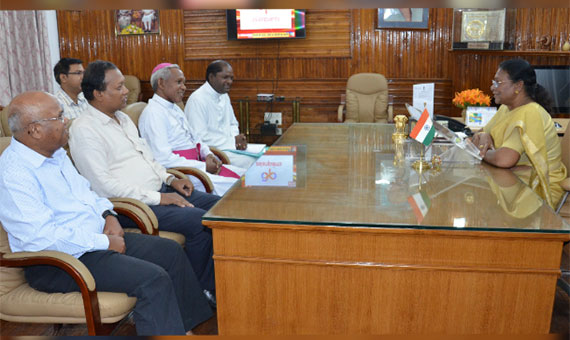
A Catholic delegation in India has sought the intervention of Jharkhand state’s governor to end what they describe as “selective” investigations targeting Christian organizations who receive foreign donations.

Auxiliary Bishop Telesphore Bilung of Ranchi led the four-member delegation to present a memorandum to governor Draupadi Murmu on May 24 urging her to dismiss ongoing selective investigations into Christian organizations.

The state has some 500 non-governmental organizations that receive foreign donations. However, the government ordered that only 88 Christian organizations be investigated to see if they “misuse foreign funds for religious conversion,” the memorandum said.

“The selective scrutiny only of the Christian institutions betrays not only the government’s discriminatory stance but is also a breach of the Indian constitution,” it said, seeking the governor’s intervention.

Christians say they began to be targeted after the pro-Hindu Bharatiya Janata Party (BJP) came to power in 2014. With a BJP-led government also in New Delhi, administrations have been supportive to Hindu groups working to make India a Hindu theocratic nation, they say.

Hindu groups have routinely accused Christian organizations of diverting foreign funds to use in efforts to convert socially poor tribal and Dalit people in the state.

Over the past five years the state has witnessed hundreds of attacks against Christians and numerous police charges against Christians accused of violating a state law of 2017 that restricts conversion.

The law prohibits converting a person from one religion to another using force or by means of allurement or inducement. Hindu groups have been accusing Christian organizations of misusing overseas funding for conversion under the pretext of social services.