Francis mandates clergy abuse reporting worldwide, empowers archbishops to do investigations

Pope Francis issued sweeping new laws for the Catholic Church on the investigation of clergy sexual abuse May 9, mandating for the first time that all priests and members of religious orders worldwide are obligated to report any suspicions of abuse or its cover-up.

The pontiff has also established a new global system for the evaluation of reports of abuse or cover-up by bishops, which foresees the empowering of archbishops to conduct investigations of prelates in their local regions with the help of Vatican authorities.

We met our Spring Fund Drive goal, thanks to your generosity! If you still want to contribute, it’s not too late.

The new norms, contained in a brief apostolic letter titled Vosestis lux mundi (“You are the light of the world”), are exhaustive in scope, applying in some way to every ordained or vowed member of the 1.3 billion-person church. They also encourage lay people to make reports of abuse, and provide for involvement of lay experts in investigations.

In his introduction to the document, which goes into effect from June 1, Pope Francis says he has created the new laws so that the church will “continue to learn from the bitter lessons of the past, looking with hope towards the future.”

“The crimes of sexual abuse offend Our Lord, cause physical, psychological and spiritual damage to the victims and harm the community of the faithful,” the Pope states. “In order that these phenomena, in all their forms, never happen again, a continuous and profound conversion of hearts is needed, attested by concrete and effective actions that involve everyone in the Church.”

The new procedure essentially contains five steps:

1. A person alleging abuse or cover-up by a prelate makes a report to their bishop, the Vatican, or the church’s ambassador in their country.

2. If that abuse or cover-up involves a prelate, the bishop or superior receiving the report is obligated to forward it to both the Vatican and the metropolitan archbishop of their regional province.

3. Once that report has been filed, the metropolitan archbishop is to ask the Vatican for authority to conduct an investigation.

4. After receiving proper authority, the metropolitan conducts the investigation, sending reports to the Vatican on its status every thirty days. The initial time-frame for investigation is ninety days, but can be extended.

5. Once the investigation is finished, the metropolitan is to communicate its results and his opinion on the matter to the Vatican for a final determination of the outcome for the bishop in question.

Pope discusses deaconesses, need for nuns to be servants not ‘maids’

She thanked the Pope for being a source of inspiration and helping the church fight the abuse of minors and vulnerable people.

“We are also grateful for your having faced the painful issue of abused religious,” she said, noting that many forms of abuse occur world-wide, including cases of religious abusing their fellow sisters.

National conferences of religious orders “are facing this scourge with courage and determination,” she said, listing a number of UISG initiatives to help congregations in raising awareness, training superiors and establishing protocols and codes of conduct.

The Pope said he was very much aware of the abuse of religious, calling it “a serious and grave problem.” Some religious face not just sexual abuse, he said, but also the abuse of power and conscience.

“We have to fight against this,” which must include the superiors general making sure they send their members where they will be in service, not servitude, the Pope said.

Fighting abuse, he continued, has been a slow process, especially seeing how it is only now that people are understanding the problem with “lots of shame.”

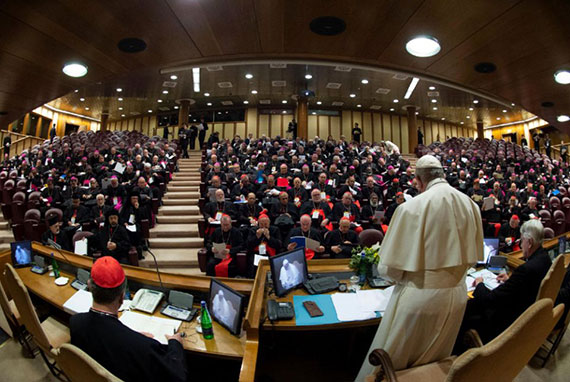
He said that he under-stood some victims’ groups were not satisfied with the outcome of a February summit at the Vatican on safeguarding children and vulnerable adults, “but if we had hung (to death) 100 priest abusers in St Peter’s Square, everyone would have been happy, but the problem would not have been solved.”

German Catholic women begin boycott over lack of reforms

A grassroots Catholic women’s movement – using the motto of the Virgin Mary who should be given her voice – launched a week of disobedient non-service on May 11 – with the backing of major lay organizations and even singular bishops.

The women planned to hold rites outside churches, without priests, and withhold services inside parishes until May 18 at least 50 locations to back their call that the Vatican open the priesthood to women and drop celibacy.

Left undone will be attendances at mass and committees, parish housework and the liturgical readings – tasks left typically to regular churchgoing women. The central protest was outdoors in the northwestern city of Münster on May 12.

One of the initiators, Andrea Voss-Frick, said the Maria 2.0 movement – conceived early this year at a women’s parish bible meeting in Münster, a hub of German Catholicism – had received endorsement from Berlin, Hamburg and Vienna. The Virgin Mary is referred to as Maria in German.

The impulse came as the initiators realized that the Vatican’s pronouncement and church teachings of hope “didn’t come across at all” amid abuse and cover-ups, said Voss-Frick.

On May 10, two nationwide groups – the Catholic German Women’s League (KDFB) and the Catholic Women’s Community of Germany (KfD) – described the strike call as an “important signal” and urged bishops not to ignore it.

KDFB president Maria Flachsbarth said abuse cases and cover-ups by priests had slid the church into deep crisis and credibility loss. Striking women wanted to show how much the church and its evangelical “gospel” meant to them, said Flachsbarth who is also a federal parliamentarian and member of Chancellor Angela Merkel’s Christian Democrat (CDU) party.

“Without the women nothing happens,” said Thomas Sternberg, president of the Central Council of German Catholics (ZdK) at its lay convention in Mainz on May 10.

Pew study finds continued support in Western Europe for paying church taxes

To Americans who drop coins into the collection plate, write a check or perhaps text in their Sunday donation, the idea that the state would charge an annual tax to support their church can seem strange and off-putting indeed.

But in several Western European countries, a majority of adults not only agree to pay a church tax imposed on all baptized Christians, but also have no intention of opting out of it, even though they can, according to a new survey by the Pew Research Center published on Tuesday (April 30).

That includes many who don’t attend church regularly but who still pay the tax.

From the outside, Western Europe is often seen as a highly secularized region where established religion is dying out. Church taxes are blamed for part of that erosion, because the only way to avoid the tax where it is mandatory is to officially leave the church one was baptized in.

But the Pew report, titled “In Western European Countries With Church Taxes, Support for the Tradition Remains Strong,” found far more people still finance their church than attend it.

Of the 15 countries it studied, Pew found six have mandatory taxes — Austria, Denmark, Fin-land, Germany, Sweden and Swi-tzerland — while Italy, Portugal and Spain have voluntary pro-grams and no church taxes are collected at all in Belgium, Britain, France, Ireland, the Netherlands and Norway.

German bishops’ vice president expects Amazon synod to propose married priests ‘with civil job’

Bishop Franz-Josef Bode, the Vice-President of the German Bishops, states in a new interview that he can “very well imagine that there are also priests with family and [civil] job, similar to our deacons, some of whom are married and have a job.” This model of married “priests with a civil job,” he predicts, will “probably be presented to the Pope by the Latin American bishops at the Amazon Synod in October.”

Speaking with the regional newspaper Osnabrücker Zeitung, Bishop Bode makes it clear that he is in favor of “rethinking the link between celibacy and the priesthood.”

“Priests with a civil job” could “celebrate the Eucharist” and also provide “the corresponding priestly services,” he says.

In Bishop Bode’s view, this model will “probably be present-ed to the Pope by the Latin American bishops at the Amazon Synod in October.” He explains that “the high and proper estimation of celibacy shall always be preserved, but it should be enriched by other priestly forms of life.” In that same interview, the German bishop also speaks in favor of female deacons “as a sign of recognition, esteem, and change of status of women in the Church who are today in large numbers active in charitable fields and in the field of the diaconate.”

Christians among ‘most persecuted’

Christians are the most persecuted of all religious groups in the world, according to a new report.

It is estimated that one third of the world’s population suffers from religious persecution in some form, with Christians being the most persecuted, according to the interim report of the independent review into Foreign and Commonwealth Office support for persecuted Christians worldwide.

The Anglican Bishop of Truro, the Right Rev Philip Mounstephen, asked by Foreign Secretary Jeremy Hunt to lead the review, said he was “truly shocked by the severity, scale and scope of the problem”.

The interim report says: “Despite the fact that the Universal Declaration of Human Rights is foundational to the UN Charter, which is binding on member states, and that ‘the denial of religious liberty is almost everywhere viewed as morally and legally invalid’, in today’s world religious freedom is far from being an existential reality.”

The full report is due to be presented to Mr Hunt by the end of June, and will make recommendations for changes in both policy and practice.

The scale of the problem was demonstrated by the fact that the report was out of date by the time it was published, most notably because of the Easter Sunday bombings in Sri Lanka.

The key research findings drawn together by the review include some from the Pew Research Centre which found that in 2016 Christians were targeted in 144 countries, a rise from 125 in 2015, and concluded: “Christians have been harassed in more countries than any other religious group and have suffered harassment in many of the heavily Muslim countries of the Middle East and North Africa.”

The charity Open Doors also revealed in its World Watch List that “approximately 245 million Christians living in the top 50 countries suffer high levels of persecution or worse”, 30 million up on the previous year.

According to Persecution Relief, 736 attacks were recorded in India in 2017, up from 348 in 2016. With reports in China showing an upsurge of persecution against Christians between 2014 and 2016, government authorities in Zheijiang Province targeted up to 2,000 churches, which were either partially or completely destroyed or had their crosses removed.

Is the Catholic Church changing on women’s ordination?

In 1979, Sister Theresa Kane welcomed Pope John Paul II on his arrival to the United States with a bold address asking for him to include women “in all ministries of our Church.” The Pope responded with stony silence.

Four decades later, and a Latin American Pope walked into the Vatican’s Paul VI hall side by side with two senior nuns for a 40-minute question and answer session with 850 superiors of female religious orders. Among the issues up for discussion is whether women can be ordained as deacons.

While many are frustrated that Pope Francis has not gone further and faster on the question of giving more visible roles to women in the Church, the meeting he held with the Union of Superiors General on 10 May 2019 is a sign of how far things have developed.

The question of women in the Church has for years been akin to a car stuck in a stationary position. The door was closed, the engine off and the questions settled. Under this pontificate, however, the vehicle is spluttering into life.

The clearest evidence for this is how Pope Francis is allowing for an open discussion to take place on female ministry, whereas John Paul II ruled in 1994 that women could not be ordained priests, and insisted that  the matter was not up for debate. While this Pope has repeatedly pledged his full adherence to John Paul II’s teaching barring female priests, Pope Francis has permitted a debate about the women’s diaconate to bubble away for the last three years. It was during a 2016 meeting with the union of superiors general that the Pope promised he would set up a commission looking into the matter. That commission’s report has been handed over by the Pope to Sr Carmen Sammut, who leads the religious superiors.

Indian court suspends tax on priests, nuns

The Supreme Court of India has given temporary relief to priests and nuns who were asked to pay income tax for the salary they earn by working in government-funded educational institutions.

The top court on May 9 asked authorities to maintain the status quo of not collecting such taxes and agreed to hear an appeal against an order of the Madras High Court in Tamil Nadu State.

The Supreme Court was hearing a challenge filed by the Institute of Franciscan Missionaries of Mary to a March 20 order of the state court that said missionaries, Catholic priests and nuns should not be exempted from paying tax on government-assisted salaries. The top court posted the case for a final hearing on Aug.7.

“We are happy that we got temporary relief,” said Father L. Sahayaraj, deputy secretary of the Tamil Nadu Bishops’ Council. He said the Church in the state was determined to fight the case.

He told ucanews.com that Catholic priests and religious serving in government-aided educational institutions did not have any income because their salary is contributed to their convents or houses “so they cannot be asked pay income tax.”

The state court ordered an end to this exemption on the basis that they received their salaries in their individual capacity and that surrendering salaries could only be treated as “application” of their income.

Their choice of application did not merit tax exemption, the court order stated.

The case dates back to 2015 when Tamil Nadu’s income tax department instructed state-funded educational institutions to deduct tax from the salaries of priests, religious brothers and nuns, ending a long-standing convention exempting them.

“Arson” destroys church in Tamil Nadu

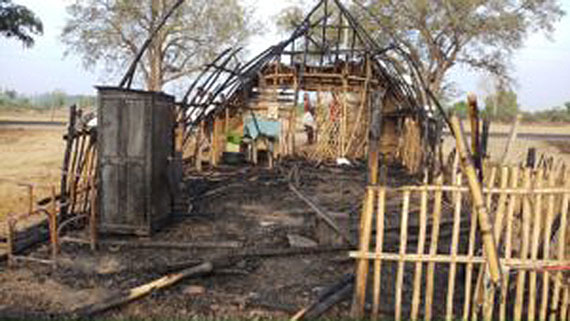
A church in Tamil Nadu was destroyed in a suspicious arson attack, Matters India learnt on May 11. According to Shibu Thomas, founder of Persecution Relief, the incident occurred on April 24 at Thittacherry, Nagapattinam.

Member of the “Jesus with us” had gathered in the church for a fasting prayer meeting.

The meeting ended late in the evening and after everybody had left, pastor Sachin Paneerselvam, locked the sanctuary and left for his home, 12 km away.

A few hours after reaching, Paneerselvam and his family were getting ready for bed when he got a call from the local Naneelan station at 11 pm that the church building was on fire.

Thomas, who heads Persecution Relief, an ecumenical church group, said Paneerselvam wanted to rush to the church, to help put out the fire and salvage the contents. However, the police were adamant that he should not come to the spot as fire-fighters were battling the blaze. Police said that they would investigate the cause of the fire to ascertain.

Persecution brought us religious vocation: Kandhamal sisters

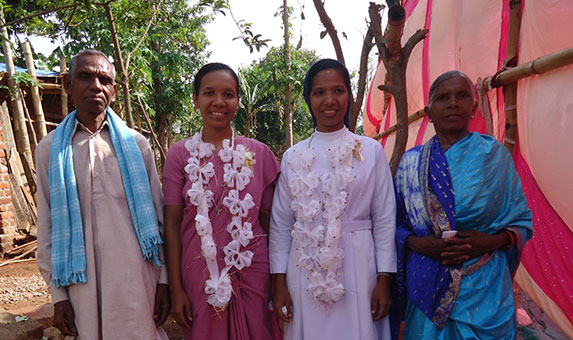
Hundreds of Christians and Hindus attended a thanksgiving Mass for two sisters who became full-fledged Catholic nuns after suffering religious persecution as teenagers in Odisha’s Kandhamal district.

While Manjuta Pradhan professed final vows as a member of the Franciscan Sisters of St Joseph on April 27, her elder sister pronounced her vows in the Daughters of Charity two years ago.

However their village decided to honour both the sisters with a thanksgiving Mass on May 4 at Our Lady of Charity Church, Raikia, a major parish under the Cuttack-Bhubaneswar archdiocese.

More than 2,500 people, including some Hindus who had persecuted the two nuns’ family, attended the Mass.

The two nuns hail from Badingnaju (village built on rock), a substation of Raikia.

Assistant parish priest Father T. Francis Kanhar who led the Mass said, the two nuns lived up to the name of their village by remaining like or rock in their faith. “During the 2008 communal violence, they underwent pain, agony, persecution as their Hindu neighbours chased them from their native place. But they remained very strong in their faith in Christ and that has brought them to this state. They have now become an inspiration to many Hindu neighbours. Nothing is impossible in the eyes of God,” the priest told the gathering.

The sisters agreed with their parish priest.