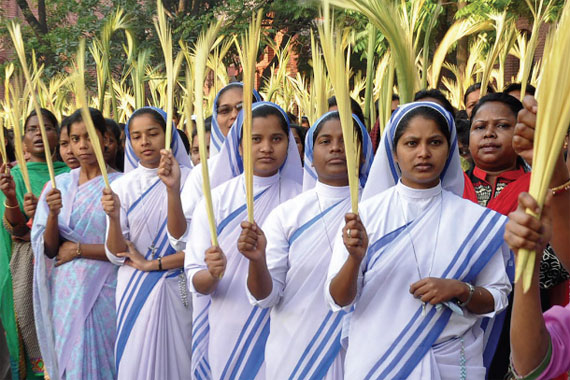
Indian state ‘treats Christians as terrorists’

All nine Catholic bishops of India’s north-eastern Jharkhand State have sought federal intervention to stop Christians being treated like terrorists as part of alleged state government harassment.

The bishops told governor Draupadi Murmu, who is the representative of the Indian president, that the state government led by the pro-Hindu Bharatiya Janata Party (BJP) had used its Anti-Terrorist Squad (ATS) to probe Christian institutions.

On July 30, three days after meeting Murmu, they also sent a memorandum to federal Home Minister Rajnath Singh seeking his assistance on the issue.

“We are now treated as terrorists and officials of the ATS are after us as if we are involved in terrorist activities,” Auxiliary Bishop Telesphore Bilung of Ranchi, who organized the meeting, told ucanews.com.

He said for the past few months, police had been arresting church people on trumped-up charges and investigators had raided Christian groups in “clear state-sponsored harassment.”

In some cases, the ATS served notices on Christian institutions ordering them to produce financial details within 24-hours, the bishop said.

Ethnic Khasia Christians fight to keep land in Bangladesh

After nearly a decade resisting eviction from ancestral land, ethnic Khasia Christians in Bangladesh are still uncertain whether the land they have lived on for generations will become their own.

About 700 ethnic Khasia from 86 families in two villages have been battling to resist eviction by Nahar Tea Estate in Moulvi-bazar district since 2010.

Most of those affected are Catholics belonging to St Joseph’s Catholic Church, under the predominantly indigenous Sylhet Catholic Diocese in north-east Bangladesh. “The Khasia are peaceful people and they have the right to live in their ancestral land like every citizen of Bangladesh,” Quazi Rosy, a ruling Awami League lawmaker, told ucanews.com.

Rosy was part of a delegation from the Parliamentary Caucus on Indigenous Peoples that visited Nahar 1 and Nahar 2 punjis (forested villages with clustered houses) on July 22. Research and Development Collective (RDC) activists were also part of the delegation to lend their support to the Khasia.

Interfaith charity run aims to build churches in Indonesia

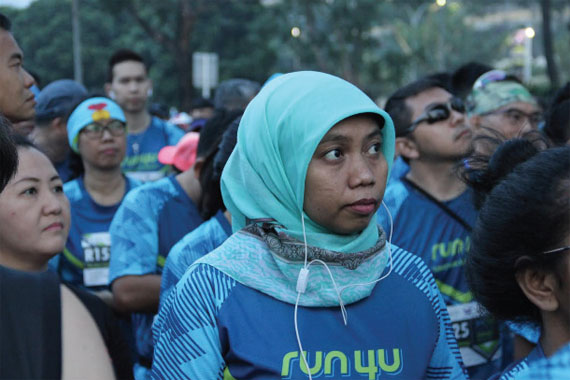
Over 3,500 people, mostly Catholics, joined a charity run organized by Indonesia’s Jakarta Archdiocese to raise money to build churches in various parts of the country.
Jakarta has declared 2018 the “Year of Unity.”

The “Run4U” campaign on July 29, one of a number of Church-led fund-raising runs in recent years, offered people the chance to test themselves with a 2.5-kilometre walk or a more gruelling 5k run in Tangerang, a city in Banten province some 25km from Jakarta.

Participants included priests, nuns, seminarians, elderly and young and people from other religions. “Our main purpose is to raise money to help out with the construction of several churches [that are in need of financial support],” Paskah Widarani, one of the organizers, told ucanews.com.

“Those parishes were chosen as they really need our help right now,” said Widarani.

A priest’s pain: Crosses destroyed, ban on catechism, the vaccine scandal

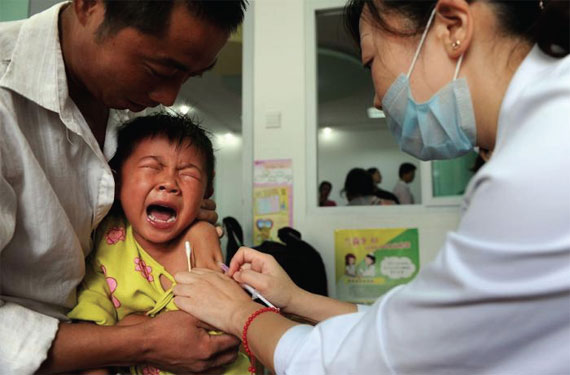
The Chinese authorities have been eliminating visible Christian signs, crosses and engravings for several months due to a campaign of “synicization.” This adds to the ban on meetings even in summer, with young people under the age of 18, who are also forbidden to attend mass. At the same time, the scandal of ineffective vaccines for new-borns has spread throughout the country. This scandal is caused by widespread corruption, by the little control exercised by the authorities; by protectionism for Chinese firms. The priest-blogger Shan Ren Shen Fu (“the hermit priest”), shares his reflection on these events with our readers. In particular, he points out that if more faith and values were spread in Chinese society, there would be less corruption and more effective vaccines. Furthermore, his regret is that in China there is a concern to vaccinate children in the body, but it is forbidden to vaccinate them in the spirit, excluding them from the cate-chism. In this way the lack of honesty and healthy conscience in society is perpetuated.

On August 6, a brother priest of mine told me on WeChat: “Brother, our bishop called me saying to remove the cross and the inscription ‘Catholic Church’.” In the last two years this confrere has worked with great difficulty. There was no church in the area, and the diocese bought a two-storey shop and turned it into a place of prayer for the local faithful, since then the priest immediately organized the people to clean up and decorate the place.

New archbishop installed in India’s troubled Jharkhand state

In a ceremony lasting over two hours, Archbishop Felix Toppo was installed as the new Archbishop of Ranchi in St Mary’s Cathedral. Ranchi is the capital of the eastern Indian State of Jharkhand.

The state has a large proportion of India’s marginalized tribal people, who exist outside of Hinduism’s traditional caste system, and many of them become Christian – Jharkhand has a Christian population of over 4% double the national average.

Bishops’ event focuses on how to beat India’s divisive politics

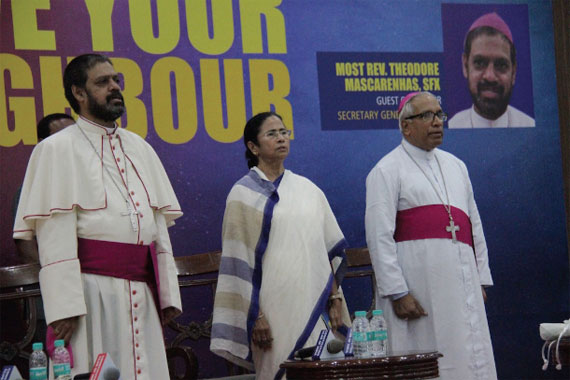
A Catholic Church-organized program in New Delhi has called on Indian politicians to cease being divisive and using religion as a way of attracting votes. Prominent opposition leader Mamta Banerjee was among several speakers voicing concerns over the divisions in Indian society during an assembly organized by the Indian Catholic bishops’ conference on July 31. “Some people are trying to divide the country in the name of religion, caste and creed. But we can’t sit here as mute spectators,” Banerjee, chief of Trinamool (grassroots) Congress party, told the gathering of 1,000 people. “Time has come for us unite and raise our voices,” she said. With the theme of “Love your neighbour,” the assembly was held as leaders of India’s ruling Bharatiya Janata Party (BJP) press their pro-Hindu ideology ahead of general elections early next year.

Banerjee, who is also the chief minister of West Bengal State, said the theme of the gathering was rightly chosen because “some communal forces are trying to dictate what we should eat, dress and how we should practice our faith.” She was alluding to cases of harassment and violence committed against Christians and Muslims by hard-line Hindu groups ever since Prime Minister Narendra Modi came to power leading the BJP in 2014.

Leaders like Banerjee accuse BJP governments in New Delhi and most northern Indian states of supporting Hindu groups who attack religious minorities in an effort to project the party as a pro-Hindu champion.

Indian tribals urged to resist exploitation

About 2,000 people who gathered to mark International Day of the World’s Indigenous Peoples were asked to fight to protect their identity and culture in the face of increasing challenges in India.

Leaders who addressed the gathering in New Delhi on Aug. 9 presented data and incidents to show how exploitation of tribal people has increased since the pro-Hindu Bharatiya Janata Party (BJP) came to power at federal level and in several states in 2014.

“Atrocities on tribals are nothing new but now tribals are branded as anti-national and the government will always harass them,” Jesuit Father Vincent Ekka, a tribal rights activist, told participants.

He said the Indian constitution provided for tribal people to enjoy self-administration in certain areas “but local administrative executives are not following it and have taken an attitude of my way or the highway.” Father Ekka heads the department of tribal studies at the Jesuit-run Indian Social Institute, which organized the meeting of tribal people and leaders across India to mark the international day, which had the theme “Indigenous peoples’ migration and movement.” Tribal leaders recalled how governments had made laws to take over and control tribal land and forests while chanting development mantras but acting on behalf of multinational companies and miners. Many tribal people were forced to migrate to cities.

“The main reasons for migration are mining, power projects and industries,” said Lakhiram Murmu, a professor at the All India Institute of Medical Sciences.

The 2011 census showed the total number of internal migrants in India was a staggering 139 million. Murmu, a tribal and senior surgeon, said that “when we speak about migration, it will be mostly our own people who are affected and we have to find the solution for that by creating jobs.” India has about 104 million tribal people who form 8% of the population. However, 30% of India’s 27 million Christians come from tribal communities, especially in northern and eastern states.