Armed man killed in shootout outside residence of Filipino archbishop

An armed man was killed in a shootout with police outside the residence of the Archbishop of Cebu in the Philippines on July 10 morning.

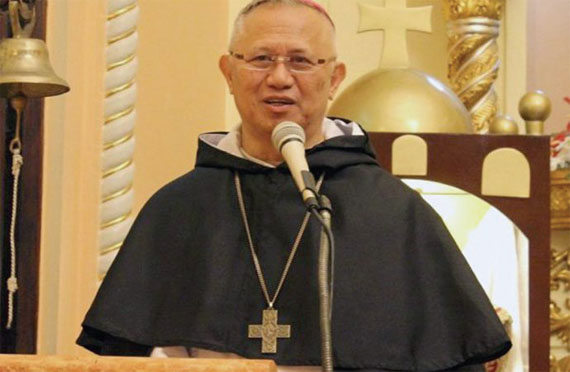
The man, who arrived on a motorbike and was wearing a facemask and helmet, entered the residence and said he was looking for Archbishop Jose Palma, who was in Manila at the time.

“The man appeared to be disturbed because he wasn’t clear on what he was saying. One of the secretaries of the archbishop noticed what seemed to be a firearm tucked in the man’s waist, prompting him to call the police,” Police Chief Superintendent Debold Sinas said, according to the Inquirer, a Philippines newspaper.

“When we arrived in the area, the man was on board his motorcycle. Our operatives tried to approach him, but he said ‘Don’t touch me’ before he fired at us,” a police officer on the scene told the Inquirer.

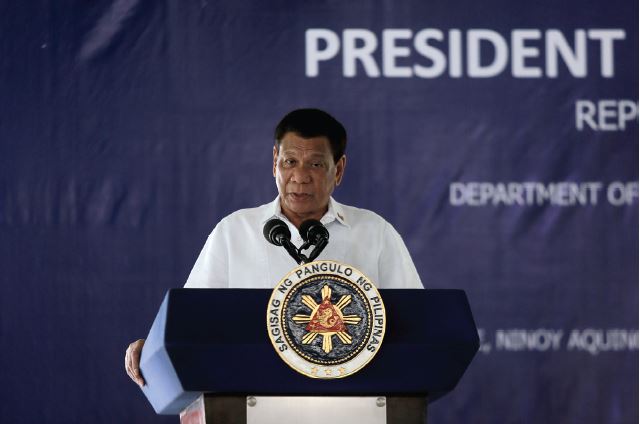
Palma has been an outspoken critic of the growing violence surrounding the administration of President Rodrigo Duterte, who has led a war against drugs that has been marked by extra-judicial killings of drug dealers and others.

The archbishop was in Manila for the Plenary Assembly of the Catholic Bishops’ Conference of the Philippines, which issued a strong statement aimed at the regime.

The Church has been a constant target of Duterte, who has warned against the bishops’ “creeping influence” in the country. Since December, three priests have been gunned down in the country.
Father Joseph Tan, the archdiocese’s press officer, issued a statement saying that there was “no known prior threat” to Palma.

China orders register of poor Catholics in Henan

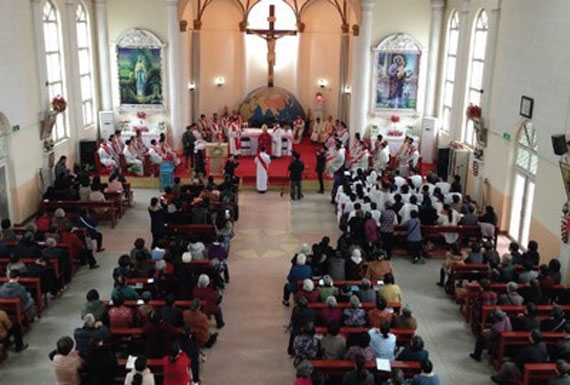
A priest in China’s Henan province claims to have received a notice from municipal authori-ties requesting churches in the province gather statistics on the backgrounds of their congrega-tions, especially those from poor families.

But he is refusing to cooperate out of fear that anyone named in the register could be barred from receiving state subsidies as punishment for practicing their faith.

“This is totally unreasonable. I suspect their hidden agenda may be to cancel people’s low-income subsidies,” said the man, who declined to give his name for fear of reprisals from the state.

China has forged an uneasy truce with the Vatican in recent years despite the Communist country being officially atheist. Pew Institute figures suggest it now has a population of 10 million Catholics with 10% concentrated in Henan, consider-ed the cradle of Chinese civilization.

“Now we just have to wait for the inspection team to come and see what they say before we determine our next move,” added the clergyman, an open-church priest who serves in Luoyang Diocese of Sanmenxia City.

Lists of clergy must also be hung up at parishes so that officials can confirm they have the necessary permits to preach from the pulpit, the notice said.

Duterte promises to resign if anyone can prove God exists with a selfie

‘If any one can go to heaven, talk to God, and take a selfie – I will resign.’

President of the Philippines Rodrigo Duterte has offered to resign if anyone can take a selfie with God to prove he exists. His comments came just days after he called God “stupid.”

The latest outburst shows Duterte, aged 73, increasingly at odds with the Church in which he was raised and to which most Filipinos belong.

In the last few days, Duterte has also said he does not like the “creeping influence” of the Catholic Church. In addition, his presidential spokesman has accused the Church of working with Communist rebels to overthrow the government in the Philippines. The spokesman said the Church “sometimes runs counter to what the government believes to be good for the people, at least in this temporal life.”

In his latest speech on June 30 at the inauguration of the Malayan colleges in Mindanao, Duterte invited everyone “to become agents of hope and catalysts of progress.”

After describing his own progress through the education system and then his career in law and politics, he said he believed in God, but did not believe in a God who intervenes in the world. “Otherwise there would be no widespread injustice: hunger, killings, and all.” The president said in his latest address: “Every Filipino is entitled to criticise me as a matter of right. A general, a school dean, the academe, the students.” Catholic bishops in the Philippines, concerned about an increase in violence and police reaction to crime, announced a day of prayer and penance on July 16 and three days of fasting, prayer and penance on July 17-19. The bishops said they wanted to “invoke God’s mercy and justice on those who have blasphemed God’s Holy Name, those who slander and bear false witness, and those who commit murder or justify murder as a means for fighting criminality in our country.”

Pope: in Bari Christians united in prayer for peace in the Middle East

Pope Francis’ ecumenical meeting next Saturday, July 7th, in Bari with the heads of the Churches and of the Christian communities of the Middle East will be “a strong gesture in its essentiality” to strengthen the path of unity among Christians and to reiterate that there cannot be a Middle East without Christians.

The meeting, which will have the title “Peace be with you! Christians together for the Middle East,” was presented today in the Vatican by Card. Leonardo Sandri, prefect of the Congregation for the Oriental Churches and Card. Kurt Koch, resident of the Pontifical Council for the Promotion of Christian Unity.

The Middle East, said Card. Koch, is the land of origin of Christianity and “it is therefore not by chance that the event that marked the beginning of the “dialogue of charity” between Catholics and Orthodox took place in Jerusalem” with the embrace of Paul VI and Patriarch Athenagoras of January 6, 1964.

“The Middle East, the land of its origins, is also one of the regions of the world where the situation of Christians is most pre-carious. Because of wars and persecution, many families abandon their historical homeland in search of security and a better future. The percentage of Christians in the Middle East has fallen dramatically over the course of a century: while they represented 20% of the population of the Middle East before the First World War, now they are only 4%. The martyred region, the Middle East is also a place where ecumenical relations are stronger and more promising, especially between Orthodox and Catholics.”

Ranchi, children sold by sisters of Mother Teresa Sr. Prema: ‘We are shocked’

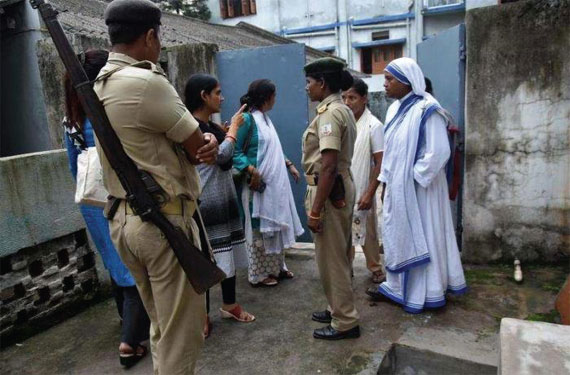
The Ranchi police (in Jharkhand) have arrested an employee of a hospital run by the Missiona-ries of Charity, the order founded by Mother Teresa, and placed two nuns in custody on charges of selling children.

The Indian Express reported that the three women took newborns from single mothers and then sold them to other couples. In a note issued by the Generalate [in Calcutta] Sr Mary Prema, superior of the congregation, says: “We are completely shocked by what has happened in our home. It should never have happened.”

The arrest is happened. Shyamanand Madal, head of the Kotwali police station, reports that a case has been opened against Anima Indwar (the employee) and the two nuns according to section 370 of the Indian Penal Code [which punishes those who traffick human beings, ed. ]. Then he adds that “clear evidence was collected against one of the nuns, who could be arrested soon.”

Suspicious, the social workers questioned the nuns: at the end one of them said that the child was taken away by his mother after she was discharged from the structure. “We contacted the woman – continued Tiwari – who instead told us that the child was not with her.

Young Catholics from 100 countries gather in Manila

Young Catholics from around 100 countries are gathered in Manila for the July 6 start of an international youth festival organized by the global Focolare Movement. The 11th edition of Genfest, which is being held for the first time outside Europe, carries the theme “Beyond All Borders.” The three-day event aims to facilitate the “sharing of experiences” among young people, especially on culture and sustainable environment.

Gio Francisco, facilitator of the event, said workshops would be held simultaneously to encourage young people “to go beyond borders.” Other activities have already taken participants to the peripheries, including a trip to the island of Boracay to immerse with the Ati tribe. “In this globalized world … we are invited not to be afraid of the differences of the other and their cultures to contribute to a world that is more united and fraternal,” said Father Emmanuel Mijares, convenor of the group Youth for a United World International.

Jharkhand: 16 Christians arrested for ‘forced conversions’ of tribals

Police in Jharkhand arrested 16 missiona-ries on June 8, on charges of converting tribal Adivasi by force to Christianity, the Press Trust of India reported.

Speaking to AsiaNews, Sajan K George, president of the Global Council of Indian Christians (GCIC), said that “In Jharkhand, extreme right-wing groups systematically persecute members of religious minorities, especially Christians.”

The arrests took place in the District of Dumka, after Ramesh Hembrom, village chief in Phoolpahari, filed a complaint.

Seven women were among those taken into custody. Police Superintendent Kishore Kaushal said that those arrested were part of a group of 25 “preachers” held hostage “by an angry mob of tribals living in the village.”

According to the policeman, the Christians were held for two days by residents in the Shikaripara area, who accused them of insulting a place of tribal worship.

The police did not disclose the names of the Christian missionaries involved in the case of alleged forced conversions. “We are verifying the allegations,” Kaushal said.

The officer noted that in his complaint, Hembrom claimed that the attempt to convert the tribals to Christianity had been going on for several months.

In eastern India, radicals expel ten Christian families

Several Christian families have been assaulted and expelled from their village by local extremists for refusing to renounce their faith, drawing protest from an American group who says the attack violates the families’ rights under Indian law. “We here at International Christian Concern are deeply concerned to see that 10 Christian families have been beaten and displaced for merely exercising their religious freedom rights,” William Stark, regional manager at International Christian Concern, said July 3.

International Christian Concern, a non-denominational Christian NGO based in the U.S., reports that 10 Christian families in the eastern Indian State of Jharkhand have been driven from their homes for refusing to renounce their faith.

On June 5 the ten Christian families from Pahli village in Latehar district were summoned to a meeting with local radicals. The radicals told them to renounce their faith or leave. After the families refused, they were beaten and driven from their village.

Lack of evaluation will disintegrate religious congregation: Montfort scholar

Reclaiming the charism and spirituality has to be a top priority if religious congregations in India have to survive, says Montfort Brother Paul Raj. Addressing a gathering of the local unit of the Conference of Religious India (CRI) in Bangalore on July 1, the Brother said that equally important is the creation of new apostolate and promotion of cultural formation in the congregations. Some 500 sisters, priests and brothers attended the gathering and a local CRI general body that followed.

Paul Raj is a former director and principal of Vidya Deep College of Theology in Bangalore. He also served as the Congregation of the Montfort Brothers of St Gabriel’s International executive secretary for the Desk on Justice, Peace and Integrity of Creation in Rome.

Quoting French Jesuit Ray-mond Hostie, the Montfort Brother noted that the religious congregations go through different stages, such as foundation, consolidation, expansion, growth, stabilization, dissatisfaction, decline and death. Several congregations in the west are going through difficult transitions and many of them are declining or dying or already dead, he said.

When Carnatic music calls a nun

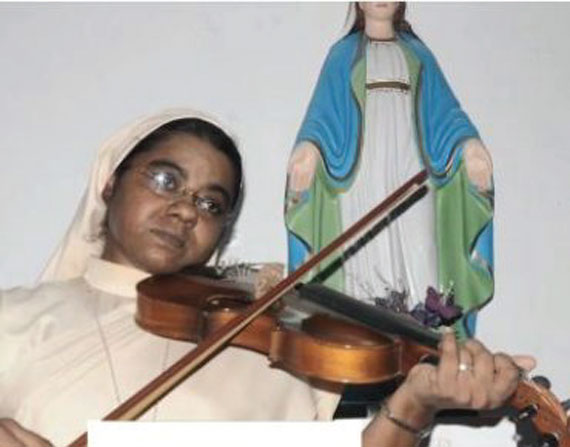
Wearing her veil, congrega-tion’s uniform and sporting a calm smile, Sr Linet Antony SKD would match anyone’s concept of a Christian nun.

But once the Kannur native gets on to the stage and starts singing, the listeners can’t help not being pleasantly surprised. For, she can sign a Vathapi Ganapathi with as much ease as she can belt out a choir song.

The 37-year-old nun, who is a faculty at Chetana Sangeeth Natya Academy in Thrissur, is probably the only professional Carnatic musician of the State from her community. Sister Linet, who did her arangettam way back in 2011, has performed on stages both in Kerala and outside, in the past few years.

As she speaks about her tryst with Carnatic music, Sr Linet remembers how music was always a part of her life, since childhood.

She remembers, “I used to be active in the music circles of church and could also play a keyboard. Moreover, everybody in my family loved music and could sing. My sister and brother were also getting trained in Carnatic music. So, even before I went for my music studies, I was familiar with the various stages like saptha swaras, varisakal, geetham and the like in Carnatic music.”